
Few recordings capture the creative energy of early jazz as vividly as Louis Armstrong’s Potato Head Blues. Recorded in 1927 with his Hot Seven, this landmark performance demonstrates Armstrong’s extraordinary command of melody, rhythm, improvisation, and musical storytelling. Its combination of blues language, rhythmic invention, and expressive phrasing makes it an important piece in the history of jazz.
Although Armstrong is best remembered as a cornet and trumpet player, his compositions and recordings have influenced generations of pianists, instrumentalists, and jazz musicians. Potato Head Blues is particularly interesting because it offers an opportunity to explore the foundations of jazz improvisation: blues harmony, dominant seventh chords, rhythmic variation, melodic development, and the relationship between a solo and its harmonic accompaniment.
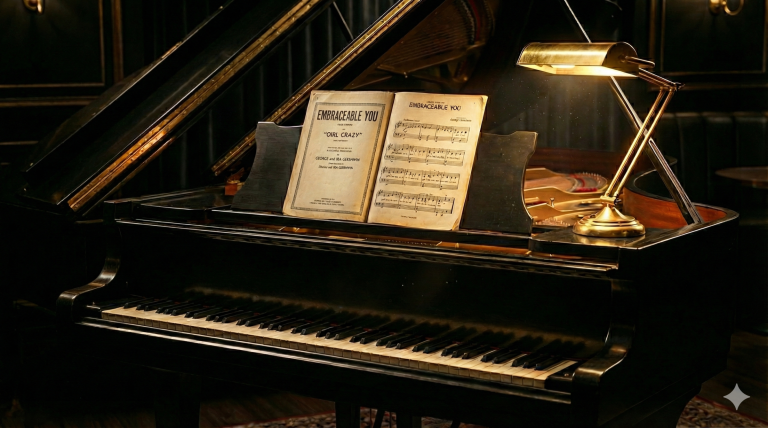
The piano score presented in this guide is an arrangement by Andy Hollandbeck. It is not a complete transcription of Armstrong’s original cornet performance. Instead, it adapts the composition into a two-staff piano arrangement, combining melodic material, chord voicings, and a written harmonic framework. This makes it possible to study the piece directly at the keyboard while exploring some of the musical ideas associated with the original recording.
This tutorial is based on the three-page PDF provided for PianoMode. It examines the notation, the chord symbols, the rhythmic character, and the main technical challenges of the arrangement. You will also find a practical learning method, a four-week practice plan, and advice on how to approach the swing feel without sacrificing accuracy.
If you are a classical pianist discovering jazz, an intermediate player interested in early jazz repertoire, or a beginner exploring blues harmony, Potato Head Blues offers a rewarding introduction to a different way of thinking about the piano.
1. Score Overview
Potato Head Blues is a jazz composition by Louis Armstrong, recorded in 1927 by Louis Armstrong and His Hot Seven. The supplied piano arrangement is credited to Andy Hollandbeck and is presented across three pages.
The arrangement uses a conventional grand staff, with treble and bass clefs, and includes chord symbols above the musical staff. These chord symbols are an important part of the score because they identify the underlying harmony and help the pianist understand how the melodic material relates to the progression.
The opening is marked Moderate swing. The score has one flat in its key signature and uses common time, with the harmonic framework centred on F. The opening chord is F, followed by F6 and F7, before moving towards B-flat harmony. Other chords appearing throughout the arrangement include Gm, D7, G7, C7, Dø7, G9, F9, and diminished chords.
Score information
| Detail | Information |
|---|---|
| Title | Potato Head Blues |
| Composer | Louis Armstrong |
| Arrangement | Andy Hollandbeck |
| Original recording | Louis Armstrong and His Hot Seven |
| Recording date | May 10, 1927 |
| Instrumentation of supplied score | Solo piano |
| Score length | 3 pages |
| Key signature | One flat |
| Tonal centre | F |
| Time signature | Common time (4/4) |
| Tempo indication | Moderate swing |
| Exact BPM | Not specified in the supplied score |
| Notation | Piano grand staff with chord symbols |
Understanding the Arrangement
The most important distinction is between Armstrong’s original recording and the piano arrangement.
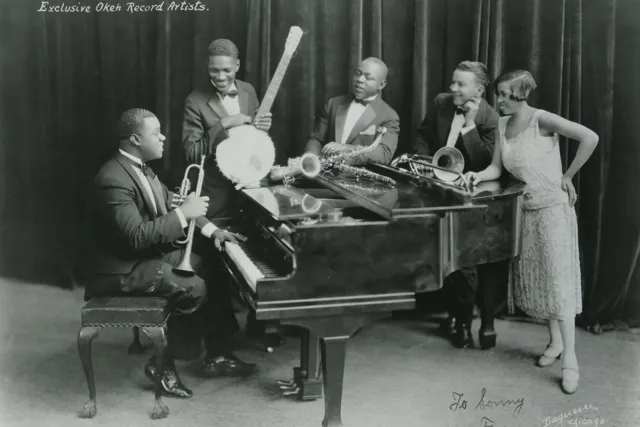
The original recording features a jazz ensemble, including Armstrong on cornet, Johnny Dodds on clarinet, John Thomas on trombone, Lil Hardin Armstrong on piano, Johnny St. Cyr on banjo, Pete Briggs on tuba, and Warren “Baby” Dodds on drums. The Smithsonian’s recording catalogue identifies the ensemble as Louis Armstrong and His Hot Seven.
Andy Hollandbeck’s arrangement translates the composition into a piano format. It includes a written melodic part and accompanying harmonies, allowing one pianist to work with musical material that originally belonged to a larger ensemble.
This is not the same as reproducing every instrumental line from the original recording. The arrangement should therefore be studied as a piano version of the composition, not as a note-for-note transcription of Armstrong’s cornet solo.
What Makes This Score Interesting?
The score combines several elements that are particularly useful for learning jazz piano:
- Blues harmony: The arrangement uses the harmonic language associated with the blues, including dominant seventh chords and movement between related harmonic areas.
- Jazz chord symbols: The notation identifies chords such as F6, F7, Gm7, Dø7, G9, and C7.
- Swing rhythm: The opening indication asks the pianist to use a moderate swing feel rather than play all subdivisions mechanically straight.
- Melodic and harmonic coordination: Both hands must contribute to a coherent musical texture.
- Chromatic movement: Accidentals and altered notes add colour to the melodic and harmonic writing.
These features make the piece a useful introduction to jazz vocabulary, even for pianists whose previous experience has been mainly classical.
2. History and Composer: Louis Armstrong
Louis Armstrong (1901–1971) was one of the most influential musicians in jazz history. Born in New Orleans, Louisiana, he became internationally recognised as a cornet and trumpet player, singer, improviser, and entertainer.
His influence extends far beyond his technical ability. Armstrong helped establish the jazz soloist as a central musical voice. Rather than treating improvisation simply as a variation on an existing melody, he developed solos with their own structure, direction, rhythmic identity, and expressive character.
His recordings with the Hot Five and Hot Seven ensembles during the 1920s were particularly important in this development. These sessions helped transform the sound of early jazz and established Armstrong as one of the music’s defining figures. The Library of Congress describes these recordings as a major contribution to the development of jazz improvisation and ensemble playing.
The Hot Five and Hot Seven Recordings
Between 1925 and 1928, Armstrong made a series of influential recordings with his Hot Five and Hot Seven groups. The Hot Five was initially a small ensemble featuring Armstrong alongside musicians such as Johnny Dodds, Kid Ory, Lil Hardin Armstrong, and Johnny St. Cyr.
The Hot Seven expanded this format with the addition of tuba and drums. This change gave the ensemble a different rhythmic foundation and created new possibilities for the interaction between the solo instruments.
The National Park Service explains the importance of Armstrong’s Hot Five recordings in the development of jazz, particularly the growing emphasis on the individual soloist within the ensemble.
The Recording of Potato Head Blues
Potato Head Blues was recorded on May 10, 1927, in Chicago by Louis Armstrong and His Hot Seven. The Smithsonian’s National Museum of American History preserves a 78 rpm recording of the composition and identifies the performing ensemble and recording year. MusicBrainz also records the May 10 session and identifies Armstrong as the composer.
The recording is particularly celebrated for Armstrong’s cornet improvisation. His solo demonstrates how a musician can build a compelling musical statement from a relatively compact harmonic framework.
Instead of simply repeating the melody, Armstrong develops ideas through rhythmic variation, melodic patterns, expressive articulation, and carefully shaped phrases. His playing gives the impression of a musical conversation, with ideas introduced, extended, interrupted, and developed.
A jazz education resource published by Jazz Education Network highlights the importance of the recording and identifies Armstrong’s solo as a particularly valuable example of early jazz improvisation.
Why the Title Matters
The title Potato Head Blues belongs to the original composition and recording. It is part of Armstrong’s early jazz repertoire, alongside other important pieces from the Hot Seven period.
For pianists, the significance of the composition lies less in its title than in the musical language it contains. The blues framework provides a foundation for exploring dominant harmony, melodic development, rhythmic flexibility, and improvisation.
3. Musical Structure and Theory
Understanding the harmony is one of the most important steps in learning Potato Head Blues. Unlike a beginner classical piece where the score may be approached primarily through individual notes and finger patterns, this arrangement includes chord symbols that reveal the underlying harmonic structure.
The key signature contains one flat, and the harmonic centre is F. The opening chord symbols are F, F6, and F7, followed by B-flat harmony. Later sections introduce a wider range of chords, including Gm, D7, G7, C7, Dø7, G9, and F9.
These symbols are not decorative additions. They explain the harmonic framework and help the pianist understand the musical relationships between notes.
The Blues in F
The blues is one of the foundations of jazz. It is characterised by distinctive melodic gestures, rhythmic flexibility, and a harmonic language that frequently makes use of dominant seventh chords.
In F, the three principal harmonic areas traditionally associated with a basic blues framework are:
| Harmonic function | Chord in F |
|---|---|
| Tonic | F7 |
| Subdominant | B♭7 |
| Dominant | C7 |
The supplied arrangement uses these harmonic areas, alongside additional chords and extensions.
It is important not to reduce the arrangement to a simple twelve-bar blues formula. The supplied score contains a longer written arrangement, with a variety of harmonic changes and melodic passages. The chord symbols should be followed as printed rather than replaced with a generic blues progression.
Understanding the Opening Chords
The opening of the score introduces three important harmonic colours.
The F chord establishes the tonal centre. It provides the harmonic foundation from which the opening material develops.
The addition of the sixth introduces a different colour to the tonic harmony. In F6, the sixth is D, giving the chord the notes F, A, C, and D.
F7 introduces the dominant seventh, E-flat. This creates a stronger blues and jazz character than a simple major triad.
These three chords demonstrate how a relatively small change in the notes can produce a different harmonic colour.
The Role of B-flat Harmony
B-flat is the fourth scale degree above F and an important harmonic area in an F blues.
The score introduces B-flat harmony early in the arrangement. This movement provides contrast with the opening F material and helps establish the relationship between the main harmonic areas.
In jazz piano, understanding this relationship is more useful than memorising chord names in isolation. Try to recognise how each chord relates to the tonal centre.
Dominant Seventh Chords
Dominant seventh chords appear frequently in the score. Examples include F7, G7, and C7.
A dominant seventh chord contains four notes:
- Root
- Major third
- Perfect fifth
- Minor seventh
For example, C7 contains C, E, G, and B-flat.
These chords are important because they provide harmonic movement and create the characteristic tension and resolution associated with jazz and blues.
When practising, do not concentrate only on the chord’s name. Listen to its sound and identify how it connects to the next harmony.
Extended and Altered Chords
The arrangement also includes more advanced chord symbols, such as G9 and F9, as well as Dø7 and diminished chords.
These symbols introduce additional harmonic colours.
A ninth chord extends a dominant seventh chord by adding the ninth. A half-diminished seventh chord, written with the symbol ø7, contains a diminished fifth and a minor seventh above the root.
Diminished chords create another type of harmonic tension and are often used to connect or colour surrounding harmonies.
For a pianist learning jazz, these chords are worth recognising even if the exact voicings initially feel unfamiliar.
Swing Rhythm
The score is marked Moderate swing. This is one of its most important performance instructions.
Swing is not simply a matter of playing every second note late. It involves a particular rhythmic feel in which pairs of written subdivisions are interpreted with a flexible long-short relationship.
The exact ratio varies according to tempo, style, and performance context. It should not be treated as a fixed mathematical formula.
For this arrangement, the best starting point is to listen to the original recording and develop a sense of the rhythmic character before trying to reproduce it at the keyboard.
4. Section-by-Section Analysis
The supplied arrangement is spread over three pages. The printed measure numbers allow us to follow its development through the score.
The following analysis focuses on the harmonic labels and visible musical textures in Andy Hollandbeck’s arrangement. It does not claim that the piano arrangement reproduces every detail of the original recording.
Measures 1–5: Establishing the F Blues Character
The opening begins with the indication Moderate swing and introduces the F harmonic area.
The first measures move through F, F6, and F7 before approaching B-flat. This is an important introduction to the harmonic character of the piece.
The pianist should pay attention to the relationship between the chord symbols and the written notes. The arrangement is not simply a melody accompanied by repeated block chords. The two hands contribute to a more integrated piano texture.
What to practise:
- Read the opening melodic material separately.
- Identify the F, F6, and F7 harmonies.
- Practise the left-hand part slowly.
- Listen to the difference between the three opening chords.
- Establish a relaxed swing pulse.
What to listen for: A clear opening statement, with a stable rhythmic foundation and a recognisable blues character.
Measures 6–10: Harmonic Movement and Melodic Development
The next section introduces additional harmonic colours, including B-flat, D diminished, F7 with an added thirteenth, G minor, D7, and G7.
This is where the arrangement begins to demonstrate a wider range of jazz harmony.
The pianist should avoid treating each chord as an unrelated object. Instead, identify how the harmony moves from one area to another and how the melodic line interacts with those changes.
What to practise:
- Identify each chord symbol before playing.
- Practise unfamiliar chord shapes separately.
- Notice where the harmony changes.
- Keep the melodic line clear.
- Avoid interrupting the swing feel when changing chords.
What to listen for: Smooth harmonic transitions and a clear distinction between the different chord colours.
Measures 11–15: Developing the Jazz Piano Texture
The following section introduces more active writing in both hands. The score includes G7, C7, and F-related harmony, with passages that require the pianist to coordinate melodic movement and chordal support.
This is an important section for developing hand independence.
The left hand should not simply follow the right hand mechanically. Each part has its own musical function, and the pianist must maintain control over the balance between them.
What to practise:
- Practise each hand separately where necessary.
- Identify the chord changes.
- Work on short passages rather than repeating the whole section.
- Keep the accompaniment rhythmically consistent.
- Listen for a clear melodic line.
What to listen for: The music should sound like a coherent piano arrangement, not two independent parts competing with one another.
Measures 16–20: More Extended Jazz Harmony
The chord symbols in this section include Dø7, G9, C7, F9, and F7.
These harmonies introduce a more sophisticated harmonic vocabulary. Students who are unfamiliar with jazz chord symbols should take time to understand the notes represented by each chord.
Do not attempt to memorise every chord voicing immediately. First understand the root and chord quality, then practise the written notes.
What to practise:
- Read the chord symbols aloud.
- Identify the root of each harmony.
- Practise the written chord shapes slowly.
- Listen to the movement from one chord to the next.
- Keep the rhythmic feel stable.
What to listen for: Clear chord changes without excessive emphasis on every individual note.
Measures 21–25: B-flat and Diminished Harmony
The next section introduces B-flat and D diminished harmony, followed by further movement through the progression.
The texture becomes increasingly varied, with changes in melodic direction and chordal writing.
Diminished harmony can be unfamiliar to pianists who have mainly studied traditional major and minor triads. It is useful to isolate these chords and compare their sound with the surrounding dominant harmonies.
What to practise:
- Identify the diminished chord notes.
- Practise the chord transitions slowly.
- Keep the hands relaxed.
- Listen to the difference between major, dominant, and diminished sonorities.
What to listen for: The harmonic tension should be clear without making the music sound heavy or forced.
Measures 26–31: Chord Changes and Rhythmic Coordination
The second page begins with a sequence of chord symbols including D7, G7, C7, F6, and D diminished harmony.
The passage combines chord changes with melodic movement. The pianist must maintain rhythmic accuracy while moving between different harmonic shapes.
This section is particularly useful for learning how jazz harmony can move through a progression without losing the overall musical pulse.
What to practise:
- Work on each chord change independently.
- Practise the hands together at a reduced tempo.
- Maintain the swing feel.
- Avoid pausing between unfamiliar chords.
- Identify repeated musical patterns.
What to listen for: Smooth transitions and a consistent rhythmic foundation.
Measures 32–36: Changes in Texture and Phrase Direction
This passage introduces further changes in the musical texture. The score includes F6, F+, and G minor harmony, alongside melodic and rhythmic material that requires careful coordination.
The pianist should pay attention to the direction of the phrases rather than treating the passage as a sequence of unrelated notes.
What to practise:
- Identify the main melodic gestures.
- Practise the left-hand accompaniment.
- Work on the transitions between chords.
- Maintain a consistent swing feel.
- Avoid excessive tension when playing more complex shapes.
What to listen for: A clear sense of direction and a balanced relationship between melody and accompaniment.
Measures 37–41: Return of the Main Harmonic Areas
The score returns to familiar harmonic material, including G7, C7, F6, F diminished, and F7.
Recognising recurring chords can make the arrangement easier to understand. Instead of reading every chord as something completely new, the pianist can begin to recognise familiar harmonic functions.
What to practise:
- Compare the recurring chords with earlier sections.
- Identify the differences between F6 and F7.
- Practise the chord transitions.
- Maintain the same rhythmic feel.
- Listen to the way the melody develops over the harmony.
What to listen for: Familiar harmonic material should sound connected to the overall progression.
Measures 42–46: A New Harmonic Passage
The next section introduces B-flat harmony, B-flat seventh, G7, C, D minor, G7, and C7.
This sequence offers an opportunity to practise movement through different harmonic areas.
Students should be careful not to let unfamiliar chords disrupt the pulse. A steady rhythm is essential, particularly when the hands are required to move through different shapes.
What to practise:
- Read the chord symbols before playing.
- Practise the harmonic sequence slowly.
- Identify the bass movement.
- Work on the melodic line separately.
- Combine the parts gradually.
What to listen for: Clear harmonic direction and consistent timing.
Measures 47–51: Preparing the Next Section
The score moves through F6, F7, B-flat, and G minor harmony.
This passage gives the pianist another opportunity to recognise recurring harmonic relationships. The contrast between the F and B-flat areas should be clear.
What to practise:
- Review the chord shapes.
- Maintain a controlled accompaniment.
- Avoid rushing the melodic passages.
- Listen for the harmonic movement into G minor.
What to listen for: A natural progression between the different harmonic areas.
Measures 52–56: D7, G7, and C7
The third page begins with D7 and G7 harmony, followed by further movement towards C7.
These chords are useful for developing an understanding of dominant relationships. D7 can lead towards G-related harmony, while G7 and C7 introduce further dominant movement.
The pianist should learn to recognise these relationships instead of approaching each chord in isolation.
What to practise:
- Identify the root of each chord.
- Practise the written voicings.
- Work on the transitions between D7, G7, and C7.
- Maintain rhythmic continuity.
- Listen for the harmonic tension and release.
What to listen for: Smooth movement between dominant harmonies.
Measures 57–61: Chordal Movement and Harmonic Colour
This section includes C7, F, B-flat, D diminished, and G minor harmony.
The score combines several harmonic colours, making it useful for developing chord recognition and coordination.
What to practise:
- Review the chord symbols before playing.
- Practise the more difficult shapes separately.
- Keep the left hand controlled.
- Avoid excessive accents.
- Listen to the relationship between the chord changes.
What to listen for: A clear distinction between the different harmonic colours.
Measures 62–66: Blues Harmony and Melodic Development
The following measures include C7, F7, and B-flat-related harmony.
The melodic writing becomes an important part of the musical direction. Students should pay attention to the relationship between the melody and the underlying chords.
This is a good place to practise hearing the harmony rather than simply reading the notes.
What to practise:
- Play the chord progression slowly.
- Identify the melodic notes that relate to each chord.
- Practise the hands separately where necessary.
- Maintain the swing feel.
- Work on phrase continuity.
What to listen for: The melody should remain clear while the harmony supports its direction.
Measures 67–70: Final Harmonic Development
The score introduces B-flat6, B-flat minor, B diminished, F, F7, and D7.
The presence of B-flat minor and B diminished creates additional harmonic colour. These changes should be approached carefully because their notes may be unfamiliar to pianists who have mainly studied major and minor triads.
What to practise:
- Identify the notes in each chord.
- Practise the transitions slowly.
- Listen to the differences between B-flat major and B-flat minor.
- Keep the rhythm consistent.
- Avoid forcing the chord changes.
What to listen for: A controlled and coherent harmonic progression.
Measures 71 to the End: Closing the Arrangement
The final system contains G7, G minor seventh, C7, and F-related harmony.
The ending should feel deliberate and controlled. Avoid rushing the last phrases simply because the piece is approaching its conclusion.
Follow the written rests, chord durations, and final notation carefully.
What to practise:
- Isolate the final chord sequence.
- Practise the transition into the final F harmony.
- Maintain the swing character.
- Observe the final rests and note durations.
- Play the ending without unnecessary tension.
What to listen for: A clear final harmonic resolution and a confident ending.
5. Technical Challenges
Potato Head Blues is not primarily a test of speed. Its main challenges involve jazz rhythm, chord recognition, hand coordination, and the ability to maintain a coherent musical feel while moving through different harmonies.
1. Developing a Moderate Swing Feel
The opening indication is Moderate swing. This means the pianist should avoid playing the rhythm with a completely straight classical interpretation.
Swing involves a flexible relationship between subdivisions. The exact feel depends on the musical context and should be developed through listening rather than by applying a rigid mathematical ratio.
How to practise:
- Listen to the original recording.
- Tap the main pulse.
- Hum or clap the rhythmic patterns.
- Play the passage slowly while preserving the swing character.
- Gradually increase the tempo without losing the feel.
The objective is to develop a natural rhythmic movement, not to exaggerate every swing subdivision.
2. Recognising Jazz Chord Symbols
The score contains a variety of chord symbols, including F6, F7, Gm7, Dø7, G9, and F9.
A pianist who is unfamiliar with jazz notation may find these symbols difficult at first.
Start by learning the basic structure of each chord. Identify the root, third, fifth, and seventh where applicable. Then add the extensions or altered notes shown by the symbol.
Do not attempt to learn every possible jazz voicing at once. Begin with the exact notes written in the supplied arrangement.
3. Moving Between Chord Shapes
The arrangement requires the pianist to move between different chord structures. Some changes are relatively straightforward, while others involve different note positions and accidentals.
The best approach is to practise the transitions rather than repeatedly playing each chord in isolation.
Practical exercise:
- Play the first chord.
- Identify the notes of the next chord.
- Move the hands slowly.
- Check the position before playing.
- Repeat until the transition becomes comfortable.
This helps reduce unnecessary movement and improves accuracy.
4. Coordinating Melody and Accompaniment
The two hands have different musical responsibilities. The pianist must coordinate melodic movement with chordal support and bass notes.
This requires more than simply playing both hands at the same time. The melody needs to remain clear while the accompaniment supports the harmony.
Practise the hands separately if necessary, then combine them at a reduced tempo.
5. Managing Accidentals
The score contains numerous accidentals, including sharps and flats that modify notes beyond the key signature.
In jazz, these alterations are often part of the harmonic vocabulary rather than random exceptions.
Read the notation carefully and pay attention to the relationship between the written notes and the chord symbols.
Never assume that a note belongs to the basic F major scale simply because the piece is centred on F.
6. Maintaining a Relaxed Hand Position
Jazz chord voicings can require the hands to move between different intervals and positions.
Avoid stretching the fingers unnecessarily or pressing too hard. The hands should remain relaxed, with movement coming from a comfortable combination of fingers, wrist, and arm.
If a chord shape feels uncomfortable, slow down and examine the written notes before attempting to force the position.
6. How to Practise Potato Head Blues
The most effective way to learn this arrangement is to combine score reading, chord recognition, rhythmic practice, and listening.
Step 1: Listen to the Original Recording
Before playing, listen to Louis Armstrong and His Hot Seven performing Potato Head Blues.
Try to identify the pulse, the ensemble interaction, and the character of Armstrong’s improvisation.
The original recording is not the same as the piano arrangement, but it provides valuable musical context.
Step 2: Study the Chord Symbols
Read the chord symbols above the staff before beginning.
Identify the F, F6, F7, B-flat, Gm, D7, G7, and C7 harmonies. Then examine the extended and diminished chords.
This will help you understand the progression instead of approaching the score as a long sequence of unrelated notes.
Step 3: Learn the Bass and Accompaniment
Begin with the lower staff.
Practise the written bass notes and chordal material slowly. Pay attention to the timing and duration of each note.
The accompaniment should provide a stable foundation for the melodic material.
Step 4: Learn the Upper Staff
Work on the right-hand material separately.
Identify the melodic phrases, accidentals, and rhythmic patterns. Avoid rushing the notes simply because they look familiar.
If a passage is difficult, divide it into smaller sections and practise each one carefully.
Step 5: Combine Both Hands
Once the individual parts are reasonably secure, combine the hands.
Start with a reduced tempo. Focus on accuracy and coordination before trying to reproduce the full swing character.
If the hands repeatedly become confused, return to the difficult passage and practise it separately.
Step 6: Develop the Swing Feel
Once the notes and chord changes are more secure, work on the rhythmic character.
Listen to the original recording again and compare its pulse with your own performance.
Avoid treating swing as a mechanical formula. The goal is to develop a natural rhythmic feel that supports the music.
Step 7: Play the Complete Arrangement
Finally, practise the full arrangement from beginning to end.
Concentrate on continuity, chord recognition, and rhythmic consistency. Try not to stop after every small mistake.
A complete performance helps reveal whether the sections connect naturally and whether the harmonic progression is understood.
7. Four-Week Practice Method
This four-week plan is a suggested framework for learning Andy Hollandbeck’s piano arrangement. It is not an official practice schedule. Adapt it to your experience, available practice time, and familiarity with jazz harmony.
Week 1: Reading and Chord Recognition
Objective: Understand the score and become familiar with its harmonic vocabulary.
Practical tasks:
- Identify the key signature and time signature.
- Read the opening F, F6, and F7 chords.
- Learn the basic dominant seventh chord structure.
- Identify the chord symbols throughout the score.
- Listen to the original Armstrong recording.
- Practise the first sections slowly.
What to listen for: Clear notes, accurate rhythm, and a stable pulse.
Milestone: Recognise the main chord symbols and play the opening section slowly.
Week 2: Coordination and Structure
Objective: Develop coordination between both hands and understand the arrangement’s progression.
Practical tasks:
- Practise the bass and accompaniment separately.
- Learn the right-hand melodic material.
- Combine both hands gradually.
- Work on difficult chord changes.
- Divide the arrangement into manageable sections.
- Maintain a consistent pulse.
What to listen for: Balanced hands, clean chord changes, and accurate rhythm.
Milestone: Play the main sections with both hands at a controlled tempo.
Week 3: Technique and Interpretation
Objective: Develop a more natural swing feel and improve harmonic fluency.
Practical tasks:
- Practise the arrangement with a moderate swing feel.
- Review dominant seventh chords.
- Work on extended and diminished harmonies.
- Refine transitions between sections.
- Listen to Armstrong’s original recording again.
- Record selected passages for review.
What to listen for: Rhythmic flexibility, clear harmony, and a coherent musical character.
Milestone: Play longer sections without losing the pulse or struggling with the main chord changes.
Week 4: Performance and Refinement
Objective: Consolidate the arrangement and prepare a complete performance.
Practical tasks:
- Review the most difficult chord transitions.
- Practise the complete arrangement.
- Maintain a consistent swing feel.
- Refine the balance between the hands.
- Work on the final harmonic sequence.
- Record a complete performance and listen critically.
What to listen for: Continuity, rhythmic stability, chord clarity, and a natural jazz character.
Milestone: Perform the arrangement from beginning to end at a comfortable tempo, with secure coordination and a clear understanding of the harmony.
8. Practice Tips for a More Authentic Jazz Performance
Learning the notes is only the first stage. To make Potato Head Blues sound convincing, the pianist must also develop an understanding of jazz phrasing, rhythm, and harmonic movement.
Listen to the Original Hot Seven Recording
The original recording should be your main musical reference.
Listen to the relationship between Armstrong’s cornet, the clarinet, the trombone, and the rhythm section. Notice how the different instruments contribute to the overall musical texture.
The recording is particularly valuable for understanding how Armstrong develops his solo through rhythmic and melodic ideas.
Do Not Overcomplicate the Swing Feel
A common mistake is to exaggerate swing by making every pair of notes extremely uneven.
Swing is more flexible than that. The rhythmic relationship depends on tempo, style, and musical context.
Start with a moderate, relaxed feel and listen carefully to the original recording.
Understand the Chords Before Playing Them Quickly
Jazz chord symbols are an important part of the arrangement. Take the time to understand them.
Knowing that a chord is F7 or G9 is useful, but the real learning comes from understanding how the notes are organised and how the harmony moves to the next chord.
Keep the Melody Clear
The melody should remain recognisable even when the harmony becomes more complex.
Avoid playing every chord with the same intensity. Listen to the relationship between the melodic material and the accompanying notes.
Practise Short Sections
Jazz arrangements often contain many chord changes and rhythmic variations. Trying to learn the entire score in one session can become frustrating.
Work on short passages, identify the difficult transitions, and gradually connect them.
Develop Your Ear
Try to recognise the sound of the main chords without looking at the notation.
Play F7, B-flat, and C7 separately. Listen to their differences and their relationships.
This kind of listening helps develop the musical understanding required for jazz improvisation.
9. Common Mistakes to Avoid
Playing the Rhythm Too Straight
One of the most common mistakes is ignoring the Moderate swing indication.
Playing every subdivision with an identical straight rhythm can make the piece sound stylistically disconnected.
Listen to the original recording and work towards a natural swing feel.
Treating Chord Symbols as Decoration
The chord symbols are an essential part of the arrangement.
Ignoring them means losing an important part of the musical structure. Learn to recognise the chords and understand how they relate to the written notes.
Playing Every Chord Too Loudly
Jazz harmony can sound heavy if every chord is attacked with the same intensity.
Work on balance and phrasing. The music should move naturally rather than sound like a sequence of disconnected chord exercises.
Rushing Difficult Chord Changes
Unfamiliar chord shapes often cause interruptions in the rhythm.
Practise the transition between the two chords rather than repeatedly playing the entire passage.
Ignoring Accidentals
The score includes many altered notes. Reading them incorrectly can change the harmonic character of the music.
Check every accidental carefully and relate it to the chord symbol above the staff.
Confusing the Arrangement with the Original Recording
The supplied score is an arrangement by Andy Hollandbeck. It should not be treated as an exact transcription of Armstrong’s original cornet part or the complete ensemble recording.
Understanding this distinction will help you use the original recording as a musical reference without expecting the piano score to reproduce every instrumental detail.
10. Why Potato Head Blues Matters in Jazz History
Potato Head Blues is important not simply because it is an enjoyable composition, but because it captures an important stage in the development of jazz improvisation.
The recording demonstrates Armstrong’s ability to construct a solo through melodic and rhythmic ideas that relate to the underlying harmony. His approach helped establish a model for jazz soloists who sought to develop complete musical statements rather than simply decorate an existing melody.
The Library of Congress discusses Armstrong’s Hot Five and Hot Seven recordings as a major part of his historical contribution to jazz. Its research on these recordings describes the development of his improvisational language and the increasing importance of the individual soloist. The Library of Congress+1
The original recording also offers a useful opportunity to study the interaction between ensemble playing and solo improvisation. The clarinet, trombone, rhythm section, and cornet contribute different musical roles, creating a texture that is characteristic of early New Orleans jazz.
For pianists, the piece provides an introduction to the harmonic and rhythmic vocabulary behind this music. Learning the arrangement can help develop chord recognition, rhythmic flexibility, and a better understanding of how melody and harmony work together.
Conclusion
Potato Head Blues by Louis Armstrong is one of the most interesting compositions to explore when studying early jazz. Recorded in 1927 with his Hot Seven, it demonstrates Armstrong’s extraordinary ability to develop musical ideas through rhythm, melody, and improvisation.
The supplied piano arrangement by Andy Hollandbeck offers a practical way to explore the composition at the keyboard. Its F-centred harmonic framework, dominant seventh chords, extended harmonies, and moderate swing indication provide several useful learning opportunities.
The most effective approach is to understand the chord symbols, practise the hands separately where necessary, and develop the swing feel through careful listening. Rather than concentrating only on the notes, try to understand how the harmony supports the melody and how the rhythmic character gives the music its identity.
For pianists interested in jazz, Potato Head Blues is more than an arrangement to learn. It is an opportunity to explore the musical language of Louis Armstrong and discover the foundations of a style that continues to influence jazz musicians today.
Who composed Potato Head Blues?
Potato Head Blues was composed by Louis Armstrong. It is one of the important recordings from his Hot Seven period in the 1920s.
When was Potato Head Blues recorded?
The original recording was made on May 10, 1927, in Chicago by Louis Armstrong and His Hot Seven. The Smithsonian and MusicBrainz both document the recording in 1927. National Museum of American History+1
Is Potato Head Blues a Hot Five or Hot Seven recording?
The famous 1927 recording was made by Louis Armstrong and His Hot Seven. The group expanded the earlier Hot Five ensemble with additional bass and percussion instruments.
What key is Potato Head Blues in?
The supplied piano arrangement has one flat in its key signature and is centred on F. Its chord symbols include F, F6, F7, B-flat, and other harmonies associated with the F blues framework.
What is the tempo of Potato Head Blues?
The supplied piano score is marked Moderate swing but does not provide an exact BPM. It is therefore not possible to identify a definitive metronome tempo from this edition alone. The best starting point is to listen to the original recording and establish a comfortable moderate swing pulse.
Is the supplied score an exact transcription of Louis Armstrong’s solo?
No. The PDF is a piano arrangement by Andy Hollandbeck. It adapts the composition for solo piano and should not be confused with a complete transcription of Armstrong’s original cornet solo or the entire Hot Seven recording.
What piano skills can I develop by learning Potato Head Blues?
The arrangement offers opportunities to develop jazz chord recognition, dominant seventh harmony, coordination between the hands, swing rhythm, accidentals, and melodic phrasing.
Is Potato Head Blues suitable for beginners?
It is not an ideal first piano piece for someone who has just started learning the instrument. The chord symbols, harmonic changes, and swing feel make it more suitable for pianists who already have some experience reading music and coordinating both hands. Beginners interested in jazz can still use selected passages as an introduction to blues harmony.
What is the difference between blues and swing?
Blues refers to a musical tradition and harmonic language associated with characteristic melodic gestures and expressive techniques. Swing describes a rhythmic feel in which subdivisions are interpreted with a flexible long-short relationship. A composition can use blues harmony and a swing feel, as this arrangement does.
Should I listen to the original recording while learning the piano arrangement?
Yes. The original recording is an excellent musical reference for understanding the composition’s character, rhythmic energy, and improvisational language. However, remember that the supplied piano arrangement does not reproduce every instrumental part of the original ensemble.
Sources
Smithsonian National Museum of American History. Potato Head Blues; Put ‘Em Down Blues. Catalogue record for the 78 rpm recording by Louis Armstrong and His Hot Seven, identifying the recording year and ensemble. View the Smithsonian recording record
Library of Congress, National Recording Preservation Board. Hot Five and Hot Seven Recordings. Historical research on Armstrong’s recordings between 1925 and 1928 and their importance in the development of jazz improvisation. Read the Library of Congress research
National Park Service, New Orleans Jazz National Historical Park. A New Orleans Jazz History, 1895–1927. Historical background on the Hot Five and the development of Armstrong’s role as a jazz soloist. Read the National Park Service history
MusicBrainz. Louis Armstrong and His Hot Five and Hot Seven, 1926–1927. Recording session information for Potato Head Blues, including the May 10, 1927 recording date and personnel. View the recording session information
Jazz Education Network. Traditional Jazz Curriculum: Potato Head Blues. Educational commentary on the original recording, its personnel, musical style, and Armstrong’s solo. Read the jazz education resource
Andy Hollandbeck. Piano arrangement supplied for this PianoMode tutorial. The three-page score is the primary source for the arrangement-specific musical analysis.