As an Amazon Associate, PianoMode earns from qualifying purchases. Recommendations are made on their merits; the price you pay is the same.
I was fascinated by how pressing just a few keys together could create such rich and beautiful sounds. Over time, I realized that chords are the foundation of most music, and understanding them unlocked so much creativity in my playing. That’s why I wanted to share The Ultimate Beginner’s Guide to Piano Chords, a complete walkthrough from my experience, designed to help anyone new to the piano grasp this essential skill.
Whether you’re learning to accompany yourself singing, write your own songs, or simply want to play popular tunes, knowing chords is a game changer. In this guide, I’ll take you through what chords are, how to find and play them on the keyboard, the basic types you need to know, and tips to make your practice productive and fun.
The piano stands as the supreme vessel of harmonic theory in the Western musical tradition. Unlike monophonic instruments such as the flute or trumpet, or even the guitar with its topographical idiosyncrasies and voicing limitations, the piano offers a linear, visual, and tactile representation of the frequency spectrum. To understand piano chords is not merely to memorize shapes or hand positions; it is to engage with the fundamental physics of sound, the psychophysics of perception, and the cultural history of human emotion encoded in vibration. The piano is a machine designed to manipulate the harmonic series, a mechanical computer that allows the human hand to trigger complex mathematical ratios that the brain interprets as emotion.
We will dissect the anatomy of the harmonic series to understand why a major chord feels “stable”. We will analyze the evolution of jazz voicings from the sparse shells of Bud Powell to the impressionistic clusters of Bill Evans. We will explore the rhythmic interlocking of Reggae’s “bubble” technique and the lush, tension-filled extensions of Neo-Soul. Furthermore, we will contextualize this knowledge within the global landscape of music education, comparing examination systems like the Australian Music Examinations Board (AMEB) and the Associated Board of the Royal Schools of Music (ABRSM), and the digital realities of the modern musician.
1. The Physics and Psychophysics of Harmony
To grasp the nature of chords, one must first understand the raw material from which they are sculpted: sound waves. The aesthetic concepts of “consonance” (rest/stability) and “dissonance” (tension/instability) are not arbitrary cultural inventions but are rooted in the physical properties of vibrating systems and the neurobiology of the auditory cortex. The piano, as a stringed instrument, is subject to the laws of physics that govern standing waves, and every chord played is an interaction of these physical forces.
The Harmonic Series and Interval Strength
When a piano string is struck, it does not vibrate at a single frequency. It vibrates along its entire length (the fundamental), but also in halves, thirds, quarters, and so on. These subdivisions produce a series of “overtones” or “harmonics” that ascend in pitch. The specific arrangement of these harmonics dictates the timbre of the instrument and the hierarchy of intervals used in harmony. The fundamental frequency determines the pitch we perceive, but the overtones determine the color and the harmonic implication of that pitch.
The “simplicity” of the mathematical ratio between two frequencies correlates with the perception of consonance. The brain processes simple integer ratios more easily than complex ones. This is the Pythagorean view, later supported by Galileo, who argued that simple ratios do not “torment” the ear drum.
| Harmonic Partial | Interval from Fundamental | Frequency Ratio (Just Intonation) | Psychoacoustic Quality |
| 1st | Unison (Fundamental) | 1:1 | Perfect Unity. The reference point. |
| 2nd | Octave | 2:1 | Perfect Consonance. The waves align 2:1, creating a sense of “sameness”. |
| 3rd | Perfect Fifth | 3:2 | Highly Consonant, Stable. The most important interval after the octave. |
| 4th | Perfect Fourth | 4:3 | Consonant, but context-dependent. Historically treated as dissonant in counterpoint. |
| 5th | Major Third | 5:4 | Consonant, warm, bright. The defining interval of Major tonality. |
| 6th | Minor Third | 6:5 | Consonant, slightly melancholic. |
| 7th | Minor Seventh (approximate) | 7:4 | Dissonant, “Bluesy”. The “Harmonic 7th” is flatter than the piano’s minor 7th. |
| 9th | Major Second | 9:8 | Dissonant. |
| 15th | Major Seventh | 15:8 | Dissonant, leading tone tension. |
| 16th | Minor Second | 16:15 | Highly Dissonant, Rough. Maximum “beating”. |
David Cope’s concept of “interval strength” suggests that an interval’s stability is determined by its approximation to a position lower in the harmonic series. Thus, the Perfect Fifth (2:3 ratio) is stronger and more stable than a Minor Third (5:6 ratio), because it appears earlier in the series. The just minor third appears between harmonics 5 and 6, while the just fifth appears lower, between harmonics 2 and 3. This physical hierarchy explains why open fifths (Power Chords) sound so ancient and grounded, they are utilizing the most fundamental building blocks of sound.
The human ear perceives the “roughness” of dissonance when the critical bands of the hair cells in the cochlea overlap in a chaotic manner. This physical sensation, a rapid amplitude fluctuation or “beating”, is what musicians manipulate to create tension. When two notes are a minor second apart (frequency ratio 16:15), the beating is rapid and jarring, demanding resolution to a simpler ratio.
Tuning Systems: Just Intonation vs. Equal Temperament
A critical distinction in piano theory is that the modern piano does not play perfectly in tune with the harmonic series. The piano uses 12-Tone Equal Temperament (12-TET), a compromise system where the octave is divided into twelve mathematically equal semitones. This system was developed to solve the “wolf interval” problem of earlier tuning systems, allowing for modulation into all 12 keys.
In the harmonic series, the interval of a Major Third (5:4 ratio) is pure and beatless. In 12-TET, the Major Third is tuned slightly sharp (wider) than the pure ratio, specifically, it is about 14 cents sharp (a cent is 1/100th of a semitone). This discrepancy causes a rapid “beating” or wavering in the sound, which gives the piano its characteristic shimmering quality but creates a slight inherent dissonance in every major chord.
| Interval | Harmonic Occurrence | Deviation from 12-TET (Cents) | Implication |
| Perfect Fifth | 3rd Harmonic | +1.9 cents | Almost imperceptible. The piano’s fifth is very slightly flat. |
| Major Third | 5th Harmonic | -13.7 cents | Significant. The piano’s major third is “sharp” and active. |
| Minor Seventh | 7th Harmonic | -31.2 cents | Massive. The “Harmonic 7th” is much flatter than the piano’s minor 7th. |
| Major Second | 9th Harmonic | +3.9 cents | Mild. |
| Tritone | 11th Harmonic | -48.7 cents | Extreme. The 11th harmonic is essentially a “quarter tone” sharp of the perfect fourth. |
This data reveals that the “Major Third” we play on a piano is an approximation. The “Harmonic 7th” (the 7th partial) is 31 cents flatter than the minor 7th on a piano. This is why a barbershop quartet (singing in Just Intonation) sounds “purer” and “locks in” better than a piano triad; they are adjusting their pitch to match the pure ratios of the harmonic series. However, the equal temperament system allows the piano to modulate from C Major to F# Major without the instrument sounding like it is breaking, a feat impossible in Just Intonation. This compromise paved the way for the complex, modulation-heavy harmony of the Romantic era (Liszt, Chopin) and Modern Jazz.
2. The Taxonomy of Chords: From Triads to Thirteenths
The nomenclature of piano chords is a descriptive language, a code that tells the player exactly which intervals to stack above a root note. It is a generative grammar: once you understand the rules of construction, you can build any chord in any key.
The Four Fundamental Triads
Every complex chord is built upon the foundation of a triad, a three-note stack consisting of a Root, a Third, and a Fifth. These are the primary colors of the harmonic palette.
- Major Triad: Root + Major 3rd + Perfect 5th (e.g., C-E-G).
- Acoustic profile: Stable, bright, resting. The intervals align closely with the first 5 harmonics.
- Usage: The “home” chord in major keys.
- Minor Triad: Root + Minor 3rd + Perfect 5th (e.g., C-Eb-G).
- Acoustic profile: Stable but “darker” or “sad.” The minor third (Eb) clashes slightly with the major third overtone of the root (E), creating a subtle internal rub that the ear interprets as melancholy.
- Diminished Triad: Root + Minor 3rd + Diminished 5th (e.g., C-Eb-Gb).
- Acoustic profile: Unstable, tense, constrictive. The interval of the tritone (diminished 5th) is the “Devil in Music” (Diabolus in Musica), creating a restless sound that demands resolution.
- Augmented Triad: Root + Major 3rd + Augmented 5th (e.g., C-E-G#).
- Acoustic profile: Unstable, dreamy, expanding. This chord is built of two major thirds stacked on top of each other. Because the octave is divided symmetrically, the augmented triad has an ambiguous root function. C augmented (C-E-G#) comprises the same notes as E augmented (E-G#-B#) and Ab augmented (Ab-C-E). This symmetry makes it useful for modulating to distant keys.
The Five Families of Seventh Chords
The addition of the seventh degree unlocks the harmonic vocabulary of Jazz, R&B, and Impressionist music. A seventh chord is a four-note structure that adds a layer of complexity and directional tendency.
| Chord Quality | Symbol | Construction Formula | Component Triad | Seventh Interval | Emotional Character |
| Major 7th | Maj7, $Delta$ | 1 – 3 – 5 – 7 | Major | Major 7th | Dreamy, nostalgic, “floating”. The M7 interval softens the stability of the triad. |
| Dominant 7th | 7, dom7 | 1 – 3 – 5 – b7 | Major | Minor 7th | Tense, bluesy, expectant. The tritone between 3 and b7 is the “engine” of functional harmony. |
| Minor 7th | m7, -7 | 1 – b3 – 5 – b7 | Minor | Minor 7th | Mellow, jazzy, contemplative. Used heavily in ii-V-I progressions. |
| Half-Diminished | m7b5, $phi$ | 1 – b3 – b5 – b7 | Diminished | Minor 7th | “Tristan” sound, yearning, mysterious. The ii chord in minor keys. |
| Fully Diminished | dim7, $^circ$7 | 1 – b3 – b5 – bb7 | Diminished | Diminished 7th | Symmetrical, terrifying, intense tension. Stacked minor thirds. |
The Dominant 7th is the most acoustically active of these. The interval between the 3rd (E) and the b7 (Bb) in a C7 chord is a Tritone (6 semitones). This interval is highly unstable and “wants” to resolve. The E wants to move up to F, and the Bb wants to move down to A. This dual resolution resolves the C7 into an F Major chord, establishing the V-I relationship that dominates Western music.
The “Spy Chord”: The Minor Major Seventh
A special category exists outside the five main families: the Minor Major Seventh (e.g., C-Eb-G-B). This chord is constructed from a minor triad with a Major 7th on top. It acts as the tonic chord in minor keys, particularly in Jazz and Film Noir soundtracks.
- Usage: It is the final chord in a minor key jazz tune (e.g., the end of “Solar” or “Blue Bossa”).
- Emotional Quality: Its sound is piercing, mysterious, and bittersweet. It combines the darkness of the minor third with the leading-tone tension of the major seventh. This juxtaposition creates a sound often associated with spy themes (James Bond) or Hitchcock films.
- Source Scale: It is derived from the Melodic Minor scale (ascending), which contains both the minor 3rd and the major 7th.
Extended Chords: 9ths, 11ths, and 13ths
In advanced piano styles like Neo-Soul and Jazz, triads and seventh chords are merely skeletons. The “flesh” of the chord is provided by Upper Extensions, notes that exist beyond the octave. These extensions add “color” without changing the chord’s function.
- The 9th (Compound 2nd):
- Adds richness and “size” to a chord.
- Major 9: 1-3-5-7-9 (e.g., C-E-G-B-D). Very common in Pop ballads and Jazz.
- Minor 9: 1-b3-5-b7-9 (e.g., C-Eb-G-Bb-D). A staple of the “smooth jazz” sound.
- Dominant 9: 1-3-5-b7-9 (e.g., C-E-G-Bb-D). A funkier, fuller dominant sound.
- The 11th (Compound 4th):
- The treatment of the 11th is highly context-sensitive.
- On Minor Chords: The natural 11th is beautiful and consonant (e.g., Cm11: C-Eb-G-Bb-F). It creates a “sus” feel within the minor quality.
- On Major Chords: The natural 11th (F on a C major chord) creates a harsh dissonance (a minor 9th interval) against the major 3rd (E). Therefore, in jazz theory, the 11th on a major chord is almost always raised to a Sharp 11 (#11). This implies the Lydian Mode and creates a dreamy, ethereal sound (e.g., C Maj7#11).
- On Dominant Chords: The natural 11th creates a “sus4” sound, clashing with the 3rd. Dominant chords usually take a #11 (Lydian Dominant) or the natural 11 is used in a “sus” context where the 3rd is omitted.
- The 13th (Compound 6th):
- The highest extension, adding a sophisticated sheen.
- Dominant 13: 1-3-5-b7-9-(11)-13. On the piano, it is physically impossible to play all 7 notes with one hand. We therefore use “voicings” to select the most critical notes. A standard “Rootless” voicing for C13 might be E-A-Bb-D (3-13-b7-9).
3. The Grammar of Progression: Functional Harmony
Chords do not exist in a vacuum; they exist in motion. Functional Harmony describes the gravitational pull between chords, the syntax of musical language. Just as a sentence has a subject, verb, and object, a musical phrase has a Tonic (home), Subdominant (away), and Dominant (tension leading home).
The Circle of Fifths and Diatonic Sequences
The Circle of Fifths is the map of harmonic proximity. It arranges the 12 keys in a circle where each adjacent key is a Perfect Fifth apart.
- Moving clockwise (C -> G -> D) adds one sharp (#) to the key signature. This direction is often felt as “brightening” or increasing tension.
- Moving counter-clockwise (C -> F -> Bb) adds one flat (b). This is felt as “darkening” or relaxing.
In a standard Major Key (e.g., C Major), the diatonic chords are built on the seven notes of the scale:
- I (C Maj7) – Tonic (Rest)
- ii (D m7) – Subdominant (Motion)
- iii (E m7) – Tonic Substitute (Mediant)
- IV (F Maj7) – Subdominant (Departure)
- V (G 7) – Dominant (Tension)
- vi (A m7) – Tonic Substitute (Submediant)
- vii (B m7b5) – Dominant function (Leading Tone)
The most robust progression in jazz and classical music is the ii-V-I (Dmin7 -> G7 -> Cmaj7). The motion of roots descending by fifths (D -> G -> C) creates a strong structural logic. The ear hears the bass falling by fifths as an inevitability, creating a satisfying sense of arrival.
As an Amazon Associate I earn from qualifying purchases.
Secondary Dominants and Modulation
To escape the diatonic loop, composers use Secondary Dominants. These are dominant 7th chords borrowed from other keys to “tonicize” a target chord.
- Concept: In the key of C, the chord A minor is the vi chord. If we want to emphasize A minor, we can precede it with its own dominant chord. The dominant of A is E. So, we play E7 -> Am.
- Analysis: In the key of C, E is normally minor (Em7). Changing it to E7 introduces a G# (an accidental). This G# acts as a leading tone to A. We analyze this E7 as “V7/vi” (The Five of Six).
- Effect: This creates a temporary feeling that A minor is the new “home,” adding harmonic momentum and color.
Modulation often uses Pivot Chords. To modulate from C Major to G Major, one might look for a chord common to both keys.
- C Major chords: C, Dm, Em, F, G, Am, Bdim.
- G Major chords: G, Am, Bm, C, D, Em, F#dim.
- Intersection: C, Em, G, Am are in both keys.
- Method: We can use A minor (vi in C) as a pivot. We play C -> Am. Then, we treat Am as ii in G. We follow it with D7 (V in G) and resolve to G. The Am acts as a harmonic “hinge” swinging the door open to the new key.
The Tritone Substitution
A defining characteristic of Jazz harmony is the Tritone Substitution. This technique replaces a Dominant 7th chord with another Dominant 7th chord whose root is a tritone (6 semitones) away. This substitution is the secret behind the “chromatic sliding” sound of jazz basslines.
- Mechanism: The “engine” of a G7 chord (G-B-D-F) is the tritone interval between the 3rd (B) and the 7th (F). This interval creates the tension that wants to resolve to C (E and C).
- The Swap: If we look at a Db7 chord (Db-F-Ab-Cb), the 3rd is F and the 7th is Cb (enharmonically B).
- Result: G7 and Db7 share the exact same tritone interval (B and F). Therefore, they can perform the same harmonic function. They are interchangeable.
- Application: Instead of playing Dm7 -> G7 -> Cmaj7, a musician can play Dm7 -> Db7 -> Cmaj7.
- Bass Movement: D -> Db -> C. This creates a smooth, chromatic descent in the bass, which is harmonically sophisticated and pleasing to the ear.
4. The Art of Voicing: From Shells to Clusters
“Voicing” refers to how a pianist distributes the notes of a chord across the keyboard. This is where theory meets physical execution. The same Cmaj7 chord can sound muddy, hollow, sparkly, or aggressive depending entirely on its voicing.
Shell Voicings (The Bud Powell Style)
In the Bebop era (1940s), pianists like Bud Powell needed to play at breakneck tempos to keep up with saxophonists like Charlie Parker. They stripped chords down to their essential elements. A Shell Voicing typically consists of two or three notes played in the left hand:
- The Root: Defines the chord name.
- The Guide Tones (3rd and 7th): Define the chord quality (Major/Minor/Dominant).
The 5th is often omitted because it is harmonically “neutral” (unless altered). Shell voicings provide a sparse, percussive accompaniment that leaves room for right-hand improvisation. They are the “skeleton” of jazz piano.
- Example for G7: Left Hand plays G (Root) and F (7th).
- Ambiguity: Sometimes only the Root and 3rd or Root and 7th are played.
Rootless Voicings (The Bill Evans Style)
In the 1950s, Bill Evans revolutionized jazz piano by omitting the root entirely. He assumed the bass player would handle the root, freeing the pianist’s left hand to play richer “color tones” (9ths, 13ths) in the middle register of the piano.
These voicings are categorized into Type A and Type B forms:
- Type A: Built from the 3rd up (3-5-7-9).
- Dm9 (Type A): F – A – C – E. (Bottom note is the 3rd).
- Type B: Built from the 7th up (7-9-3-5).
- Dm9 (Type B): C – E – F – A. (Bottom note is the 7th).
The genius of this system is Voice Leading. To move from Dm9 to G13 in a ii-V progression:
- Dm9 (A Form): F – A – C – E
- Transition: We want to go to G13. The 3rd of Dm (F) becomes the 7th of G. The 7th of Dm (C) moves down a half step to become the 3rd of G (B). The 9th (E) stays to become the 13th (E). The 5th (A) stays to become the 9th (A).
- G13 (B Form): F – A – B – E
- Result: The hand barely moves. The notes F, A, and E remain stationary; only the C drops to B. This minimal movement creates a seamless, sophisticated sound where harmonies dissolve into one another rather than jumping.
Cluster Voicings and Neo-Soul Mechanics
Neo-Soul and modern R&B utilize Cluster Voicings, where notes are packed tightly together (intervals of a 2nd) to create “thick” or “crunchy” textures. This aesthetic was popularized by pianists like Robert Glasper.
- The “Thickener” Formula:
- For Major 7 chords: Add the 2nd and 6th (e.g., C-D-E-G-A-B). The seconds (C-D, G-A, A-B) create a rich friction.
- For Minor 7 chords: Add the 2nd and 4th (11th) (e.g., C-D-Eb-F-G-Bb).
- Common Tone Strategy: Neo-soul progressions often keep a single high note (melody) stationary while the chords underneath change. This “pedal point” technique glues unrelated chords together, creating a sense of coherent drift. For example, playing a high G over a Cmaj9, then over an Ebmaj7 (where G is the 3rd), then over a Db7#11 (where G is the #11).
5. Genre-Specific Stylistic Analysis
A chord is not just a vertical stack of notes; it is a cultural artifact. The way a C Major chord is played in Reggae is fundamentally different from how it is played in Rock or Bollywood music. To play authentically, one must understand the rhythmic and textural role of the piano in each genre.
Reggae: The Bubble vs. The Skank
Reggae keyboard playing is defined by strict rhythmic interlocking. It is a puzzle where the piano, organ, and guitar must not step on each other’s toes. The keyboardist often plays two distinct roles simultaneously.
- The Skank (The Chop/The Bang):
- Instrument: Typically Piano or Rhythm Guitar.
- Action: A staccato strike on the “off-beats”. In 4/4 time, if you count “1 and 2 and 3 and 4 and”, the skank lands on the “and” (or on beats 2 and 4 depending on the feel).
- Voicing: Usually a dry triad or 7th chord. No sustain pedal. The attack must be razor-sharp.
- The Bubble:
- Instrument: Hammond B3 Organ (or synth equivalent).
- Action: This provides a rhythmic “motor” that propels the track. It is more felt than heard.
- Technique:
- Right Hand: Plays chords on the off-beats (matching the skank).
- Left Hand: Plays ghost notes or subdivided 16th notes on the “e” and “a” of the beat.
- Result: A “chugga-chugga” texture. Left-Right-Left-Right. The bubble fills the empty space between the heavy bass drum and the sharp skank. Mastering this requires significant hand independence.
Neo-Soul: The Aesthetic of “Laid Back” Tension
Influenced by artists like Robert Glasper, Erykah Badu, and J Dilla, Neo-Soul piano is characterized by a specific rhythmic and harmonic sensibility.
- Harmonic Ambiguity: Preferring m11, maj9, and altered dominants over simple triads. The “V” chord is often replaced by a minor ii-V or a tritone sub, avoiding the “perfect cadence” sound of pop music.
- The “Dilla Feel”: Rhythms are often played slightly “behind the beat” or with a “drunk” swing (unquantized). This mimics the production style of J Dilla, where the kick drum might be straight but the hi-hat is swung, creating a “limping” groove that is deeply soulful.
- Grace Notes and Slurs: Frequent use of rapid “crushed” notes (acciaccaturas) sliding from a black key to a white key (e.g., Eb to E on a C chord). This imitates the vocal melisma of a soul singer.
Australian Pub Rock: The “Cold Chisel” Sound
Rock piano, particularly the Australian Pub Rock style exemplified by bands like Cold Chisel (pianist Don Walker), treats the piano as a percussion instrument within a loud electric band.
- Rhythm: Driving 8th notes or “pumping” quarter notes to lock in with the drummer.
- Left Hand: Often doubles the bass guitar or plays open fifths/octaves for power. Low-end clarity is sacrificed for sheer volume and impact.
- Inversions: Rock piano frequently uses 2nd inversion triads (5-1-3) in the right hand. This voicing places the 5th at the bottom and the 3rd at the top, creating a “thicker,” more stable wall of sound that competes well with distorted guitars.
- Technique: Use of “glissandos” (sliding the hand up the keys) and “crushed” major/minor thirds to emulate blues guitar bends. The aesthetic is raw and aggressive.
Bollywood and Indian Fusion: The Clash of Intonation
Bollywood music represents a fascinating hybrid of Western harmony and Indian melodic sensibilities (Raga).
- The Conflict: Indian Classical music is horizontal (melodic) and based on Just Intonation and Shruti (microtones). There are 22 Shrutis in an octave, meaning many notes fall “between the cracks” of the piano keys. Western harmony is vertical (chordal) and based on Equal Temperament.
- Adaptation:
- Chord Progressions: While Western pop often uses I-V-vi-IV, Bollywood frequently employs progressions that support Phrygian or Mixolydian modes (e.g., i – bII – i). The “Andalusian Cadence” (i – bVII – bVI – V) is common due to its affinity with Ragas like Bhairavi.
- Melodic Emulation: Bollywood pianists often use “grace notes” or rapid trills to simulate the Meend (gliding between notes) typical of sitar or vocal performance.
- Harmonic Ambiguity: To avoid clashing with a microtonal melody, accompanists may use “sus4” chords (1-4-5) or open fifths, which lack the defining 3rd. This allows the singer to intonate the 3rd freely (sharp or flat) without conflicting with the piano’s fixed tuning.
6. Pedagogy and Practice: Building the Machine
To execute these theories, the pianist must develop a robust physical technique. The debate on how to acquire this technique is centuries old.
The Hanon Controversy
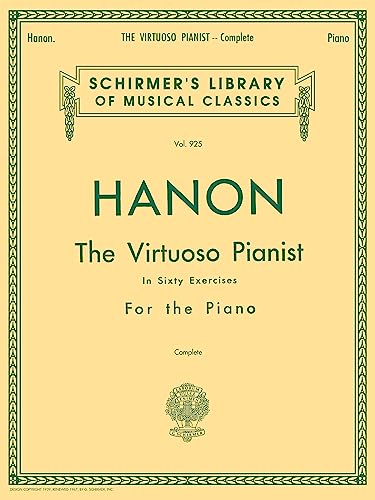
Charles-Louis Hanon’s “The Virtuoso Pianist” (1873) is perhaps the most famous (and infamous) exercise book in piano history. It consists of 60 exercises designed to train “finger independence,” strength, and equality.
- The Argument For: Advocates argue it builds raw endurance and equality between the weak fingers (4 and 5) and the strong fingers. It acts as a “gym” for the hands.
- The Argument Against: Critics argue it is “unmusical” and promotes a mechanical mindset. More dangerously, the original instruction to “lift the fingers high” is biomechanically unsound and can lead to tension, Repetitive Strain Injury (RSI), and tendonitis.
- Modern Consensus: Hanon is useful if adapted. Modern pedagogy emphasizes Arm Weight and Rotation rather than pure finger isolation. The wrist should remain flexible, and the energy should come from the shoulder and gravity, not just the forearm muscles.
As an Amazon Associate I earn from qualifying purchases.
The Alberti Bass
A ubiquitous technique in Classical era music (Mozart, Haydn, Clementi) is the Alberti Bass. This accompaniment pattern breaks a blocked chord into a fluid arpeggio: Bottom – Top – Middle – Top.
- Function: It provides rhythmic movement and harmonic support without overwhelming the melody. It keeps the texture light and transparent, which was ideal for the early fortepianos that lacked the sustain of modern instruments.
- Variations: The pattern can be reversed or adapted for 3/4 time, but the core objective is to create a “wash” of harmony from a static hand position. It teaches the left hand to be a steady timekeeper.
Global Terminology and Examination Boards
The standardization of music theory varies by region, creating a “Babel” of terminology that the modern musician must navigate.
| Concept | UK / Australia (AMEB, ABRSM) | USA (RCM*, Standard) | Meaning |
| Note Value 1 | Semibreve | Whole Note | 4 Beats |
| Note Value 1/2 | Minim | Half Note | 2 Beats |
| Note Value 1/4 | Crotchet | Quarter Note | 1 Beat |
| Note Value 1/8 | Quaver | Eighth Note | 1/2 Beat |
| Note Value 1/16 | Semiquaver | Sixteenth Note | 1/4 Beat |
| Note Value 1/32 | Demisemiquaver | Thirty-second Note | 1/8 Beat |
*RCM is Royal Conservatory of Music (Canada) but widely used in the US.
Exam Board Nuances:
- AMEB (Australia): Known for rigorous technical requirements (scales, arpeggios). Their “Piano for Leisure” syllabus is popular for allowing pop/jazz repertoire, acknowledging the modern student’s diverse interests.
- ABRSM (UK/Global): The gold standard for classical theory; highly structured. Exams include sight-reading and aural tests that are notoriously difficult.
- Trinity College London: Often favored for a more performance-centric approach with fewer scales and technical exercises, focusing more on the musicality of the repertoire.
Recommended Books
As an Amazon Associate I earn from qualifying purchases.
 Kindle editionRead on Kindle ›
As an Amazon Associate I earn from qualifying purchases.
 Kindle editionRead on Kindle ›
As an Amazon Associate I earn from qualifying purchases.
 Kindle editionRead on Kindle ›
As an Amazon Associate I earn from qualifying purchases.
Kindle editionRead on Kindle ›As an Amazon Associate I earn from qualifying purchases.
Conclusion
The study of piano chords is a discipline of infinite depth. It begins with the physics of the harmonic series, which dictates the consonance of a major triad and the inevitable pull of the tritone. It evolves through the history of tuning systems that allow us to modulate across the circle of fifths, breaking the shackles of Just Intonation to embrace the expressive possibilities of Equal Temperament. It fractures into the myriad styles of the 20th and 21st centuries—from the smoke-filled jazz clubs of Bill Evans to the skanking rhythms of Kingston and the synthesized wobble of Neo-Soul.
For the pianist, the keyboard is a canvas of 88 keys that can summon the entire history of harmonic thought. Whether playing a simple C Major triad or a complex polychord, the player is manipulating the fundamental laws of physics to speak directly to the human emotional experience. Mastery requires not just the fingers of an athlete (trained, perhaps, by Hanon), but the mind of a theorist and the ear of a poet.
The journey from “knowing the notes” to “feeling the resonance” is the lifelong work of the musician. As we have seen, every chord, whether the stable Major, the restless Altered Dominant, or the mysterious Minor Major Seventh, tells a story. It is now up to the player to decide which story to tell.
- Psychoacoustic Consonance: The physical sensation of stability produced by simple integer ratios in the harmonic series (e.g., 2:1 Octave).
- Interval Strength: The theory that an interval’s stability is determined by its proximity to the fundamental frequency in the overtone series.
- Rootless Voicings (Bill Evans Style): A jazz technique where the Root is omitted by the pianist (usually played by the bassist) to allow for richer color tones (9ths, 13ths).
- The Reggae Bubble: A rhythmic “motor” technique using the left and right hands in a subdivided 16th-note pattern on the organ.
- Neo-Soul Tension: Harmonic and rhythmic “laid-back” feels, often involving late attacks to create a soulful, unquantized groove.
- The Dilla Feel: A specific “drunk” swing or micro-timing technique inspired by hip-hop producer J Dilla.
- Standardized Examination Boards: Reference to the AMEB (Australian Music Examinations Board) and ABRSM (Associated Board of the Royal Schools of Music) for global grading.
- Long-Tail Keywords: Specific, high-intent search terms (e.g., “how to play reggae bubble”) used to capture niche traffic in SEO.
- Hub and Spoke Model: A content strategy where a main “Hub” page (e.g., Piano Chords) links to detailed “Spoke” articles.
- Cents (12-TET Deviation): A unit of measure where 100 cents equal one Half Step (Semitone); used to measure how much Equal Temperament deviates from pure harmonics.
- Triad Acoustic Rub: The internal dissonance created when a Minor 3rd clashes with the natural Major 3rd overtone of the Root.
- Seventh Chord Tiers: The transition from basic harmony to functional Jazz and R&B vocabulary.
- Emotional Quality (7th Chords): The specific “vibe” or character assigned to chord qualities (e.g., Major 7th as “dreamy”).
- Melodic Minor Derivation: The use of the ascending Melodic Minor scale to create the Minor Major 7th “Spy Chord.”
- Upper Extensions: Harmonic notes (9th, 11th, 13th) that add color without changing the functional identity of the chord.
- Lydian Dominant / #11: The practice of raising the 11th on a Major or Dominant chord to avoid the “avoid note” (natural 4th).
- Smooth Jazz Vocabulary: Frequent use of Minor 9th chords to create a mellow, sophisticated texture.
- Circle of Fifths (Circle of Fourths): The map of harmonic proximity used for understanding key signatures and modulation.
- Structural Logic (ii-V-I): The gravitational pull of roots descending by a Perfect Fifth, creating the strongest resolution in Western music.
- Tonicization: Using Secondary Dominants (V of X) to briefly make a non-tonic chord feel like “home.”
- Tritone Engine: The unstable interval between the 3rd and b7 of a Dominant chord that drives the resolution to the Tonic (I).
- Shell Voicings: Essentialized jazz chords containing only the Root, 3rd, and 7th, popularized during the Bebop era.
- The Skank (The Chop): The staccato, off-beat rhythmic strike essential to Reggae and Ska piano styles.
- Australian Pub Rock (Cold Chisel Sound): Aggressive, percussive piano techniques utilizing 2nd inversion triads to cut through loud electric guitars.
- Meend (Melodic Gliding): The emulation of Indian microtonal slides through the use of grace notes (acciaccaturas) on a fixed-pitch piano.
- Hanon Endurance: The original 19th-century goal of building raw finger strength through repetitive mechanical patterns.
- Biomechanical Consensus: The modern shift in pedagogy toward Arm Weight and rotation rather than isolated finger lifting.
- Alberti Bass: A broken-chord accompaniment (Bottom-Top-Middle-Top) used to create movement in Classical Era (e.g., Mozart) music.
Why does a Major chord on a piano sound slightly different than when sung by a professional a cappella group?
The difference lies in the tuning system. Modern pianos use 12-Tone Equal Temperament (12-TET), which divides the octave into twelve mathematically equal semitones to allow for playing in all 12 keys. However, this is a compromise. In the natural Harmonic Series (Just Intonation), a Major Third is a pure 5:4 ratio. On a piano, the Major Third is tuned approximately 14 cents sharp, creating a slight “beating” or shimmer that doesn’t exist in pure vocal harmony.
What is the “Harmonic Series” and how does it affect chord stability?
The Harmonic Series is a sequence of frequencies (overtones) that sound along with a fundamental pitch.
- Interval Strength: According to David Cope, an interval’s stability is determined by how low it appears in the harmonic series.
- Consonance: The Octave (2:1 ratio) and Perfect Fifth (3:2) appear first, making them the most stable.
- Dissonance: Intervals like the Minor Second (16:15) appear much higher and create “beating” in the ear, which the brain interprets as tension requiring resolution.
What are the five main families of seventh chords and their emotional characters?
Seventh chords add a fourth note to the basic triad, introducing specific “moods”:
- Major 7th (Maj7): Dreamy and nostalgic; the “floating” sound of jazz and bossa nova.
- Dominant 7th (7): Tense and expectant; the “bluesy” engine that drives music toward a resolution.
- Minor 7th (m7): Mellow and contemplative; a staple of R&B and jazz ballads.
- Half-Diminished (m7b5): Yearning and mysterious; often used as the “ii” chord in minor keys.
- Fully Diminished (dim7): Intense, symmetrical tension; frequently used in film scores to denote terror or suspense.
What is a “Tritone Substitution” in Jazz piano?
A Tritone Substitution is a harmonic technique where a Dominant 7th chord is replaced by another Dominant 7th chord located a tritone (six semitones) away.
- Why it works: Both chords share the same “tritone engine” (the 3rd and 7th degrees). For example, G7 and Db7 both contain the notes B and F.
- The Result: It creates a smooth, chromatic descending bass line (e.g., Dm7 -> Db7 -> Cmaj7 instead of Dm7 -> G7 -> Cmaj7), adding a sophisticated “sliding” sound to the progression.
How do “Rootless Voicings” (Type A and Type B) improve my playing?
Popularized by Bill Evans, Rootless Voicings omit the root note (leaving it for the bass player) to allow the pianist to play richer color tones like 9ths and 13ths.
- Type A: Built from the 3rd up (3-5-7-9).
- Type B: Built from the 7th up (7-9-3-5).
- Benefit: These allow for smooth voice leading, meaning your hand barely has to move when transitioning between chords (like a ii-V-I), creating a seamless and professional harmonic texture.
What is the rhythmic difference between “The Skank” and “The Bubble” in Reggae?
Reggae keyboard playing requires high rhythmic independence:
- The Skank (The Chop): A sharp, staccato strike on the “off-beats” (the “ands”) usually played with a clean piano sound.
- The Bubble: Typically played on an organ, this creates a “motor” effect. The right hand matches the skank while the left hand plays subdivided 16th-note ghost notes to fill the rhythmic gaps.
Is the “Hanon” exercise method still relevant for modern pianists?
While Charles-Louis Hanon’s The Virtuoso Pianist is a classic for building finger independence, modern pedagogy is divided:
- Pros: It builds raw strength and equality in the weak 4th and 5th fingers.
- Cons: If played with “high finger lifts” as originally instructed, it can cause Repetitive Strain Injury (RSI).
- Recommendation: Use Hanon as a technical “gym,” but focus on arm weight and wrist rotation rather than pure finger isolation to avoid tension.
What are the main differences between ABRSM and AMEB examination boards?
Standardization varies by region, but here are the general reputations:
- ABRSM (UK/Global): The rigorous “Gold Standard” for classical theory, famous for difficult sight-reading and aural tests.
- AMEB (Australia): Known for very high technical standards in scales and arpeggios, but offers a “Piano for Leisure” path for pop/jazz interests.
- RCM (Canada/US): Widely used in North America, balancing technical requirements with a comprehensive theory syllabus.
Sources & References
Mark Andrew Cook, Music Theory v. 1.0, 2012.
Mark Feezell, Music Theory Fundamentals: High-Yield Music Theory, vol. 1, 2011.
Charles-Louis Hanon, The Virtuoso Pianist, 1873. (Historical Reference).
Stefan Kostka and Dorothy Payne, Tonal Harmony with an Introduction to Twentieth-Century Music, 2017.
Lawrence Martin, Basic Music Theory for Adult Beginner-Level Piano Players, 2023.
Michael Pilhofer and Holly Day, Music Theory For Dummies, 2007.
The Associated Board of the Royal Schools of Music (ABRSM), Piano Syllabus 2023 & 2024, 2022.
Australian Music Examinations Board (AMEB), Piano for Leisure Syllabus, 2023.