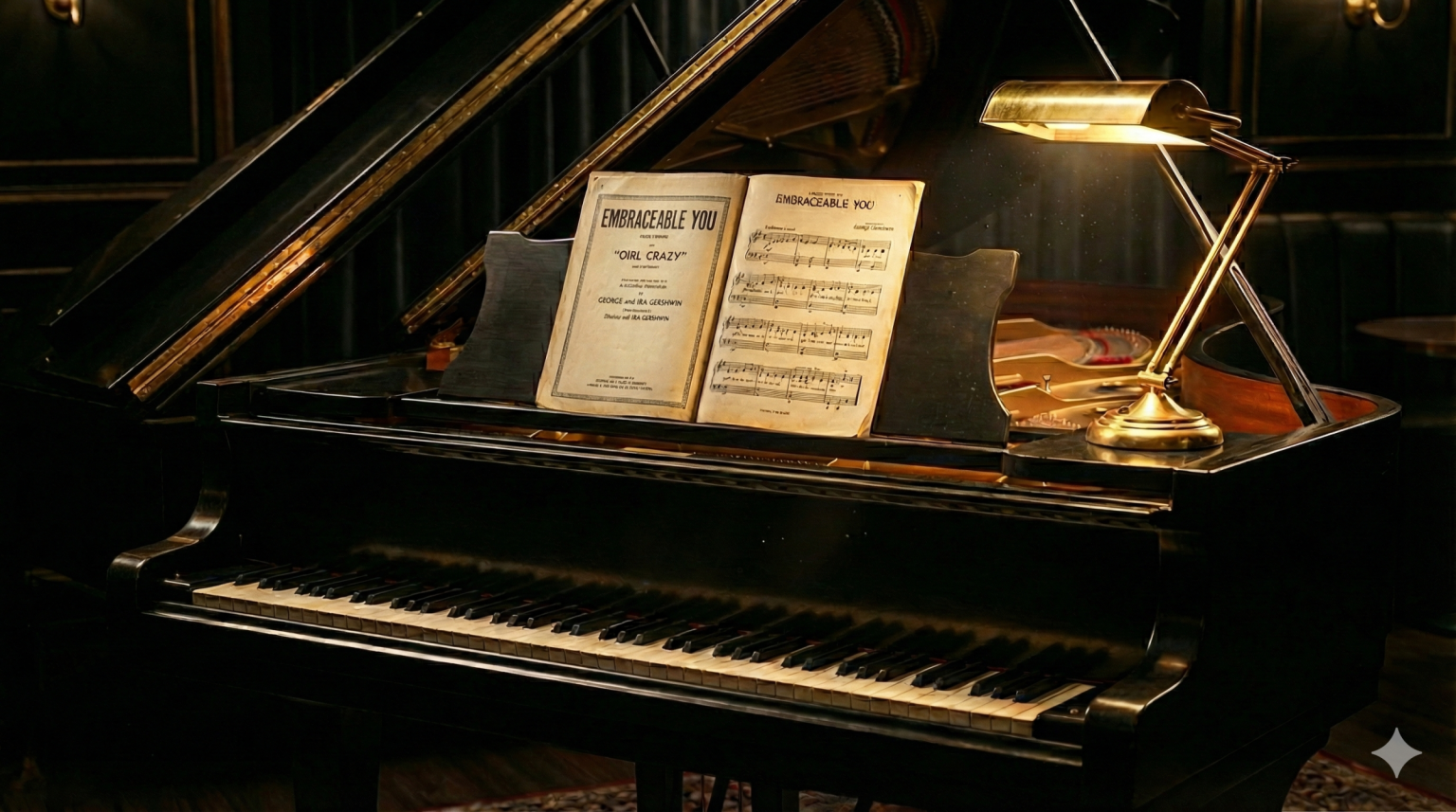
The discovery of a pristine 1930 score of “Embraceable You” often acts as a transformative moment for a dedicated pianist. One might recall the initial tactile sensation of the heavy paper, the distinct typography of the New World Music Corp., and the immediate realization that within these few pages lies the bridge between the rigorous discipline of classical counterpoint and the soulful improvisation of the American jazz idiom. This composition is not merely a song; it is a pedagogical artifact that challenges a student’s grasp of harmonic voice-leading, rhythmic syncopation, and melodic phrasing. By deconstructing this Gershwin masterpiece, one gains far more than a repertoire piece; one acquires an essential vocabulary of “niche” musical techniques, from the movement of harmonic intervals to the implementation of polyphonic textures in the left hand. This analysis will explore the historical context, the biographical brilliance of the Gershwin brothers, and an exhaustive technical breakdown of the music theory underpinning the score.
The 1930 publication of “Embraceable You” is a jazz standard written in the key of G Major, characterized by a leisurely verse and a rhythmically vibrant refrain that utilizes sophisticated chromatic alterations, secondary dominants, and passing diminished chords. Originally intended for the 1928 operetta East Is West, the song became a cornerstone of the Broadway musical Girl Crazy, serving as a primary vehicle for the development of the “Standard” jazz repertoire through its unique lopsided melodic theme and embellished chord progressions.
History of the Work and its Authors
The narrative of “Embraceable You” is intrinsically linked to the cultural awakening of the United States in the late 1920s and early 1930s. It represents a period where popular music began to transcend its vaudeville roots, adopting the complexity of “serious” symphonic works.
The Evolution of a Standard
The music for “Embraceable You” was initially drafted in 1928. George and Ira Gershwin had been commissioned by producer Florenz Ziegfeld to create a musical adaptation of the 1918 play East Is West, which focused on Americans in China. When the production was shelved, the Gershwins did not abandon the composition. Instead, they recognized its potential and placed it into Girl Crazy, which premiered at the Alvin Theatre on October 14, 1930. The musical was a phenomenal success despite the onset of the Great Depression, running for 272 performances.
The impact of the song was immediate. Within weeks of the premiere, a recording by Red Nichols and His Five Pennies rose to number two on the pop charts, notably outperforming “I Got Rhythm,” which was featured in the same show. The orchestration for the original Broadway run was a star-studded affair, including jazz legends Glenn Miller, Benny Goodman, and Gene Krupa, whose presence in the pit orchestra infused the score with a level of virtuosity that set a new standard for musical theater.
George Gershwin: The Architect of Fusion
George Gershwin, born Jacob Gershowitz in 1898, was a son of Russian Jewish immigrants in Brooklyn. His musical journey began by accident when his family purchased an upright piano for his older brother, Ira. George’s natural affinity for the instrument was profound; he surprised his parents by sitting down and fluently playing tunes he had heard on player pianos.
Gershwin’s formal education involved studying under Charles Hambitzer, Rubin Goldmark, and eventually the modernist Henry Cowell. At age 15, he dropped out of school to become a “song plugger” on Tin Pan Alley, demonstrating new sheet music to customers. This environment, though taxing, served as a “plugger’s purgatory” that immensely sharpened his improvisational skills and technical dexterity. Throughout his career, George sought to prove that jazz was an “American folk music” that could serve as the basis for major symphonic works, a goal he achieved with Rhapsody in Blue and Porgy and Bess.
Ira Gershwin: The Intellectual Jeweler
Ira Gershwin, the older brother born in 1896, was the family intellectual, characterized by a quiet and bookish demeanor. Unlike the outgoing George, Ira was a soft-spoken boy who spent his youth absorbing poetry and prose. His careful way with words eventually earned him the nickname “The Jeweler,” as he would spend days polishing lyrics to ensure they matched the rhythmic contours of George’s melodies with surgical precision.
Ira’s contribution to “Embraceable You” is marked by a clever “rhymed conversation” style. He prioritized internal rhymes and slang that felt uniquely American, such as the famous pairing of “tipsy” and “gypsy”. His lyrical mastery ensured that the songs were not merely freestanding ditties but integral parts of a script’s narrative arc.
| Historical Performance Milestones | Date | Significance |
| Initial Composition | 1928 | Written for East Is West. |
| Broadway Premiere | Oct 14, 1930 | Debut in Girl Crazy at the Alvin Theatre. |
| Pop Chart Debut | Nov 1930 | Red Nichols recording reaches #2. |
| MGM Film Version | 1943 | Starring Mickey Rooney and Judy Garland. |
| Grammy Hall of Fame | 2005 | Induction of Billie Holiday’s 1944 version. |
Foundational Music Theory and Notation
To effectively interpret the score of “Embraceable You,” one must understand the fundamental building blocks of music notation as they were standardized by the early 20th century.
The Grand Staff and Pitch Placement
Music is visually represented on a staff consisting of five parallel horizontal lines and four spaces. Piano music employs the Grand Staff, which connects two five-line staves via a brace. The upper staff uses the Treble Clef (G-clef), identifying the second line as “G4,” while the lower staff uses the Bass Clef (F-clef), identifying the fourth line as “F3”.
The concept of Middle C is critical here; it is the pitch that resides on a ledger line directly between the two staves, acting as a connective bridge. Ledger lines are small horizontal dashes used to extend the staff’s range, a frequent necessity in the virtuoso passages of Gershwin’s piano arrangements.
Rhythmic Values and Time Signatures
Rhythm serves as the “backbone” of the Gershwin sound. The score of “Embraceable You” is primarily set in Simple Quadruple Meter (4/4 time), meaning there are four beats per measure, and the quarter note receives one beat. However, the performance is governed by the “Pulse,” the recurring background heartbeat that dictates how the listener interacts kinesthetically with the piece.
Gershwin utilizes Durational Values to create a sense of movement:
- Whole Notes: Representing the duration of an entire measure in 4/4.
- Half and Quarter Notes: Used to establish the “Leisurely” pace of the verse.
- Eighth Notes: Often grouped with “Beams” or “Ligatures” to clarify the beat division.
- Dotted Values: These represent the addition of half the original duration (e.g., a dotted half note equals three beats), a technique essential for creating the “swing” feel of the 1930s.
Intervals: The Metric of Jazz
An interval is the relative distance between two pitches. Gershwin’s harmonic language is built on the understanding of Half Steps (semitones) and Whole Steps (tones). A half step is the smallest distance between any two adjacent keys on the piano, while a whole step spans two half steps.
In “Embraceable You,” the Perfect Fourth and Perfect Fifth are used for structural stability, but the “jazziness” arises from Chromatic Alterations—sharps (#), flats (b), and naturals, that modify the diatonic scale to create tension and emotional color. The Leading Tone, located a half step below the tonic, is particularly powerful in this score, as it compels the ear toward resolution.
Score Breakdown: Technical and Harmonic Analysis
The 1930 score of “Embraceable You” is a case study in Common Practice Period tonal harmony, layered with early jazz sophistication.
Key Signature and Tonal Center
The score is written in G Major, indicated by a single sharp on the “F” line of the staff. The Tonic (G) serves as the “home note,” while the Dominant (D) acts as its polar opposite, creating the fundamental continuum of tension and release.
| Tonal Center Analysis | Component | Theoretical Role |
| G Major | Key Signature | 1 Sharp (F#). |
| G | Tonic | Stability and sense of conclusion. |
| D | Dominant | Instability and sense of tension. |
| C | Subdominant | A “big” IV chord used before the ending. |
| Em | Submediant | Used in the “Tipsy/Gypsy” sequence. |
The Verse: Leisurely Dialogue
The opening of the score is marked Whimsically, with the verse set to a Leisurely tempo. This section is a dialogue between Danny and Molly, moving through a series of “embellishing” chords that decorate a standard I-V-I progression.
Specific progressions extracted from the score include:
- Initial Hook: D7 – G – F#m – D7.
- Chromatic Ascent: Eb9 – D7 – G – Am7.
- Transition: The end of the verse features a Rallentando e diminuendo (slowing and softening) to prepare the listener for the refrain.
The Refrain: Rhythmic Playground
The refrain is marked Rhythmically, signifying a shift toward a more driving jazz pulse. Here, Gershwin introduces the core melodic motif: three notes ascending scalewise, beginning on the 6th of the scale.
A primary technical feature is the Passing Diminished Chord. In the sequence G – Bbdim7 – Am7, the Bbdim7 chord (a “passing chromatic” diminished) creates strong tension. The inner voices move by half steps (B to Bb to A, and D to Db to C), while the G note is shared between the chords, providing a remarkably smooth transition. This “bridge” functionality allows the harmony to move chromatically from the I to the ii chord without sounding disjointed.
Melodic Leaps and Wistfulness
The melody is famously “lopsided,” utilizing unconventional accentuation. Gershwin places the biggest accent four syllables before the end of the verse, which is a departure from the declamatory styles of the era.
The melody is characterized by:
- 80% Step-wise Movement: Smooth, linear motion that makes the song singable.
- Downward Leaps: Periodic intervals ranging from a fourth to a full octave that delay resolution.
- The Minor IV: At the very end of the piece, the sequence I7 – iv – V7 – I (G7 – Cm7 – D7 – G) is used. The use of the Cm7 (minor IV) on the last iteration of “embraceable” adds a layer of wistfulness and sadness to the resolution.
Pedagogical Tips for Success
Teaching “Embraceable You” to a beginner-intermediate student requires a structured approach focusing on the “Seven Facts of Music”: sound, production, harmonic shapes (chords), melodic shapes (scales), direction, decoration, and expression.
Technical Challenges and Solutions
| Technical Challenge | Pedagogical Solution |
| Wide Melodic Leaps | Practice “Legato” phrasing, imitating a vocal style to connect the intervals fluidly. |
| Complex Chord Voicing | Use “Chord Inversions” to minimize hand movement and maintain the rhythm. |
| Syncopated Rhythms | Employ a metronome to internalize the 4/4 pulse before “skipping” the beat through syncopation. |
| Pedal Management | Use the damper pedal to sustain the “Rhythmic” refrain without mudding the chromatic inner voices. |
Advanced Improvisation Techniques
For students moving into jazz improvisation, “Embraceable You” is an ideal vehicle for practicing Tritone Substitutions and Secondary Dominants. For instance, an Ab7 can lead to G7 as a tritone sub for D7. Students should be encouraged to “camouflage” the original melody with chromaticism, moving beyond the notes on the page to interpret the “feeling” of the Gershwin standard.
Heritage of Interpretation
The score’s true depth is revealed in how legendary artists have reinterpreted Gershwin’s blueprint over the decades.
Charlie Parker and Bebop
Charlie Parker’s 1947 recording is a pinnacle of “Embraceable You” history. Parker introduces a virtuosic technique characterized by fast tempos and advanced harmonies. He utilized Rapid Passing Chords and Chord Substitutions, creating a version where 36.7% of the notes are syncopated, effectively breaking the form into a masterpiece of spontaneous composition.
Billie Holiday and Vocal Phrasing
Billie Holiday’s 1944 version (Grammy Hall of Fame) provides a lesson in “languorous intimacy”. Her interpretation focuses on “elongated phrasing,” drawing out syllables to emphasize Ira’s clever rhymes. She makes inventive departures from the melody with octave leaps that showcase a sophisticated range and controlled vibrato.
Earl Wild’s Piano Etude
For the classical pianist, Earl Wild’s arrangement is the ultimate test. He adds a multitude of arpeggios that surround the melody, requiring a circular movement of the hands that mimics “embracing” the piano. This arrangement is not easily sight-read; it requires a mastery of long lines and rapid chord changes that push the boundaries of piano-centric composition.
Conclusion and Recommendations
“Embraceable You” remains a timeless testament to the synergistic genius of George and Ira Gershwin. By studying the 1930 score, one uncovers a world where classical rigor meets the unbridled spirit of the Jazz Age. The piece teaches us that sophisticated harmony does not have to be inaccessible; rather, it can be built from simple half-step movements and a profound understanding of melodic “target notes”.
For the modern student, the following actions are recommended:
- Master the Intervals: Use the counting of half steps and whole steps to define the “jazzy” chords in the left hand.
- Sing the Phrasing: Before playing, vocalize the melody to understand Ira’s accentuation, ensuring the rhythmic stress falls correctly on the “four syllables before the end”.
- Layer the Texture: Start with the simple I-V-I foundation provided in lead sheets before layering in Gershwin’s “embellishing” chords and passing diminished sequences.
Ultimately, performing “Embraceable You” is about more than hitting the right keys; it is about embracing a legacy of American creativity that continues to inspire generations of musicians across the globe.
What is the primary difficulty in playing Embraceable You for piano beginners?
The main challenge lies in the unexpected resolutions and wide interval leaps in the melody. Beginners often struggle to maintain a smooth, legato connection when the melody jumps an octave or a fifth while the left hand is managing chromatic chord changes.
How does the passing diminished chord function in this song?
Gershwin uses a passing chromatic diminished chord (like Bbdim7) to create tension as the music moves from the tonic (G) to the supertonic (Am7). This allows for half-step movement in the inner voices, which provides the “jazzy” and “wistful” sound characteristic of the era.
Why is the 1930 score considered “standard”?
It is considered a “Standard” because its basic harmonic structure (I-V-I) is so finely crafted that it allows for near-infinite variation and improvisation. It has been recorded by more jazz artists than almost any other Gershwin song, including “I Got Rhythm”.
What tempo should I use when starting to learn this piece?
The score suggests Leisurely for the verse and Rhythmically for the refrain. For a student, it is recommended to start at a slow, constant pulse (roughly 75-80 BPM) to ensure clarity in the chromatic voice-leading before increasing the speed to a “walking” jazz pace.