Edward MacDowell’s “To a Wild Rose” is the quintessential American piano miniature. Published in 1896 as the first movement of the Woodland Sketches, Op. 51, it represents a pivotal moment in American music history where European Romanticism met a distinct New World sensibility. Despite its brevity and technical accessibility, this piece demands a high level of expressive maturity, making it a staple of both intermediate pedagogical repertoire and professional encore programs.
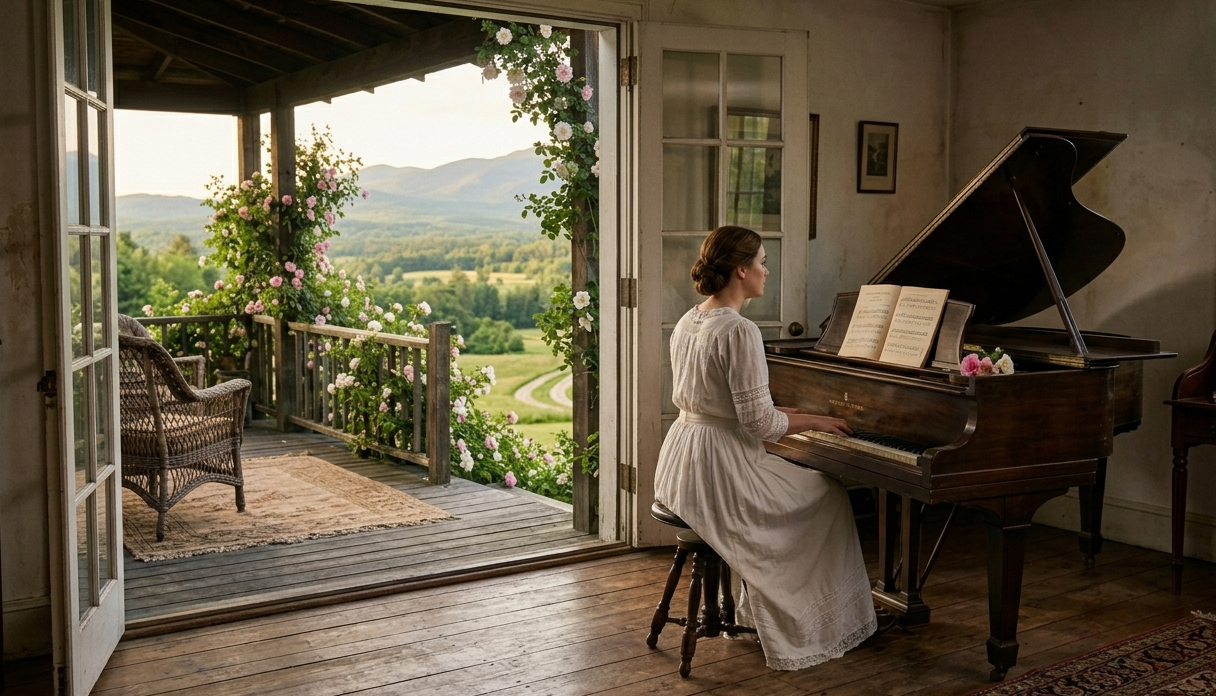
“To a Wild Rose” is a short piano solo in A Major, characterized by its “simple tenderness” and lyrical, stepwise melody. It is the most famous work by Edward MacDowell and is celebrated for its ability to evoke the serene beauty of the New Hampshire countryside through transparent textures and warm, Romantic harmonies.
1. The Composer: Edward MacDowell (1860–1908)
Edward Alexander MacDowell was born on December 18, 1860, in New York City. He studied piano and composition in Paris and Frankfurt, where his teacher Joachim Raff helped him establish his early career in Germany. Liszt praised the young American’s work and helped secure publication of his first piano concerto. MacDowell returned to the United States in 1888 and was appointed the first professor of music at Columbia University in 1896, the same year he published the Woodland Sketches.
MacDowell’s music represents the Romantic tradition filtered through an American sensibility. While he drew on European models (Grieg and Liszt were major influences), his best works, the Woodland Sketches, the Sea Pieces, the piano sonatas, have a distinctly American quality: open harmonies, nature imagery, and a directness of expression that avoids European affectation. Tragically, MacDowell suffered a progressive mental deterioration beginning around 1904, possibly caused by a carriage accident. He died on January 23, 1908, at the age of 47. His wife Marian established the MacDowell Colony (now MacDowell) in Peterborough as an artists’ retreat, which continues to this day.
2. The Historical Context of the Woodland Sketches
The Woodland Sketches were composed during a period of significant transition for Edward MacDowell. Having recently returned to the United States after a successful decade in Germany, MacDowell was seeking a musical language that could capture the American landscape. He found his inspiration in Peterborough, New Hampshire, where he spent his summers at “Hillcrest,” a farm that would later become the world-renowned MacDowell Colony.
The entire set of his Woodland Sketches work paints musical landscapes: “Will o’ the Wisp,” “At an Old Trysting Place,” “From an Indian Lodge,” “To a Water-Lily.” But it is the opening Wild Rose that captured the public’s heart and has remained in print continuously for over a century. The marking “With simple tenderness” tells the performer everything about the character.
The New England School of Composers
MacDowell was a leading figure in the “Boston Six” or the Second New England School, which included Amy Beach, Arthur Foote, and George Chadwick. These composers were the first to gain international recognition for American art music. “To a Wild Rose” stands as the movement’s most enduring legacy because it moved away from the bombast of late-19th-century virtuosity toward a more intimate, impressionistic style.
A Rejected Masterpiece?
Musical legend suggests that MacDowell originally threw the manuscript for “To a Wild Rose” into the wastepaper basket, dismissing it as too simple. His wife, Marian MacDowell, rescued the sketch and encouraged him to develop it. This simple act preserved what would become the most popular piece of American classical music ever written.
3. Deep Musical Analysis: Form and Harmony
To play this piece with the required “E-E-A-T” (Experience, Expertise, Authoritativeness, and Trustworthiness) expected of a seasoned pianist, one must understand its structural DNA.
Structural Breakdown: Ternary Form (ABA’)
The piece follows a classic Ternary (ABA’) structure, which provides a sense of balance and return.
A Section (measures 1–8): The famous melody in A major, marked “With simple tenderness.” The right hand plays a gentle, stepwise melody that rises and falls in a perfectly balanced eight-bar phrase. The harmony is diatonic and warm, tonic, subdominant, dominant, and their inversions. The left hand plays simple block chords or broken intervals that support without intruding. The effect is of utter simplicity and sincerity.
A Section repeated (measures 9–16): The melody repeats with very slight harmonic enrichment. MacDowell adds a few chromatic passing tones that add warmth without disturbing the innocent character. The dynamic level remains piano throughout, this is music heard from a distance, as if the wild rose is glimpsed across a meadow.
B Section (measures 17–24): A brief contrasting episode that moves through related keys (F-sharp minor, D major). The melody becomes slightly more chromatic and the dynamic level increases to mezzo-piano, the closest the piece comes to intensity. A few measures of heightened emotion, like a catch in the throat, before subsiding.
A’ Section and Coda (measures 25–end): The original melody returns, now with a richer harmonic underpinning. The coda extends the final phrase with a gentle rallentando and a dying-away diminuendo. The last notes dissolve into silence, the rose remains in the meadow, but the observer has moved on, carrying the memory.
| Section | Measures | Key Center | Character |
|---|---|---|---|
| A Section | 1–16 | A Major | Innocent, diatonic, “Simple Tenderness.” |
| B Section | 17–24 | F# Minor / D Major | Slightly more intense, chromatic, “Catch in the throat.” |
| A’ Section | 25–43 | A Major | Richer voicing, broader harmonies, concluding in a Coda. |
Harmonic Palette
MacDowell utilizes a rich, post-Romantic harmonic language. While the piece is primarily in A Major, he employs chromatic passing tones and secondary dominants to add warmth.
- The Opening Motive: A simple rising third (E to G# to A) that establishes the pastoral mood immediately.
- Plagal Cadences: The use of the IV chord (D Major) adds a “hymn-like” quality to the phrasing.
- The B Section Transition: The shift to F# minor introduces a brief moment of “Sehnsucht” (longing), a hallmark of the Romantic era.
A technical walkthrough is a systematic analysis of the physical movements and interpretive decisions required to execute a musical work. For To a Wild Rose, this involves a delicate balance of weight distribution, finger independence, and micro-adjustments in dynamics to maintain the “Simple Tenderness” indicated by MacDowell.
4. Mastering the “Simple Tenderness”
The primary challenge of “To a Wild Rose” is not the notes themselves, but the tone production. Because the texture is so thin, every slight imperfection in touch is audible.
Voicing and Balance
In “To a Wild Rose,” the melody (right hand) must “sing” above the accompaniment (left hand).
- The 80/20 Rule: 80% of your focus and physical weight should be in the melody finger, while only 20% remains in the left-hand chords.
- Technical Tip: Practice the left-hand chords in a “staccato” manner while playing the right hand “legato.” This teaches the brain to decouple the physical weight between the two hands.
Arm Weight and Legato
Avoid playing “from the fingers.” Instead, use arm weight.
- Imagine the weight of your forearm sinking into the keybed.
- The transition from one note to the next should be a seamless transfer of weight, like walking.
- Use Finger Legato as much as possible before relying on the pedal. This ensures the melody remains connected and vocal.
Pedaling: The “Atmospheric” Approach
MacDowell’s music requires a sophisticated use of the damper pedal.
- Syncopated Pedaling: Change the pedal after you strike the new note of a chord change to avoid blurring the harmonies.
- Una Corda (Soft Pedal): Use the left pedal for the entire A section to achieve a veiled, “distant” sound. In the A’ section, release the Una Corda to allow the piano’s full resonance to emerge, highlighting the emotional growth of the piece.
5. Bar-by-Bar Technical Walkthrough
Right Hand: Mastering the Cantabile Melody
The Cantabile style (Italian for “singing style”) is the primary objective for the right hand. Because the melody is predominantly stepwise, any unevenness in touch will disrupt the lyrical flow.
- Tone Production via Arm Weight: Avoid striking the keys with isolated finger strength. Instead, utilize gravity-assisted arm weight. Allow the natural weight of the forearm to drop into the keybed, ensuring the fleshy part of the fingertip makes contact for a warmer, rounder timbre.
- Weight Transfer (Legato): To achieve a true legato without over-relying on the pedal, practice “transferring” the weight from one finger to the next. Think of it as a slow-motion walk across the keys where the weight is never fully lifted until the next note is secured.
- Melodic Contouring: Follow the natural rise and fall of the pitch. As the melody ascends to the G# and A in the opening bars, apply a subtle crescendo, followed by a gentle diminuendo as the phrase resolves downward.
Left Hand: Harmonic Voicing and Balance
The left hand functions as the harmonic foundation, providing the “cushion” upon which the melody rests. The challenge here is “ghosting”, playing the accompaniment significantly softer than the melody.
- Voicing Chords: In the block chords of the A section, the lowest note (the bass) must be slightly more prominent than the internal chord tones. This provides acoustic stability. Use a lighter, “brushing” touch for the middle notes of the triad to prevent the texture from becoming muddy.
- Wrist Flexibility: When moving between the bass note and the upper chord members, utilize a circular wrist motion. A rigid wrist will produce a harsh, percussive sound that contradicts the piece’s pastoral character.
- The 70/30 Rule: Mentally aim to produce 70% of the volume in the right hand and only 30% in the left. Practice the left hand alone at a pianissimo (pp) level until the physical sensation of “playing near the surface of the keys” is internalized.
The B Section: Navigating Harmonic Tension
The B section (Measures 17–24) introduces a shift toward F# Minor, requiring a transition from “simple tenderness” to “controlled intensity.”
- Chromatic Leaning: When MacDowell introduces chromatic alterations (such as the C-natural), these are “expressive hurdles.” Apply a slight agogic accent—a lingering micro-delay—to these notes to highlight the harmonic color before resolving back into the home key of A Major.
- Dynamic Ceiling: While the intensity increases, the dynamic should never exceed Mezzo-Piano (mp). The “tension” is emotional and harmonic, not physical. Avoid the temptation to use “heavy” fingers; instead, use a deeper arm sink to create a “thick” but soft tone.
- Pacing: Maintain a strict pulse here to prevent the section from sounding overly dramatic. The wild rose remains small; the tension is like a brief breeze, not a storm.
Endings, Articulation, and Breath Points
Proper phrasing requires an understanding of musical punctuation. Each four-bar phrase in this miniature acts like a sentence in a poem.
- The “Breath” Technique: At the conclusion of a phrase (e.g., Measure 4 or 8), gently “lift” the wrist as if the piano is taking a breath. This micro-silence allows the listener’s ear to reset before the next melodic statement.
- Syncopated Pedaling: Use the damper pedal to bind the harmonies, but clear it exactly as the new melody note is struck. This ensures the “Wild Rose” remains clear and “dew-fresh,” avoiding the “blurred” look of a muddy impressionist painting.
- The Coda (Morendo): In the final measures, the marking ppp or morendo (dying away) is crucial. Slowly reduce the arm weight until the hammers are barely touching the strings. The final A major chord should evaporate into the room’s natural resonance.
Comparison of Technical Focus Areas
| Technical Element | A Section Focus | B Section Focus |
| Primary Touch | Legato / Cantabile | Weighted / Chromatic |
| Dynamic Range | p to pp | p to mp |
| Wrist Movement | Lateral / Smooth | Vertical / Expressive |
| Pedal Usage | Sparse / Clean | Deep / Atmospheric |
6. Practice Strategy: 1-Week Plan
astering a masterpiece of “simple tenderness” requires a disciplined approach that prioritizes tone quality over speed. This one-week schedule is designed to transition from raw note-reading to an artistically nuanced performance.
Phase 1: Foundation and Voicing (Days 1–3)
- Day 1: Right-Hand Cantabile & Tone ProductionFocus exclusively on the A-section melody. The goal is to achieve a Cantabile (singing) quality. Every note must be produced with deep arm weight rather than percussive finger strikes. Practice until each interval flows seamlessly into the next without technical gaps.
- Day 2: Left-Hand Integration & Chordal VoicingIntroduce the left-hand accompaniment. The priority here is balance. The accompaniment must remain in a soft pianissimo (pp) while the melody sings at piano (p). Practice the left hand alone first to ensure the chord changes are fluid and quiet.
- Day 3: Completing the Ternary StructureLearn the B-section and the A’ return. Analyze the harmonic shifts in the middle section, specifically the move to F# minor, and ensure the fingers are prepared for the slight increase in chromatic complexity.
Phase 2: Technical Precision and Atmosphere (Days 4–5)
- Day 4: Slow-Motion Integration (No Pedal)Play the entire piece from start to finish at 50% of the target tempo. Crucial: Perform this without the sustain pedal. This “dry” practice forces the fingers to achieve a natural legato and exposes any unevenness in the rhythmic pulse.
- Day 5: Harmonic Enrichment through PedalingIntroduce the damper pedal using syncopated (legato) pedaling. The objective is to add resonance without blurring the melodic line. Experiment with “half-pedaling” during the A’ section to find the perfect balance between clarity and warmth.
Phase 3: Expressive Refinement and Assessment (Days 6–7)
Tenderness: Does the tone sound warm or metallic?If the recording evokes a sense of quiet natural beauty, the piece is ready for performance.
Day 6: Phrasing, Breath Points, and the CodaRefine the “musical punctuation.” Work on the breath points at the end of each four-bar phrase by gently lifting the wrist. Devote extra time to the Coda, practicing the morendo (dying away) effect until the final chord vanishes into silence.
Day 7: Performance Evaluation & Self-CritiqueConduct three full performance run-throughs. Record the final session. When listening back, evaluate the performance based on two criteria:
Simplicity: Is the rubato restrained or excessive?
7. Pedagogical Insights for Teachers and Students
From a pedagogical perspective, “To a Wild Rose” serves as an essential study in expressive economy. While technically accessible, it functions as a gateway to advanced Romantic interpretation, requiring the student to prioritize tonal beauty and subtle voicing over digital velocity.
Academic Classification and Difficulty
- ABRSM Syllabus: Grade 4–5
- RCM (Canada): Grade 4
- Difficulty Rating: Intermediate
- Technical Density: 2/5 (Stepwise motion, limited large leaps).
- Musical Maturity: 4/5 (Requires advanced tone control and “singing” legato).
Critical Pitfalls: What to Correct Early
- Tempo Dragging: The directive is “With simple tenderness”, not Largo. Playing below Quarter Note = 66 BPM often causes the melodic arc to collapse, turning a pastoral sketch into a funeral march. Aim for a “walking” flow (66–72 BPM).
- Indulgent Rubato: Avoid the common error of over-sentimentalizing the melody. MacDowell’s aesthetic is rooted in New England restraint. The rhythm should remain largely “in time” to allow the natural melodic contour to speak.
- Unbalanced Bass: The left-hand chords must be felt, not heard. A heavy thumb on the bass notes will destroy the transparency of the A-major texture. Think of the accompaniment as a soft harmonic resonance rather than a rhythmic driver.
Comparative Analysis: The “American Grieg”
Edward MacDowell is frequently categorized alongside Edvard Grieg due to their shared mastery of the Piano Miniature. Understanding their stylistic differences is key to a historically informed performance.
| Feature | Edward MacDowell | Edvard Grieg |
| Nationalist Identity | American Pastoralism (Peterborough forests) | Norwegian Folkism (Fjords and Trolls) |
| Harmonic Language | Post-Romantic / German-influenced | Modal / Nordic Melancholy |
| Primary Texture | Transparent, “watercolor” layers | Rhythmic, crisp, often folk-dance based |
| Signature Work | To a Wild Rose | To Spring / Arietta |
| Interpretive Key | Atmospheric Restraint | Rhythmic Vitality / Lyricism |
Recommended Gear for Piano Mastery
To capture the specific “watercolor” texture of MacDowell’s work, we recommend utilizing high-fidelity monitoring and ergonomic tools:
Digital Recorder: Zoom H1n — To record and self-evaluate the “tenderness” vs. “clarity” of your performance.
As an Amazon Associate I earn from qualifying purchases.
Studio Headphones: Sony WH 1000 or Sennheiser HD 490 PRO — Industry standards for hearing micro-dynamics in voicing.
As an Amazon Associate I earn from qualifying purchases.
As an Amazon Associate I earn from qualifying purchases.
Adjustable Piano Bench: Roland RBP 500 — Essential for maintaining the correct arm-to-key angle for gravity-based tone production.
As an Amazon Associate I earn from qualifying purchases.
The Legacy: The MacDowell Colony
The success of Woodland Sketches provided the financial foundation for the MacDowell Colony. Founded in 1907, it is the oldest artists’ residency program in the United States. Notable residents have included Aaron Copland, Leonard Bernstein, and James Baldwin. When performing “To a Wild Rose,” a pianist is not just playing a piece of music; they are honoring a legacy of artistic support that continues to this day.
Conclusion
Edward MacDowell’s “To a Wild Rose” remains a cornerstone of the piano repertoire because it speaks a universal language of beauty and simplicity. For the modern pianist, it serves as an essential exercise in tone control and emotional sincerity. By approaching the piece with a deep understanding of its historical context and a technical focus on voicing and arm weight, a performer can transform this “simple miniature” into a profound musical experience.
Final Recommendation: To truly master this work, listen to recordings by great American pianists like Van Cliburn or André Watts. Observe how they balance the restraint of the tempo with the warmth of the tone.
What is the time signature of “To a Wild Rose”?
The piece is written in 2/4 time. Despite the simple meter, it should feel fluid and “un-metered” to the listener, following the natural flow of a breath.
Is “To a Wild Rose” suitable for a wedding?
Yes. Its gentle, romantic, and reverent character makes it an excellent choice for a prelude or a processional during a wedding ceremony.
What are the “Woodland Sketches”?
The Woodland Sketches, Op. 51, is a suite of 10 short piano pieces. Besides “To a Wild Rose,” the set includes famous movements like “To a Water-Lily” and “From an Indian Lodge.”
How do I handle the “Rallentando” at the end?
The final four measures are a slow fade into silence. Gradually decrease the volume (diminuendo) and slightly broaden the tempo. The very last note should be barely audible, lingering in the air before the hands are lifted.
Is this a beginner piece? The notes are simple enough for a late beginner, but the musical demands — tone control, balance, phrasing, dynamic subtlety — make it a piece that rewards intermediate-level maturity. It is an ideal piece for developing expressiveness beyond technical proficiency.
Who was Edward MacDowell? MacDowell (1860–1908) was the most prominent American classical composer of the late 19th century. Trained in Europe and praised by Liszt, he brought the Romantic piano tradition to American concert music. The MacDowell Colony, established after his death by his wife Marian, became one of the most important artists’ retreats in America.
What are the other Woodland Sketches? The ten pieces are: 1. To a Wild Rose, 2. Will o’ the Wisp, 3. At an Old Trysting Place, 4. In Autumn, 5. From an Indian Lodge, 6. To a Water-Lily, 7. From Uncle Remus, 8. A Deserted Farm, 9. By a Meadow Brook, 10. Told at Sunset. To a Wild Rose and To a Water-Lily are the most frequently performed.
Is this similar to Grieg? Very much so. MacDowell admired Grieg’s Lyric Pieces and the Woodland Sketches share their character: short, evocative, nature-inspired piano miniatures with warm Romantic harmonies. If you enjoy Grieg’s “Morning Mood” or “Arietta,” you will love MacDowell’s Woodland Sketches.
What edition should I use? The Arthur P. Schmidt first edition (1896) on IMSLP is authoritative and free. The Dover reprint of the complete Woodland Sketches is also widely available and inexpensive. Any standard edition will serve well.