George Frideric Handel’s Passacaglia in G Minor, more accurately titled Passacaille in the original collection, is one of the most compelling variation movements in Baroque keyboard music. Built from an extraordinarily compact harmonic idea, it demonstrates how a composer can generate increasing movement, density, and technical excitement without abandoning a stable underlying structure.
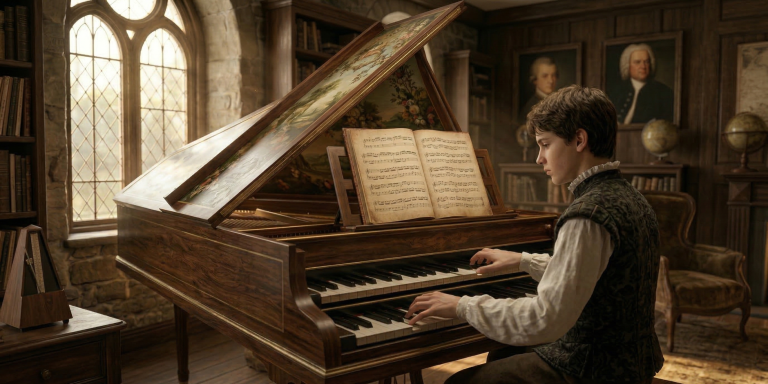
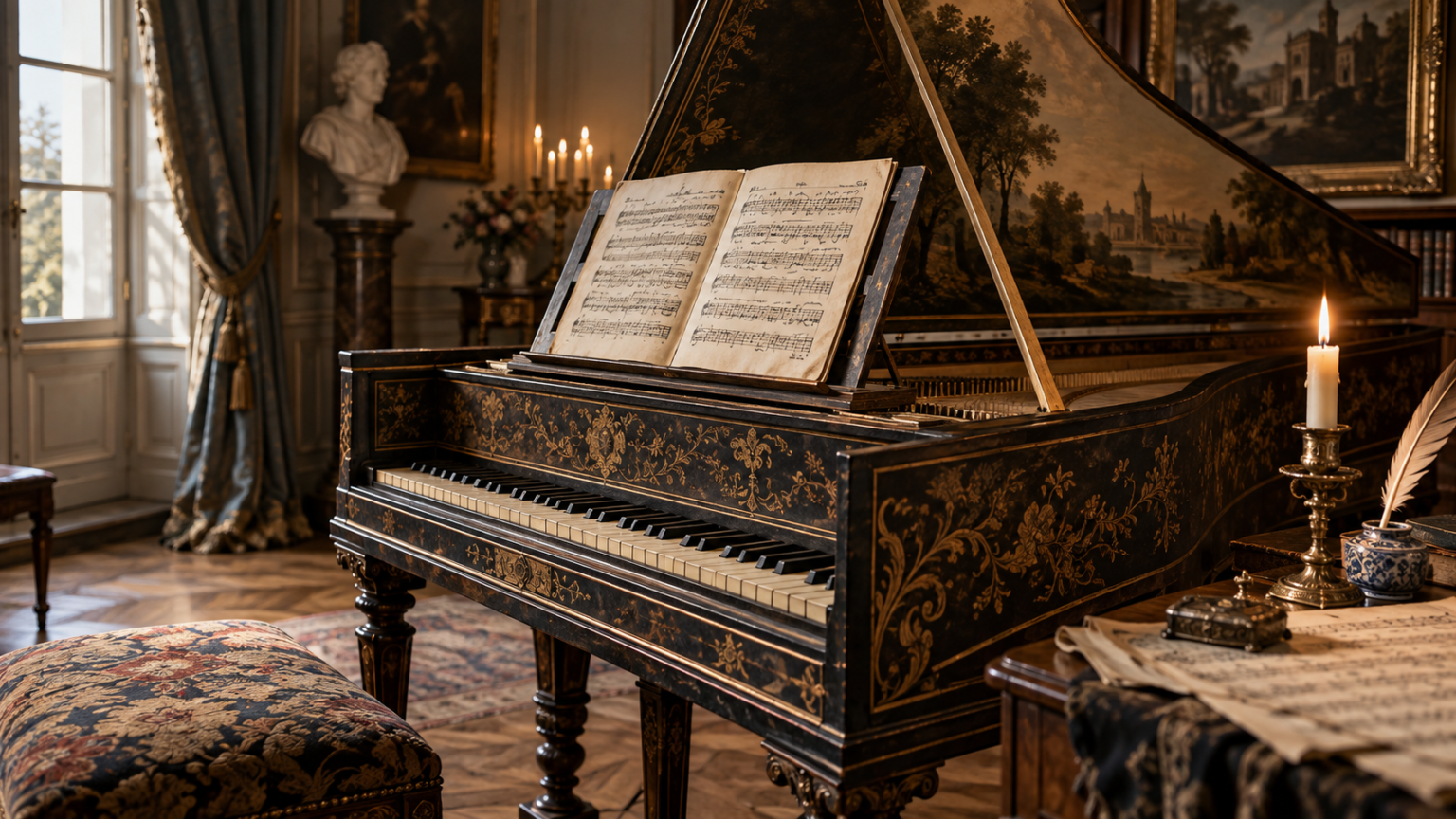
The piece belongs to Handel’s Suite No. 7 in G Minor, HWV 432. It is the sixth and final movement of a suite that also contains an Ouverture, Andante, Allegro, Sarabande, and Gigue. The suite formed part of Handel’s first printed collection of eight keyboard suites, published in London in 1720 as Suites de Pièces pour le Clavecin. The original instrumentation is therefore harpsichord, even though the work is now frequently played on the modern piano.
For pianists, the Passacaglia offers an unusually concentrated technical lesson. The harmonic foundation remains recognizable while the surface of the music is repeatedly transformed. Chords become scales, flowing lines, ornaments, rapid semiquaver patterns, and increasingly energetic textures. As a result, learning the piece is not simply a question of reading more and more notes. The real challenge is understanding which part of the music remains structurally constant while everything around it changes.
Handel’s Passacaglia in G Minor, HWV 432 consists of a four-measure theme followed by fifteen four-measure variations. Its underlying harmonic cycle is G minor, C minor, F major, B-flat major, E-flat major, A diminished, D major, and back to G minor. This recurring framework gives the performer a map for the entire movement, making harmonic understanding one of the most effective tools for learning and memorizing the score. Henle’s scholarly commentary confirms both the fifteen-variation structure and this harmonic sequence.
1. Score Overview
The Passacaglia is the final movement of Handel’s Suite No. 7 in G Minor, HWV 432. It was written for keyboard and published as part of the 1720 collection commonly known today as Handel’s Eight Great Suites. The modern piano did not yet occupy the position it would later assume in European keyboard music, and Handel’s printed title specifically refers to the clavecin, or harpsichord.
| Feature | Handel’s Passacaglia |
|---|---|
| Composer | George Frideric Handel |
| Work | Suite No. 7 in G Minor |
| Catalogue | HWV 432 |
| Movement | No. 6, Passacaille |
| Period | Baroque |
| Original instrument | Harpsichord |
| Key | G minor |
| Meter | Common time |
| Form | Theme and continuous variations |
| Structure | Theme plus 15 four-measure variations |
| Harmonic basis | Repeating four-measure chord cycle |
The score used as a musical reference for this guide has two flats in the key signature and common time. Its notation shows a compact theme followed by uninterrupted variation writing that eventually fills the keyboard texture with rapid figurations.
One important detail concerns tempo. The referenced critical-derived score is headed simply Passacaille and does not provide a modern metronome marking. Pianists should therefore be cautious about treating a tempo indication found in a later arrangement as though it necessarily came from Handel. Some later editions and transcriptions do add performance indications.
This matters when learning the piece. The goal should not be to reach an arbitrary fast tempo, but to find a pulse at which the harmonic progression remains perceptible and the increasingly elaborate figurations remain controlled.
2. History and Composer
George Frideric Handel was born in Halle in 1685 and eventually established himself in London, where he became one of the central musical figures of eighteenth-century Britain. He settled permanently in London in 1712 and later became a naturalized British citizen.
Although Handel is now especially associated with operas, oratorios such as Messiah, orchestral works, concertos, and ceremonial music, keyboard composition formed an important part of his output. His 1720 collection demonstrates that his writing for keyboard was not limited to standardized sequences of courtly dances. Henle describes the Eight Suites as highly individual works containing large-scale freely designed movements alongside traditional dance forms.
The Suite No. 7 in G Minor is especially expansive. Its six movements are:
- Ouverture
- Andante
- Allegro
- Sarabande
- Gigue
- Passacaille
This ordering is confirmed both by the work catalogue and by the Philharmonie de Paris, whose notice is based in part on the Händel-Handbuch.
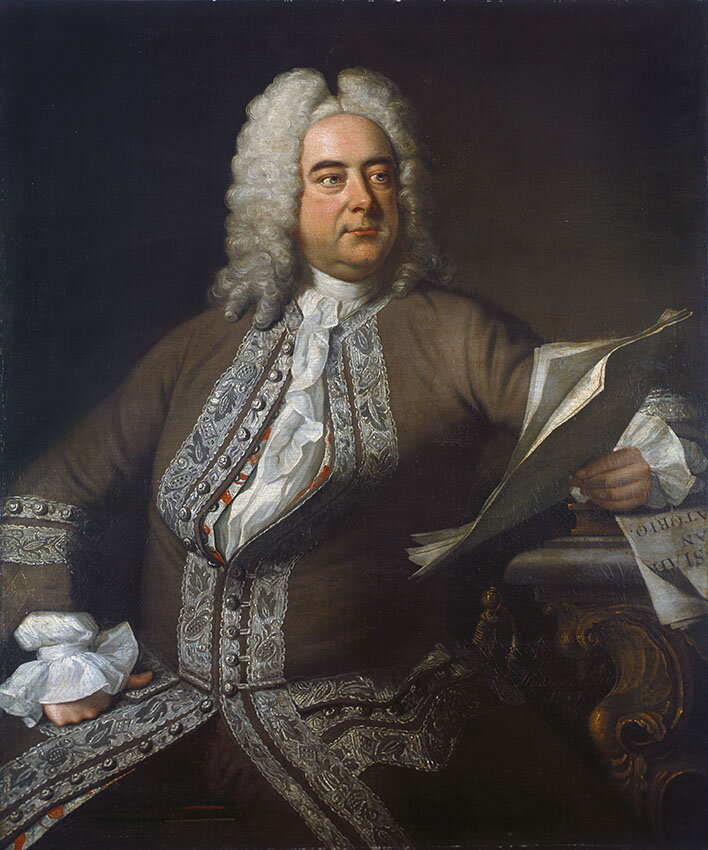
The 1720 Publication
Handel’s first collection of eight major suites appeared in London in 1720. The Henle editorial material identifies the 1720 edition checked by Handel himself as the principal source for its modern scholarly edition.
That fact is particularly useful when dealing with a piece such as the Passacaglia, because many later arrangements have circulated independently of the complete suite. A pianist may easily encounter a score labeled simply Passacaglia by Handel without realizing that it is actually the final movement of HWV 432.
Understanding its place within the suite also helps explain its character. After five contrasting movements, the repeated harmonic foundation of the Passacaille gives Handel an opportunity to close the suite through accumulation. Instead of presenting an entirely new formal argument, he continually reworks the same harmonic structure.
Handel, Bach, and the Common Confusion
Handel did not write Bach’s famous Passacaglia and Fugue in C Minor, BWV 582, and Bach did not write HWV 432.
Bach’s BWV 582 is a different work associated with the organ repertoire and is based on an eight-measure ostinato developed through twenty variations before the fugue. The Netherlands Bach Society identifies it specifically as Bach’s Passacaglia in C minor, BWV 582.
Handel’s piece is shorter in structural units. Its fundamental idea occupies four measures, and the work contains the original theme plus fifteen variations.
Handel and Halvorsen
There is another source of confusion.
Norwegian composer and violinist Johan Halvorsen created the famous Passacaglia after Handel for violin and viola. Henle’s modern scholarly preface explains that the work received its first documented performance in Bergen on January 9, 1894, with Halvorsen playing violin and Karl Johannessen playing viola.
Halvorsen retains Handel’s four-measure fundamental theme, but his piece should not be treated as a literal transcription of the entire Handel movement. Henle explicitly notes that only the statement of the theme and the first three variations can be regarded as relatively straightforward instrumentation of Handel’s original. From that point, Halvorsen increasingly develops independent material.
For a PianoMode score page devoted to Handel, the correct object of study is therefore the original keyboard Passacaille from HWV 432.
3. Musical Structure and Theory
The most useful way to understand Handel’s Passacaglia is to separate two musical levels: the stable harmonic framework and the changing surface figuration.
The harmonic plan repeatedly returns while the rhythmic and melodic treatment changes. This is why a pianist who understands the chords will usually learn the piece more securely than someone who tries to memorize sixty-four measures as an uninterrupted sequence of unrelated notes.
What Is a Passacaglia?
Historically, the terms passacaglia and chaconne have not always been used with absolute consistency. Both became associated with variation procedures built around recurring harmonic or bass patterns. Cambridge defines the passacaglia as a type of composition involving repeated musical material varied over a series of low bass notes.
In Handel’s case, the most precise description is a series of continuous variations over a recurring harmonic cycle.
The four-measure harmonic pattern identified in the scholarly Henle commentary is:
G minor → C minor → F major → B-flat major → E-flat major → A diminished → D major → G minor
The sequence contains eight harmonic events across four measures. Several important relationships become immediately visible.
G minor functions as the tonal center. C minor provides the minor subdominant region. F major leads naturally toward B-flat major, the relative major of G minor. E-flat major continues the progression before the diminished harmony intensifies the return toward D major, the dominant, which in turn resolves back to G minor.
The result is a harmonic circle that continually moves away from and returns to the tonic.
Why the Harmonic Pattern Matters for Pianists
Do not treat the progression merely as a theory exercise. It provides practical information for nearly every stage of learning.
If you know that a passage is still expressing the same G minor to C minor to F major progression, a rapid sequence of semiquavers becomes easier to understand. Instead of seeing sixteen isolated notes, you can recognize them as a decorated version of a harmony you already know.
This also improves recovery during performance. If a memory slip occurs, knowing the position within the harmonic cycle gives you a structural point from which to continue.
Theme and Fifteen Variations
Handel begins with the four-measure theme and follows it with fifteen variations of the same four-measure span. Henle explicitly confirms this structure.
This gives the movement a clear large-scale logic:
Theme + 15 variations = 16 four-measure units
The written structure therefore contains 64 measures in the edition used for this analysis.
The remarkable feature is not the complexity of the underlying architecture. It is its simplicity. Handel deliberately restricts himself to a concise framework and generates variety through texture, register, rhythm, ornamentation, and the redistribution of material between the hands.
4. Section by Section Analysis
Because every variation occupies the same basic structural space, the most useful way to study the piece is by following the transformation of the texture rather than searching for conventional contrasting sections such as exposition, development, and recapitulation.
The Theme
The opening establishes the harmonic identity immediately. The upper texture articulates the progression while the bass establishes its foundation. The characteristic dotted rhythmic profile gives the theme a recognizable shape before the variations begin.
Do not rush this opening. The theme is effectively the listener’s reference model for everything that follows.
A good practice method is to play the theme several times while naming the harmonies mentally:
G minor, C minor, F major, B-flat major, E-flat major, A diminished, D major, G minor.
Once that cycle becomes familiar, later variations become much easier to decode.
Variations 1 to 3: Redistributing the Motion
The first group begins by transferring greater rhythmic activity between the two hands. One hand may preserve the harmonic outline while the other develops flowing movement around it.
These variations are pedagogically important because they establish one of the central principles of the entire piece: the accompaniment is not permanently assigned to one hand.
A pianist must therefore avoid the common habit of automatically treating the right hand as expressive and the left hand as secondary. Both hands will eventually carry moving material.
Practice each hand alone and identify which notes belong to the harmonic skeleton. When the hands are reunited, those structural notes should remain audible beneath the decorative movement.
Variations 4 to 7: Coordination Becomes Central
The next stage introduces increasingly active exchanges between the hands. The score begins to feel less like a melody with accompaniment and more like an integrated keyboard texture.
This is where many pianists begin to lose rhythmic stability. The problem is often not speed itself, but the transition from one figuration to another at the four-measure boundaries.
Practice those boundaries deliberately. Instead of repeatedly starting at the beginning of each variation, begin one beat or one measure before the transition and continue into the next variation.
The goal is to make the formal seam disappear without losing the awareness that a new variation has begun.
Variations 8 to 11: Semiquaver Energy
The central and later portions of the work increasingly use rapid semiquaver figuration. In the surviving score, fast patterns are successively placed above chordal support and then transferred between the hands.
This creates the impression of acceleration even if the basic tempo itself does not change.
That distinction is essential. Handel generates momentum through rhythmic subdivision, not necessarily through an accelerando. If you continually increase the tempo because the notes become smaller, the final variations can become uncontrollable.
Keep the underlying quarter-note pulse stable and allow the denser notation to create the natural increase in energy.
Variations 12 to 14: Increasing Keyboard Brilliance
As the work approaches its conclusion, rapid broken figures and arpeggiated shapes occupy more of the texture. The challenge becomes physical as well as musical.
Avoid playing every semiquaver with isolated finger action. Efficient lateral movement of the hand and forearm is essential when patterns move across changing positions.
The fingers articulate the notes, but the arm should quietly transport the hand to the next position. This prevents unnecessary stretching and helps maintain an even tone.
Harmonic awareness remains crucial. Although the surface appears more elaborate, the same underlying cycle continues to organize the music.
Final Variation: Both Hands and the Closing Resolution
The final variation brings the accumulating technical process to its natural conclusion. Both hands participate in rapid figuration before Handel closes firmly on G minor.
The ending should sound inevitable rather than frantic.
One of the most useful ways to practise it is to remove the ornamental surface temporarily. Play only the principal notes of each harmony, then restore the written subdivisions. This reveals that the apparent virtuosity remains anchored to the same simple structure introduced at the beginning.
5. Technical Challenges
The technical difficulty of the Passacaglia comes less from any single extreme gesture than from the accumulation of several keyboard skills.
Hand Independence
Both hands alternate between structural and decorative roles. A pianist who has developed only right-hand agility may find the left-hand variations unexpectedly demanding.
Practice the left-hand figurations by themselves until their shape feels as natural as the corresponding right-hand material.
Even Semiquavers
The later variations require rapid, controlled semiquavers. Unevenness often comes from using too much vertical finger force.
Keep the hand flexible and group the notes according to their harmonic destination. Thinking in groups is more reliable than trying to control every note individually.
Chord to Figuration Transitions
Some of the most difficult moments occur when a chordal texture suddenly becomes a flowing one, or when the active figuration moves from one hand to the other.
Practise the final beat of one variation together with the first beat of the next. Then expand the fragment gradually.
Ornamentation
The score contains ornaments that should feel integrated into the pulse rather than pasted onto it.
A practical first step is to learn the underlying note without the ornament. Once the rhythm and harmony are secure, add the ornament without allowing it to disturb the beat.
The Henle editorial commentary on Handel’s 1720 keyboard music also notes that performers of Handel’s period were accustomed to adding ornamentation, particularly in repeated passages. That historical context does not mean a modern pianist must add elaborate decorations everywhere. Restraint is usually more effective until the written ornamentation is completely secure.
Balance
On the modern piano, the bass can easily overpower the upper texture. That problem did not arise in exactly the same way on the harpsichord.
Listen vertically as well as horizontally. Every harmony should sound complete, but the texture should not become heavy merely because the instrument is capable of producing greater volume.
6. How to Practice the Piece
The most efficient learning method begins with harmony rather than speed.
Learn the Harmonic Cycle First
Before attempting the full notation, reduce the movement to its basic chords.
Play:
G minor → C minor → F major → B-flat major → E-flat major → A diminished → D major → G minor
Repeat this until the sequence becomes predictable.
You should eventually know where the harmony is going before your fingers arrive there.
Learn in Four-Measure Units
The architecture of the piece gives you an ideal practice system. Each variation occupies four measures.
Use those four-measure units as your primary learning blocks.
This is much more efficient than stopping at random places determined by where mistakes happen. The variation structure gives every practice segment a musical beginning, direction, and conclusion.
Practice Hands Separately Where the Texture Changes
Hands-separate practice is especially valuable when fast activity transfers between the hands.
Do not practise one hand only to memorize its notes. Listen for its harmonic and rhythmic function.
Ask:
Is this hand supplying the harmony?
Is it carrying the moving line?
Is it outlining an arpeggio?
Is it preparing a cadence?
Knowing the answer changes how you play the passage.
Use Rhythmic Variations
For fast semiquaver passages, temporarily change groups of four equal notes into uneven rhythmic patterns.
For example, practise them as long-short-long-short, then short-long-short-long.
Return afterward to equal values.
This method exposes weak finger transitions and prevents the hand from relying exclusively on automatic momentum.
Do Not Chase Speed Too Early
A technically secure Baroque performance depends on rhythmic definition. A faster tempo is not an improvement if it destroys articulation or hides harmonic changes.
Increase tempo only when the four-measure harmonic pattern remains clear and the hand feels physically free.
7. Four Week Practice Method
Four weeks can provide a useful structured learning cycle, but it should not be treated as a promise that every pianist will have the piece performance-ready after exactly one month. The appropriate pace depends on reading ability, technical background, available practice time, and familiarity with Baroque keyboard music.
Week 1: Reading and Fingering
Objective: Understand the score and establish reliable physical patterns.
Begin by learning the harmonic cycle away from the complete texture. Then read the theme and early variations slowly.
Choose fingering according to recurring shapes rather than individual notes. When a figure returns in transposed or modified form, try to preserve a similar physical movement whenever the notation allows it.
Practise the hands separately where necessary.
Listen for: clean note attacks, correct accidentals, and awareness of every harmonic change.
Realistic milestone: the theme and first portion of the variation sequence can be played slowly without losing the underlying progression.
Week 2: Coordination and Structure
Objective: Connect the four-measure variations into a continuous musical sequence.
Work especially on the transition points. Practise the final measure of one variation and the first measure of the next.
Start building longer chains of two or three variations without stopping.
Continue to name the harmonic cycle mentally.
Listen for: stable pulse and equal rhythmic subdivision when the texture becomes busier.
Realistic milestone: the entire piece has been read, and most sections can be played at a controlled practice tempo.
Week 3: Technique and Interpretation
Objective: Improve the semiquaver figurations and shape the long-term progression.
Use slow practice, rhythmic variants, and small bursts for the fastest passages.
At the same time, decide how each variation contributes to the overall architecture. Avoid giving every variation the same dynamic weight and articulation.
Listen for: whether increased note density sounds like musical intensification rather than simple rushing.
Realistic milestone: the piece can be played from beginning to end at a moderate tempo with only occasional technical instability.
Week 4: Performance and Refinement
Objective: Turn a sequence of learned variations into a coherent performance.
Reduce unnecessary physical movement. Record complete run-throughs rather than repeating individual difficult passages indefinitely.
After each recording, identify only the two or three problems that most affect the musical result.
Practise starting from several different variations so that memory does not depend entirely on beginning at the first measure.
Listen for: harmonic direction, clean articulation, controlled climax, and a convincing final arrival in G minor.
Realistic milestone: a musically coherent performance at a tempo appropriate to the pianist’s current technical level.
8. Practice Tips
Think Harmonically, Not Note by Note
The repeated chord structure is your greatest advantage.
When learning rapid broken figures, identify the chord first and the individual notes second. This converts a difficult visual pattern into a familiar keyboard shape.
Keep a Stable Pulse
The increasingly fast notation already creates momentum.
You do not need to manufacture excitement by accelerating.
Practise occasionally with a metronome to confirm that semiquaver passages remain connected to the same underlying beat as the opening.
Use Small Technical Bursts
If a four-measure variation cannot yet be played evenly, do not always repeat all four measures.
Practise one beat, then two beats, then one measure. Gradually reconnect the fragments.
Prepare Hand Positions Early
Many mistakes occur because the hand arrives late at the next keyboard position.
During slow practice, notice where the hand must move before the next pattern starts. The arm should begin repositioning while the preceding figure is finishing.
Memorize the Architecture
Even if you perform from the score, understanding the structure reduces cognitive load.
Know where you are within the sequence of fifteen variations and know which hand carries the active figuration.
9. Common Mistakes
Confusing Handel with Bach
Handel’s Passacaille in G minor, HWV 432, and Bach’s Passacaglia and Fugue in C minor, BWV 582, are completely separate works.
Learning a Halvorsen Arrangement as Though It Were Handel’s Original
Halvorsen’s work is based on Handel, but its later variations depart substantially from Handel’s keyboard score.
Always check the instrumentation and title page of the score you are using.
Accelerating as the Notes Become Faster
Semiquavers create the impression of increasing motion. The underlying beat does not therefore need to become faster.
Overusing the Sustain Pedal
Handel’s collection was published for harpsichord, an instrument without the modern piano’s sustaining pedal.
On a modern piano, discreet pedal can sometimes add resonance or help connect particular sonorities, but continuous pedal risks blurring the harmonic sequence and weakening the articulation.
The fingers should provide the primary legato and clarity.
Playing Every Variation at the Same Dynamic Level
The original harpsichord does not offer the same touch-sensitive dynamic control as the modern piano, but the pianist still needs to shape the large form intelligently.
Use changes in register, texture, articulation, and density as clues when creating contrast.
Treating Fast Passages as Finger Exercises
The rapid figurations are harmonic variations, not detached études.
If the listener can no longer perceive the progression underneath them, technical speed has begun to obscure the composition.
10. Historical and Musical Legacy
The independent popularity of Handel’s Passacaglia is closely connected to its exceptionally strong harmonic foundation. A four-measure idea proved capable not only of sustaining Handel’s original keyboard variations but also of inspiring substantial later reinterpretation.
The most important of these is Johan Halvorsen’s Passacaglia after Handel for violin and viola. Henle’s research documents a first performance in Bergen on January 9, 1894 and explains that Halvorsen ultimately developed twenty variations, moving increasingly away from Handel’s original figurations while preserving the harmonic basis.
That history helps explain why modern listeners sometimes encounter the music in forms that sound much more overtly Romantic and virtuosic than Handel’s harpsichord original.
The keyboard version is valuable precisely because it reveals the source before that transformation. Its virtuosity grows directly from the manipulation of rhythm and texture within an extremely concise harmonic design.
For pianists, that makes the work more than a showpiece. It is a practical lesson in variation technique, harmonic memory, keyboard pattern recognition, hand independence, and the transformation of a simple structure into a large expressive arc.
Conclusion
Handel’s Passacaglia in G Minor, HWV 432 is the final movement of his Suite No. 7 in G Minor, published in the 1720 collection Suites de Pièces pour le Clavecin. It is an original keyboard work by George Frideric Handel, not Johann Sebastian Bach, and it should also be distinguished from Johan Halvorsen’s later virtuoso composition based on Handel’s theme.
The architecture is remarkably economical. A four-measure theme establishes a recurring progression of G minor, C minor, F major, B-flat major, E-flat major, A diminished, D major, and G minor. Handel then develops fifteen four-measure variations over that foundation.
For the pianist, the best learning strategy is therefore structural. Learn the harmonic cycle first, divide the score into its four-measure variations, practise the changing figurations separately, and resist the temptation to accelerate simply because the notation becomes denser.
On a modern piano, clarity is especially important. Use pedal cautiously, maintain a stable pulse, and allow changes in texture and subdivision to create the growing intensity naturally.
Once that underlying design is understood, the piece stops looking like a long chain of increasingly difficult notes. It becomes what Handel constructed: a disciplined and highly inventive exploration of how one short harmonic idea can continually renew itself.
Is the famous Passacaglia by Handel or Bach?
The Passacaglia in G Minor discussed here is by George Frideric Handel. It is the final movement of his Suite No. 7 in G Minor, HWV 432. Johann Sebastian Bach wrote a different and also famous Passacaglia and Fugue in C Minor, BWV 582 for organ.
What is HWV 432?
HWV stands for Händel-Werke-Verzeichnis, the catalogue used to identify Handel’s works. HWV 432 designates his Suite No. 7 in G Minor. The Passacaille is its sixth and final movement.
How many variations are in Handel’s Passacaglia?
Handel’s original contains a four-measure theme followed by 15 four-measure variations. This structure is explicitly confirmed in Henle’s scholarly commentary comparing Handel’s work with Halvorsen’s later Passacaglia.
What chords are used in Handel’s Passacaglia?
The recurring harmonic cycle is:
G minor, C minor, F major, B-flat major, E-flat major, A diminished, D major, G minor.
The progression repeats beneath changing figurations throughout the variation sequence.
Was Handel’s Passacaglia originally written for piano?
Not for the modern piano. HWV 432 belongs to Handel’s Suites de Pièces pour le Clavecin, and the original instrumentation is harpsichord. It is commonly performed on modern piano today.
Is Handel’s Passacaglia the same as Halvorsen’s Passacaglia?
No. Johan Halvorsen used Handel’s four-measure theme as the basis of a later virtuoso work for violin and viola. According to Henle, only the theme and first three variations closely correspond to Handel’s original; Halvorsen increasingly develops independent material afterward.
Should I use the sustain pedal when playing Handel’s Passacaglia?
The work was written for harpsichord, so modern sustain pedal was not part of Handel’s original keyboard conception. On piano, limited and carefully changed pedal can be used as an interpretive choice, but finger articulation and harmonic clarity should remain the priority.
Sources
- G. Henle Verlag, Øyvin Dybsand, 2025. Preface to Johan Halvorsen, Passacaglia after Handel. Particularly valuable for the direct comparison with Handel’s original, the four-measure theme, the exact fifteen-variation structure, and the recurring chord sequence. Henle scholarly preface
- G. Henle Verlag, Anthony Hicks, ed. Keyboard Suites, London 1720, HN 336. Urtext edition of Handel’s first collection of eight suites. Henle Keyboard Suites, London 1720
- Philharmonie de Paris. Work notice for Suite pour clavecin no 7 en sol mineur, HWV 432, based in part on the Händel-Handbuch. Confirms the six-movement structure, G minor tonality, harpsichord instrumentation, and final Passacaille. Philharmonie de Paris work notice
- International Music Score Library Project. Suite in G minor, HWV 432. Catalogue information and historical score sources for the complete suite and Passacaille. IMSLP, Suite in G minor HWV 432
- Netherlands Bach Society. Passacaglia in C minor, BWV 582. Used to distinguish Bach’s separate organ work from Handel’s HWV 432. Netherlands Bach Society, BWV 582