Hand independence is often the “glass ceiling” for intermediate pianists. There is a specific moment in every musician’s journey where the fingers seem to have a mind of their own, refusing to operate as separate entities. This struggle usually occurs when transitioning from melody-and-accompaniment pieces to the complex world of polyphony. Mastering the Bach Two-Part Inventions is the definitive solution to this technical hurdle. In this comprehensive guide, you will learn the historical context of these masterpieces, deep-dive into the technical requirements of the most famous inventions, and acquire specific strategies to achieve the elusive “cantabile” style that Bach himself demanded.
The Two-Part Inventions (BWV 772–786) are a collection of fifteen short keyboard pieces composed by Johann Sebastian Bach. Originally written as exercises for his eldest son, Wilhelm Friedemann Bach, they serve as the ultimate pedagogical tool for developing hand independence, finger dexterity, and musical “invention.” By treating the left and right hands as equal partners in a musical conversation, these works teach pianists how to manage multiple melodic lines simultaneously, a skill known as polyphony.
- Style: Polyphonic Counterpoint.
- Era: Late Baroque (c. 1720–1723).
- Recommended Prerequisites: Achievement of Grade 5 or 6 in standard methods (e.g., Clementi Sonatinas, Anna Magdalena Notebook).
History Behind the Inventions
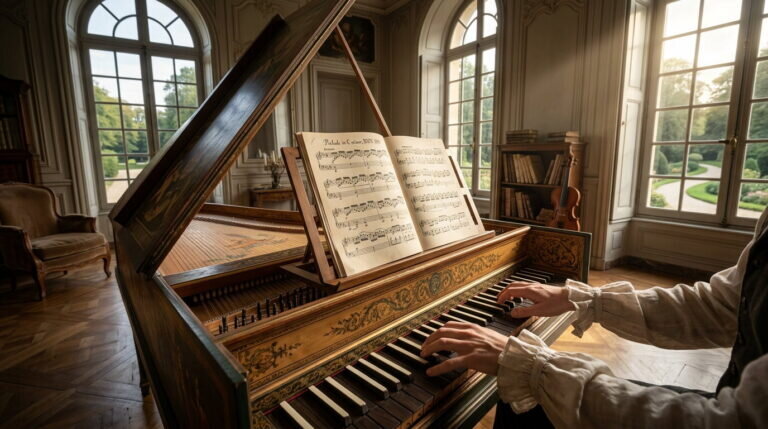
The genesis of the Inventions is inseparable from Bach’s tenure as Kapellmeister in Köthen (1717–1723), a period largely devoid of the liturgical demands he would later face in Leipzig. This secular environment allowed Bach to focus on chamber music and pedagogical materials. The earliest versions appeared in the 1720 Klavierbüchlein für Wilhelm Friedemann Bach, a notebook compiled for his eldest son. The transition from the 1720 “Preambles” to the 1723 fair copy of “Inventions” reveals Bach’s deepening interest in the intersection of musical craft and classical rhetoric.
The Rhetorical Foundation: Inventio and Elocutio
In the 18th century, the study of music was inextricably linked to the study of rhetoric, the art of persuasive speech. The term “Invention” (from the Latin inventio) refers to the first step of creating an oration: the discovery of a topic or a “good idea”. Bach’s pedagogical goal was not just to improve finger dexterity but to show the student how a small kernel of musical information could be “invented” and then logically developed (the dispositio and elocutio) into a complete discourse.
The preface of the 1723 edition, titled Aufrichtige Anleitung (Forthright Instruction), serves as a clear mission statement. Bach states that the collection is intended to show the “lovers of the clavier” a clear way to play cleanly in two voices and, subsequently, three obbligato parts. More importantly, he stresses the acquisition of a “cantabile” style, a singing tone that reflects the expressive capabilities of the human voice.
Tonal Hierarchy and Order
Bach organized the 1723 collection in a systematic tonal order, ascending through the keys used most frequently in the Baroque era. This sequence was designed to familiarize the student with the “affect” (emotional character) and specific fingering challenges inherent in different key centers.
| Invention Number | Key | Character/Technical Focus |
| No. 1 | C Major | Scalic fragments; fundamental imitation |
| No. 2 | C Minor | Strict canon; lyrical depth |
| No. 3 | D Major | Broken triads; rhythmic vitality |
| No. 4 | D Minor | Melancholy; trill integration |
| No. 5 | Eb Major | Grandeur; sophisticated modulation |
| No. 6 | E Major | Syncopation; pastoral thirds |
| No. 7 | E Minor | Intense rhythmic drive |
| No. 8 | F Major | Vivacity; canonic imitation at the octave |
| No. 9 | F Minor | Lyrical, vocal-like expression |
| No. 10 | G Major | Gigue-style energy; binary structure |
| No. 11 | G Minor | Chromatic complexity |
| No. 12 | A Major | Ornate elegance |
| No. 13 | A Minor | Arpeggiated motives; structural clarity |
| No. 14 | Bb Major | Joyful flow; 16th-note focus |
| No. 15 | B Minor | Tense, advanced contrapuntal work |
Music Theory: The Mechanics of the Baroque Language
Before a student can effectively navigate the Inventions, a grounded understanding of the “building blocks” of music theory is essential. Bach assumes the student understands the relationship between intervals, scales, and the fundamental pulse that governs Baroque time.
Pitch, Intervals, and the Heptatonic Scale
The Inventions are built upon heptatonic (seven-note) scales, the major and minor systems that define the Common Practice Period. In Baroque theory, the distance between notes, or intervals, determines the “consonance” or “dissonance” of a passage.
- Diatonic Half Steps: The smallest distance in the Baroque tuning system (e.g., E to F or B to C).
- Perfect Intervals (Unisons, 4ths, 5ths, Octaves): These provide the harmonic stability found at the beginning and end of phrases.
- Major/Minor Intervals (2nds, 3rds, 6ths, 7ths): These provide the “color” or “affect” of the piece.
Bach’s Inventions frequently use the Leading Tone (the 7th scale degree) to create a compelling need for resolution to the Tonic (the home note). In minor keys, Bach often employs the Harmonic Minor scale, raising the 7th degree to create this leading-tone effect, though this often results in an “un-singable” augmented second interval between the 6th and 7th degrees. To rectify this for melodic fluidity, he utilizes the Melodic Minor scale, raising both the 6th and 7th degrees when ascending and reverting to the natural minor when descending.
The Pulse and Meter of the Baroque
Baroque music is characterized by a “motoric” rhythm—a consistent, driving pulse that rarely wavers. The Inventions utilize both Simple Meter (where beats divide into two, as in 4/4 or 2/4) and Compound Meter (where beats divide into three, as in 3/8 or 6/8). Understanding the difference is vital for correct accentuation:
- In 4/4 (Common Time), the strongest pulse is on beat 1, with a secondary strong pulse on beat 3.
- In 3/8 or 6/8, the music takes on a “lilting” or “swaying” feel, moving in groups of three subdivisions per beat.
Technical Analysis of Invention No. 1 in C Major (BWV 772)
As the standard entry point for intermediate pianists, Invention No. 1 is a masterclass in motivic economy. It is constructed from a subject only seven notes long, yet it explores the full breadth of tonal development.
Motivic Breakdown
Analysis of BWV 772 reveals three distinct four-note motifs that comprise the subject:
- Motif A (Scale Fragment): A stepwise ascent (C-D-E-F).
- Motif B (The Leap): An ascending second followed by a third in the opposite direction, ending with a leap.
- Motif C (The Swing): A swaying neighbor-tone motion (C-B-C-D).
Bach introduces these motifs and then immediately subjects them to Imitation. While the right hand plays the subject in the first measure, the left hand rests for one eighth-note before imitating the subject exactly one octave lower. This “staggered” entry is the fundamental mechanism of counterpoint, teaching the ear to follow two independent events simultaneously.
The Development of Motif A: Rhythmic Augmentation
In measures 3 and 4, Bach employs Rhythmic Augmentation in the bass part. The four-note scale fragment (Motif A) is doubled in duration, transforming 16th notes into 8th notes. This serves two purposes: it provides a stable rhythmic floor while the right hand engages in more complex sequences, and it demonstrates how a single idea can change its “weight” within the musical structure.
Harmonic Structure and Modulation
Despite its brevity (22 measures), the piece follows a rigorous harmonic plan:
- Section A (mm. 1–6): Establishing the tonic (C Major).
- Section B (mm. 7–14): Moving toward the dominant (G Major) and eventually the relative minor (A Minor).
- Section C (mm. 15–22): Modulating back through the subdominant (F Major) to a final resolution in C Major.
Technical Analysis of Invention No. 4 in D Minor (BWV 775)
Invention No. 4 provides a stark contrast to the brightness of No. 1. It is characterized by a melancholic affect and serves as the primary study for integrating long ornaments into a melodic line.
The “Sighing” Subject and Harmonic Tension
The subject of No. 4 is built on a D minor harmonic scale. A critical interpretative detail is the displacement of the 7th scale degree (C#). Instead of the B-flat continuing upward to the C#, it is displaced downward, creating a large, “sighing” leap. This unexpected interval creates a sense of pathos and requires the performer to use a flexible wrist to “drop” into the lower note without a harsh accent.
Orchestrating the Long Trill
The most significant technical hurdle in No. 4 is the sustained trill in measures 19–22 and 29–32.
- Measured vs. Unmeasured: While some editions suggest a strict mathematical division (32nd notes), the goal is a fluid, expressive ornament that doesn’t sound mechanical.
- Forearm Rotation: To prevent fatigue and tension, the trill should be executed using a small, rapid rotation of the forearm rather than isolated finger motion.
- Dissonance in the Trill: A common debate involves the trill in measure 29 (E). Theoretical consensus suggests playing it diatonically (E-F natural), even if it creates a brief “cross-relationship” dissonance with the F# in the right hand, as this dissonance heightens the dramatic tension of the passage.
The Hemiola and Rhythmic Drama
Bach utilizes the Hemiola in measures 16–17. By accentuating the second eighth-note of the 3/8 measure, he makes two measures of 3/8 feel like one large measure of 3/4. This “cross-rhythm” interrupts the lilting dance feel, signaling a major structural shift in the piece.
Technical Analysis of Invention No. 8 in F Major (BWV 779)
Invention No. 8 is a study in brilliance, velocity, and canonic imitation. It is often the second invention taught to students because it requires less complex finger independence than No. 1 while demanding high levels of agility.
The Perfect Canon
The first six measures of No. 8 are written as a Canon at the Octave. The left hand follows the right hand exactly, one measure later and one octave lower. This teaches the student “Hand Equality”, the idea that the left hand is a co-equal partner in the conversation, not merely an accompaniment for the right hand.
Managing Velocity and Tempo Drift
Because of its flowing 16th-note character, Invention No. 8 is prone to “tempo run-away”.
- The Backbeat Anchor: Students should focus on feeling the “anchor” of the last 16th note of each group of four. This prevents the fingers from tumbling forward uncontrollably.
- Articulation as a Speed Governor: Playing the 8th-note subject more detached (staccato/portato) against the legato 16th-note sequence provides rhythmic clarity and helps the performer maintain control at higher speeds.
Cadential Resolution
The piece ends with a grand, full-measure resolution. The left-hand octave jump (C to F) in the penultimate measure should be treated with dignity and a strong dynamic presence, concluding the “conversation” with authority.
Technical Analysis of Invention No. 13 in A Minor (BWV 784)
Invention No. 13 is arguably the most “pianistic” of the set, featuring large arpeggiated figures that require an expanded hand position. It is a study in melodic leaps and clear structural phrasing.
The Arpeggiated Theme Phrase
Unlike the scalic (stepwise) motion of No. 1, the subject of No. 13 is an arpeggiated A minor triad. This requires the hand to “open” and “close” rapidly.
- Pivot Points: The performer must identify the thumb as the “pivot” in the descending arpeggios to ensure smooth weight transfer across the keyboard.
- Dramatic Architecture: The piece builds to a high point in measure 19, where the motive is developed through intense sequence, leading to a critical “dominant arrival” in measure 22.
Phrasing and Interpretative Choices
Since Bach provided few phrasing marks, the performer must use structural cues to delineate voices.
- Grouping: Arpeggiated figures often benefit from a slight legato to show their harmonic nature, while the stepwise descending lines can be played more détaché to provide contrast.
- The Ending: Bach often ends his minor-key inventions with a simple, stark tonic note in each hand rather than a full chord. This creates a sense of “finality without clutter,” emphasizing the linear nature of the work.
Pedagogical Strategies for Contemporary Mastery
Approaching the Bach Inventions requires a rejection of the “rote learning” common in later repertoire. Because every voice is a melody, the student must learn the piece “from the inside out.”
The Three-Stage Learning Process
- Hands Separate (HS) – The Soloist Phase: Each hand must be learned as a standalone solo piece. The student should be able to play the left hand alone at tempo with perfect articulation before ever joining it to the right.
- Landmark Identification – The Synchronization Phase: The student should mark “landmark notes” where both hands strike together on the principal beats. This “unifies the body” and ensures that the two independent lines are synchronized to a single internal pulse.
- Extreme Slow Motion – The Integration Phase: When joining hands, the tempo should be reduced by 50% or more. The student should wait for the “fingers to want to go faster” naturally rather than forcing speed with a metronome, which can cause mechanical, robotic playing.
Fingering and Hand Position
Baroque fingering differs significantly from modern practice.
- Paired Fingering: Bach’s circle often used fingers 3 and 4 for scales, avoiding the thumb on black keys due to the narrowness of the keys on harpsichords.
- Modern Adaptation: While modern pianists use the thumb freely, the “rounded hand” position with curled fingers is essential to minimize the distance the fingers must travel, facilitating the rapid “conversation” between voices.
Developing a Cantabile Touch
To achieve the “singing style” Bach requested, the pianist must overcome the percussive nature of the piano hammers. This involves:
- Weight Transfer: Feeling the weight of the arm move from one fingertip to the next without a break in the sound.
- Active Listening: Intently listening to the “decay” of each note to ensure the next note is struck at the same volume level, creating a seamless line.
Advanced Interpretation: Ornaments and Affect
In the Baroque era, ornaments were not “extra” decorations but essential components of the melodic line.
- The Ornament Table: Bach included a specific chart for his son explaining how to realize various symbols (trills, mordents, turns).
- Harmonic Function: Most ornaments should begin on the upper neighbor tone to create a brief dissonance with the bass, which then resolves downward to the principal note.
- Unity of Affect: Each Invention adheres to a single “affect” or emotional state. A piece should not wander between happy and sad but should explore the nuances of a single mood throughout.
Strategic Learning Order for the Full Set
While many students start with No. 1, an alternative pedagogical order can help manage the technical “ramps” of the collection.
- Phase 1 (The Scalic Starters): No. 1 (C Major), No. 4 (D Minor). Focus on smooth 16th-note runs and simple imitation.
- Phase 2 (The Arpeggiated/Canonic): No. 8 (F Major), No. 13 (A Minor), No. 10 (G Major). Focus on hand equality and larger intervals.
- Phase 3 (The Syncopated/Rhythmic): No. 6 (E Major), No. 14 (Bb Major). Focus on complex “cross-rhythms”.
- Phase 4 (The Chromatic/Advanced): No. 11 (G Minor), No. 15 (B Minor), No. 2 (C Minor). These require the highest level of intellectual and physical maturity.
Conclusion and Recommendations
The Two-Part Inventions of Johann Sebastian Bach remain the most significant pedagogical legacy in the keyboard canon. They represent the moment a student stops “playing the piano” and starts “making music”. By forcing the performer to manage two independent melodic conversations simultaneously, Bach builds a foundation of intellectual rigor and physical control that is applicable to every subsequent genre of music, from the Classical sonatas of Mozart to the complex improvisations of modern Jazz.
For the modern student, success lies in Patience and Analysis. Do not merely play the notes; identify the motifs, understand the harmonic “roadmaps,” and strive for the “cantabile” soul that Bach demanded. Mastering these fifteen works is not just a milestone; it is the “sure road to a sound musicianship” and the gatekeeper to the greatest masterpieces of Western music.
How long does it take to learn one Bach Invention?
For an intermediate student, mastering a single invention to performance standard usually takes 4 to 8 weeks of consistent practice. Rushing the process leads to “sloppy” counterpoint and lack of voice clarity.
Can I use the sustain pedal when playing Bach?
In general, avoid it. Bach’s keyboard instruments (harpsichord and clavichord) did not have a sustain pedal. Using the pedal on a modern piano often “muddies” the voices, making it impossible to hear the independent lines.
Why is my left hand so much harder to play than my right?
Bach wrote these pieces to be balanced, but most modern music favors the right hand. The left hand in the Inventions is a “lead voice.” Extra Hands Separate practice for the left hand is usually required to match the dexterity of the right.
Are there any “shortcuts” to hand independence?
No. Hand independence is a result of coordination, not strength. The best way to acquire it is to play a wide variety of contrapuntal pieces slowly and deliberately, allowing the brain to map the two lines independently.
What is the difference between an “Invention” and a “Sinfonia”?
An Invention is written for two voices, while a Sinfonia (also called a Three-Part Invention) adds a third independent voice. Sinfonias are significantly more difficult and should only be attempted after several two-part inventions are mastered.