
As an Amazon Associate, PianoMode earns from qualifying purchases. Recommendations are made on their merits; the price you pay is the same.
I first came across the Circle of Fifths during my early days at the piano, and I’ll be honest: it looked like a confusing ancient wheel or a complex clock from a fantasy novel. I saw letters, sharps, and flats scattered around, and I remember thinking, “Do I really need this to play the piano?” It wasn’t until I sat down to compose my first simple melody that the “mystery wheel” suddenly became a roadmap. As I explored it, I realized it was the DNA of music itself. The Circle is not just a theory concept for academics; it is a practical, everyday tool that helps you understand keys, master chord relationships, and make music flow naturally.
In this guide, I want to share a comprehensive look at the Circle of Fifths explained for piano players, showing you how to turn this theoretical diagram into your most trusted musical ally.
1. What is the Circle of Fifths?
The Circle of Fifths is a visual representation of the 12 tones of the chromatic scale, organized by their relationship through intervals of Perfect Fifths. In music theory, a perfect fifth is an interval that spans seven half-steps (semitones). By arranging keys in this sequence, the circle reveals how many sharps or flats are in a specific key signature and identifies which keys are harmonically “close” to one another. For pianists, it serves as a shortcut for sight reading, transposition, and understanding the logic behind Western harmony.
The Circle of Fifths functions like a musical clock with 12 stops, representing the 12 unique pitches in Western music. Its mathematical elegance dates back to the Greek scholar Pythagoras, who discovered that pitch frequencies are linked to string length.
The Perfect Fifth Interval
The entire system is based on the Perfect Fifth. If you start on Middle C and count up seven half-steps, you land on G. G is the fifth note of the C Major scale. This relationship is constant:
- C to G (7 half-steps)
- G to D (7 half-steps)
- D to A (7 half-steps)
When you continue this pattern 12 times, you eventually return to C, completing the circle. This symmetry is why the circle is the foundation of Western harmony.

2. The Anatomy of the Circle: How It Works
Think of the Circle of Fifths like a clock face with 12 positions, each representing a different key.
The Starting Point: C Major
At the very top (12 o’clock), we find C Major. This is the “home base” because it has zero sharps and zero flats. It’s the only major key that uses only the white keys on your piano.
Moving Clockwise: The Sharp Keys
Every time you move one “hour” clockwise, you are moving up by a Perfect Fifth (7 half-steps). Each step adds exactly one sharp (#) to the key signature:
- 1 o’clock: G Major (1 sharp: F#)
- 2 o’clock: D Major (2 sharps: F#, C#)
- 3 o’clock: A Major (3 sharps: F#, C#, G#)
- 4 o’clock: E Major (4 sharps: F#, C#, G#, D#)
Moving Counter-Clockwise: The Flat Keys
If you move counter-clockwise, you are moving in intervals of Perfect Fourths (5 half-steps). Each step adds exactly one flat (b) to the key signature:
- 11 o’clock: F Major (1 flat: Bb)
- 10 o’clock: Bb Major (2 flats: Bb, Eb)
- 9 o’clock: Eb Major (3 flats: Bb, Eb, Ab)
Enharmonic Equivalents at the Bottom
At the 6 o’clock position, you reach the bottom of the circle where keys overlap. For example, F# Major (6 sharps) and Gb Major (6 flats) sound identical on the piano, they are enharmonic equivalents. They use the same physical keys but are written differently depending on the musical context.
3. Mastering Key Signatures with Mnemonics
The Circle of Fifths is the ultimate memory aid for identifying key signatures. Instead of memorizing every scale, you only need to remember the order in which sharps and flats appear.
The Order of Sharps (Clockwise)
Sharps always enter the key signature in a specific sequence: F – C – G – D – A – E – B.
- Mnemonic: “Fat Cats Go Down Alleys Eating Birds” or “Father Charles Goes Down And Ends Battle.”
The Order of Flats (Counter-Clockwise)
Flats appear in the exact reverse order: B – E – A – D – G – C – F.
- Mnemonic: “Battle Ends And Down Goes Charles’ Father” or simply the word “BEAD” followed by GCF.
| Key | # of Accidentals | Notes Affected |
| G Major | 1 Sharp | F# |
| D Major | 2 Sharps | F#, C# |
| F Major | 1 Flat | Bb |
| Bb Major | 2 Flats | Bb, Eb |
4. The Relationship Between Major and Relative Minor Keys
Every major key has a “Relative Minor” key that shares the exact same key signature. On most Circle diagrams, the major keys are on the outer rim, and the Relative Minors are on the inner rim.
- C Major’s relative minor is A Minor.
- G Major’s relative minor is E Minor.
Pro Tip for Pianists: To find a relative minor on your keyboard, count down three half-steps from the major tonic (e.g., C down to A). This is crucial for polyphony and understanding the emotional shift from a bright major sound to a somber minor one without changing the “alphabet” of notes you are using.
5. The Harmonic Compass: Finding Chord Progressions
The Circle isn’t just for scales; it’s a cheat sheet for harmonic progressions.
- The Tonic (I): Your current key.
- The Subdominant (IV): The key immediately to the left.
- The Dominant (V): The key immediately to the right.
If you are playing in C Major, your primary chords (I-IV-V) are C, F, and G. These three chords form the foundation of thousands of songs, from “Silent Night” to modern pop. By looking at the Circle, you can instantly find these neighbors for any key, allowing you to improvise or arrange songs with confidence.
6. Practical Piano Tips for Internalizing the Circle
- Circle Scale Practice: Instead of playing scales in alphabetical order (C, D, E…), play them in “Circle order” (C, G, D, A…). This trains your ear to hear the “Perfect Fifth” relationship and helps you master the black keys progressively.
- Transposition Practice: Take a simple melody in C Major. Move it two steps clockwise to D Major. The Circle tells you that you now need to “activate” two sharps (F# and C#). This makes moving keys a visual, logical task rather than guesswork.
- Chord Neighbor Exercises: Play a triad for your home key, then jump to the triad of its neighbor to the left, then the right. This helps you visualize harmonic intervals and chord shapes across the keyboard.
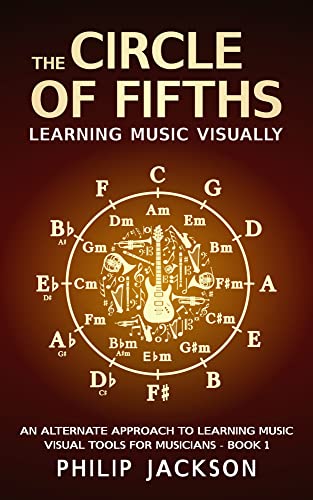
Looking for a physical book to guide your journey? Check out our top-rated recommendations:
 Kindle editionRead on Kindle ›
As an Amazon Associate I earn from qualifying purchases.
 Kindle editionRead on Kindle ›
As an Amazon Associate I earn from qualifying purchases.
 Kindle editionRead on Kindle ›
As an Amazon Associate I earn from qualifying purchases.
Conclusion
The Circle of Fifths is more than a diagram; it is an essential guide for any pianist who wants to move beyond simply reading notes to truly understanding the language of music. It clarifies key signatures, simplifies chord progressions, and provides a logical framework for improvisation and modulation.
To truly master these concepts, I recommend the following:
- Active Practice: Spend 5 minutes of your daily warm-up exploring a new “slice” of the circle.
- Gamify Your Learning: Use tools like our Sight Reading App to practice identifying key signatures in a fun, interactive way.
- Deepen Your Knowledge: For a structured approach, I highly recommend “Music Theory Fundamentals” by Mark Feezell (High-Yield Music Theory) or the classic “Music Theory For Dummies” for a more conversational guide.
By embracing the Circle, you aren’t just learning theory, you’re gaining a superpower that will stay with you for your entire musical journey.
Why is it called the “Circle of Fifths”?
It is named after the interval of a Perfect Fifth (7 half-steps). Starting from C, if you move up a perfect fifth 12 times, you will touch every note in the chromatic scale before returning to C.
How does the Circle help with sight reading?
When you see a key signature (e.g., three sharps), you can use the mnemonic “Fat Cats Go…” to know they are F#, C#, and G#. Knowing that 3 sharps equals A Major helps you immediately identify the “home” note of the piece.
Is the Circle of Fifths only for Major keys?
No! It works exactly the same way for Minor keys. You can think of it as two circles in one—an outer circle for Major and an inner circle for Relative Minors.
Sources
Pilhofer, M., & Day, H. (2007). Music Theory For Dummies. Wiley Publishing, Inc.
Martin, L. (2023). Basic Music Theory for Adult Beginner-Level Piano Players. Lakeside Press.
Feezell, M. (2011). High-Yield Music Theory, Vol. 1: Fundamentals.LearnMusicTheory.net
Schmitz, A. (2012). Music Theory v. 1.0. Lardbucket Creative Commons Project.
Berklee Online. The Circle of Fifths: A Guide for Musicians.