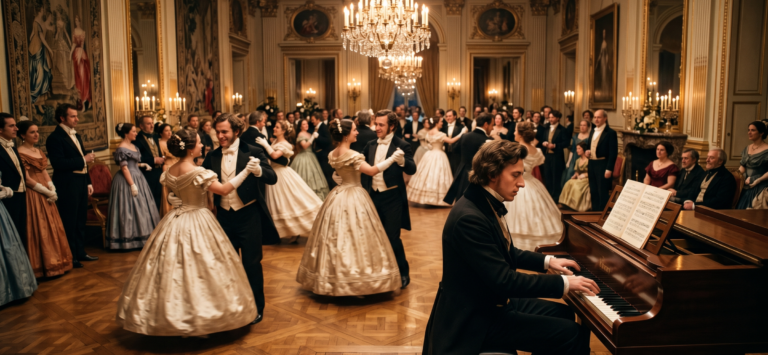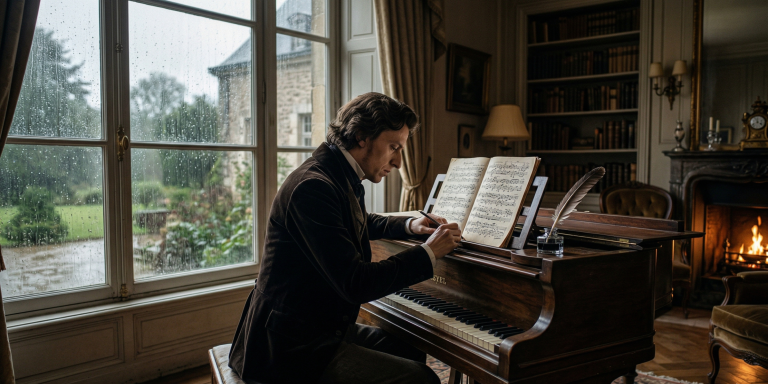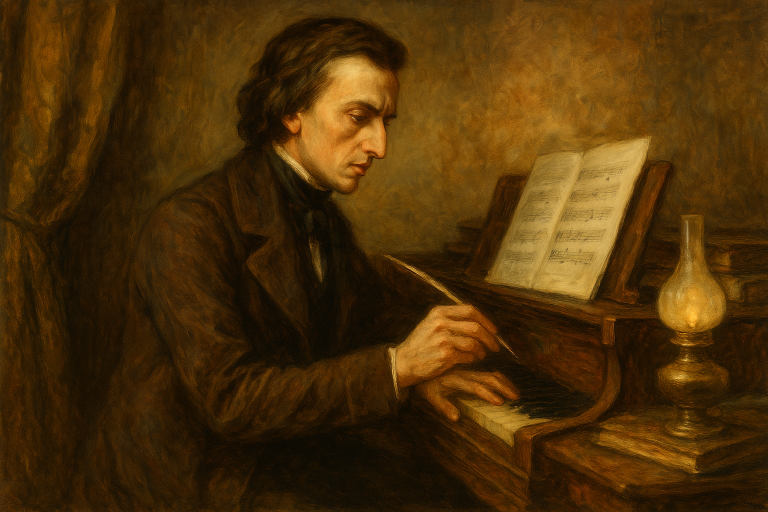

Frédéric Chopin’s Waltz in C-sharp Minor, Op. 64 No. 2 is one of the most recognizable waltzes in the Romantic piano repertoire. Written during the final years of the composer’s life and published in 1847, this elegant work combines a deeply expressive melody, flowing passages of eighth notes, and a contrasting lyrical section in D-flat major.
Unlike a conventional ballroom waltz, Chopin’s composition invites the pianist to explore subtle changes in tone, expressive phrasing, and the relationship between melody and accompaniment. Its distinctive opening theme has a restrained, melancholy character, while the more animated passages introduce a continuous sense of movement. Although the piece is relatively compact, playing it convincingly requires much more than learning the notes. The pianist must control the familiar three-beat waltz rhythm, produce a singing melodic tone, maintain clarity through rapid passages, and use rubato without losing the underlying musical pulse.
This guide explores the history, structure, technical challenges, and interpretation of Chopin’s Waltz in C-sharp Minor, Op. 64 No. 2, helping intermediate and advanced pianists approach the sheet music with greater understanding and confidence.
About the Waltz in C-sharp Minor, Op. 64 No. 2
Composer: Frédéric Chopin (1810–1849)
Composition: 1846–1847
First publication: 1847
Musical period: Romantic
Instrumentation: Solo piano
Key: C-sharp minor, with a contrasting section in D-flat major
Time signature: 3/4
Opening tempo marking: Tempo giusto
Form: A–B–C–B–A–B
Length: 192 measures in the standard score
Recommended playing level: Intermediate to advanced
Henle difficulty rating: 6/9, classified as medium
Approximate performance duration: Around 3–4 minutes, depending on interpretation
Principal technical challenges: Melodic voicing, waltz accompaniment, right-hand passagework, controlled rubato, pedaling, and expressive contrast.
1. The History of the Music and the Composer Behind It
Frédéric (Fryderyk) Chopin and the Romantic Piano
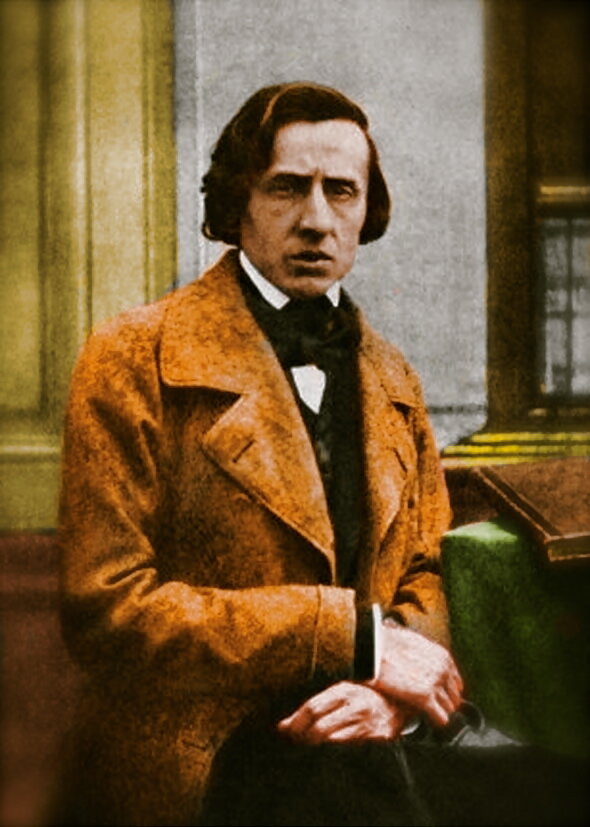
Frédéric Chopin was born in 1810 in Żelazowa Wola, near Warsaw, Poland. Recognized for his musical abilities during childhood, he developed into an important pianist and composer before leaving Poland in 1830. He settled in Paris in 1831, establishing a career closely connected with the city’s musical and aristocratic circles.
Chopin’s reputation rested on both his compositions and his highly distinctive approach to piano performance. Unlike composers who concentrated on orchestral or operatic works, he devoted most of his creative activity to the piano. His compositions include nocturnes, études, mazurkas, polonaises, preludes, ballades, scherzos, and waltzes. Across these genres, he developed a language characterized by chromatic harmony, refined ornamentation, flexible rhythm, and an exceptional sensitivity to piano tone. The waltz occupied a special place in nineteenth-century musical culture. Originally associated with social dancing, it became an increasingly important subject for instrumental composition. Chopin retained the characteristic triple meter of the dance but transformed it into a medium for sophisticated pianistic expression. His waltzes range from brilliant, lively compositions to more restrained and reflective works.
The Waltz in C-sharp Minor, Op. 64 No. 2 belongs to the latter category, although its animated passages provide an important contrast to the opening melody.
The Three Waltzes of Op. 64
Chopin’s Op. 64 consists of three waltzes published in 1847:
- Waltz in D-flat Major, Op. 64 No. 1, marked Molto vivace, commonly known as the Minute Waltz.
- Waltz in C-sharp Minor, Op. 64 No. 2, marked Tempo giusto.
- Waltz in A-flat Major, Op. 64 No. 3, marked Moderato.
The three works offer contrasting approaches to the waltz. The first emphasizes brilliant movement and virtuosity. The second combines intimate lyricism with flowing figuration. The third explores a different balance of melody, rhythm, and harmonic movement.
The C-sharp Minor Waltz was dedicated to Baroness Charlotte de Rothschild, identified in the original dedication as Madame la Baronne Nathaniel de Rothschild. Charlotte de Rothschild was a pupil of Chopin and belonged to the aristocratic Parisian circles in which he taught and performed. The dedication illustrates the relationship between Chopin’s compositions, his teaching activities, and the musical culture of nineteenth-century Paris.
A Composition from Chopin’s Final Years
The Op. 64 waltzes appeared only two years before Chopin’s death in Paris on October 17, 1849. By this stage of his career, Chopin had already written many of the works for which he is best known. His later compositions continued to explore refined pianistic textures and complex expressive relationships within established musical forms.
In Op. 64 No. 2, the musical material is economical. A relatively small number of recognizable ideas provides the foundation for the complete composition. Rather than relying on a long sequence of unrelated melodies, Chopin creates variety through changes in texture, tempo, tonality, and the order in which his themes return. This ability to generate expressive contrast from tightly organized material is an important characteristic of the piece.
2. Understanding the Musical Structure of Chopin’s Waltz
A Six-Part Design Built from Three Musical Ideas
The Waltz in C-sharp Minor is sometimes described as a ternary-form composition with a contrasting middle section. A more detailed examination reveals six consecutive sections built around three principal musical ideas.
The complete sequence is A–B–C–B–A–B.
| Section | Measures | Musical character |
|---|---|---|
| A | 1–32 | Expressive opening theme in C-sharp minor |
| B | 33–64 | Flowing eighth-note figuration |
| C | 65–96 | Più lento, lyrical contrast in D-flat major |
| B | 97–128 | Return of the animated figuration |
| A | 129–160 | Return of the opening melodic theme |
| B | 161–192 | Final appearance of the flowing figuration |
The recurring B section acts as a connecting idea between the more lyrical passages. This is one reason the work can also be understood through a rondo-like interpretation. The repeated sections are not simply unnecessary restatements. Their placement creates relationships between contrasting musical characters, allowing previously heard material to acquire a different expressive significance.
For pianists, understanding this organization makes the piece easier to memorize and provides a practical basis for planning its interpretation.
Section A: Measures 1–32, The Expressive Opening Theme
The composition begins in C-sharp minor with a melodic idea of remarkable simplicity and emotional character. The right hand presents a lyrical theme shaped by expressive intervals, changes of register, and carefully articulated rhythmic figures. Its opening gestures create a sense of hesitation and release.
The left hand establishes the familiar waltz accompaniment, providing the harmonic and rhythmic foundation underneath the melody. An important feature of this opening is the distinction between melodic notes that carry expressive weight and the shorter notes that connect them.
In measures 3–4, for example, the rhythmic relationship between the eighth note and the following sixteenth note deserves particular attention. The editors of the Polish National Edition specifically emphasize the importance of distinguishing their values. The opening theme should not sound like a sequence of equally accented notes. Its character emerges from the hierarchy of the melodic line.
Practice focus: Learn the right-hand melody without accompaniment. Identify the longer notes and the points toward which each phrase moves. Then add the left hand while keeping the melody clearly audible.
Section B: Measures 33–64, The Flowing Waltz Motion
At measure 33, the texture changes noticeably.
The right hand introduces an extended sequence of flowing eighth notes, creating a more animated and continuous musical character. The melody seems to circulate through recurring patterns while the left hand maintains the waltz accompaniment.
This passage is technically different from the opening theme. Instead of concentrating primarily on the projection of a lyrical line, the pianist must now control a longer sequence of moving notes while preserving a light, elegant sound. The six eighth notes within each measure should feel connected to the larger waltz pulse rather than becoming six individually accented beats.
The National Edition draws particular attention to measures 49–64, where the pianissimo marking and long slurs support a light, regular interpretation. This quieter continuation is important. The music should retain its mobility without becoming heavy or excessively brilliant.
Practice focus: Divide the passage into short groups of two or four measures. Practice slowly, looking for repeated melodic shapes and comfortable hand movements. Increase the tempo only when the notes remain even and the hand feels relaxed.
Section C: Measures 65–96, The Più Lento in D-flat Major
The central section introduces one of the composition’s most striking contrasts. At measure 65, Chopin moves to D-flat major and marks the music Più lento, meaning more slowly. The right-hand writing becomes broader and more sustained, encouraging a singing approach to the melody. The longer note values create a feeling of expanded musical space after the continuous eighth-note movement of the preceding section.
The change of key is especially interesting. C-sharp minor and D-flat major share the same sounding tonic because C-sharp and D-flat are enharmonically equivalent notes. However, the major and minor scales contain different pitch relationships.
The effect is therefore more significant than a simple change in notation.
The new tonal setting allows Chopin to explore a different harmonic color while retaining a close connection with the original tonic. Although this passage may sound warmer or more expansive, its character is not necessarily uncomplicated happiness. The melody retains an expressive seriousness that connects it with the surrounding sections. The National Edition also identifies authentic alternatives in this passage, including differences between repeating and sustaining particular melodic notes. These variants help explain why certain editions do not look completely identical.
Practice focus: Play the melody alone and listen to the length of every sustained note. Allow the phrases to develop naturally without exaggerating the slower tempo. When adding the accompaniment, prioritize a clear singing line.
Section B: Measures 97–128, The Return of Motion
After the lyrical middle section, the flowing eighth-note material returns. The contrast is immediately recognizable. The more sustained melody gives way to the continuous movement of the earlier B section.
The transition requires careful tempo control.
The score indicates a return toward the more animated character through Più mosso. This should not be interpreted as an invitation to accelerate without restraint. The essential goal is to restore the original sense of motion while preserving the relationship between the various tempi of the composition. Because the right-hand patterns have already appeared, this passage offers an opportunity to reinforce familiar material rather than learning a completely new technical texture.
Practice focus: Practice the last four measures of the Più lento section together with the first four measures of the returning B section. Concentrate on making the transition sound intentional and fluid.
Section A: Measures 129–160, The Return of the Opening Melody
The original lyrical material returns in C-sharp minor. From a structural perspective, this is an important moment because the listener recognizes the opening theme after hearing the contrasting D-flat major section.
The main technical responsibilities remain similar to those of measures 1–32. The right hand must sing above the accompaniment. The inner notes should remain subordinate to the melodic line, and the left hand must preserve its rhythmic foundation.
However, the pianist does not need to reproduce every expressive decision identically. Small adjustments in dynamic shape, tone, and phrase direction can make the return meaningful without introducing arbitrary changes to the written music.
Practice focus: Compare the opening passage with its return, paying close attention to the notation. Use the same basic fingering where the musical material is identical, but allow the broader structure to influence the way each phrase is shaped.
Section B: Measures 161–192, The Final Return
The waltz ends with a final presentation of its animated B material.
This is an important correction to the common assumption that the piece concludes with a substantial, separate coda. Instead, Chopin brings the work to its conclusion through the recurring figuration already established earlier.
The final passage requires controlled movement, clear articulation, and a consistent underlying waltz pulse. Its familiarity can make it tempting to accelerate excessively. However, technical control and musical coherence are more important than speed. The pianist should maintain the light character of the passage and allow the written ending to complete the composition naturally.
Practice focus: Start by practicing the final eight measures independently. Then extend the passage backward until the complete final B section can be performed confidently without unnecessary tension.
3. Playing Tips: How to Master Chopin’s Waltz in C-sharp Minor
Establish the Three-Beat Waltz Rhythm
The left hand provides the rhythmic foundation of the entire composition.
In much of the piece, the accompaniment follows a recognizable pattern:
Beat 1: A bass note establishes the harmony.
Beat 2: A chord supplies harmonic support.
Beat 3: Another chord completes the measure.
The bass note should be sufficiently clear to establish the pulse, but it does not need to be played heavily. The chords on beats two and three should generally remain lighter. A common mistake is to accent every beat equally, producing an accompaniment that sounds mechanical.
Another is to make the first beat excessively strong, disturbing the elegant character of the music. Practice the left hand alone, listening to the complete three-beat gesture rather than treating each note as an isolated event. The objective is to create a stable dance rhythm that supports the melody without competing with it.
Develop a Singing Right-Hand Melody
Chopin’s lyrical writing requires careful control of melodic tone. The right hand should not merely reproduce the correct notes. It must communicate the shape and direction of each phrase.
Begin by identifying the principal melodic line, particularly when additional notes occur beneath it.
Practice this melody separately whenever possible.
Listen for the notes that create tension, those that provide resolution, and the points where the phrase naturally reaches its highest intensity. When the full texture is restored, keep the accompaniment quieter than the melody.
Avoid forcing the sound through excessive finger pressure. Instead, seek a coordinated movement of the fingers, hand, wrist, and arm that allows a clear tone without unnecessary tension. This type of melodic control is especially important in the opening theme and the Più lento section.
Master the Continuous Eighth-Note Passages
The running passages of the B section are among the most recognizable features of Op. 64 No. 2. Their challenge is not simply speed. The notes must sound even, connected, and musically directed.
At a slow practice tempo, identify the groups of notes that form each recurring pattern.
Pay attention to fingering changes, shifts in hand position, and moments where tension begins to accumulate.
Avoid unnecessary finger lifting. Let the hand and forearm assist with movement across the keyboard while the fingers remain precise. Once the notes are reliable, try practicing with a gentle emphasis on the beginning of each larger musical group. Remove this artificial accent during the final performance.
The goal is to make the passage sound flowing and effortless rather than aggressively articulated.
Use Rubato Without Losing the Waltz Pulse
Rubato is an essential aspect of Chopin’s expressive language, but it is frequently misunderstood. It does not simply mean slowing down wherever the melody becomes emotional. Accounts of Chopin’s teaching describe an approach in which the accompaniment can maintain a stable pulse while the melody moves with greater rhythmic freedom. This relationship is particularly relevant to a waltz because the accompaniment provides a recognizable rhythmic framework.
A useful practice method is to play the left hand at a consistent tempo while allowing limited flexibility in the right-hand melody. The right hand may slightly delay or anticipate certain expressive notes, provided that the overall phrase remains coherent. However, this is not the only legitimate type of rubato in Chopin. Broader fluctuations in tempo may also be appropriate when they arise naturally from the musical structure. In Op. 64 No. 2, restraint is especially valuable. Excessive slowing at every phrase ending can interrupt the continuity of the dance.
Control the Contrast Between Tempo Giusto, Più Lento, and Più Mosso
The piece contains several important tempo indications that shape the overall interpretation of the waltz. The composition begins with Tempo giusto at measure 1, establishing the principal waltz character. At measure 33, Chopin’s flowing eighth-note material is marked Più mosso, indicating a more animated movement.
The contrasting middle section begins at measure 65 with Più lento, introducing a broader, more lyrical character in D-flat major. At measure 97, Più mosso marks the return of the faster material.
At measure 129, Tempo I restores the opening tempo and melodic character. Finally, the indication Più mosso appears again at measure 161, introducing the concluding section. These markings describe relationships between tempi rather than prescribing exact metronome values. Pianists should maintain a coherent underlying pulse while allowing each section to develop its distinctive musical character.
For practice, approximately 132 BPM, measured in quarter notes, can serve as an initial reference for the opening section. However, this is a suggested practice tempo, not an original metronome marking printed in the score.
Learn to Pedal with Harmonic Clarity
The sustain pedal can enrich the sonority of Chopin’s piano writing, but excessive pedaling quickly reduces clarity. This is particularly noticeable in the faster eighth-note passages and in sections with changing harmonies.
Begin by practicing short passages without pedal. Make sure that the melodic connection and rhythmic coordination are convincing before using the pedal to enhance the sound. Once the passage is secure, introduce light pedaling according to the harmony, articulation, and acoustic response of the instrument.
The pedal should not automatically remain depressed for an entire measure simply because the music is written in 3/4. Listen carefully whenever the harmony changes. A modern concert grand, an upright piano, and a digital piano may respond differently. Pedaling therefore requires adjustment to the instrument and the room.
In the Più lento section, a slightly more sustained sound may help support the singing melody, but harmonic clarity should remain the priority.
Respect the Dynamic Details
Chopin’s dynamic markings contribute significantly to the expressive character of the waltz. A particularly useful example occurs in the first B section. Measures 49–64 contain a pianissimo indication that encourages a notably delicate sound. Playing the entire animated passage at the same dynamic level would reduce the contrast written into the music. Instead, distinguish the more active musical gestures from their quieter continuations.
The same principle applies to the lyrical sections. The music should contain natural changes of intensity, but not every expressive phrase requires a large crescendo. A refined performance often depends on relatively small differences in tone and dynamic shading.
4. Common Mistakes When Learning This Waltz
Playing the Opening Too Slowly
The opening melody is expressive, but the composition remains a waltz. An excessively slow tempo can make the accompaniment feel disconnected and prevent the phrases from developing naturally.
Choose a tempo that allows the melody to breathe while retaining a recognizable three-beat pulse.
Treating the Fast Passages as a Speed Exercise
The continuous eighth notes can encourage unnecessary acceleration. When speed becomes the principal objective, the passage often loses clarity and elegance.
Return to a slower tempo, check the fingering, and practice the motion as a series of coordinated musical patterns.
Overusing the Sustain Pedal
Excessive pedaling can blur the accompaniment and obscure harmonic changes. Practice without pedal periodically to check that the articulation remains clear.
Reintroduce pedaling only where it contributes positively to the sound.
Making the Più Lento Section Too Sentimental
The middle section is lyrical and expressive, but exaggerated slowing and heavy phrasing can interrupt the composition’s balance.
Aim for a broad, singing tone with carefully controlled movement.
Neglecting the Repeated Sections
Because the B material appears three times, pianists sometimes give less attention to its later returns. Repetition does not eliminate technical difficulty.
Practice every transition into the B section and verify that the tempo, articulation, and dynamic character remain consistent with the overall interpretation.
5. A Practical Four-Stage Practice Plan
The time required to learn Op. 64 No. 2 depends on the pianist’s experience, technical preparation, and daily practice routine. The following progression is a flexible learning method rather than a fixed promise of mastery.
Stage 1: Learn the Musical Themes
Begin with the opening A section, measures 1–32.
Practice both hands separately, concentrating on accurate rhythm, fingering, and melody. Continue with the first B section, measures 33–64, identifying recurring eighth-note patterns.
Finally, learn the C section, measures 65–96. At the end of this stage, aim to recognize and play all three principal musical ideas at a comfortable practice tempo.
Stage 2: Develop Technical Security
Work on the sections that require the greatest coordination.
For the B passages, concentrate on even note production and relaxed hand movement.
For the A and C sections, prioritize melodic projection and the balance between the two hands.
Practice difficult transitions in short groups rather than repeatedly performing the entire work. Use a metronome when it helps establish rhythmic accuracy, but do not rely on it as the final model for expressive phrasing.
Stage 3: Connect the Complete Structure
Once the three themes are secure, assemble the full sequence:
A–B–C–B–A–B
Because the music returns to previously heard material, this stage can become more manageable when repeated sections have been learned carefully.
Practice each transition independently.
Pay particular attention to the change from the Più lento section back into the moving eighth-note figuration. At this point, focus on continuity and accuracy rather than performing at maximum speed.
Stage 4: Refine the Musical Interpretation
Begin shaping the overall dynamic design.
Listen to the relationship between the opening melody, the flowing B sections, and the contrasting middle passage.
Refine the pedal, melodic voicing, and rubato.
Record a complete performance and listen critically. Can the melody be heard clearly? Does the left hand maintain the waltz rhythm? Are the eighth notes even? Does the Più lento section provide a convincing contrast?
Once these elements are secure, perform the full composition without stopping, treating small mistakes as part of the process of developing performance confidence.
6. What Makes This Waltz Technically Challenging?
The Waltz in C-sharp Minor presents several kinds of difficulty within a relatively short composition.
Its first challenge is coordination. The left hand must maintain the dance accompaniment while the right hand performs melodic figures with a different rhythmic character.
The second is technical fluency. The repeated eighth-note passages need controlled fingering and efficient hand movements.
The third is voicing. In the lyrical sections, the principal melody must remain audible above the harmonic support.
The fourth is musical judgment. Tempo changes, dynamic contrasts, and rubato must contribute to the structure rather than distract from it.
The piece is therefore especially valuable for pianists moving from the accurate reproduction of notes toward a more sophisticated understanding of Romantic interpretation. The publisher G. Henle assigns it difficulty level 6 out of 9, within its medium category. This makes it a reasonable study for an experienced intermediate pianist, although a fully polished performance can still present considerable challenges.
7. Why Learn Chopin’s Waltz in C-sharp Minor?
Chopin’s Waltz Op. 64 No. 2 offers a valuable combination of musical expression and technical development.
Its lyrical passages encourage a singing tone and an understanding of phrase direction. Its waltz accompaniment develops rhythmic coordination and control of musical balance. The faster passages improve fluency and require efficient movement across the keyboard. Its recurring themes also provide a useful introduction to formal analysis, demonstrating how a composer can create a complete piece by reorganizing and contrasting a small number of musical ideas.
Most importantly, the waltz teaches the pianist to connect technique with expression. A technically correct performance is only the beginning. The interpretation becomes convincing when rhythm, phrasing, tone, and harmonic awareness work together.
Conclusion
The goal of learning Chopin’s Waltz in C-sharp Minor, Op. 64 No. 2 is not simply to reach a particular speed. It is to develop an interpretation in which the opening melody sings naturally, the left-hand accompaniment retains its dance character, and the flowing passages sound effortless.
Work progressively through the three principal themes before connecting them into the complete structure.
Pay attention to the written dynamics, listen carefully to the contrast between the minor and major sections, and allow expressive freedom to develop from a secure rhythmic foundation.
Your final objective is to perform the entire waltz with clear articulation, controlled rubato, balanced voices, and a coherent sense of musical direction. With patient practice and careful listening, this celebrated composition becomes much more than a technical challenge. It provides an opportunity to explore the refined pianistic language that makes Chopin’s music so distinctive.
Is Chopin’s Waltz in C-sharp Minor difficult to play?
It is generally suitable for intermediate to advanced pianists. Henle rates the work 6/9, within its medium difficulty category. The greatest challenges include right-hand fluency, melodic voicing, coordination, and expressive tempo control.
Is the Waltz in C-sharp Minor suitable for beginners?
The complete original composition is not an ideal first piece for beginners. Pianists should already be comfortable reading both clefs, playing in 3/4 time, coordinating different rhythms between the hands, and performing moderately fast passages. A simplified arrangement may be more appropriate for an early-stage learner, but it should be clearly identified as an arrangement rather than Chopin’s original score.
What key is Chopin’s Waltz Op. 64 No. 2 in?
The principal key is C-sharp minor. Its contrasting Più lento section is written in D-flat major, the enharmonic equivalent of C-sharp major.
What does Tempo giusto mean in Chopin’s Waltz?
Tempo giusto means an appropriate or correct tempo. In this composition, it establishes a suitable waltz movement without requiring one universally fixed metronome speed. The Polish National Edition emphasizes flexibility in the relationship between the different sections.
What is the time signature of the Waltz in C-sharp Minor?
The piece is written in 3/4 time, with three quarter-note beats per measure. Much of the left-hand accompaniment follows the characteristic waltz pattern of one bass note followed by two chords.
How many measures does Chopin’s Waltz in C-sharp Minor have?
The standard complete score contains 192 measures. Its six main sections each occupy 32 measures, producing the sequence A–B–C–B–A–B.
Is this Waltz harder than the Minute Waltz?
Not necessarily. Both pieces present different technical and interpretive challenges. The Minute Waltz, Op. 64 No. 1, places particular emphasis on agile, brilliant movement. Op. 64 No. 2 requires a combination of sustained melodic expression, flowing passagework, and sensitive tempo relationships.
The more difficult piece will depend on the pianist’s individual strengths.
How long does it take to learn Chopin’s Waltz Op. 64 No. 2?
There is no universal learning time. A pianist already familiar with Chopin’s style may learn the notes relatively quickly, while developing a refined performance can require substantially more work.
Consistent short practice sessions focused on specific difficulties are usually more effective than repeatedly playing the entire piece from beginning to end.
Which edition of the Waltz should I use?
A scholarly Urtext edition from Henle or the Polish National Edition is a useful choice for detailed study. Historical editions available through IMSLP can also be consulted, particularly when comparing editorial variants. Check the specific edition and its legal status before redistributing a PDF.
Is Chopin’s Waltz in C-sharp Minor copyright-free?
The original composition is in the public domain. However, the rights associated with a particular modern edition, arrangement, PDF, or recording must be assessed separately.
Sources
Mieczysław Tomaszewski, The Fryderyk Chopin Institute, “Waltz in C sharp minor,” commentary published through the International Chopin Competition website. Historical background, dedication, thematic structure, and interpretation. Chopin Competition.
Jan Ekier and Paweł Kamiński, Polish National Edition, Waltzes: Performance Commentary and Source Commentary, particularly pages 3, 10, and 11. Authoritative editorial discussion of the form, rhythmic notation, tempo relationships, and authentic variants of Op. 64 No. 2. National Edition PDF.
Matthew Riley (August 8, 2026), “Chopin’s Craft of Musical Form: Making Romantic Music with Classical Theme Types and Galant Schemata,” Music Analysis. Scholarly analysis of Chopin’s thematic organization and phrase structures, including Op. 64 No. 2. DOI: 10.1111/musa.70019.
G. Henle Verlag, Waltz C-sharp Minor, Op. 64 No. 2, Urtext edition HN 654. Editorial information, historical context, and difficulty classification. Henle.
International Music Score Library Project (IMSLP), Waltzes, Op. 64 (Chopin, Frédéric). Historical first editions, publication information, scores, and copyright notices. IMSLP.
The Fryderyk Chopin Institute, “Fryderyk Chopin,” biographical reference covering his life, musical education, and career. Chopin Institute.