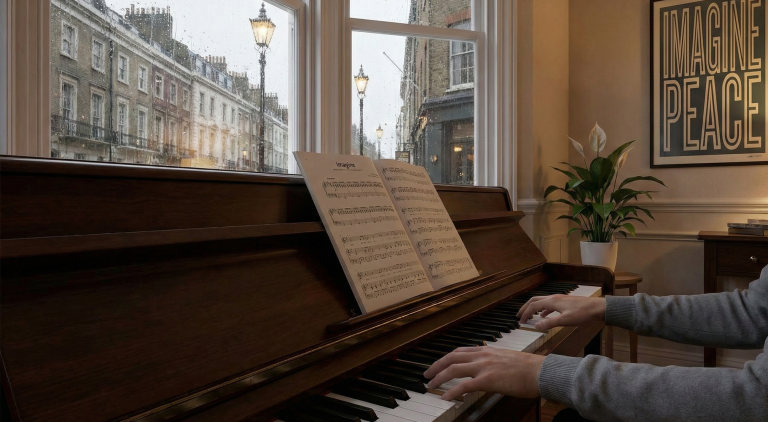
The transition from classical or pop piano into the world of jazz can feel like stepping into a new dimension where the rules of gravity have shifted. In this dim-lit realm, syncopation replaces steady beats, and the “right” notes are often found in the spaces between the keys. For many students, the initial hurdle is not a lack of technique, but a lack of a clear entry point. This guide explores the foundational repertoire known as jazz standards, compositions that serve as the common language for musicians globally, and identifies the most accessible pieces to begin this musical journey.
In this exploration, readers will learn:
- The fundamental definition and structure of a jazz standard.
- The essential theoretical building blocks, from seventh chords to the ii-V-I progression.
- A curated list of eight beginner-friendly standards with detailed analysis.
- Proven strategies for moving from reading a lead sheet to fluent improvisation.
The most effective beginner-friendly jazz standards to learn include “Autumn Leaves,” “Blue Monk,” “C Jam Blues,” and “Satin Doll.” These pieces are ideal because they utilize foundational harmonic structures like the 12-bar blues and the ii-V-I progression, featuring repetitive melodies that are easy to internalize. By starting with these standards, aspiring pianists can focus on developing a “swing” feel and basic improvisation skills without being overwhelmed by rapid chord changes or complex non-diatonic harmonies.
Play this exercise
A beginner-friendly jazz standard is a composition from the Great American Songbook or jazz canon characterized by a predictable form (such as the 32-bar AABA or the 12-bar blues), repetitive melodic motifs, and a reliance on fundamental harmonic units like the ii-V-I progression. These tunes are selected because they offer ample space for improvisation while remaining grounded in functional harmony that is easy to analyze and internalize.
1. Understanding the Jazz Standard and the Lead Sheet
A jazz standard is a musical composition that is widely known, performed, and recorded by jazz musicians as part of the core repertoire of the genre. Many of these tunes originated as popular songs from Broadway musicals or Hollywood films between the 1920s and 1950s, a period often referred to as the Great American Songbook.
The Role of the Lead Sheet
In jazz, musicians rarely read from fully notated scores. Instead, they use a lead sheet. A lead sheet provides the bare essentials of a song: the melody (often called the “head”) and the chord symbols. Unlike classical sheet music, which dictates every note the left and right hands must play, a lead sheet acts as a roadmap. The performer is responsible for:
- Comping: Creating rhythmic accompaniment using the provided chord symbols.
- Improvising: Developing new melodic lines over the existing harmonic structure.
- Interpretation: Deciding on the tempo, dynamics, and overall “feel” (such as swing or bossa nova).
The “Real Book” Tradition
Aspiring jazz players will inevitably encounter “The Real Book.” Originally an underground collection of lead sheets transcribed by students at the Berklee College of Music, it has since become the industry standard. Owning a Real Book provides access to hundreds of standards, allowing a beginner to participate in jam sessions where these tunes are the primary currency.
2. Theoretical Foundations: The Architecture of Jazz Harmony
To successfully navigate jazz standards, the musician must first possess a robust understanding of foundational music theory. This includes the mechanical and physical properties of sound, the construction of scales, and the intervallic relationships that define jazz tonality.
The Physics and Notation of Pitch
Pitch is defined as the relative highness or lowness of a sound, a sensation determined by the frequency of vibrations generated by an instrument or voice. In the Western tradition, the piano keyboard serves as the primary visual tool for organizing these pitches. The keyboard is organized into octaves, representing thirteen keys (including eight white and five black keys) spanning from one letter name to the next.
Each note corresponds to a specific frequency measured in Hertz (Hz). For example, Middle C (C4) vibrates at approximately 261.6 times per second, while the A above it (A4) is tuned to 440 Hz. The conceptual distance between these notes is measured in half steps and whole steps.
| Note Name | Frequency (Hz) | Distance from Previous White Key |
| C (Middle C) | 261.6 | Tonic / Starting Point |
| C# / Db | 277.2 | Half Step |
| D | 293.7 | Whole Step |
| D# / Eb | 311.1 | Half Step |
| E | 329.6 | Whole Step |
| F | 349.2 | Half Step (Natural Half Step) |
| F# / Gb | 370.0 | Half Step |
| G | 392.0 | Whole Step |
| G# / Ab | 415.3 | Half Step |
| A | 440.0 | Whole Step |
| A# / Bb | 466.2 | Half Step |
| B | 493.9 | Whole Step |
| C (Octave Up) | 523.3 | Half Step (Natural Half Step) |
A whole step is composed of two half steps. On the piano, most adjacent white keys are a whole step apart, with the critical exceptions of E to F and B to C, which represent natural half steps because there is no intervening black key. Understanding these micro-distances is the prerequisite for building the major and minor scales that dictate the “feel” of every jazz standard.
Intervals: The Building Blocks of Melody and Harmony
An interval is the specific distance in pitch between two notes, serving as the fundamental measurement of musical space. In jazz, intervals are classified as either melodic (played separately in sequence) or harmonic (played simultaneously). The identity of an interval consists of two components: quantity and quality.
Quantity is determined by the number of lines and spaces an interval occupies on the musical staff. Quality refers to the specific “color” of the interval—Major, Minor, Perfect, Augmented, or Diminished, which is determined by the exact number of half steps contained within it.
| Interval Name | Quantity | Half Steps | Quality Type |
| Perfect Unison | 1st | 0 | Perfect |
| Minor Second | 2nd | 1 | Minor |
| Major Second | 2nd | 2 | Major |
| Minor Third | 3rd | 3 | Minor |
| Major Third | 3rd | 4 | Major |
| Perfect Fourth | 4th | 5 | Perfect |
| Tritone (Aug. 4/Dim. 5) | 4th/5th | 6 | Augmented/Diminished |
| Perfect Fifth | 5th | 7 | Perfect |
| Minor Sixth | 6th | 8 | Minor |
| Major Sixth | 6th | 9 | Major |
| Minor Seventh | 7th | 10 | Minor |
| Major Seventh | 7th | 11 | Major |
| Perfect Octave | 8th | 12 | Perfect |
Intervallic reading is the practice of recognizing these distances by sight on a score rather than identifying individual note names. This skill is essential for sight reading (lecture à vue) in jazz, as it allows the musician to perceive the “contour” of a melody and the structure of complex chords instantly. Furthermore, consonant intervals (such as Perfect 5ths) provide a sense of stability, while dissonant intervals (such as the Tritone) create the tension necessary for the sophisticated resolutions characteristic of the genre.
Scale Construction and Tonal Centers
Scales are sequential collections of five or more pitches arranged in patterns of whole and half steps. The Major Scale, which follows the pattern W-W-H-W-W-W-H, serves as the primary reference point for most Western harmony. Each degree of the scale is assigned a functional label that indicates its harmonic weight:
- Tonic (I): The home note; represents total stability and resolution.
- Supertonic (ii): The second degree; often the starting point for a ii-V-I progression.
- Mediant (iii): Determines the primary tonality of the scale.
- Subdominant (IV): A major point of departure from the tonic.
- Dominant (V): The fifth degree; creates the highest tension that compels movement toward the tonic.
- Submediant (vi): Often used to transition toward the relative minor.
- Leading Tone (vii): A half step below the tonic that demands immediate resolution.
Minor scales are more varied, appearing in Natural, Harmonic, and Melodic forms. In jazz standards, the Harmonic Minor is frequently used for chordal structures because it raises the seventh degree to create a Leading Tone, ensuring a strong V-i resolution in a minor key. Parallel scales are those that share the same starting note (e.g., C major and C minor), while relative scales share the same pitch content but have different starting points (e.g., C major and A minor).
3. Essential Theoretical Foundations for Jazz Piano
Before diving into specific tunes, it is vital to understand the “High-Yield” theory that underpins the jazz sound. Jazz is built upon the same fundamentals as classical music—pitch, duration, and timbre, but organizes them differently.
The Power of Seventh Chords
While pop and folk music rely heavily on three-note triads (root, third, and fifth), jazz is defined by seventh chords. A seventh chord adds a fourth note, the seventh interval, to the triad, creating a richer, more complex harmonic texture. The primary types of seventh chords used in beginner standards are:
- Major 7th (maj7): Root, major 3rd, perfect 5th, major 7th.
- Minor 7th (m7): Root, minor 3rd, perfect 5th, minor 7th.
- Dominant 7th (7): Root, major 3rd, perfect 5th, minor 7th.
Understanding these intervals is crucial, as the distance from the root determines the chord’s “flavor”.
The ii-V-I Progression: The Heart of Jazz
The most common chord progression in jazz is the ii-V-I. In the key of C Major, this would be:
- ii: D minor 7 (Dm7)
- V: G dominant 7 (G7)
- I: C major 7 (Cmaj7)
This progression creates a satisfying sense of tension and release. The “ii” chord sets the scene, the “V” chord provides maximum tension (due to the tritone interval between its 3rd and 7th), and the “I” chord offers resolution.
Rhythm and the “Swing” Feel
Jazz rhythm differs from the straight, even pulses found in much classical or rock music. The “swing” feel is created by treating pairs of eighth notes as a triplet-based rhythm, where the first note is slightly longer than the second. This creates the “long-short” lilt characteristic of the genre.
4. Top 9 Beginner-Friendly Jazz Standards
1. Autumn Leaves
“Autumn Leaves” is widely regarded as the most important standard for any jazz beginner. Originally a French composition, it was adapted into the jazz repertoire and typically follows a 32-bar AABA or AABC structure. The brilliance of this standard lies in its systematic use of the “diatonic cycle”, it moves through a major ii-V-I progression and its relative minor ii-V-i progression in the same section.
In the common concert key of G minor, the A section begins with a major ii-V-I in Bb major:
- C minor 7: The supertonic chord.
- F 7: The dominant chord.
- Bb Major 7: The resolution.
- Eb Major 7: A subdominant extension that provides motion into the next cycle.
It then transitions into a minor ii-V-i in G minor:
- A half-diminished 7: The supertonic in minor.
- D 7(b9): The altered dominant borrowed from the harmonic minor.
- G minor 6: The tonic resolution.
Mastering “Autumn Leaves” allows the student to internalize the “Charleston rhythm”, a dotted quarter note followed by an eighth note, which is a ubiquitous rhythmic figure in jazz accompaniment. Furthermore, it teaches the “1-7-3” voice leading pattern, where the 7th of one chord resolves by a half step into the 3rd of the next
- Harmonic Structure: The song moves through a series of “ii-V-I” progressions in both a major key (G Major) and its relative minor (E minor).
- Why it’s for beginners: The melody is composed almost entirely of scale-wise motion and simple leaps, making it easy to memorize.
- Learning Focus: Use this tune to practice connecting chords smoothly. Focus on the “voice leading”, moving as little as possible between chord positions.+1
2. Blue Monk
Composed by the legendary Thelonious Monk, “Blue Monk” is a 12-bar blues in Bb major that introduces the fundamental elements of the “jazz blues” sound. Unlike more harmonically dense versions of the blues, “Blue Monk” relies on a simpler 5-4-1 (V-IV-I) cadence, making it highly accessible for beginners.
The melody is constructed from a four-note chromatic rise, which serves as a “springboard” for motivic development. This composition is an ideal vehicle for learning to target the “third” of each chord, the most expressive note that anchors the melody to the underlying harmony. The use of the tritone (6 half steps) within the dominant chords (like the B-F interval in G7) provides the essential “bluesy” dissonance that must be managed through careful resolution.
- Harmonic Structure: It follows the standard blues form (I-IV-V) with chromatic passing tones.
- Why it’s for beginners: The melody is “catchy” and repetitive, built on a simple rhythmic motif that moves up and down the scale.
- Learning Focus: This is the perfect piece to develop a solid “swing” feel. The slow, walking tempo allows the player to focus on the weight and timing of each note.
3. Satin Doll
“Satin Doll,” a collaboration between Duke Ellington and Billy Strayhorn, is a 32-bar AABA standard that is often referred to as a “ii-V Frankenstein” due to its structure being comprised almost entirely of ii-V units. This tune is distinct because it begins on the 7 chord (Dm7) in the key of C major rather than starting on the tonic.
For the beginner, “Satin Doll” serves as an exercise in “phrase response”, a call-and-response style where one bar’s melody is answered by a similar but modified motif in the next. The bridge (B section) involves a temporary modulation to the subdominant key of F major, followed by a sequence of turnaround progressions that guide the music back to the final A section. This tune is perfect for practicing “shell voicings” and “chord melodies,” where the pianist plays the melody in the right hand while supporting it with harmonically rich chords in the left.
- Harmonic Structure: The song consists of several ii-V progressions that do not immediately resolve to the “I” chord, creating a sense of forward motion.
- Why it’s for beginners: The AABA structure (two identical sections, a bridge, and a return to the original section) is a fundamental form in jazz.
- Learning Focus: Focus on the syncopated “Charleston” rhythm in the left hand while maintaining a steady melody in the right.
4. C Jam Blues
Duke Ellington’s “C Jam Blues” is perhaps the most accessible entry into jazz improvisation. The melody consists of only two notes: G and C. By stripping away melodic complexity, the standard forces the student to take full responsibility for rhythm, articulation, and “swing feel”.
The composition follows a standard 12-bar blues form in C major. Pedagogically, it teaches the importance of “space” between notes and how a single syncopated riff can create pent-up energy that propels a solo forward. It is an excellent piece for a first jam session, as it allows the musician to focus on their “comping” (syncopated chording) without being overwhelmed by a difficult head.
- Harmonic Structure: A standard 12-bar blues in C Major.
- Why it’s for beginners: The entire melody consists of only two notes: G and C.
- Learning Focus: Because the melody is so simple, the student can focus entirely on rhythmic variations and “call and response” phrasing. It is an excellent vehicle for a first attempt at a solo.
5. Misty
“Misty,” written by Erroll Garner, is the quintessential jazz ballad. Following a 32-bar AABA structure, it is traditionally performed at a slow tempo (42-58 BPM) in the key of Eb major. This standard introduces the student to “backdoor dominants”.
Practicing “Misty” helps students develop “dynamic expression”—the ability to play with a wide range of volume and touch to convey emotion. It also serves as an introduction to “upper extensions” like 9ths, 11ths, and 13ths, which add sophisticated “color” to the music. The bridge of “Misty” is harmonically “juicy,” featuring unresolved ii-V progressions that build tension before resolving back to the final A section.
- Harmonic Structure: Richer than the blues, “Misty” uses major 7th and diminished chords to create its lush atmosphere.
- Why it’s for beginners: The slow tempo gives the student “thinking time” to find the next chord voicing.
- Learning Focus: Focus on dynamics (loud and soft) and the use of the sustain pedal to create a “singing” tone on the piano.
6. Summertime
George Gershwin’s “Summertime” is a 16-bar standard that bridges the gap between folk song and jazz. Because the melody is almost entirely pentatonic (A-C-D-E-G), it is an excellent choice for a novice improviser, as it is nearly impossible to play a “wrong” note when using this scale over the home key of A minor.
The form is essentially a single 16-bar chorus, making it shorter and easier to track than most standards. Advanced beginners can use “Summertime” to practice “tritone substitutions” during the turnaround for example, playing an Eb7 dominant chord to resolve down a half step into the tonic Dm6 at the conclusion of the piece.
- Harmonic Structure: It is often played as a minor blues, typically in A minor or D minor.
- Why it’s for beginners: The melody is based on the pentatonic scale, which is inherently melodic and easy to improvise with.
- Learning Focus: Experiment with different “moods.” This tune can be played as a haunting ballad or a mid-tempo swing.
7. Fly Me to the Moon
Popularized by Frank Sinatra, this tune is an excellent exercise in the “Cycle of Fourths” (or Fifths).
- Harmonic Structure: The chords follow a predictable downward motion: Am7 – Dm7 – G7 – Cmaj7 – Fmaj7.
- Why it’s for beginners: The harmonic “gravity” of the song makes the next chord feel inevitable.
- Learning Focus: Practice “shell voicings”, playing only the 1st, 3rd, and 7th of each chord in the left hand.
8. Take the A Train
Written by Billy Strayhorn for the Duke Ellington Orchestra, this tune is famous for its “bright” and energetic feel.
- Harmonic Structure: It introduces the “II7” chord (a major chord on the second scale degree), which provides a unique, sophisticated sound.
- Why it’s for beginners: The melody is iconic and provides a clear guide for the underlying harmony.
- Learning Focus: Use the “C Major” section to practice chromatic passing tones, notes that “slide” into the target chord tone.
This addition elevates the list to a Top 9, integrating “Georgia on My Mind” with the same level of technical depth and pedagogical focus as your other standards.
9. Georgia on My Mind
Composed in 1930 by Hoagy Carmichael, “Georgia on My Mind” is a masterclass in melodic development and blues-influenced harmony. It follows a standard 32-bar AABA structure. This piece is particularly valuable for beginners because it introduces “Secondary Dominants” and the “Subdominant” bridge in a way that feels natural and intuitive.
In the standard concert key of F Major, the A section utilizes a sophisticated yet accessible progression that moves beyond basic diatonic changes:
- F Major 7: The tonic center.
- A 7 (or A7/C#): The VI7 chord, acting as a secondary dominant that pushes strongly toward the next chord.
- D minor 7: The relative minor (vi), providing a melancholic contrast to the opening.
- Bb Major 7 to Bb minor 6: The “IV to ivm” move, a classic jazz cliché that creates a “gravity” pulling back toward the tonic.
The B section (the bridge) provides a harmonic shift to the subdominant (Bb Major), allowing the student to practice navigating away from the home key before the final “A” section returns.
Learning “Georgia on My Mind” helps the pianist master the “slow-motion” swing required for ballads. It is an ideal vehicle for practicing “Left-Hand Stride” patterns or “Shell Voicings” (Root, 3rd, and 7th), as the harmonic rhythm allows plenty of time for the hands to find their positions.
- Harmonic Structure: A 32-bar AABA form that heavily features secondary dominants (VI7 and II7) and a brief modulation to the subdominant.
- Why it’s for beginners: The tempo is typically slow (ballad), and the melody is highly “vocal,” meaning it follows the natural phrasing of a singer, which makes it easier to memorize and internalize.
- Learning Focus: Use this tune to study the “IV to iv minor” transition and to practice playing with “soul”, incorporating grace notes and slight rhythmic delays to mimic a vocal performance.
5. Methodology: How to Learn a Standard
Learning a jazz standard is fundamentally different from the “read-and-reproduce” methodology used in classical music. While classical music prioritizes the exact execution of a written score, jazz is built upon the Lead Sheet, a skeletal representation of a song containing only the melody and chord symbols. To master this, a student must transition from being a “note-reader” to an “architect of sound.”
The following four-step framework, combined with the “Chunking” pedagogical method, ensures that the standard is internalized, not just memorized.
Step 1: Internalize the Melody (The Aural Foundation)
Internalization is the cognitive process of moving a musical idea from an external source (a recording or score) into the “inner ear” so it can be recalled without visual aid. Before touching the piano keys, the student must establish a deep aural connection to the tune. In the jazz tradition, the melody is the “story.” If you cannot sing it, you do not truly know it.
- Active Listening: Listen to at least three diverse versions of the standard (e.g., a vocal version by Ella Fitzgerald, a piano trio version by Bill Evans, and a horn version by Miles Davis). This exposes the “DNA” of the song versus the individual’s interpretation.
- Vocalizing: Sing the melody along with the recordings. Focus on the phrasing (where the singer breathes) and the inflection (how they attack or release a note).
- The Goal: You should be able to hum the entire melody from start to finish in a vacuum. This ensures you are “making music” from an internal intent rather than mechanically “pressing buttons” based on paper instructions.
Step 2: Master the Chord Changes (Functional Harmony)
Once the melody is secure, the student must build the harmonic foundation. In jazz, chords are not static; they are functional “signposts” that lead to a destination.
- From Triads to Seventh Chords: Beginners should start by identifying the basic triads (Major, Minor, Diminished). However, Jazz is the language of Seventh Chords. You must master the four primary types: Major 7 (maj7), Dominant 7 (7), Minor 7 (m7), and Half-Diminished (m7b5).
- Shell Voicings: To keep things beginner-friendly, use “Shell Voicings” in the left hand. These consist of the Root, 3rd, and 7th. These are the “guide tones” that define the chord’s quality without cluttering the sound.
- The Circle of Fifths Connection: Most jazz standards utilize the ii-V-I progression. Use the Circle of Fifths to understand how the song moves through different keys. For example, in the key of C Major, a ii-V-I is Dm7 – G7 – Cmaj7.
Step 3: Combine Melody and Synthesis (Comping & Lead)
Synthesis is the act of coordinating the right-hand melody with the left-hand harmony. This is where the song begins to sound like a finished arrangement.
- The “Block Chord” Method: Play the melody exactly as written in the right hand while playing the shell voicings as “blocks” in the left hand on the first beat of every measure (or whenever the chord changes).
- Rhythmic Integrity: Use a metronome set to beats 2 and 4 (the “backbeat”) to simulate a jazz drummer’s hi-hat. This forces the student to develop a Swing Feel, which is essential for the genre.
- Lead Sheet Navigation: Practice looking only at the chord symbols while playing the melody. This bridges the gap between reading and “real-time” processing.
Step 4: Explore Functional Improvisation
Improvisation is often feared by beginners, but it is simply “composing at a faster speed.” It should be approached in stages.
- Melodic Embellishment: Start by slightly altering the melody you already know. Change a quarter note to two eighth notes, add a “grace note” (accacciatura), or use a “slide” into a pitch.
- Chord Tone Soloing: Create new lines using only the notes found within the current chord. If the chord is Cmaj7, your “safe notes” are C, E, G, and B. This guarantees harmonic accuracy.
- Scale Association: Gradually introduce the scales associated with the chords (e.g., the Dorian mode for the ii chord, the Mixolydian mode for the V chord).
The “Chunking” Approach: Cognitive Efficiency
Chunking is a pedagogical method where a large amount of information is broken down into small, manageable units, typically 2 to 4 measures, to improve encoding in long-term memory.
In music, “Chunking” prevents the student from becoming overwhelmed by the length of a piece. Instead of practicing a 32-bar standard from start to finish, the student masters a “chunk” (e.g., the first 4 bars).
Spontaneous Recall: Mastery of a chunk means you can play those 4 bars perfectly, starting from a cold stop. Once two chunks are mastered, they are “linked” together. This build-up method is significantly more effective than repetitive, mindless playing of the whole piece.
Linking Harmony and Melody: Within each chunk, the student must see the melody and the chords as a single unit. For example, in Autumn Leaves, the first “chunk” is a ii-V-I-IV progression. By learning this as one “harmonic sentence,” the brain recognizes the pattern rather than individual notes.
Transcription and Listening
Listening is the primary mechanism of immersion. The student should listen to a variety of interpretations of the same standard, comparing Erroll Garner’s “Misty” to Johnny Mathis’s vocal version, to understand how different artists handle phrasing and texture. Transcription, writing out a melody or solo by ear, is the most beneficial exercise a student can perform, as it tests their comprehension of harmony and rhythm in a real-world context.
Recommended Gear for Learning Jazz Standards
To succeed in jazz, choosing the right instructional materials is as important as choosing the right songs. Below is a detailed comparison of the top-rated resources for jazz piano and improvisation.
Yamaha P225 88-Key Weighted Action Digital Piano: For those starting out, a weighted-key digital piano provides the necessary “touch” to develop jazz dynamics. You cannot develop a jazz “touch” (especially for ballads) on a non-weighted keyboard. You need the resistance of a hammer-action key.
As an Amazon Associate I earn from qualifying purchases.
Digital Metronome Korg MA-2: A reliable metronome is non-negotiable for developing the “swing” feel.
As an Amazon Associate I earn from qualifying purchases.
The Jazz Piano Book – Mark Levine
This is widely considered the most comprehensive resource for the modern jazz pianist.
- Pros:
- Exhaustive Content: Covers everything from basic intervals to advanced “Scale Syllabus” theory and Latin jazz.
- Real-World Examples: Uses transcriptions from legends like Bill Evans and Mulgrew Miller.
- Professional Standard: It is the primary textbook for many university jazz programs.
- Cons:
- High Difficulty Curve: Can be overwhelming for those who do not yet read music fluently.
- Organization: It is not a “step-by-step” method; it requires the student to jump between chapters.
As an Amazon Associate I earn from qualifying purchases.
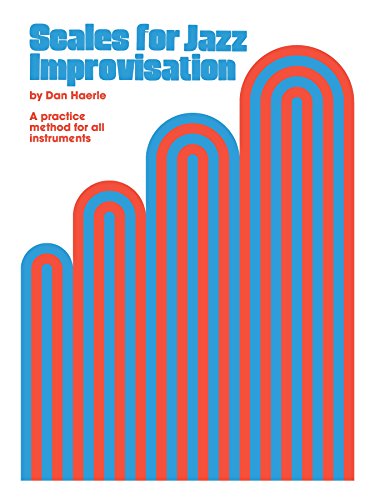
Scales for Jazz Improvisation – Dan Haerle
This book focuses on the technical “gymnastics” required to master the jazz language.
- Pros:
- Clarity: Presents every necessary scale (Dorian, Mixolydian, Altered) in all 12 keys.
- Technical Foundation: Excellent for building finger independence and muscle memory.
- Reference Tool: Serves as a great “lookup” guide when encountering unfamiliar chords.
- Cons:
- Dry Material: It is strictly technical and lacks musical pieces or “fun” arrangements.
- Academic Tone: Feels more like a math workbook than a music book.
 Kindle editionRead on Kindle ›
As an Amazon Associate I earn from qualifying purchases.
How to Improvise – Hal Crook
A practical guide focused on the “how” rather than just the “what” of improvisation.
- Pros:
- Rhythmic Focus: One of the few books that prioritizes rhythm over pitch, which is essential for jazz.
- Practice Constraints: Gives the student specific “rules” for a solo (e.g., “only use half notes”) to force creativity.
- Interactive Feel: Highly recommended for those who want to start playing immediately.
- Cons:
- Rigorous: Requires a high level of self-discipline to follow the practice instructions.
- Less “Chunky” Theory: Does not explain the deep “why” of harmony as well as Levine does.
As an Amazon Associate I earn from qualifying purchases.
Ready, Aim, Improvise! – Hal Galper
This book dives into the philosophy and “physics” of the jazz language.
- Pros:
- Forward Motion: Explains the concept of “rhythmic gravity” and how to make lines sound professional.
- Mindset Shift: Helps students overcome the “fear” of hitting wrong notes.
- Deep Insight: Provides advice that only a seasoned pro can give.
- Cons:
- Text-Heavy: Contains more reading and philosophy than actual musical notation.
- Abstract: Might be too conceptual for someone just looking for “where to put their fingers.”
As an Amazon Associate I earn from qualifying purchases.
Conclusion
Mastering beginner-friendly jazz standards to learn is not merely about memorizing notes; it is about joining a centuries-old conversation. Pieces like “Autumn Leaves” and “C Jam Blues” provide the structural integrity needed to explore the vast freedom of improvisation. By grounding practice in solid music theory, understanding seventh chords, the ii-V-I progression, and the 12-bar blues, the aspiring pianist transforms from a reader of music into a creator of it.
The journey into jazz is one of patience and active listening. It is recommended to spend ample time with a single tune, exploring its harmonic depths before moving to the next. The beauty of jazz lies in its infinite possibilities; a single lead sheet can provide a lifetime of musical exploration.
How long does it take to learn one standard?
For a beginner, mastering the “Melody + Shell Voicings” of a standard like Fly Me To The Moon typically takes 2 to 4 weeks of consistent “Chunking” practice.
What is the best jazz standard to learn first?
“Autumn Leaves” is generally considered the best first standard because it contains the most common jazz chord progressions (major and minor ii-V-I) and a very singable melody.
Do I need to know classical piano to play jazz?
While a classical background provides excellent finger technique and reading skills, it is not strictly required. Jazz requires a different “touch” and a focus on ear training and improvisation that is often not emphasized in classical training.
Do I need to be able to read music to play jazz?
While many jazz musicians play by ear, fluency in note reading (lecture à vue) is a valuable skill that allows a musician to function at a high level, especially when navigating lead sheets in a band setting.
What are “chord voicings”?
A “voicing” is simply the way you choose to arrange the notes of a chord on the keyboard. In jazz, you might move the 3rd or 7th of a chord to the bottom to create a different sound or to make it easier to reach with your hand.
How can I improve my swing rhythm?
The best way is to listen to the masters (Count Basie, Oscar Peterson, Duke Ellington) and play along with backing tracks. Focus on the “upbeats”, the “ands” of the beat, and give them a slight accent.
How can I make my improvisation sound “jazzy” immediately?
The quickest way to achieve a “jazz sound” is to use the minor pentatonic scale over minor-key standards like “Summertime” or to focus on targeting the “thirds” of the chords in your melodic lines.
What is a “fake book” or “lead sheet”?
A lead sheet is a simplified score that shows only the melody and the chord symbols (harmony). A collection of these sheets is called a “fake book” because it allows musicians to “fake” an arrangement of a song they might not know by heart.
Sources et References
Levitin, Daniel J. This Is Your Brain on Music. New York: Dutton. (Cognitive principles of chunking and memory).
Coker, Jerry. How to Practice Jazz. Jamey Aebersold Jazz. (The definitive guide to structured jazz methodology).
Levine, Mark. The Jazz Piano Book. Sher Music Co. (The gold standard for jazz chord theory and voicings).
National Association for Music Education (NAfME): Standards for jazz pedagogy and improvisational frameworks.