
As an Amazon Associate, PianoMode earns from qualifying purchases. Recommendations are made on their merits; the price you pay is the same.
The journey of mastering the piano often begins with a fundamental realization: music is not a chaotic collection of sounds, but a structured language built upon specific patterns. For many students, the first encounter with a scale feels like a mere finger exercise, a repetitive task designed to build dexterity. However, looking deeper reveals that scales are the architectural blueprints of Western music. They provide the map for every melody, the logic for every chord progression, and the physical coordination necessary to navigate the 88 keys with confidence.
In this comprehensive guide, we will explore the intricate world of piano scales. You will learn the mathematical formulas behind major and minor tonalities, the physiological benefits of daily scale practice, and how understanding these patterns transforms sight-reading from a chore into an intuitive skill. Whether you are an adult beginner or an intermediate player looking to solidify your theoretical foundation, this article serves as your roadmap to keyboard fluency.
Piano scales are organized sequences of notes that move in ascending or descending order based on a specific pattern of whole steps and half steps. They function as the “alphabet” of music, establishing the key signature and the harmonic framework of a piece. By mastering scales, a pianist develops essential technical skills, such as finger independence and “thumb-under” agility, while simultaneously internalizing the tonal relationships required for improvisation, composition, and professional-level performance.
1. The Building Blocks of Music: Intervals and the Chromatic Foundation
In this section, we will deconstruct the keyboard’s layout, define the essential intervals that form the “DNA” of all scales, and explore the Chromatic Scale, the complete spectrum of Western music. You will learn how to identify distances between notes by sight and touch, and why these small measurements are the key to unlocking advanced music theory.
An interval is the measurement of the distance between two pitches. In piano music, the most fundamental intervals are the half step (semitone) and the whole step (whole tone). These units act as the “atoms” of music theory; by combining them in specific sequences, we create the major, minor, and modal scales that define musical emotion and structure.
Understanding the Physics of the Keyboard
To navigate the piano efficiently, one must look past the 88 keys and see the underlying pattern. The keyboard is a repeating cycle of twelve notes. The way these notes are spaced determines how we perceive distance and harmony.
The Half Step (Semitone): The Smallest Unit
The half step is the smallest interval used in traditional Western music. On a piano, a half step occurs when you move from one key to the very next available key, with no keys left in between.
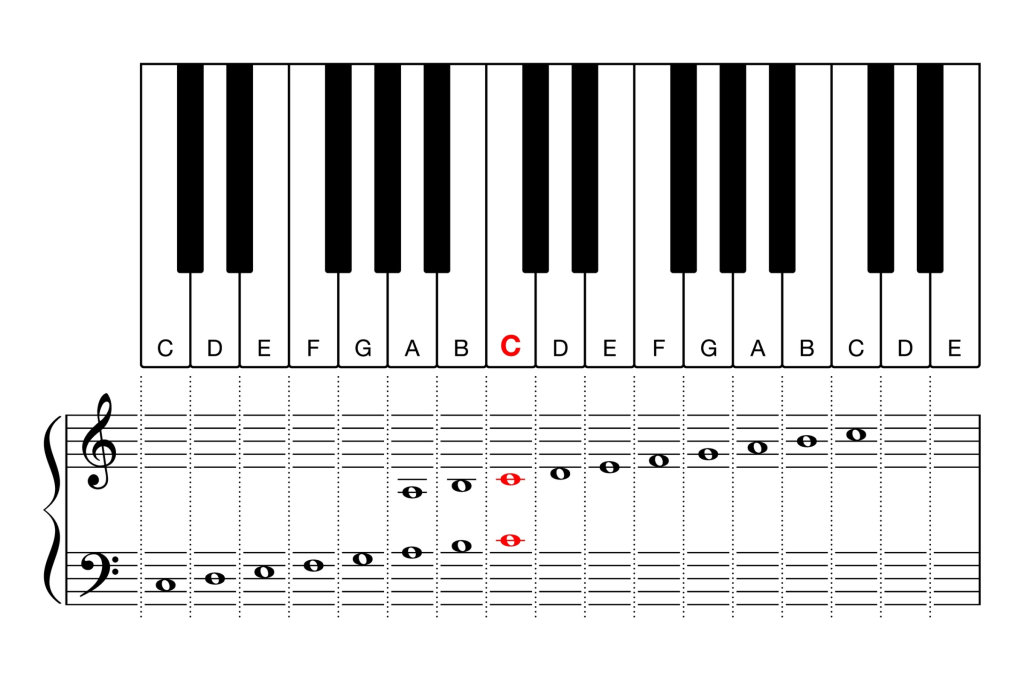
- White to Black: Moving from C to the black key immediately to its right (C#) is a half step.
- Black to White: Moving from that C# to the D immediately to its right is another half step.
- White to White (The Exceptions): This is a critical pedagogical point. Most white keys have a black key between them, but two pairs do not: E to F and B to C. These are “natural” half steps. Recognizing these “gaps” in the black keys is essential for visual orientation on the keyboard.
The Whole Step (Whole Tone): The Power of Two
A whole step is equal to exactly two half steps. Visually, this almost always involves “skipping” one key.
- Standard Examples: C to D is a whole step (skips C#). F to G is a whole step (skips F#).
- The Black-Key Whole Step: Moving from C# to D# is a whole step because you skip the white key (D) in between.
- The “Natural” Challenge: To move a whole step from E, you must skip F and land on F#. Therefore, E to F# is a whole step.
2. The Chromatic Scale: The Full Spectrum of Sound
If the major scale is a specific “filter” of notes, the Chromatic Scale is the raw, unfiltered source. It consists of all twelve available notes within an octave, played in succession using only half steps.
Why the Chromatic Scale is the Foundation
The Chromatic Scale represents the total available palette of Western tonality. While it is rarely used as the primary melody of a song, it serves several vital functions for the developing pianist:
- Technical Dexterity: Because it uses every key, practicing the chromatic scale is the fastest way to develop uniform finger strength and the ability to glide between white and black keys.
- Tonal Understanding: It teaches the student that there are no “wrong” notes in the abstract, only notes that exist outside of a specific key signature.
- Aural Training: It helps the ear recognize the smallest possible change in pitch, which is the basis for hearing “tension and release” in music.
Advanced Learning: Enharmonic Equivalence
A key pedagogical concept within the chromatic foundation is Enharmonic Equivalence. This is the idea that one physical key on the piano can have two different names depending on the musical context.
- C# (C Sharp) is the same physical key as Db (D Flat).
- F# (F Sharp) is the same physical key as Gb (G Flat).
- Even White Keys: In some complex scales, a B# exists (which is physically the C key) or an Fb exists (which is physically the E key).
Understanding this “musical spelling” is what separates a casual player from a literate musician. It ensures that when you read music, the grammar of the scale remains consistent.
3. Comparative Structure: Steps and Intervals
To better visualize these building blocks, refer to the following comparison table:
| Interval Name | Number of Half Steps | Piano Example | Visual Shortcut |
| Half Step | 1 | C to C# | Next door (No skip) |
| Whole Step | 2 | C to D | Skip one key |
| Minor Third | 3 | C to Eb | Skip two keys |
| Major Third | 4 | C to E | Skip three keys |
Note: While “Thirds” are technically scales/chords, they are built directly from the foundation of steps you are learning now.
4. Pedagogical Application: Developing Finger Memory
The goal of learning intervals is to move from theoretical knowledge to physical “reflex.” Expert pianists do not calculate half steps while playing; their hands have internalized the distances.
The Chromatic Fingering Rule
To play a chromatic scale smoothly, pianists use a specific fingering pattern designed for speed and ergonomics:
- The Rule of 1 and 3: Generally, use your 3rd finger on every black key and your thumb (1st finger) on every white key.
- The Exception: Where two white keys are adjacent (E-F and B-C), use your 2nd finger on the second white key to maintain a smooth, legato flow.
Practice Drill: Start on Middle C. Play C (1), C# (3), D (1), D# (3), E (1), F (2), F# (3)… and continue. This exercise builds the “thumb-under” agility required for all advanced scale work.
The Major Scale: The Pillar of Brightness
The Major Scale is the fundamental structural unit of Western music theory. Characterized by its bright, stable, and “happy” sonority, it serves as the reference point for all other musical structures, including intervals, chords, and key signatures. For a pianist, mastering the major scale is not merely a technical requirement; it is a conceptual necessity. It establishes the “tonal center” or “home base” that allows the listener to feel a sense of resolution and finality in a piece of music.
Beyond its emotional quality, the major scale provides the grammatical framework for harmony. Every chord played on the piano, be it a simple triad or a complex jazz extension—is labeled and understood based on its relationship to the parent major scale. Therefore, a deep pedagogical understanding of its construction is the first step toward true musical literacy.
The Diatonic Architecture: The Major Formula
Every major scale, regardless of the note on which it begins (known as the Tonic), is constructed using a specific, unvarying sequence of intervals. This sequence is known as the diatonic formula. By applying this “blueprint” to any of the twelve keys on the piano, you can derive the correct notes for that specific scale.
The Major Scale Formula:
Whole – Whole – Half – Whole – Whole – Whole – Half
(Abbreviated as: W-W-H-W-W-W-H)
To build a scale, you start on your chosen Tonic and move up the keyboard following these steps:
- Tonic to 2nd: Whole Step
- 2nd to 3rd: Whole Step
- 3rd to 4th: Half Step (Notice the first “pull” toward resolution)
- 4th to 5th: Whole Step
- 5th to 6th: Whole Step
- 6th to 7th: Whole Step
- 7th to Octave: Half Step (The “Leading Tone” resolving back to the Tonic)
Comparative Analysis of Key Major Scales
While the formula remains constant, the physical experience of playing each scale varies significantly due to the integration of black keys (sharps and flats). Understanding the unique characteristics of these four essential scales is vital for developing keyboard topography awareness.
| Scale | Notes | Pedagogical Characteristics |
| C Major | C, D, E, F, G, A, B, C | The “theoretical” baseline. It uses only white keys, making it the easiest to visualize but technically challenging because it lacks the “tactile landmarks” of black keys. |
| G Major | G, A, B, C, D, E, F#, G | The first step into the Circle of Fifths. It introduces the F# (the 7th degree), teaching the student how to pivot the hand toward the black key area. |
| F Major | F, G, A, Bb, C, D, E, F | The introduction of the “flat” keys. It requires a unique fingering in the right hand (ending on the 4th finger instead of the 5th) to accommodate the Bb. |
| B Major | B, C#, D#, E, F#, G#, A#, B | Often called the most “ergonomic” scale. The black keys perfectly fit the natural length of the long fingers (2, 3, 4), while the thumb (1) lands naturally on the white keys (B and E). |
The Tetrachord: The Secret to Scale Memorization
One of the most effective pedagogical tools for internalizing scales is the concept of the Tetrachord. The word “tetra” means four, and in music theory, a tetrachord is a series of four notes that follow a specific intervallic pattern.
A major scale is actually composed of two identical tetrachords joined together by a single Whole Step.
The Major Tetrachord Formula:
Whole – Whole – Half (W-W-H)
When you look at the C Major scale through this lens, the structure becomes much simpler:
- Lower Tetrachord: C – D – E – F (W-W-H)
- The Bridge: A Whole Step between F and G.
- Upper Tetrachord: G – A – B – C (W-W-H)
Why This Matters for Learning:
Visual “Chunking”: Instead of seeing eight individual notes, your brain “chunks” the scale into two manageable groups. This reduces cognitive load during sight-reading and helps establish strong muscle memory in both hands. patterns (W-W-H) separated by a whole step. This symmetry helps students memorize scales in “chunks” rather than individual notes, which is a key strategy for Generative Engine Optimization (GEO) in learning—processing information in logical, repeatable blocks.
Symmetry: You realize that you only need to learn one 4-note pattern (W-W-H) to build an entire scale.
The Circle of Fifths Connection: The “Upper Tetrachord” of one scale becomes the “Lower Tetrachord” of the next scale in the Circle of Fifths. For example, the upper part of C Major (G-A-B-C) is the starting point for G Major.
5. The Three Dimensions of Minor Scales
While the major scale is singular and consistent in its structure, the Minor Scale is far more versatile, offering three distinct variations. In music theory, this flexibility allows composers to manipulate the “tension,” “color,” and “mood” of a piece, shifting from subtle introspection to high-stakes drama.
To master the piano, one must understand that “Minor” is not just one scale, but a tonal system. These three variations, Natural, Harmonic, and Melodic, each serve a specific purpose in melody and harmony.
The Natural Minor (Aeolian Mode)
The Natural Minor scale is the foundational “standard” minor sound. It is characterized by its lowered 3rd, 6th, and 7th degrees compared to a major scale, which gives it its somber, reflective quality.
- The Formula: Whole – Half – Whole – Whole – Half – Whole – Whole (W-H-W-W-H-W-W).
- Aural Profile: It sounds pure, ancient (often called the Aeolian Mode), and lacks the aggressive “pull” toward the home note found in major keys.
Pedagogical Key: The Concept of “Relative” Keys
The most efficient way to learn natural minor scales is through their relationship to the Major scales. Every Major scale has a Relative Minor that shares the exact same key signature (the same sharps or flats).
- How to find it: The relative minor always starts on the 6th degree of the Major scale.
- The “3-Half-Step” Rule: To find the relative minor of any major key, move down three half-steps (a minor third) on the keyboard.
- Example: Start on C. Move down 3 half-steps (B, Bb, A). A Minor is the relative minor of C Major. They share the same white-key-only “alphabet.”
The Harmonic Minor
The Harmonic Minor scale was developed to solve a “problem” in the natural minor. In natural minor, the 7th note is a whole step away from the tonic, which sounds weak when trying to end a musical phrase. By raising the 7th note by a half-step, composers created a “Leading Tone.”
- The Modification: Take the Natural Minor scale and raise the 7th note by one half-step.
- The Formula: W-H-W-W-H-Augmented 2nd-H.
Learning Points:
- The “Leading Tone” Pull: Because the 7th note (e.g., G# in A minor) is now only a half-step away from the Tonic (A), it creates an intense psychological urge to resolve upward. This is essential for creating strong “cadences” (musical endings).
- The Augmented Second: Raising the 7th creates a large gap between the 6th and 7th notes (3 half-steps). This specific interval is called an Augmented Second.
- Musical Effect: This gap gives the scale a distinct, “exotic,” or “oriental” flair. It is the sound often associated with Spanish Flamenco or traditional Eastern European music.
- Usage: As the name suggests, this scale is used primarily for Harmony. It allows musicians to build “Major V” chords in a minor key, which provides the dramatic tension found in the works of Bach, Mozart, and Beethoven.
The Melodic Minor
The Melodic Minor scale is the most sophisticated variation. It was designed to provide the harmonic strength of the raised 7th while removing the “awkward” exotic gap (the augmented second) of the harmonic minor to make melodies more vocal and smooth.
The Directional Rule:
Unlike other scales, the Melodic Minor traditionally changes depending on whether the melody is going up or down.
- Ascending (Going Up): You raise both the 6th and 7th degrees by a half-step.
- Why? Raising the 6th “smooths over” the gap created by the raised 7th, making the climb to the tonic sound more elegant and less “exotic.”
- Descending (Going Down): You revert to the Natural Minor (lowering the 6th and 7th back to their original state).
- Why? When the melody moves away from the tonic, the “pull” of the leading tone is no longer needed, so the scale returns to its natural, somber state.
Comparison Table: A Minor Variations
| Scale Type | 6th Note | 7th Note | Emotional Context |
| Natural Minor | F | G | Sad, Folk-like, Pure |
| Harmonic Minor | F | G# | Dramatic, Tense, Exotic |
| Melodic Minor (Asc) | F# | G# | Sophisticated, Jazzy, Heroic |
| Melodic Minor (Desc) | F | G | Same as Natural Minor |
Pedagogical Summary for the Student:
To internalize these, always start with the Natural Minor. Think of the Harmonic and Melodic versions as “upgrades” to the 7th and 6th notes. Once you can visualize the 1-2-3-4-5 of the minor scale (which remains the same in all three versions), you only need to focus on the “variable” 6th and 7th degrees at the top of the scale. This mental shortcut will significantly speed up your ability to play in any minor key.
6. Specialized Scales: Pentatonic, Blues, and Modes
As a pianist’s technical proficiency grows, the standard major and minor “alphabet” expands to include specialized sequences. These scales are the essential tools for navigating specific genres such as Jazz, Rock, Blues, and Folk. Understanding these structures allows a musician to move beyond written scores and begin exploring the complex world of modal harmony and stylistic improvisation.
By altering just one or two notes within a standard heptatonic (seven-note) scale, a pianist can fundamentally shift the emotional and cultural context of the music.
A. The Pentatonic Scale: Simplicity and Consonance
The term Pentatonic is derived from the Greek pente (five) and tonos (tone). As the name suggests, these are five-note scales. Their primary characteristic is the deliberate removal of “clashing” intervals, specifically the half-steps found in major and minor scales. By eliminating these dissonant intervals, the pentatonic scale becomes exceptionally consonant, meaning almost any combination of its notes will sound harmonically pleasing.
The Major Pentatonic
The Major Pentatonic scale is built by taking the 1st, 2nd, 3rd, 5th, and 6th degrees of a Major scale. It removes the 4th and 7th degrees (the notes that create the “tension” of a half-step).
- Formula: 1 – 2 – 3 – 5 – 6
- Aural Profile: Open, airy, and universally positive. It is the foundation of much of the world’s folk music and early childhood melodies.
The Minor Pentatonic
The Minor Pentatonic is the cornerstone of contemporary guitar and piano solos. It uses the 1st, flattened 3rd, 4th, 5th, and flattened 7th degrees.
- Formula: 1 – b3 – 4 – 5 – b7
- Pedagogical Value: For a student beginning to improvise, the Minor Pentatonic is the “safe zone.” Because it lacks the dissonant 2nd and 6th degrees of the natural minor, it is nearly impossible to play a “wrong” note when jamming over a minor chord progression.
B. The Blues Scale: Adding the “Blue Note”
The Blues Scale is a direct evolution of the minor pentatonic. It is the defining sound of the American musical tradition, from Jazz to classic Rock ‘n’ Roll. The defining characteristic of this scale is the addition of a sixth note—the “Blue Note.”
- The Structure: It takes the Minor Pentatonic and adds a flattened 5th (b5), also known as an augmented 4th (#4) or the Tritone.
- Formula: 1 – b3 – 4 – #4/b5 – 5 – b7
- Musical Effect: The b5 note creates a “crunchy,” dissonant tension that seeks immediate resolution to either the 4th or the 5th. This specific tension provides the “soul” and “grit” associated with blues improvisation. Mastering this scale involves learning how to “crush” or grace-note the b5 to mimic the vocal slides used by blues singers.
C. An Introduction to Musical Modes (Church Modes)
Modes are variations of the Major scale. Conceptually, a mode is created by starting and ending a major scale on a degree other than the tonic, while keeping the same key signature. This “displacement” of the tonal center changes the sequence of whole and half steps, resulting in seven distinct musical “flavors.”
- Ionian (Degree I): This is the standard Major Scale. It is the baseline for all Western harmony.
- Dorian (Degree II): A minor scale with a Major 6th.
- Flavor: “Bright” minor. It sounds less sad than natural minor and is heavily used in Jazz and Santana-style rock.
- Phrygian (Degree III): A minor scale with a flattened 2nd (b2).
- Flavor: “Dark” and Spanish. The immediate half-step at the start of the scale creates a sense of mystery and urgency.
- Lydian (Degree IV): A major scale with an augmented 4th (#4).
- Flavor: Dreamy, celestial, and cinematic. It is the preferred mode for film composers like John Williams to evoke wonder.
- Mixolydian (Degree V): A major scale with a flattened 7th (b7).
- Flavor: The “Rock ‘n’ Roll” major. It has the brightness of a major scale but the “bluesy” edge of the flattened 7th.
- Aeolian (Degree VI): This is the Natural Minor Scale. It provides the standard melancholic sound found in pop and classical ballads.
- Locrian (Degree VII): A scale with both a flattened 2nd and a flattened 5th.
- Flavor: Highly unstable and diminished. Because the “home” chord is a diminished triad, it sounds unresolved and is rarely used as a primary key, appearing mostly in heavy metal or avant-garde jazz.
By internalizing these modes, a pianist moves from simply “playing keys” to “shaping atmospheres,” allowing for a much more nuanced and expert approach to performance and composition.
7. The Technical “Why”: The Physical Benefits of Practice
Why do elite conservatories insist on hours of scale practice? It is not about the notes; it is about the neuro-muscular development.
Finger Independence and Strength
Each finger on the human hand is controlled by a complex web of tendons. The 4th finger, in particular, shares a tendon with the 3rd and 5th, making it naturally “weak.” Scales force the hand to treat each finger as an isolated unit, building the strength required for complex passages in works by Chopin or Liszt.
Proprioception and Keyboard Geography
Proprioception is the brain’s ability to know where the body is in space. By practicing scales in all 12 keys, a pianist develops a “mental map” of the keyboard. You begin to feel the distance between a “white-to-black” transition versus a “white-to-white” transition without needing to look down. This is the secret to high-level Sight-Reading.
The “Thumb Under” Technique
The piano is a linear instrument, but our hands only have five fingers. To play a long run, the thumb must tuck under the fingers (or the fingers must cross over the thumb). Scales provide the most efficient way to practice this “pivot” movement, ensuring that the sound remains Legato (smooth) and connected rather than “bumpy.”
8. Integrating Scales into Musicality
A scale is a tool, but the goal is music. Understanding scales changes how a pianist perceives a piece of sheet music.
Pattern Recognition (The “Chunking” Method)
When a trained pianist sees a fast run of sixteen notes in a Mozart Sonata, they do not read sixteen individual notes. They recognize a “G Major Scale” fragment. This allows the brain to process information at a higher speed, reducing the cognitive load and making performance more relaxed.
Harmonic Context
Scales tell you which chords are “legal” in a certain key. If you are playing in the key of E Major, knowing your scale instantly tells you that an A Major chord is “subdominant” and a B Major chord is “dominant.” This theoretical knowledge is the foundation of Ear Training—the ability to hear a song and instantly know how to play it.
9. Pedagogical Best Practices: How to Practice Scales
To transform scale practice from a monotonous chore into a high-leverage technical tool, a pianist must move beyond mindless repetition. Effective practice is deliberate, varied, and analytical. By introducing specific constraints and challenges, you force the brain to stay engaged and the muscles to adapt to complex movements.
The following strategies are designed to bridge the gap between “playing a scale” and “mastering the keyboard.”
The Metronome is Mandatory: Precision over Velocity
In the world of professional piano pedagogy, speed is viewed as a byproduct of accuracy, not an end in itself. If a scale is played fast but with uneven rhythm or varying note volumes, the “speed” is essentially useless for real-world performance.
- The 60 BPM Baseline: Begin your practice at 60 beats per minute, playing one note per beat. This slow tempo allows you to monitor the “attack” of each finger and the smoothness of the thumb-under transition.
- Gradual Increments: Only increase the tempo by 2–4 BPM once you can play the scale four times in a row with zero mistakes and perfect rhythmic evenness.
- Aural Monitoring: Listen for “ghost notes” (notes that are too quiet) or “accents” (notes that are unintentionally loud). A perfect scale should sound like a string of identical pearls.
Contrary Motion: Developing Hand Independence
Most students practice scales in parallel motion (both hands moving in the same direction). While useful, this can lead to the “strong” hand masking the weaknesses of the “weak” hand. Contrary motion is the ultimate remedy for this imbalance.
- The Mirror Effect: Start with both thumbs on a central note (e.g., Middle C). Move the right hand up and the left hand down simultaneously. Because our hands are mirror images, the fingerings will often synchronize (e.g., both hands playing finger 3 at the same time).
- Neurological Benefit: This exercise forces the brain to manage two different spatial directions at once. It breaks the “dependency” between hands, a skill that is vital for playing polyphonic music like the fugues of J.S. Bach.
Articulation Variation: Building Finger “Pop” and Phrasing
A master pianist must be able to change the “touch” of their playing instantly. Practicing scales with different articulations trains the small muscles in the hand to react with precision.
- Staccato Practice: Play each note as if the key were hot. This “plucking” motion builds finger independence and what teachers call “finger pop”—the ability of the finger to release a note cleanly.
- Legato Practice: Focus on the “finger overlap.” The goal is to connect the notes so seamlessly that the listener cannot hear the physical mechanism of the piano. This requires careful weight transfer from one finger to the next.
- The Mixed Touch: For an advanced challenge, play the right hand legato while the left hand plays staccato. This is the pinnacle of hand coordination.
Rhythmic Groupings: Internalizing Pulse and Subdivision
One of the primary reasons scales sound “mechanical” is a lack of rhythmic drive. By changing the grouping of notes, you train your brain to perceive the scale in musical “phrases” rather than a linear list of tones.
- Triplets (Groups of 3): Playing three notes per metronome beat. This is particularly challenging for scales that have 8 notes (like the major scale), as the “strong beat” will land on a different note in each octave.
- Sixteenth Notes (Groups of 4): Playing four notes per beat. This emphasizes the 1st and 5th degrees of the scale and is the standard way to build professional-level velocity.
- The “Stop-and-Go” Method: Play two notes quickly, then pause on the third. Then play three notes quickly and pause on the fourth. These rhythmic “spurts” build the fast-twitch muscle fibers needed for virtuoso passages.
PianoMode Pro-Tip: Never practice scales for more than 20 minutes at a time. The goal is 100% mental focus. Once your mind begins to wander, the pedagogical value of the exercise drops to zero. Quality of attention always outweighs quantity of time.
Product Recommendations
Hanon: The Virtuoso Pianist 60 exercices — This legendary collection of finger exercises is essential for building the technical strength, speed, and precision required for professional-level piano performance.
As an Amazon Associate I earn from qualifying purchases.
Scales for jazz improvisation by Dan Haerle — For players looking to bridge the gap between classical theory and modern performance, this book offers a deep dive into the specific tonal colors used in professional jazz improvisation.
As an Amazon Associate I earn from qualifying purchases.
Music Theory for Dummies — This accessible resource breaks down complex musical concepts into clear, understandable language, making it an ideal companion for anyone looking to master the foundations of music.
As an Amazon Associate I earn from qualifying purchases.
The Circle of Fifths: visual tools for musicians — This powerful visual aid simplifies the complex relationships between keys and chord progressions, helping musicians of all levels internalize music theory at a glance.
As an Amazon Associate I earn from qualifying purchases.
Mechanical Metronome M2 — A vital tool for developing a steady internal pulse, this classic mechanical device provides a reliable and clear audible beat to ensure your scale practice stays perfectly in time.
Conclusion
Piano scales are the invisible framework of the musical world. Far from being a dry academic requirement, they are the key to unlocking the full potential of the instrument. By mastering these patterns, the pianist gains technical facility, theoretical depth, and a profound sense of confidence. The transition from “playing notes” to “making music” happens when the fingers no longer have to think about where to go, but can focus entirely on how the music should feel.
If you’re serious about improving your piano skills, whether for fun, performance, or professional goals, scales are not something to skip. Embrace them, explore their many forms, and let them become your foundation. Trust me, the time you invest in mastering scales will pay off in every note you play.
Recommendations:
- Dedicate the first 15 minutes of every practice session to scales.
- Focus on the quality of tone rather than the speed of the fingers.
- Always seek to understand the “Why” behind the “What.”
How many scales are there on the piano?
There are 12 Major scales and 36 Minor scales (12 each of Natural, Harmonic, and Melodic). Additionally, there are numerous chromatic, pentatonic, whole-tone, and modal scales, totaling hundreds of possible permutations.
Why do I need to learn scales with sharps and flats?
Most music isn’t written in C Major. Composers use different keys to access different emotional “colors.” Without knowing scales like Eb Major or F# Minor, a pianist is restricted to only a tiny fraction of the available repertoire.
What is the best fingering for scales?
Most major scales following the “White Key” pattern (C, G, D, A, E) use a standard fingering: 1-2-3, 1-2-3-4-5 (Right Hand) and 5-4-3-2-1, 3-2-1 (Left Hand). However, keys starting on black notes (like Bb or F#) require specialized fingerings to keep the thumb on the white keys.
Can I skip scales if I only want to play by ear?
Actually, scales are more important for playing by ear. They provide the “dictionary” of notes that are likely to be used in a melody, allowing you to narrow down your choices and find melodies much faster.
Sources & References
Feezell, Mark. Music Theory Fundamentals (High-Yield Music Theory, Vol. 1). LearnMusicTheory.net. This source provided the core structural formulas for the Major Scale (W-W-H-W-W-W-H) and the three variations of the Minor Scale (Natural, Harmonic, and Melodic), as well as the technical definition of intervals.
Martin, Lawrence. Basic Music Theory for Adult Beginner-Level Piano Players (Piano Syllabus). Lakeside Press. This text was instrumental in developing the “Keyboard Topography” section, focusing on the visual and tactile relationship between half-steps and whole-steps for adult learners.
Pilhofer, Michael & Day, Holly. Music Theory For Dummies. Wiley Publishing, Inc. This comprehensive reference served as the basis for the sections on Specialized Scales, including the Blues scale and the historical context of the Church Modes.
Creative Commons / Anonymous. Music Theory v. 1.0. Licensed under CC BY-NC-SA 3.0. This resource provided the framework for Tetrachord theory and the symmetrical “chunking” method used to simplify scale memorization.