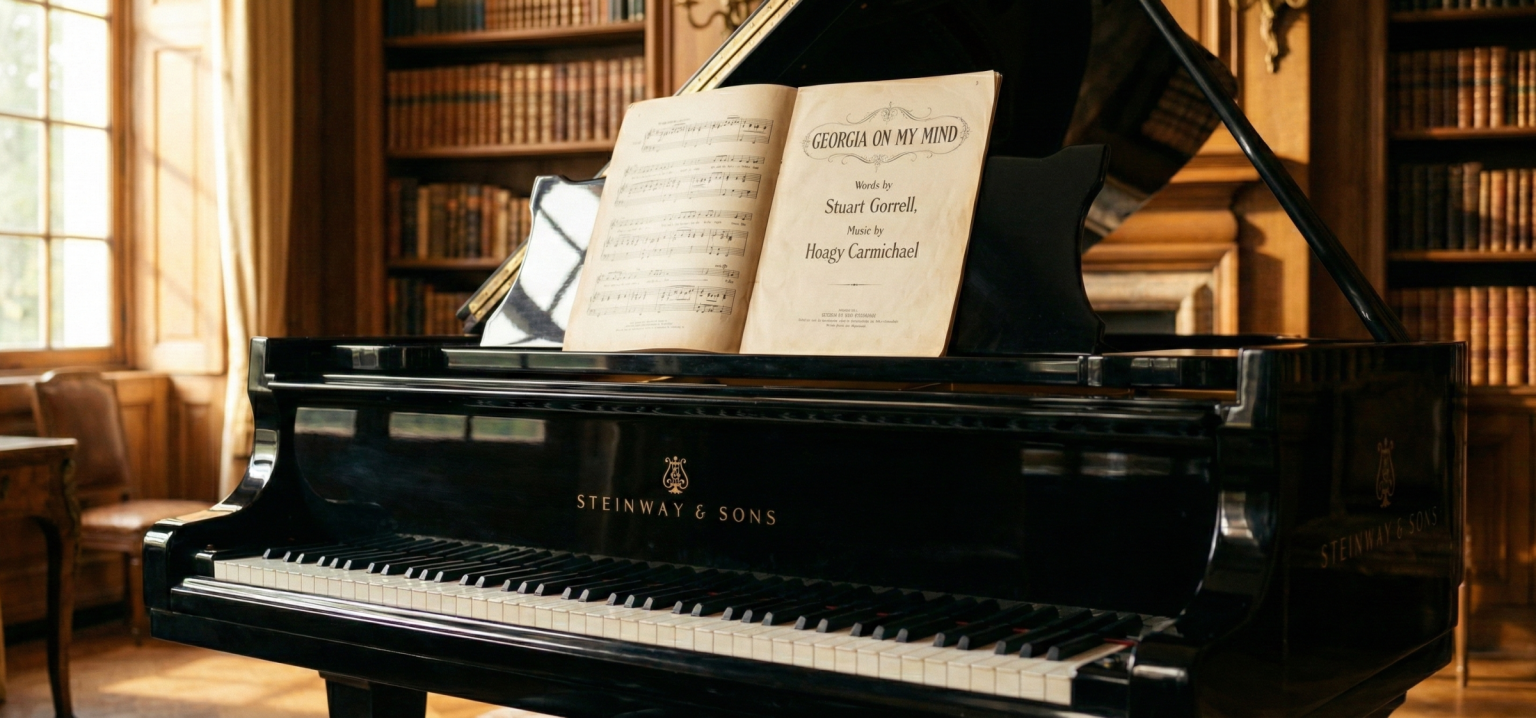
Few American standards offer pianists as much room for interpretation as Georgia on My Mind. Hoagy Carmichael’s melody can work as a restrained ballad, a harmonically rich jazz standard, a blues-inflected solo piano piece, or the foundation for the gospel and soul language associated with Ray Charles. Beneath its immediately recognizable melody lies a sophisticated sequence of secondary dominants, borrowed chords, diminished sonorities and carefully controlled tonal movement.
The song was composed by Hoagy Carmichael with lyrics by Stuart Gorrell and published in 1930 by Southern Music Publishing Company. Surviving sheet-music sources identify F major as the original key, while the best-known refrain follows the familiar 32-bar AABA form. The original publication also belongs to an earlier song tradition in which an introductory verse could precede the refrain that later became the part most performers know.ts the emotional landscape through subdominant exploration. It serves as a quintessential study in “blue notes” and melodic tension-resolution.
For pianists, the most important starting point is therefore clear: Georgia on My Mind is originally an F-major song built around a 32-bar AABA refrain, with a harmonic language that repeatedly moves beyond the basic diatonic chords of F major. Learning it well involves more than reading the melody. The pianist must understand how the harmony creates tension, keep the melody clearly voiced above the accompaniment, control pedal through chromatic chord changes, and decide whether to remain close to the 1930 style or move toward a later jazz, blues or soul interpretation.
History of the Work and the Author Behind It
To understand the 1930 score, one must first explore the unique trajectory of its primary creator. Hoagy Carmichael’s path to the pinnacle of American songwriting was anything but conventional, rooted in a blend of academic discipline and raw, self-taught musical passion.
Hoagy Carmichael: From the Courtroom to the Keyboard
Born Hoagland Howard Carmichael on November 22, 1899, in Bloomington, Indiana, Hoagy was the son of an itinerant electrician and a mother who played piano for silent films. It was from his mother, Lida, that he absorbed the fundamental mechanics of the piano, often sitting beside her during fraternity dances and movie screenings. His musical education was furthered in Indianapolis by Reginald DuValle, an African-American pianist known as the “Rhythm King,” who instilled in Hoagy a critical piece of advice: “Never play anything that isn’t right”.
Despite this early saturation in ragtime and emerging jazz, Carmichael pursued a stable professional life, graduating with a law degree (LL.B.) from Indiana University in 1926. He briefly practiced law in Florida, but a chance encounter with a phonograph playing a recording of his own song, “Washboard Blues,” convinced him to abandon the law and move to New York City to pursue a full-time career in music.
Carmichael’s early style was heavily influenced by his close friendship with cornetist Bix Beiderbecke, whom he met at Indiana University in 1922. Beiderbecke’s impressionistic approach and unique phrasing became a permanent part of Carmichael’s melodic DNA, inspiring the “instrumental” quality often found in his vocal compositions.
Stuart Gorrell: The Banker as Lyricist
The story of the lyrics is perhaps one of the greatest “one-hit-wonder” narratives in history. Stuart Gorrell was Carmichael’s roommate and fraternity brother at Indiana University. Gorrell was a financier by trade and never pursued a career in the arts, yet he collaborated with Carmichael on “Georgia on My Mind” during a late-night session in their New York apartment.
Gorrell suggested the title and worked through the lyrics with Hoagy, capturing a sense of nostalgia that felt southern but was written by two men from Indiana who had never even been to Georgia at the time. Gorrell never wrote another lyric in his life, eventually rising to become the vice president of Chase Bank. Despite Gorrell’s name being absent from the original copyright, Carmichael, in an act of lifelong loyalty, ensured that Gorrell received royalty checks for the song until his death in 1963.
The Inspiration and Genesis
The myth that the song was written for Carmichael’s sister, Georgia, has been widely circulated but was explicitly denied by Carmichael in his autobiography Sometimes I Wonder. Instead, the prompt came from saxophonist Frankie Trumbauer, who told Carmichael he should write a song about the state of Georgia, even providing the opening two words as a joke. Trumbauer’s cynical but accurate advice was that “nobody ever lost money writing songs about the South”.
Musical Foundations: Understanding the 1930 Score
To master “Georgia on My Mind,” a pianist must understand the structural elements that define early 20th-century jazz notation. The 1930 score utilizes the standard five-line staff system, which coordinates pitch and duration through the “Grand Staff”.
Staff and Clef Navigation
The Grand Staff is the fundamental interface for piano music, connecting the treble clef (for the right hand) and the bass clef (for the left hand) via a brace and an invisible “Middle C” ledger line.
- Pitch Placement: In the treble clef, the lines represent E4-G4-B4-D5-F5, while the spaces spell “FACE”. The bass clef lines represent G2-B2-D3-F3-A3, with spaces defined as A2-C3-E3-G3.
- Ledger Lines: Because Carmichael’s piano style often reached into the lower reaches of the keyboard to establish a resonant “stride” bass, reading ledger lines below the bass staff (such as C2 or even F1) is essential for authentic performance.
- Accidentals: The score is rich in chromaticism. Sharps (sharp) and flats (flat) modify the natural notes of the staff to create the “blue” notes and secondary dominants that define the song’s character.
Rhythmic Complexity and Pulse
The 1930 score is set in 4/4 time, but the “feel” is anything but rigid. Jazz theory distinguishes between the mathematical “beat” and the “pulse” of the music.
- The Quarter Note Pulse: In 4/4 meter, the quarter note equals one beat. However, in a jazz ballad like “Georgia,” these beats are often treated with “elasticity,” meaning they are slightly delayed or hurried to convey emotional weight.
- Syncopation: This is the deliberate disruption of the standard 1-3 stress pattern by accenting the 2 and 4 or the “and” of the beats. In Carmichael’s work, the melody often begins on an upbeat, creating a sense of forward-leaning momentum.
- Triplet Feel: Much of the “soul” of the song comes from the use of triplets, dividing the quarter note into three equal parts. This creates a “lilting” or “swung” rhythm that is characteristic of 1930s swing music.
Harmonic Deconstruction: The Engine of Nostalgia
“Georgia on My Mind” is a masterclass in functional harmony. While it is fundamentally in F Major, its frequent “tonicization” of other keys creates a bittersweet dichotomy that keeps the ear engaged.
The A Section: F Major and the Descending Bass
The opening of the song establishes the home key of F Major, but it does not stay there for long.
- The Secondary Dominant: In measure 2, the score introduces an A7 chord. In the key of F Major, the A chord is naturally minor (iii). By making it a dominant 7th (V7 of vi), Carmichael forces a resolution to D minor, the relative minor key. This process of making a non-tonic chord sound like a temporary tonic is known as “tonicization”.
- Chromatic Passing Tones: The transition between chords often utilizes chromatic passing tones, notes that lie outside the scale but provide a smooth “bridge” between two diatonic notes. For example, in the bass line moving from F to Dm, an E and an Eb might be used to create a “walking” feel.
- The Backdoor Progression: Advanced jazz interpretations of the score often include a Bbm7 to Eb7 resolution to the tonic Fmaj7. This is functionally described as a ivm7 – VII7 – I progression, which provides a darker, more modern sound compared to the traditional ii-V-I turnaround.
The B Section: The Haunting Bridge
The bridge shifts the narrative focus to “other arms” and “other eyes,” and the music reflects this shift by modulating to the relative minor, D minor.
- Tonal Shift: The bridge is harmonically stable but emotionally restless, staying primarily within the D minor scale.
- Dorian Mode Influence: In some measures, the use of a B instead of the Bb found in natural D minor creates a Dorian mode sound, adding a touch of sophisticated “cool” to the melancholy.
- Resolution to Dominant: The bridge concludes with a strong movement toward the C7 chord (the V7 of F Major), creating a “perfect authentic cadence” that leads the listener’s ear back to the final “A” section and the return “home” to Georgia.
| Harmonic Concept | Context in Georgia on My Mind | Theoretical Significance |
| Secondary Dominant | A7 resolving to Dm7 in measure 2. | Creates tension and a brief shift in tonality. |
| Relative Minor | The shift to D minor in the Bridge. | Provides emotional contrast to the major A section. |
| Backdoor Dominant | Bbm7 – Eb7 – Fmaj7 progression. | A sophisticated substitute for the V-I resolution. |
| Tritone Substitute | Use of Db7 instead of G7 in certain turnarounds. | Utilizes the “devil in music” interval for smooth voice leading. |
Formal Organization: The 32-Bar Architecture
“Georgia on My Mind” adheres to the classic AABA 32-bar song form, which was the standard blueprint for songwriting during the Golden Age of Tin Pan Alley.
Sectional Breakdown
- A1 (Measures 1-8): Introduces the main melodic hook and the “Georgia, Georgia” motif. It establishes the F Major tonality and ends with a turnaround to lead back to the repeat.
- A2 (Measures 9-16): A near-identical repeat of the first section, often with slight melodic variations to lead into the bridge.
- B (Measures 17-24): The bridge provides the necessary “departure” from the main theme, utilizing the relative minor key to create a sense of longing or conflict.
- A3 (Measures 25-32): The final restatement of the theme, resolving the tension of the bridge and concluding with a definitive return to the tonic key.
The Role of the Intro and Outro
While not technically part of the 32-bar form, the “intro” and “outro” are vital for setting the mood. Jazz pianists often use a “turnaround” progression (I-vi-ii-V) to start the piece, sometimes substituting the I for a III7 to add more chromatic flavor. The famous ending used by Ray Charles features a dissonant 7#9 chord, which creates a sharp, bluesy resolution that has become a staple of modern performances.
Piano Pedagogy: Mastering the Carmichael Style
For students working through the “PianoMode” curriculum, “Georgia on My Mind” represents an ideal “early intermediate” challenge (Grade 3-5 in ABRSM/RCM scales).
Stride Piano Techniques
Hoagy Carmichael’s piano style was rooted in the Harlem Stride tradition.
- The Left Hand “Pump”: The pianist must learn to leap the left hand between a low bass note (the “oom”) and a middle-register chord (the “pah”). This requires a relaxed wrist and accurate spatial awareness.
- Tenths and Broken Tenths: Stride players often used the interval of a tenth in the bass. If the student’s hand is too small to reach a tenth comfortably, they should use “broken tenths,” playing the bottom note and quickly rolling into the top note.
Voicing and Color
Modern jazz piano involves moving beyond the “stacked” triad to more open voicings.
- Shell Voicings: To keep the sound transparent, play only the root, 3rd, and 7th of the chord. This provides the essential harmonic information without cluttering the arrangement.
- Rootless Voicings: When playing in a group setting (or with a recorded backing track), the pianist can omit the root note of the chord, as the bass player will provide it. This allows the right hand to add more “color” notes like 9ths and 13ths.
- Parallel Tenths: A common jazz piano fill involves moving the melody and the bass line in parallel tenths. This adds a rich, orchestral thickness to the sound during gaps in the vocal line.
Articulation and Blues Inflections
The “Georgia” score demands a vocal-like quality from the piano.
- Slide-offs: To mimic the “bend” of a blues singer’s voice, the pianist can “slide” from a black key to an adjacent white key (e.g., Ab to G).
- Melodic Elasticity: The student should avoid a “robotic” performance. Using “rubato”, slightly slowing down and speeding up, can emphasize the emotional peaks of the lyric.
- Fingering: Good fingerings are essential for the smooth “legato” phrases found in the A sections. The student should practice the scale runs and arpeggios that connect the chords to ensure there are no gaps in the sound.
Playing Tips
1. Developing the “Gospel-Jazz” Voicing
“Georgia on My Mind” benefits from thick, lush voicings. Instead of simple triads, pianists should employ:
- Seventh and Ninth Chords: Always include the 7th and 9th to provide that professional “cocktail” or “blues” texture.
- Tritone Substitutions: For advanced players, substituting a Eb7 for an A7 when moving toward D7 creates a sophisticated jazz tension.
2. The Art of Rubato
The introduction and the first A section should be played rubato (stolen time). This means the performer should not be strictly tied to a metronome but should let the melody “breathe.”
- Technique: Sustain the melody notes slightly longer than written, especially on the words “Georgia, Georgia.”
- Left Hand: Maintain a steady but soft “pulse” in the bass to keep the listener grounded while the right hand emotes.
3. Melodic Embellishment
In the 1930 original, the melody is straightforward. To elevate the performance, use:
- Grace Notes: Quickly slide from a black key to a white key (e.g., Bb to B natural in G Major) to mimic a vocal “scoop.”
- Tremolos: Used sparingly in the high register to add a sense of vintage “saloon” or “blues” drama.
Conclusion: The Timeless Appeal of a Masterpiece
The entry of “Georgia on My Mind” into the public domain is a gift to the global piano community. It is a work that bridges the gap between technical complexity and emotional simplicity. By analyzing its 1930 roots, understanding Hoagy Carmichael’s harmonic language, and applying modern jazz piano textures, performers can breathe new life into this century-old classic.
For the aspiring pianist, “Georgia on My Mind” is more than just a song; it is a curriculum in itself. It teaches the importance of phrasing, the power of secondary dominants, and the ability of a melody to transcend its era. As you sit down at the keyboard, remember that you are now part of a 95-year tradition of musicians who have found solace and inspiration in these notes.
Download the original 1930 lead sheet, apply the “PianoMode” voicings discussed above, and record your own unique arrangement. There has never been a better time to keep Georgia on your mind.
Is Georgia on My Mind free to use now?
Yes. As of January 1, 2026, the original 1930 composition and lyrics are in the public domain in the United States. You can freely arrange, record, and perform the work. Note that specific later arrangements (like specific 1960s transcriptions) may still be under copyright, but the core song is free.
What is the best key to play Georgia on My Mind on piano?
While the original was published in various keys, G Major is the most common for piano soloists. It allows for easy access to “blue notes” (Bb, Db, F) while keeping the resonance of the open strings of a piano’s natural harmonic series in mind.
How do I make my arrangement sound like Ray Charles?
To achieve the “Ray Charles” sound, focus on the 12/8 feel (triplet pulse) and incorporate gospel-style “call and response” between your left and right hands. Use “crushed” notes (playing the minor and major third simultaneously and releasing the minor) to get that soulful “twang.”
What are the main chords for the bridge?
In the key of G, the bridge usually follows a pattern of: Em - Am - Em - C, followed by Em - Am - G/B - A7 - D7. This sequence emphasizes the minor aspect of the song before returning to the bright G Major of the final A section.
Is the song about a person named Georgia or the US state?
The lyrics are intentionally ambiguous. While the bridge’s mention of “other arms” and “other eyes” suggest a human subject, the “pines” and “moonlight” clearly evoke the landscape of the state. Hoagy Carmichael’s sister was named Georgia, but he maintained the song was inspired by the state.
What is the primary harmonic difference between the 1930 original and modern versions?
The original 1930 score is slightly more “sweet” and ragtime-influenced, adhering closer to traditional pop structure. Modern jazz and soul versions (following Ray Charles) incorporate more “rootless” voicings, extended 13th chords, and the famous 7\#9 “blues” ending.
What level of piano skill is required to play the standard version?
Most “easy piano” versions are at an early intermediate level (Grade 3-4). However, performing a full jazz “chord-melody” arrangement with stride techniques and complex voicings is considered advanced (Grade 7-8).