
The Harlem Renaissance of the 1920s birthed a revolutionary piano style that combined the rhythmic rigidity of ragtime with the improvisational soul of jazz: Stride Piano. At the heart of this movement stood Thomas “Fats” Waller, a virtuoso whose technical prowess was matched only by his charismatic showmanship. “Handful of Keys,” recorded in 1929, remains the definitive benchmark for any pianist aspiring to master the stride idiom. This guide provides an exhaustive analysis of the work, the man behind the keys, and the rigorous technical strategies required to perform this masterpiece with authenticity and precision.
“Handful of Keys” is a high-tempo stride piano composition characterized by a “walking” left hand that leaps between bass notes and mid-range chords, paired with a highly syncopated, virtuosic right hand. To play it effectively, a pianist must possess exceptional rhythmic independence, the ability to execute parallel tenths, and a deep understanding of the “swing” feel that defines early 20th-century jazz.
- Overall Level: Very Advanced / Virtuoso
- Global Style: Stride Piano / Early Jazz
- Era: Late 1920s (The Jazz Age)
Fats Waller and The Harlem Stride Era
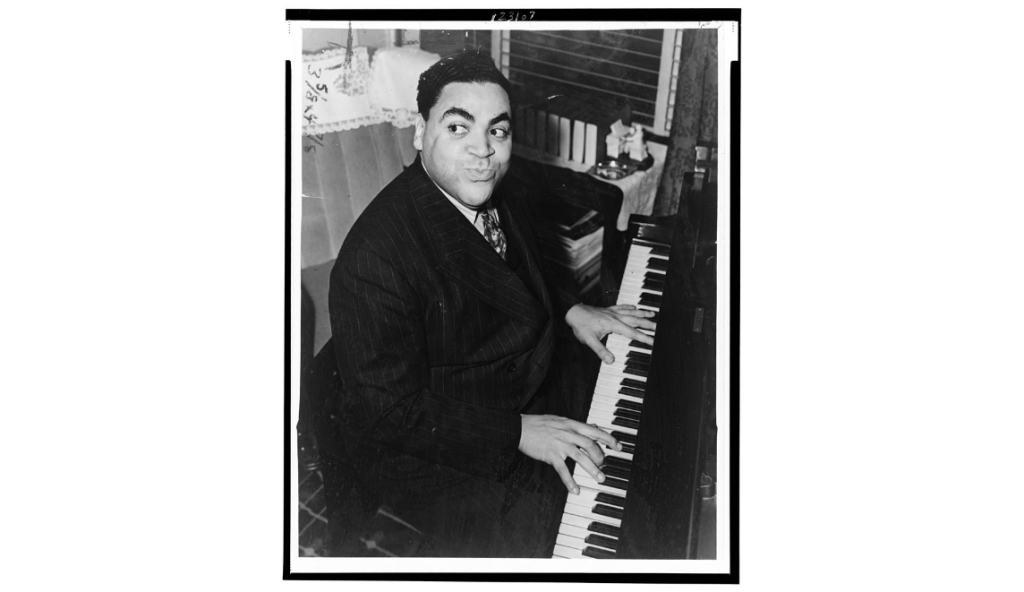
To play Waller’s music, one must first understand the environment that birthed it. The Harlem Renaissance was a period of unprecedented intellectual and artistic growth within the African American community in New York City. Stride piano was the heartbeat of this movement. Thomas “Fats” Waller was more than a composer; he was a force of nature. A student of the “Father of Stride,” James P. Johnson, Waller refined the style into something more melodic and commercially viable without sacrificing its “finger-busting” complexity.
From Ragtime to Stride
Stride piano evolved directly from the “Eastern Ragtime” traditions of the US East Coast. While ragtime, popularized by figures like Scott Joplin, was often more rigid and march-like, Stride piano introduced a more modern, swinging beat and sophisticated harmonic structures.
| Feature | Ragtime Style | Harlem Stride Style |
| Left Hand Range | Usually spans an octave or 1.5 octaves. | Leaps greater distances, often reaching tenths. |
| Rhythm | Strict, “straight” march time. | Swinging, driving four-beat pulse. |
| Improvisation | Primarily composed and reliant on scores. | Heavy emphasis on improvisation and “cutting” skill. |
| Tempos | Moderate and consistent. | Wide range, including extreme speeds. |
The Mentorship of Thomas Waller
Thomas Waller (1904–1943) was a child prodigy who learned to play the harmonium at age six to accompany his father’s sermons at the Abyssinian Baptist Church. This religious foundation gave him a “soul of melody” that remained even in his most secular, high-energy jazz works.
His formal jazz education occurred under James P. Johnson, the “Father of Stride Piano”. Johnson recognized Waller’s natural gift and taught him the “Carolina Shout,” which was the barometer for all budding stride practitioners. Waller’s ability to combine the “God box” (pipe organ) registration techniques with the piano’s percussive nature allowed him to create a sound that was uniquely rich and orchestral.
Fundamental Music Theory of the Waller Score
Mastering “Handful of Keys” requires an analytical mind as much as a fast hand. The piece is built upon the “Elements of Music”, pitch, duration, timbre, and dynamics.
Rhythmic Organization: Pulse and Meter
The primary challenge of the piece is its relentless pulse. A beat is a repeating musical pulse, and in “Handful of Keys,” this pulse is typically organized in a quadruple meter (4/4 time).
- Pulse (Beat): The underlying “heartbeat” of the piece.
- Tempo: Waller’s recording moves at a “bright” clip, demanding 120+ beats per minute (BPM) while maintaining perfect accuracy.
- Syncopation: Waller uses syncopation, placing accents where they are unexpected, to create the “swinging” feel that distinguishes jazz from classical music.
The score often utilizes an Anacrusis (or pick-up measure), a partial measure that begins the piece and propels the listener into the first strong downbeat. In Waller’s performance, this pick-up sets the “swing” feel immediately, letting the listener know that the “straight” time of ragtime has been abandoned.
Harmonic Structure and Key Center
“Handful of Keys” was originally performed and published in the key of F Major, though many modern arrangements transpose it to G Major or C Major for accessibility.
| Key Feature | Description |
| Tonic (F Major) | The “home base” of the piece; provides resolution. |
| Diatonic Half Steps | The natural intervals between E-F and B-C, which are critical for the fast, scalar runs in the right hand. |
| Chromaticism | The use of “musica ficta” or altered pitches (sharps and flats) to add color to the standard Major scale. |
| Enharmonic Equivalence | Understanding that G# and Ab are the same physical key is vital for reading the complex accidentals in Waller’s mid-section. |
The harmonic progression follows a structured framework: Theme A states the simple melody (the “head”), and subsequent themes (B, C, D) move through secondary dominants and modulations. Analysis suggests a multi-thematic structure like A-B-A-C-D-A, providing a “development” section similar to a classical sonata before returning to the familiar tonic.
Technical Mechanics: The Stride Left Hand
The left hand is the engine of “Handful of Keys.” It provides the bass, the harmony, and the rhythmic drive simultaneously, acting as its own self-contained rhythm section.
The “Oom-Pah” Pattern
This fundamental technique involves jumping between a bass note on beats 1 and 3 (the “Oom”) and a mid-range chord on beats 2 and 4 (the “Pah”).
- Beats 1 and 3: The pianist plays a single bass note, a bass octave, or most commonly in Waller’s style, a Tenth.
- Beats 2 and 4: The hand jumps to the center of the keyboard to strike a chord. These chords should be voiced around Middle C; voicing them lower creates a “muddy” sound, while voicing them higher interferes with the right hand.
Mastering the Tenth Interval
The tenth interval is a staple of stride piano master James P. Johnson and his pupil Fats Waller. It provides a full, orchestral resonance that simple octaves cannot match.
- Simultaneous Tenths: Requires a large hand span (thumb to pinky).
- Broken Tenths: Playing the pinky note first and quickly “rolling” to the thumb. This is not just a “cheat” for small hands; it adds a specific rhythmic “punch” that defines the stride sound.
- Rolling Tenths: Incorporating an interior note (the 5th or 6th of the chord) with the index finger for added color.
Spatial Awareness and the Leap
The “notoriously daunting” nature of this piece comes from the accuracy required for these leaps at high speed.
- Windshield Wiper Motion: The arm should move laterally, staying close to the keyboard. Avoid raising the hand in a large, bouncing arc, which wastes time and leads to inaccuracy.
- Pivot Points: The elbow and forearm act as a central pivot point. By flapping the elbow slightly away from the body, the hand moves inward toward the keys in a controlled, waving motion.
- Envisioning the Landing: A professional habit is to envision the target chord before the leap occurs, similar to how one targets an object before grabbing it.
Technical Mechanics: The Right Hand
While the left hand handles the structure, the right hand provides the “freshness” through syncopation, flamboyant rolls, and intricate melodic decoration.
Rhythmic Displacement
Waller often employs “teetering” motifs, alternating between fifths and thirds, with such strong accents that the perceived downbeat seems to shift. This disorientation is an intentional “ingenious” effect that creates momentum.
Flamboyant Embellishments
Waller was known for his “splashy” right-hand technique, which included:
- Glissandos: Rapid slides up or down the keys.
- Tremolo Octaves: Shimmering, rapidly repeated octaves that provide intensity.
- Chromatic Runs: Fast scalar passages used to bridge harmonic transitions.
- Right Hand Rolls: Ornamentation that leads into each chord change, providing a “vocal” quality to the piano.
Coordination and Independence
The greatest technical hurdle is the independence between the hands. The left hand must remain a rigid, swinging “metronome,” while the right hand bashfully explores the off-beats and complex sixteenth-note patterns.
Learning Strategies and Practice Routines
Mastering a work of this complexity requires a systematic pedagogical approach. One does not simply “play through” Waller; one deconstructs him.
Step 1: Harmonic Foundation (Analysis)
Before touching the keys, analyze the chord progression using lead sheets. Label all chords with Roman Numerals (I, IV, V, ii, vi) to understand the harmonic functionality.
| Degree | Roman Numeral | Chord in F Major | Function |
| Tonic | I | F Major | Home base/Resolution. |
| Supertonic | ii | G Minor | Predominant (pulls to Dominant). |
| Subdominant | IV | Bb Major | Predominant/Expansion. |
| Dominant | V | C Major (or C7) | Maximum tension/Leading back home. |
Step 2: Hands Separate (Isolation)
- Left Hand Endurance: Practice the stride leaps alone with a metronome at a very slow speed (e.g., 60 BPM). Gradually increase the speed only when accuracy is 100%.
- Left Hand Memory: Practice the left-hand part in the dark. This forces the spatial retention of the distances between the “Oom” and the “Pah”.
- Right Hand Precision: Isolate the fast sixteenth-note runs. Ensure the “swing” feel is maintained even at slow speeds—think of the notes as triplets where the first note is held twice as long.
Step 3: Slow Motion Integration
Combine the hands at a tempo that feels “too slow”. This allows the brain to map the rhythmic “interlocking” of the two hands. Waller’s right-hand accents often fall between the left hand’s pulses; this must be felt physically before it can be played at speed.
Step 4: Spatial Relaxation
The most important factor for speed is relaxation. Tension in the wrist or elbow will cause fatigue and missed notes. Stride pianists often use a “lateral arm movement” that keeps the hand close to the keys to minimize physical effort.
Performance Practice: Dynamics, Articulation, and Soul
Technique alone does not make a performance “Waller-esque.” One must capture his spirit, a combination of “heavy assertiveness with a light elegance”.
Dynamics and Balance
Dynamics refer to the relative loudness or softness of the music.
- The Bass “Punch”: The left-hand bass notes (beats 1 and 3) should be played with a certain weight to establish the “Oom”.
- Melodic Clarity: The right hand must remain the “voice” of the piece. If the left-hand chords are too loud, they will obscure the melodic syncopation.
- Tension/Release: Authentic stride uses dynamics to build tension throughout a section, culminating in a flamboyant release (like a glissando or a tremolo).
Articulation
- Staccato: Much of the stride style is percussive and detached, giving it a rhythmic “bite”.
- Legato Contrasts: Waller occasionally introduces legato sections (smooth, connected notes) for contrast, often at the start of a new phrase or during a “classical” inspired bridge.
The “Swing” Soul
“Swing” is a rhythmic phenomenon where the beat has a “swaying, swinging, or rocking feel”. A performer must avoid a “rigid” or “straight” classical approach, which makes the music sound “too careful” and lifeless. Listen to the 1929 recording repeatedly to internalize how Waller “drags” or “pushes” the melody against the steady stride of the left hand.
Conclusion
Fats Waller’s “Handful of Keys” remains the ultimate testament to the “finesse and dazzle” of the Harlem Stride era. It is a work that demands everything from the pianist: the strength to jump relentless tenths, the precision to execute high-speed chromatic runs, and the soul to make it all swing. For the student, it is more than a technical challenge; it is an invitation into a world of competitive “cutting contests” and the vibrant cultural landscape of 1920s Harlem. By following a disciplined practice regimen, starting with slow harmonic analysis and ending with the development of a relaxed lateral arm movement, one can unlock these keys. As Waller himself demonstrated, the goal is not merely to hit the notes, but to make the piano sing with both “big body and big mind”. Unlock these handful of keys, and you unlock the very spirit of jazz.
Is “Handful of Keys” suitable for someone with small hands?
Yes, but it requires adaptation. If you cannot reach a tenth, you must learn to “pivot” or “roll” the interval rapidly. Fats Waller’s music is about the sound of the tenth, and a well-executed roll can mimic that richness effectively.
What is the difference between Ragtime and Stride piano?
Ragtime is generally more rigid and march-like with a straight eighth-note feel, while Stride is more modern, highly improvisational, and features a “swinging” beat with much larger leaps and tenth intervals in the left hand.
I have small hands; can I still play Handful of Keys?
Yes, but it requires adaptation. You can play “broken tenths” (rolling from the bottom note to the top) or substitute the tenths for octaves. However, rolling the notes is preferred as it maintains the harmonic richness of Waller’s style.
How long does it take to master this piece?
For an advanced pianist, expect 3 to 6 months of dedicated practice to achieve “performance tempo” (approx. 220-240 BPM) with the necessary rhythmic “swing.”
What are the best editions of the score?
Look for transcriptions that are “Note-for-Note” from the 1929 recording. Many simplified versions exist, but they strip away the essential inner voices that make the piece sound authentic.
How long does it typically take to learn this piece?
For an advanced pianist, the notes can be learned quickly, but the “stride” accuracy and the “swing” feel can take months or even years to master. Some professional pianists report studying the piece for seven years and still perfecting the accuracy of the fast tenth-leaps.
Can I play this on a digital piano?
While possible, the heavy action of a high-quality acoustic grand piano is preferred. The “Handful of Keys” requires significant resonance from the soundboard to handle the massive bass notes of the stride style.