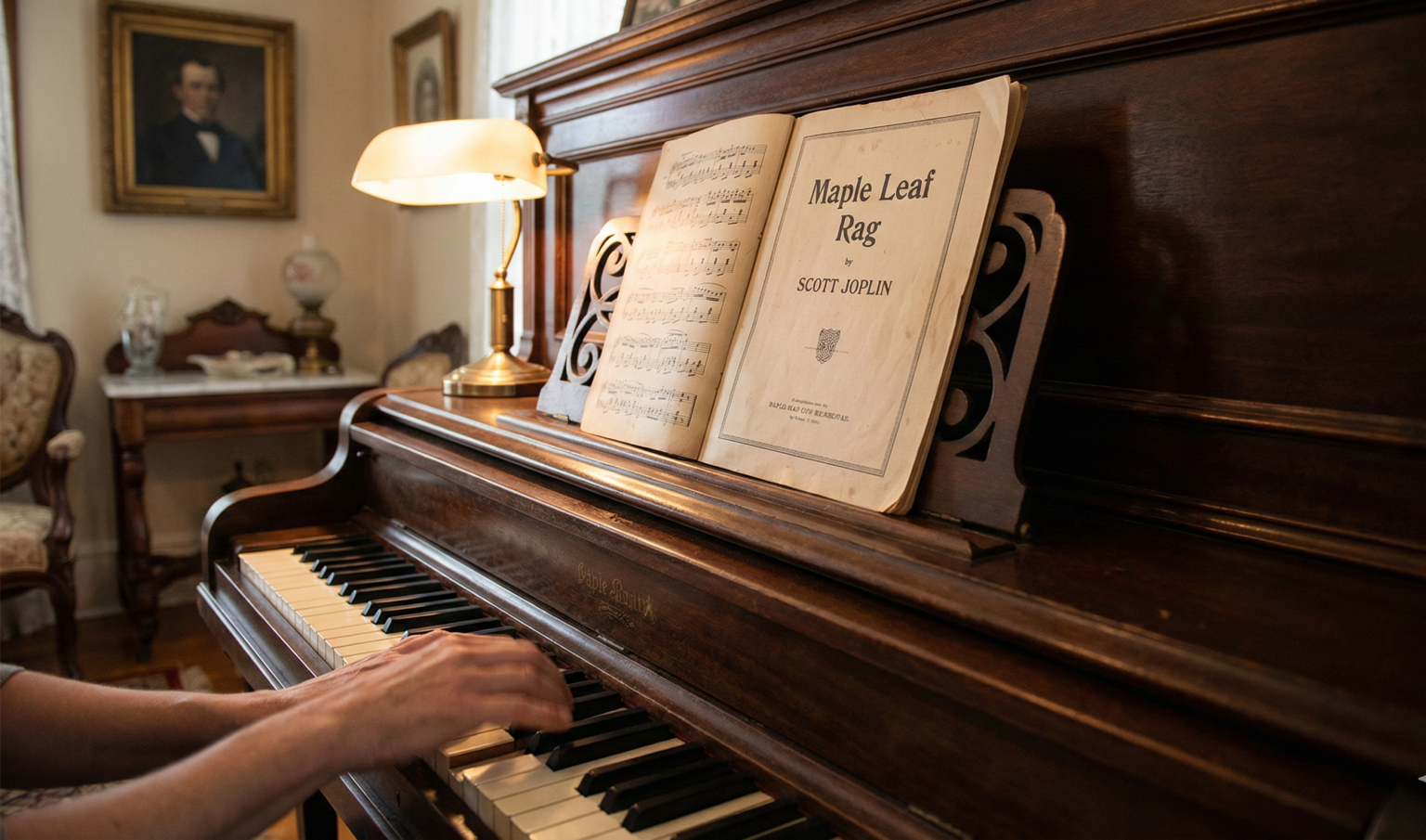
The Maple Leaf Rag is Scott Joplin’s most famous composition and the archetype of classic ragtime. Published in 1899, it is an advanced piano solo in A-flat Major known for its athletic left-hand stride patterns, rich syncopation, and four distinct musical strains (AABBACCDD). Mastering it requires developing a relaxed, pendulum-like left arm technique and a precise, rhythmic touch. It’s not just about hitting the notes; it is about locking into a groove that captivates listeners for over a century. Learning this piece is a rite of passage. It is the moment you graduate from “playing piano” to “playing ragtime.”
In this comprehensive guide, you will learn everything you need to master Scott Joplin’s magnum opus. We will dissect the history that birthed this masterpiece, analyze its complex structure, and provide a bar-by-bar walkthrough to help you conquer those treacherous left-hand jumps and syncopated right-hand chords.
History of the Piece and the Composer Behind It
Scott Joplin, often hailed as the “King of Ragtime,” was a musical visionary who sought to elevate African-American syncopated music to the status of high art. Born near Texarkana in the late 1860s, Joplin spent years as an itinerant musician before settling in Sedalia, Missouri, in the mid-1890s. It was here, amidst the bustling railhead atmosphere, that he attended music classes at George R. Smith College and played in local establishments, including the Maple Leaf Club, a social club for Black men that likely lent its name to this legendary piece.
The Maple Leaf Rag was published in September 1899 by John Stark, a white music publisher who heard Joplin play the piece and was immediately struck by its quality. Unlike the exploitative deals common at the time, Stark offered Joplin a royalty contract of one cent per copy sold. This might sound negligible, but the “Maple Leaf Rag” became the first instrumental sheet music to sell over one million copies. This steady income allowed Joplin to quit playing in brothels and saloons to focus on composing and teaching, eventually leading to his more ambitious works like the opera Treemonisha.
Musically, the piece was a game-changer. Before 1899, “ragtime” was often associated with simple improvisations or “coon songs.” The “Maple Leaf Rag” was different: it was a sophisticated, thoroughly composed work with complex harmonies and a structural integrity comparable to a Chopin mazurka or a Sousa march. It set the standard against which all future rags would be measured. It sparked a nationwide “ragtime craze” that bridged the gap between Victorian parlor music and the jazz age that was to follow.
Musical Structure and Style of “Maple Leaf Rag”
To play the “Maple Leaf Rag” effectively, you must understand its architecture. Joplin utilized a classic multi-strain form derived from military marches.
Structural Overview
The piece follows the form: AA – BB – A – CC – DD.
It is written in 2/4 time (Tempo di Marcia) and is predominantly in the key of A-flat Major (4 flats), with a modulation to the subdominant (D-flat Major) in the Trio (C section).
| Section | Keys | Bars | Description |
| Strain A | Ab Major | 1-16 (Repeated) | The “March.” Opens with a bold, ascending bass arpeggio and heavy, syncopated chords. |
| Strain B | Ab Major | 17-32 (Repeated) | The “Rhythmic Play.” Features descending melodic lines and intricate right-hand syncopation. |
| Return of A | Ab Major | 1-16 (No Repeat) | A restatement of the main theme to ground the tonality before the trio. |
| Strain C (Trio) | Db Major | 33-48 (Repeated) | The “Stomp.” Modulates to the subdominant. Famous for its driving rhythmic displacement. |
| Strain D | Ab Major | 49-64 (Repeated) | The “Finale.” Returns to home key. Athletic, with vigorous left-hand leaps and a triumphant finish. |
Stylistic Elements
- Classic Stride Bass: The left hand acts as the percussion section. It alternates between a low bass note (the “kick drum”) on beats 1 and 2, and a mid-range chord (the “snare”) on the off-beats (the ‘and’ of the beat). In “Maple Leaf Rag,” these jumps are often wide (tenths or more), requiring significant arm mobility.
- Syncopation: This is the heart of ragtime. The right hand constantly accents notes that fall between the main beats, creating a rhythmic friction against the steady left hand.
- Harmonic Sophistication: Unlike simpler rags, “Maple Leaf” uses advanced harmonic devices, including secondary dominants and diminished passing chords, giving it a rich, dense sound.
- “Tempo di Marcia”: Joplin famously warned, “It is never right to play ragtime fast.” This piece is not a race. It is a march. A tempo of quarter note = 90-100 BPM allows the intricate syncopations to “speak” clearly without sounding frantic.
Playing Tips: Technique and Interpretation
The “Maple Leaf Rag” is widely considered more difficult than “The Entertainer.” It is physically demanding and requires a higher degree of independence between the hands. Here is how to tackle the technical hurdles.
1. The Left Hand: The Pendulum Technique
The left hand (LH) in this piece is relentless. You will be jumping octaves constantly.
- Look at the Bass: Your eyes should track the low bass notes, not the chords. It is easier to “feel” for the mid-range chord than to find a specific low octave blindly.
- The Arc Motion: Do not move your hand in a straight line. Visualise a shallow arc or semi-circle. This keeps the wrist loose and uses gravity to help you land on the bass notes.
- Practice Without Looking: Once you know the notes, try playing the LH part with your eyes closed. This builds proprioception (body awareness) and muscle memory, which is crucial when reading the complex RH part.
2. The Right Hand: Octaves and Chords
The right hand (RH) plays thick chords, often spanning an octave.
- Keep the Bridge Firm: Your knuckles (the bridge of the hand) should be firm, not collapsing. This allows you to transfer arm weight into the keys for a full tone without banging.
- Wrist Flexibility: Do not lock your wrist. Use a “shock absorber” motion—a slight dip of the wrist on chords—to prevent tension buildup.
3. Rhythm: Straight vs. Swing
Important Definition: Classic ragtime is played with straight eighth notes, not swung (like jazz).
- Imagine a ticking clock. The division of the beat must be even. The “swing” feel comes from the accentuation of the off-beats, not from changing the time value of the notes.
- Metronome Practice: This is non-negotiable. Start at 60 BPM. Do not speed up until you can play an entire strain error-free.
4. Articulation and Dynamics
- Left Hand: Staccato and light. Think of the bass notes as a double bass (plucked) and the chords as a brass section (short bursts). Do not let the LH drown out the melody.
- Right Hand: Legato for the melody line (usually the top note of the chords), but detached for the accompanying harmony notes under the hand.
- Dynamics: Joplin does not mark many dynamics, implying a generally steady volume (mezzo-forte to forte). However, use “terraced dynamics” for repeats—play the strain loud the first time, and softer (echo effect) the second time, or vice versa, to add variety.
Bar-by-Bar Technical Walkthrough
Let’s break down the “Maple Leaf Rag” section by section. Have your sheet music ready.
Strain A: The March (Bars 1-16)
The piece explodes out of the gate. There is no introduction; you are immediately thrown into the action.
- Bars 1-4: The RH plays a striking motif of octaves. The LH begins with a trademark ascending arpeggio (Eb – Ab – C – Eb).
- Tip: In Bar 1, ensure the LH octaves are crisp. The RH syncopation lands on the “and” of beat 2. Be careful not to rush this.
- Fingering: Use 1-5 for all RH octaves. If you have small hands, keep your hand open and relaxed between strikes.
- Bars 5-8: The music answers the opening call.
- Technique: Watch for the LH bass movement. It moves stepwise. Ensure the chromatic passing tones are clear.
- Bars 9-16: The phrase repeats and resolves.
- The “Break”: In ragtime, the ends of phrases often have a “break” or a turnaround. Ensure the cadence (V-I) in bars 15-16 is definitive. Land on the final Ab chord with confidence.
Strain B: The Rhythmic Puzzle (Bars 17-32)
This section is often the hardest for students to count because the melody feels like it is “falling” across the bar lines.
- Bars 17-20: The RH plays a descending melody line high in the treble, while the LH maintains a steady Ab rhythmic pedal.
- Syncopation Alert: The RH melody accents the “and” of the beats consistently. It creates a polyrhythmic feel. Count out loud: “One-AND-Two-AND.”
- Fingering: The RH runs in thirds/sixths. Use 3-5 and 1-2 pairings to keep the legato line smooth on top.
- Bars 21-24: The harmony shifts. We see secondary dominants (Bb7) pushing toward the dominant (Eb).
- Hand Independence: The LH has some tricky leaps here involving black keys (Bb, Eb). Keep your eyes on the LH jumps.
- Bars 25-28: Similar to 17-20 but harmonized differently.
- Bars 29-32: The “Cadential Hammer.” The RH chords here are thick and percussive.
- Tip: Bring out the top note of the RH chords (the melody). The LH must drive forward to the repeat sign without slowing down.
Strain C: The Trio (Bars 33-48)
We modulate to D-flat Major (5 flats). This key change brings a mellower, richer tone. This section is famous for its “foot-stomping” rhythm.
- Bars 33-36: The texture changes. The RH plays a melodic ostinato while the LH does a call-and-response.
- Visual: Imagine dancers stomping on the floor. The LH bass notes on beats 1 and 2 should be heavy and resonant.
- Bars 37-40: The melody climbs.
- Technique: Watch the RH arpeggios. They sweep up quickly. Use a rotational wrist movement (like turning a doorknob) to facilitate the speed.
- Bars 41-44: A repeat of the opening Trio motif.
- Bars 45-48: The Return to Ab preparation.
- Crucial Moment: The Trio ends in Db, but must pivot back to Ab for the final D strain. Joplin uses a clever diminished chord progression to modulate back. Practice bars 47-48 on a loop to master this transition.
Strain D: The Grand Finale (Bars 49-64)
Back in A-flat Major. This is the victory lap. It is arguably the most athletic section of the piece.
- Bars 49-52: The RH plays a soaring melody with grace notes, while the LH performs its widest jumps of the entire piece.
- LH Jumps: You are jumping from low Ab to high chords. Stay relaxed. If you tense up here, you will miss notes.
- Bars 53-56: The “Call.” A distinctive syncopated rhythm in the RH that sounds like a question.
- Bars 57-60: The “Response.” A descending chromatic run in chords.
- Power: This needs to be forte. It is the climax. Put your body weight into the keys.
- Bars 61-64: The final cadence.
- The Last Bars: The piece ends with a classic ragtime tag. The final Ab octaves should be struck with finality. Let the pedal catch the last chord, then release sharply for a clean cutoff.
Conclusion
The Maple Leaf Rag is more than just a piece of sheet music; it is a monument of American culture. It represents the moment when syncopation moved from the dance halls to the parlors, demanding respect and attention.
Learning this piece is a journey. You will struggle with the jumps, you will tangle your fingers in the B section, and you will likely curse the key of A-flat Major at least once. But when you finally lock into that groove—when your left hand becomes an unstoppable metronome and your right hand dances freely over the keys—you will feel the pure, unadulterated joy that Scott Joplin felt in 1899.
My recommendation: Take it strain by strain. Do not rush to put the hands together. Treat the left hand as its own solo instrument until it is automatic. And above all, listen to the silence between the notes; that is where the “rag” lives.
Now, sit down at the bench, take a deep breath, and transport yourself back to the Maple Leaf Club. It’s time to play.
What grade level is Maple Leaf Rag?
It is generally considered Grade 8 (ABRSM/RCM) or early advanced. It is significantly harder than “The Entertainer” due to the density of chords and the speed of the left-hand jumps.
My hands are small. Can I still play it?
Yes, but you may need to adapt. If you cannot reach the octaves or tenths comfortably, you can “roll” the chords (play bottom to top quickly) or omit the bottom note of the RH octaves in fast passages. However, the LH tenths are usually played as broken intervals (bass note then chord) anyway, so hand span is less of an issue there.
How fast should I play it?
Ignore the fast performances you see on YouTube. Joplin’s own indication is “Tempo di Marcia.” Aim for 90-100 BPM. Clarity and rhythm are far more impressive than speed.
How do I stop my left hand from getting tired?
Tension is the enemy. If your arm hurts, you are using your muscles to hold your hand in place rather than relying on the natural weight of your arm. Practice the “drop and release” method: drop your arm weight into the key, then instantly relax the muscles while keeping the key depressed.