As an Amazon Associate, PianoMode earns from qualifying purchases. Recommendations are made on their merits; the price you pay is the same.
I remember the distinct, suffocating sensation of hitting “The Wall.” I was twenty years old, a conservatory student surrounded by prodigies who seemed to inhale repertoire rather than practice it. I was logging six, sometimes seven hours a day in a windowless practice room. My forearms burned with a dull, persistent ache that I convinced myself was the feeling of “strength building.” I believed in the brute-force method, the philosophy that if I couldn’t play a passage, I just hadn’t repeated it enough times. I was treating the piano like a heavy weight that needed to be lifted, rather than a puzzle that needed to be solved.
My breakthrough didn’t come from practicing more; it came from stopping completely. Frustrated and on the brink of injury, I stepped away from the instrument and dove into the library, specifically, into the sections on cognitive psychology, motor learning theory, and biomechanics. What I discovered was a revelation: I wasn’t untalented; I was inefficient. I was practicing mistakes, ingraining bad habits, and relying on muscle memory that was as fragile as glass because it wasn’t backed by cognitive understanding.
This report is the crystallization of that journey, supported by modern research in neuroscience and pedagogy. It is not a collection of generic tips. It is a comprehensive deconstruction of piano mastery. We will dismantle the “10,000-hour rule” and replace it with high-efficacy protocols like interleaved practice and spaced repetition. You will learn why your brain deletes musical information practiced in blocks, how to utilize gravity instead of muscle for speed, and why your eyes are the biggest bottleneck in sight-reading. This is the blueprint for learning piano faster, smarter, and with a depth of understanding that separates the amateur from the artist.
What You Will Learn
- Mental Mastery: Visualization techniques that count as physical practice and reduce bench time.
- Cognitive Architecture: How to hack your brain’s retention systems using Spaced Repetition, Interleaving, and Dopamine regulation.
- Biomechanics & Physics: The truth about “finger strength” vs. weight transfer (analyzing Taubman & Russian Schools).
- The Sight-Reading Hierarchy: Why rhythm trumps pitch and how to develop “Audiation” to hear music before you play it.
- Strategic Curriculum: A comparative analysis of ABRSM, RCM, and CM systems, and the “Hanon Debate.”
To learn piano faster, you must abandon “repetition” in favor of “Deliberate Practice.” This means replacing mindless run-throughs with highly focused, goal-oriented sessions that utilize Interleaved Practice (mixing different skills to force neural reloading) and Spaced Repetition (revisiting material just as you are about to forget it) to maximize long-term retention. Biomechanically, you must prioritize Proprioception (keyboard awareness without sight) and Weight Transfer over isolated finger strength to achieve speed without tension. Finally, integrating Mental Play (visualization) and Audiation (hearing music internally) accelerates neural myelination, allowing you to learn repertoire away from the keyboard and reducing physical practice time by up to 50%.
1. The Cognitive Architecture of Learning
The human brain is not designed to memorize complex motor sequences through passive repetition. It is an adaptation machine that prioritizes efficiency. When we practice mindlessly, the brain disengages to save energy. To learn faster, we must engage the brain’s active learning protocols.
The Science of Deliberate Practice
Deliberate Practice is a highly structured activity explicitly designed to improve performance. Unlike “naive practice”, where a student plays a piece from beginning to end, enjoys the parts they know, and stumbles through the parts they don’t, deliberate practice requires specific goals, intense focus, immediate feedback, and frequent discomfort.
The Core Components
Research in cognitive science indicates that deliberate practice operates on a feedback loop that constantly corrects errors and refines neural maps.
- Specific Goals: You cannot simply “practice the sonata.” A deliberate goal is: “I will fix the uneven voicing in measures 42-45 by practicing the left hand alone with a metronome at 60 BPM until I have three perfect repetitions.” This specificity gives the brain a clear target.
- Focused Attention: You cannot practice deliberately while watching TV or daydreaming. The cognitive load must be high. If you are not mentally exhausted after 45 minutes, you are likely not practicing deliberately. The brain requires high-intensity focus to trigger the release of neurochemicals like acetylcholine, which marks neurons for change.
- Immediate Feedback: You need an external standard to measure against. This can be a teacher, a recording, or a specific metric. Without feedback, you cannot correct errors, and practicing an error ingrains it just as deeply as practicing the correct version.
- Stepping Out of the Comfort Zone: Improvement only happens at the edge of your ability. If a practice session feels easy, you are maintaining, not learning. Deliberate practice involves a constant struggle against a task that is just slightly beyond your current capability.
Insight: Deliberate practice is often not “fun” in the traditional sense. It requires willpower and mental effort. However, just as muscles grow stronger under load, your ability to focus strengthens over time. Start with short, intense 20-minute sessions and expand as your cognitive endurance builds.
Interleaved Practice: Breaking the Block
Interleaved Practice involves mixing different tasks (e.g., Scale A, Arpeggio B, Piece C) within a single session, as opposed to Blocked Practice, which focuses on one task until it is “mastered” before moving to the next.
The Illusion of Competence
Blocked practice (AAAA-BBBB-CCCC) is the most common method used by students because it feels productive. After twenty minutes of practicing just the A Major scale, you see immediate, rapid improvement. You feel competent. However, research shows that this improvement is temporary. You are utilizing short-term working memory. When you return to the scale the next day, much of the progress has evaporated.
Interleaved practice (ABC-BCA-CAB), by contrast, feels difficult and frustrating. You don’t see the same rapid, smooth improvement during the session because you are constantly switching contexts. However, this struggle is exactly why it works.
The Neuroscience of Retrieval
When you repeat a passage ten times in a row, your brain enters “autopilot.” You are not retrieving the motor program from long-term memory; you are simply looping it in working memory. When you interleave, switching from a scale to a piece and back to the scale, your brain is forced to “reload” the motor program from long-term memory every single time. This act of retrieving and reconstructing the memory strengthens the neural pathway significantly more than simple repetition.
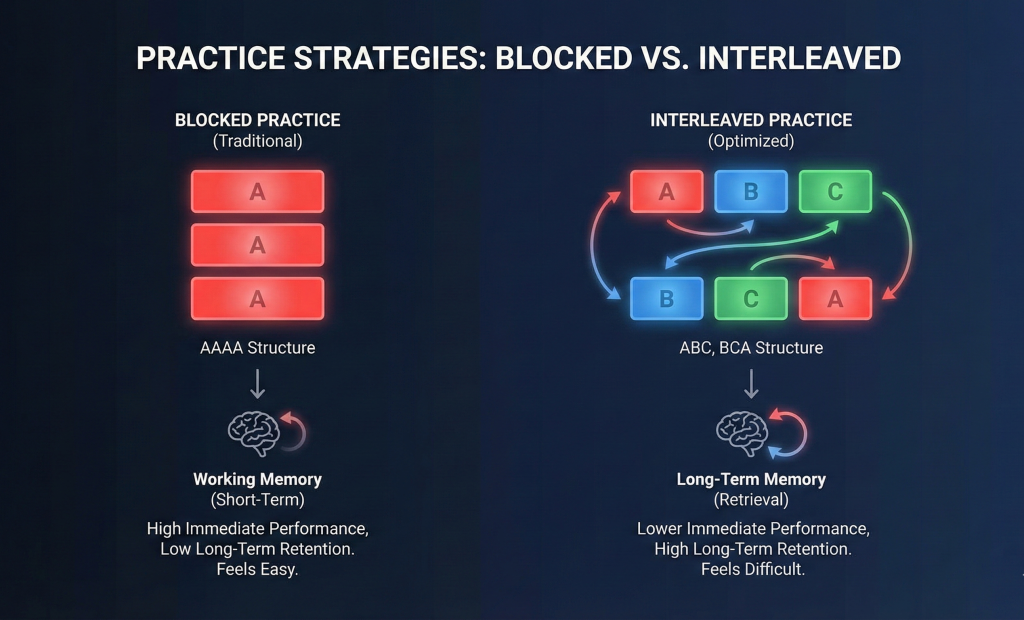
Comparative Table: Blocked vs. Interleaved Practice
| Feature | Blocked Practice (Traditional) | Interleaved Practice (Optimized) |
| Structure | AAAA, BBBB, CCCC | ABC, BCA, CAB |
| Immediate Performance | High (feels easy/smooth) | Lower (feels difficult/confusing) |
| Long-Term Retention | Low (rapid forgetting) | High (strong neural encoding) |
| Cognitive Effort | Low (autopilot/low load) | High (constant retrieval/high load) |
| Contextual Transfer | Poor (isolated context) | Excellent (varied context) |
| Best Used For | Initial learning of a brand new concept | Refining and solidifying known material |
Implementation Strategy:
Do not practice your repertoire sequentially every day. Randomize your sections. Play the exposition, then the coda, then the development. This “contextual interference” forces your brain to understand the music structurally rather than just mechanically, preventing the common issue where a student can only play a piece if they start from the very beginning.
Spaced Repetition and Memory Consolidation
Spaced Repetition is a learning technique that incorporates increasing intervals of time between subsequent review of previously learned material in order to exploit the psychological spacing effect.
The “Forgetting Curve,” originally hypothesized by Hermann Ebbinghaus, dictates that we lose a significant percentage of new information within 24 hours. However, interrupting this forgetting process at the right moment resets the curve and strengthens the memory trace (engram).
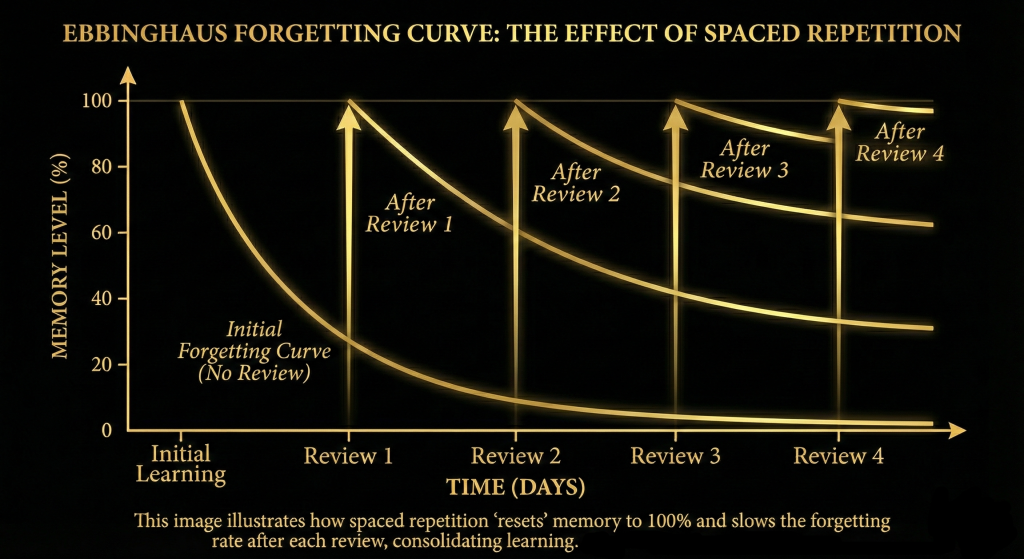
Hacking the Forgetting Curve
Instead of practicing a passage for an hour on Monday and then ignoring it until Friday, distribute that hour across the week. The struggle to recall the information after a delay is the catalyst for stronger memory formation.
- Day 1: 15 minutes (Initial learning).
- Day 2: 10 minutes (Recall is difficult; neural pathway strengthens).
- Day 4: 10 minutes (Recall is easier; consolidation occurs).
- Day 7: 5 minutes (Maintenance).
The Role of Sleep:
Sleep is the critical component of spaced repetition. During REM sleep and slow-wave sleep, the brain processes motor skills and moves them from explicit memory (conscious, hippocampus-dependent) to implicit memory (subconscious, motor cortex/cerebellum).
You often play better the next day not because you practiced more, but because you slept. The brain “practices” while you sleep, pruning irrelevant connections and strengthening the core motor patterns.
The Neurochemistry of Motivation: Dopamine Loops
Dopamine is a neurotransmitter that functions as a reward and motivation signal. It is not just about pleasure; it is about drive. It is released when we anticipate a reward or experience a “prediction error”, a positive surprise where the outcome is better than expected.
Engineering the Dopamine Loop
To maintain the intense motivation required for deliberate practice over years, you must engineer “dopamine loops.” If you set a goal to “Learn the Rachmaninoff Concerto No. 2,” the reward is months or years away. Your brain will lose motivation because the feedback loop is too long.
The Strategy: Small Wins
You must break the massive goal into micro-goals that can be achieved in 5-10 minutes.
- Goal: “I will play this run cleanly three times in a row.”
- Action: Focused practice.
- Result: Success.
- Neurochemical Response: Achieving this “small win” releases dopamine. This dopamine chemically reinforces the neural circuit you just used (making the skill stickier) and fuels the motivation to tackle the next chunk.
The Science of Frustration:
Conversely, chronic frustration inhibits this process. If you practice a section that is too difficult and fail repeatedly, cortisol (stress hormone) levels rise, which can block neuroplasticity. This is why it is crucial to set goals that are challenging but achievable. If you are failing more than 50% of the time, the task is too hard; simplify it (slow it down, hands separate) to get back into the “dopamine zone” where success is possible.
2. The Biomechanics of Virtuosity
Piano playing is, at its core, a manipulation of physics. We use a system of levers (the body) to manipulate another system of levers (the piano action). Efficiency in this system allows for speed and power; inefficiency leads to tension and injury.
Ergonomics: The Physics of the Seated Position
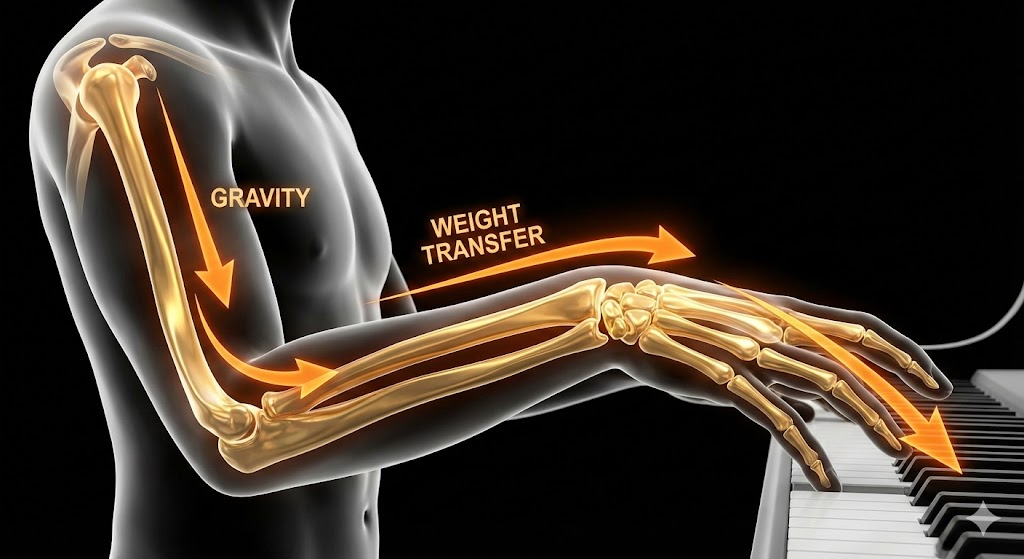
Before a single note is played, the relationship between the body and the instrument must be calibrated. The piano is a machine; your body is the actuator. If the leverage is wrong, the output will be inefficient.
The Bench Height Formula
There is no “standard” height that works for everyone, but there is a standard relationship based on fulcrums and levers.
- Elbow Alignment: When sitting with hands on the keys, your elbows should be slightly above the level of the keyboard. This allows gravity to flow down into the keys. If you sit too low (the “Glenn Gould” position), you must use muscular effort to hold your arms up or push up into the keys, creating tension in the trapezius and shoulders. Sitting high allows the weight of the arm to do the work.
- Knee Position: Knees should be slightly under the keyboard, feet flat and grounded. The feet act as stabilizers for the torso. If the feet are floating or wrapped around the bench legs, the lower back must tense up to stabilize the body, robbing the arms of freedom.
- Distance: You must be far enough back that your elbows comfortably clear your torso. If your elbows are jammed against your ribs, rotation (a key Taubman concept) is impossible. You need space for the arm to swing freely across the torso.
As an Amazon Associate I earn from qualifying purchases.
As an Amazon Associate I earn from qualifying purchases.
Standard Adjustment Protocol:
- Sit tall on the front half of the bench (ischial tuberosities anchored).
- Measure distance from knee to floor.
- Subtract cushion compression (approx. 1-2 inches).
- Adjust bench to this height.
- Check forearm angle: It should slope slightly downward toward the keys.
The Taubman Approach: Rotation and Alignment
The Taubman Approach, developed by Dorothy Taubman, is a pedagogical system that emphasizes coordinate motion, alignment, and forearm rotation to prevent injury and maximize technical facility. It challenges the traditional notion of “finger independence”.
The Myth of Finger Isolation
The fingers have no muscles; they are moved by tendons connected to the forearm muscles (flexors and extensors). Moving fingers in isolation, lifting them high and hammering them down, is mechanically inefficient and places immense strain on the tendons. Taubman teaches that a subtle rotation of the forearm (pronation and supination, like turning a doorknob) should support every finger stroke. This brings the power of the larger arm muscles behind the relatively weak fingers.
Key Concepts of Taubman
- Forearm Rotation: Even for playing a simple scale, the forearm rotates slightly toward the playing finger. This “rotational support” ensures that the finger does not have to work alone. It feels like the arm is “pouring” weight into the finger.
- The Walking Hand: The hand should not stretch to reach keys, as stretching creates tension (co-contraction of flexors and extensors). Instead, the arm should move the hand to the correct position. If you need to play an octave, do not stretch your hand open and hold it rigid; utilize lateral arm movement to transport the hand.
- Shaping: This refers to the curvilinear motion of the arm (moving in and out of the black key area). “In and out” movements allow the shorter fingers (thumb/pinky) and longer fingers (middle) to play with equal leverage without twisting the wrist (ulnar/radial deviation).
Insight: Paradoxically, minimizing active finger movement and maximizing arm rotation results in faster playing. The large muscles of the forearm do not fatigue as quickly as the small flexors of the hand, and the rotation provides a rhythmic impulse that organizes the fingers.
The Russian School: Weight and Tone Production
The Russian School (exemplified by pedagogues like Heinrich Neuhaus and Alexander Goldenweiser) emphasizes “Weight Production” or the “Singing Tone.” While Taubman focuses on mechanics and injury prevention, the Russian school focuses on the sonic result of gravity.
Gravity vs. Muscle
The central tenet is that “strength” is a misnomer. You do not need strong fingers; you need a strong arch (bridge) to support the weight of the arm. The arm is treated as a relaxed dead weight that hangs from the shoulder.
- The Technique: Imagine your arm is a heavy rope and your finger is the hook at the end. When you play, you release the weight of the arm into the bottom of the key. To move to the next note, you do not lift the arm; you transfer the weight, like walking on your legs. One finger supports the weight until the next takes over. This creates a seamless legato, known as the “cantabile” style.
The Synthesis:
Modern virtuosity often combines these schools. We use the rotation of Taubman to facilitate the weight transfer of the Russian school. This hybrid approach allows for the massive sound required for Rachmaninoff (Russian weight) and the agile clarity required for Mozart (Taubman rotation).
Proprioception: The Art of Blind Playing
Proprioception is the body’s ability to sense its location, movements, and actions in space. It is the “internal map” that allows you to touch your nose with your eyes closed.
Many pianists are “keyboard gazers.” They rely entirely on vision to find notes. This is a fatal flaw for two reasons:
- Latency: The visual processing loop (Eye -> Brain -> Motor Cortex) is slower than the tactile/proprioceptive loop (Touch -> Spinal Cord/Cerebellum -> Motor Cortex).
- Score Reading: You cannot look at the sheet music if you are looking at your hands.
Developing Keyboard Topography
To play faster, you must trust your hands. You must feel the intervals (the distance between notes) rather than see them.
- The Black Key Map: The black keys are the Braille of the piano. You locate white keys by feeling their position relative to the groups of two and three black keys. A “C” is not just a white key; it is the “white key to the left of the two black keys.” Advanced pianists navigate entirely by feeling these groups.
- Blind Practice: Playing scales, jumps, and pieces with eyes closed forces the brain to switch from visual dependence to proprioceptive dependence. It strengthens the neural map of the keyboard topography.
Exercise: The Blind Jump
- Place your hand on a C Major chord.
- Close your eyes.
- Visualize the position of the C Major chord one octave higher.
- Move your hand in an arc and land on the chord.
- Before you press the keys, feel the black keys to confirm your position.
- Play.
3. Strategic Curriculum Design
Structuring your learning path is as important as the practice itself. Without a curriculum, you are a ship without a rudder.
The Great Debate: Hanon and Technical Drills
The Topic: The Virtuoso Pianist by Charles-Louis Hanon (1873) consists of 60 exercises designed to build finger independence, strength, and equality. It is perhaps the most famous, and divisive, technical book in piano history.
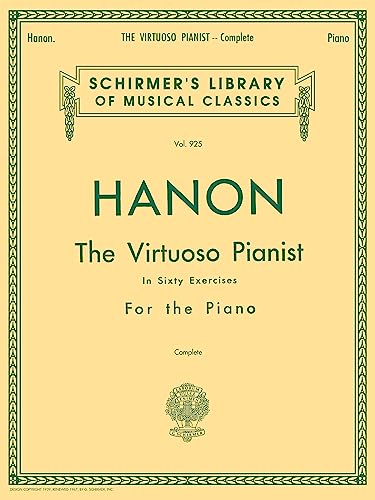 Kindle editionRead on Kindle ›
As an Amazon Associate I earn from qualifying purchases.
The Arguments:
- Pro-Hanon: Supporters argue that the exercises provide a simplified “gym” for the fingers. They build endurance, strengthen the weak 4th and 5th fingers, and allow students to focus purely on mechanics without the distraction of musical interpretation. It is seen as a way to “warm up” the machine.
- Anti-Hanon: Detractors (including many Taubman/Russian advocates) argue that Hanon encourages “finger isolation” and tension. The exercises are repetitive, unmusical, and if played with high fingers (as originally instructed), can lead to injury (tendonitis). They argue technique should be learned through real repertoire (e.g., Chopin Etudes, Bach Inventions) which offer musical context.
The Expert Verdict: Hanon is a tool, not a religion. It is dangerous only if practiced with tension.
- Don’t use it to build “strength” by hammering keys or lifting fingers high.
- Do use the patterns to practice wrist rotation, transposition (playing them in all 12 keys), and rhythmic variations. Used mindfully, the patterns are useful for coordination. Used mechanically, they are a waste of time.
Standardized Systems: ABRSM vs. RCM vs. CM
For students in the USA, UK, Canada, and Australia, graded exams provide a structured ladder of progress. However, they differ significantly in philosophy and requirements.
Comparative Table: Major Piano Exam Boards
| Feature | ABRSM (UK/Global) | RCM (Canada/USA) | CM (California/USA) |
| Full Name | Associated Board of the Royal Schools of Music | Royal Conservatory of Music | Certificate of Merit |
| Philosophy | Academic, rigorous, deeply traditional. | Comprehensive, performance-focused. | Teacher-run, focused on state standards. |
| Levels | Grades 1-8 + Diplomas | Levels 1-10 + Diplomas | Levels 1-10 |
| Repertoire | Smaller selection (3 pieces/exam). | Large syllabus options. | Wide selection. |
| Technical | Scales/Arpeggios (Specific keys per grade). | Scales/Arpeggios (More extensive). | Technique is heavily emphasized. |
| Sight Reading | Mandatory and notoriously difficult. | Mandatory. | Mandatory. |
| Theory | Theory Grade 5 required to take Practical Grade 6+. | Theory co-requisites for certificates. | Theory test included in annual eval. |
| Difficulty | High. Grade 8 is essentially pre-conservatory entry. | High. Level 10 is equivalent to ABRSM 8+. | Variable. Generally considered slightly easier than ABRSM/RCM at upper levels. |
| Global Rec. | The “Gold Standard” internationally. | Dominant in N. America. | Mostly recognized in California/USA. |
Recommendation:
- Choose RCM for a balanced, North American-friendly comprehensive curriculum with excellent publications (Celebration Series).
- Choose ABRSM if you want the internationally recognized credential and a rigorous academic approach, particularly if you are in Europe or Asia.
- Choose CM if you are in California and working with a local MTAC teacher.
The Jazz Advantage for Classical Pianists
Classical pianists are often “score-bound.” They can play complex Liszt concertos but panic if asked to play “Happy Birthday” without sheet music. Integrating Jazz theory bridges this gap and creates a complete musician.
The “Circle of Fifths” Workout:
The Circle of Fifths is not just a theory chart; it is a map of harmonic gravity.
As an Amazon Associate I earn from qualifying purchases.
- Exercise: Play a ii-V-I progression (the DNA of Jazz) in C Major (Dm7 – G7 – Cmaj7). Then, move the root motion around the circle (C -> F -> Bb -> Eb…).
- Benefit: This builds tactile fluency in all 12 keys. You stop being “scared” of keys with 5 or 6 sharps because your hands know the shape of the chords in those topographies.

Why Learn Jazz?
- Harmonic Understanding: You begin to see music as chords and structures, not individual notes. This drastically improves memory and sight-reading. You realize that a measure of Chopin is just a fancy Eb Major chord.
- Rhythmic Freedom: Jazz demands a “groove” and “swing” that improves the rhythmic solidity of classical playing.
- Compositional Insight: Improvisation is “real-time composition.” It helps you understand why Bach or Beethoven made the choices they did. Research suggests that jazz pianists and classical pianists engage different brain networks; integrating both creates a “super-network” of musical ability.
As an Amazon Associate I earn from qualifying purchases.
4. The Sight-Reading Ecosystem
Sight-reading is the ability to read and perform a piece of music you have never seen before. It is not “reading individual notes.” It is the rapid decoding of patterns. It is a language skill. A fluent reader does not read l-e-t-t-e-r-s; they read words and sentences.
The Hierarchy of Processing
When sight-reading, the brain must prioritize information because the processing load is immense. Novices prioritize Pitch (hitting the right note) at the expense of Rhythm. Experts prioritize Rhythm at the expense of Pitch.
The Sight-Reading Pyramid (Priority Order):
- Rhythm: If you play the wrong note but the right rhythm, the musical structure survives. If you play the right note but the wrong rhythm, the structure collapses. Rhythm is the skeleton.
- Contour/Direction: Is the music going up or down? By step (interval of a 2nd) or by skip (3rd or larger)? Even if you miss the exact note, getting the direction right preserves the shape.
- Harmony/Patterns: Recognizing a C Major chord as a single “chunk” rather than three individual notes (C-E-G).
- Exact Pitch: The final detail.
Insight: Poor sight-readers stop when they make a mistake to correct it. This is a habit that must be broken. In the “real world” (accompanying, bands), the beat goes on. You must learn to “ghost” (fake) the notes but nail the downbeat.
Audiation: The Inner Ear
Audiation is the ability to hear and comprehend music in one’s mind without physical sound being present. It is to music what thinking is to language.
If you can look at a score and “hear” it in your head, your fingers will instinctively find the notes because the auditory cortex cues the motor cortex. Without audiation, you are essentially typing in a language you don’t speak, matching dots to keys mechanically.
Developing Audiation:
- Singing: Sing the melody while playing the accompaniment. This forces your brain to internalize the pitch.
- Silent Score Study: Look at a piece of music away from the piano. Try to hear the rhythm and the melody. This mental effort builds the “inner ear” and prepares the mind for the physical execution.
Pattern Recognition and Chunking
Chunking is the process of binding individual pieces of information together into a meaningful whole. A pianist sees a run of notes not as “G, A, B, C, D, E, F#, G” but as “G Major Scale”.
Expert vs. Novice Eye Movements:
Eye-tracking studies show that novices look at every note vertically (clef to clef). Experts look horizontally and “look ahead.” The expert’s eye is usually 1-2 measures ahead of their hands. This buffer allows the brain to process the “chunk” before the motor system needs to execute it.
- Drill: Use a card to cover the measure you are currently playing, forcing you to look at the next measure. This forces the brain to buffer information and prevents looking back.
As an Amazon Associate I earn from qualifying purchases.
5. Advanced Practice Protocols
Once the cognitive and biomechanical foundations are laid, we move to the specific tactics of the practice room.
Metronome Mastery and Rhythmic Variants
The metronome is often misused as a mere speedometer. It should be used as a microscope and a rhythm trainer.
Strategy 1: Rhythmic Variants (The “French” Method)
If a passage of even notes (like a scale or run) is uneven or sloppy, do not just play it slowly. Alter the rhythm.
- Variant A: Long-Short (Dotted rhythm). Hold the first note, snap the second.
- Variant B: Short-Long (Reverse dotted). Snap the first note, hold the second.This forces the brain to process the rapid transition between notes quickly, while giving a “rest” on the long note. When you return to even playing, the fingers feel lighter and faster because they have essentially practiced the run at double speed in tiny bursts.52
Strategy 2: Progressive Speed-Up
Start at 50% tempo. Increase by 2-5 BPM only after a perfect repetition. If you make a mistake, drop back 10 BPM. This “two steps forward, one step back” approach ensures solidity.
As an Amazon Associate I earn from qualifying purchases.
Ghosting and Dynamic Control
Ghosting is a powerful technique for balancing the hands (e.g., a loud melody in Right Hand, quiet accompaniment in Left Hand) and improving coordination.
The Protocol:
- Play the Right Hand (melody) forte (loud).
- Play the Left Hand (accompaniment) silently. Touch the keys, depress them slightly, but make no sound.
- This decouples the dynamic connection between the hands. It teaches the Left Hand to move without weight, while the Right Hand pours weight into the keys.
- Gradually allow the Left Hand to whisper. You will find you have much greater independence.
Mental Play and Visualization
Mental Play involves visualizing the performance of a piece in vivid detail, imagining the visual aspect of the keys, the tactile sensation of the weight, and the auditory sound of the notes.
fMRI studies show that visualizing playing the piano lights up the same motor centers in the brain as actually playing.
- The Experiment: One group practiced physically for 2 hours. Another mentally practiced for 2 hours. Both showed similar neurological reorganization and skill acquisition.
How to Practice Mentally:
- Lie down or sit away from the piano.
- Close your eyes.
- Visualize your hands on the keys. See the black and white patterns.
- “Play” the piece in your mind at full tempo. Feel the stretch of the intervals. Hear the sound.
- Crucial Point: If you get “stuck” in your mind (can’t remember what comes next), that is exactly where your memory is weak physically. Go to the score, check it, and repair the mental map.
Recording and Self-Evaluation
You cannot be the performer and the critic simultaneously. Your brain is too busy executing motor commands to objectively listen to the output.
The Recording Protocol:
- Record a run-through of your piece (use a phone or dedicated recorder).
- Wait 5 minutes. Do not listen immediately. Reset your ears.
- Listen with a pen and paper (or score in hand).
- Mark the score: Circle areas where rhythm rushed, dynamics were flat, or notes were missed.
- The Golden Rule: If you can hear the mistake on the recording, you have the ability to fix it. If you cannot hear it, you need a teacher to point it out. Most students are shocked to hear how much they rush.
As an Amazon Associate I earn from qualifying purchases.
6. Physical Maintenance and Warm-Up
A pianist is an athlete of the small muscles. Like a sprinter, you must warm up to prevent injury.
The Physiology of Warm-Ups
Cold muscles are prone to micro-tears. A good warm-up increases blood flow, raises muscle temperature, and lubricates the synovial joints.
The Routine:
- Large Body Movements: Arm circles, shoulder shrugs, and torso twists. Release tension in the neck and back before sitting down.
- Finger Stretches: Gentle extension of the flexors (pulling fingers back gently).
- Scales at 50% Tempo: Play a simple scale slowly, focusing on deep tone and full weight transfer. Do not start with fast etudes.
Injury Prevention Strategies
Tendonitis and Carpal Tunnel Syndrome are the enemies of the pianist. They are almost always caused by:
- Tension: Holding the muscle contracted after the work is done.
- Ulnar/Radial Deviation: Twisting the hand sideways at the wrist. Keep the wrist aligned with the forearm.
- Overuse: Playing for hours without breaks.
The Rule of 20: Every 20 minutes, take a 20-second break. Drop your arms to your sides, shake them out, and reset your posture. This allows the lactate to flush out of the muscles and resets the neural focus.
Recommended Mastery Gear:
Ergonomics: Adjustable Piano Bench – Essential for proper weight transfer.
As an Amazon Associate I earn from qualifying purchases.
Technique: Hanon: The Virtuoso Pianist – For rotational drills.
As an Amazon Associate I earn from qualifying purchases.
Precision: Digital Metronome – For rhythmic variant training.
As an Amazon Associate I earn from qualifying purchases.
Feedback: Zoom H1n Handy Recorder – For objective self-evaluation.
As an Amazon Associate I earn from qualifying purchases.
Conclusion
Learning the piano faster and smarter is not about finding a magic pill that bypasses the work. It is about applying the scientific method to your art. It is the realization that how you practice matters infinitely more than how long you practice.
By integrating Cognitive Science (Spaced Repetition, Interleaving), you stop fighting your brain’s natural forgetting curve. By adopting sound Biomechanics (Taubman rotation, Russian weight transfer), you work with physics rather than against it, preventing injury and unlocking speed. By mastering Sight-Reading through audiation and pattern recognition, you open the library of musical history.
The “Golden Rule” is mindfulness. Every second spent at the keys must be conscious. If you are playing on autopilot, you are not learning; you are stagnating. Step out of your comfort zone, embrace the difficulty of interleaved practice, and visualize your success before your hands ever touch the keys. This is the path of the master.
Action Plan for Tomorrow:
- Analyze your bench height. (Is your elbow above the keys?)
- Pick one difficult measure. Apply the “Rhythmic Variants” technique.
- End your session by playing “blind” (eyes closed) for 5 minutes to wake up your proprioception.
- Visualize your piece before you sleep to consolidate the memory.
Stop practicing harder. Start practicing smarter.
Is it too late to learn piano as an adult?
No. While neuroplasticity (the brain’s ability to rewire itself) is higher in children, adults possess superior analytical skills, discipline, and abstract understanding. Adults can learn faster in the initial stages because they understand concepts (theory, patterns) quicker. The only disadvantage is physical flexibility, which can be mitigated with ergonomic technique (Taubman/Russian approaches). Adults often struggle more with the ego of being a beginner than the actual cognitive task.
How long should I practice each day?
Quality trumps quantity. 45 minutes of Deliberate Practice (intense focus, feedback loops, interleaving) is superior to 4 hours of mindless repetition. For beginners, 20-30 minutes is sufficient. For advanced students, 2-4 hours is standard, but must be broken into sessions to avoid mental fatigue and injury. If you practice past the point of concentration, you are practicing mistakes.
Do I really need to learn scales and music theory?
Direct Answer: Yes, if you want to learn faster. Music is a language. Scales and chords are the vocabulary. If you don’t know them, you are reading “letter by letter” (sight-reading every individual note). If you know theory, you recognize “words” and “sentences” (scales and chords), allowing you to process information 10x faster. It turns a page of confusing dots into a logical map.
Digital vs. Acoustic Piano: Does it matter?
Ideally, an acoustic piano is best for developing subtle touch and “tone production” due to the complex feedback of the real action. However, a high-quality digital piano with weighted hammer action is acceptable for the first few years. Avoid non-weighted “keyboards” (synthesizers), as they do not build the finger strength or weight-transfer technique required for real piano playing. If you practice on non-weighted keys, you will struggle to play a real piano.