As an Amazon Associate, PianoMode earns from qualifying purchases. Recommendations are made on their merits; the price you pay is the same.
Imagine sitting before a grand piano, the polished black and gold keys shimmering under the warm glow of a stage light. Your heart races with excitement as you prepare to play your first melody. You look at the sheet music, and suddenly, you see tiny numbers hovering over the notes. These are not mathematical equations or page numbers; they are the “secret map” that guides your hands across the ivory. When beginners first encounter these digits, they might seem like a minor detail, but they are, in fact, the blueprint for ergonomic efficiency and musical expression. Mastering piano finger numbers is the first step in transforming clumsy movements into a fluid, professional performance.
In this comprehensive guide, you will learn the universal numbering system, the biomechanics of hand positioning, and advanced techniques like thumb-tucking and finger-crossing that professional pianists use to navigate complex scores.
Piano finger numbers are a standardized pedagogical system that assigns a specific digit from 1 to 5 to each finger on both the right and left hands to dictate the most efficient way to play a musical passage.
This system is universal across all modern piano methods and sheet music, ensuring that a pianist in New York can read a score published in London, Paris, Berlin or Toronto with total clarity. The numbering is symmetrical between the hands, meaning the thumb is always the starting point:
- Finger 1: The Thumb
- Finger 2: The Index Finger
- Finger 3: The Middle Finger
- Finger 4: The Ring Finger
- Finger 5: The Pinky (Little Finger)
1. The universal 1-5 Map: Left Hand vs. Right Hand
The most common point of confusion for adult beginners is the mirror symmetry of the hands. While both thumbs are “1,” they sit on opposite sides of their respective hands. On the keyboard, your right-hand thumb (1) is the leftmost finger, while your left-hand thumb (1) is the rightmost finger.
To understand why a numerical system is necessary, one must look toward the history of music notation and the physical requirements of keyboard performance. In the early stages of keyboard music, particularly during the era of the harpsichord and clavichord, fingering was often left to the intuition of the performer. However, as compositions grew in complexity during the Baroque and Classical periods, it became clear that “intuitive” fingering was often inefficient, leading to awkward hand positions and interrupted melodic lines.
Right Hand (RH) Fingering
In the right hand, the numbers increase as you move up the keyboard (toward the higher pitches).
- 1 (Thumb): Plays the lowest note in a standard five-finger position.
- 5 (Pinky): Plays the highest note.
Left Hand (LH) Fingering
In the left hand, the numbers increase as you move down the keyboard (toward the bass notes).
- 1 (Thumb): Plays the highest note in a standard position.
- 5 (Pinky): Plays the lowest note.
| Finger | Right Hand Role | Left Hand Role |
| 1 (Thumb) | Anchor for ascending scales | Anchor for descending scales |
| 2 (Index) | Directional guide | Directional guide |
| 3 (Middle) | Pivot point | Pivot point |
| 4 (Ring) | Weakest/Support | Weakest/Support |
| 5 (Pinky) | Boundary/Melody lead | Boundary/Bass foundation |
The finger numbering system allows pedagogy to target these physiological realities. By labeling the fingers, exercises like those by Hanon or Czerny can specifically reference the “weak” digits (4 and 5) to build the strength and independence necessary for even playing. Furthermore, the system reinforces the “economy of motion”, the principle that a pianist should cover as many notes as possible within a single hand position before shifting.
 Kindle editionRead on Kindle ›
As an Amazon Associate I earn from qualifying purchases.
 Kindle editionRead on Kindle ›
As an Amazon Associate I earn from qualifying purchases.
2. Why Finger Numbers Are Essential for Progress
Using the correct finger numbers is not just a suggestion; it is a requirement for technical development. Music theory and notation evolved alongside the keyboard to accommodate the human hand’s natural ergonomics.
Efficiency and Speed
If you try to play a rapid scale using only your index finger, you will quickly hit a physical speed limit. Standardized fingering allows you to use all ten fingers in a coordinated sequence, enabling the “rapid-fire” execution of notes required in advanced classical or jazz pieces.
Muscle Memory (Proprioception)
Consistency is the key to mastery. When you use the same finger for the same note every time you practice a piece, your brain develops proprioception, the ability to know where your hand is in space without looking at the keys. If you change your fingering every time you play, your muscle memory will never “lock in,” leading to frequent mistakes during performance.
Phrasing and Articulation
Certain fingers have natural strengths. The thumb (1) is heavy and strong, while the pinky (5) is agile but thinner. Pedagogy uses these traits to create articulation, the way a note is struck to sound short (staccato) or smooth (legato).
3. The Foundations of Hand Position: The “C Position”
The “C Position,” also known as the “C Major Pentascale,” (C is Do in Latin name) is the standard starting point for most adult beginners. This position establishes the relationship between finger numbers and the seven natural pitches of Western music (C, D, E, F, G, A, B – Do, Ré, Mi, Fa, Sol, La, Si).
Right Hand (RH) Configuration
In the right hand, the thumb (finger 1) is placed on “Middle C” (C4), the pitch located in the center of the piano with a frequency of approximately 261.6 Hz. The remaining fingers are assigned as follows:
- Finger 2: D (ré)
- Finger 3: E (mi)
- Finger 4: F (fa)
- Finger 5: G (sol)
Left Hand (LH) Configuration
In the left hand, the little finger (finger 5) is usually placed on the C one octave below Middle C (C3). The configuration is:
- Finger 5: C (do)
- Finger 4: D (ré)
- Finger 3: E (mi)
- Finger 2: F (fa)
- Finger 1: G (sol)
This arrangement creates a mirror effect. When playing a basic five-note melody that ascends (moves from low to high), the right hand uses fingers 1-2-3-4-5, while the left hand uses 5-4-3-2-1. This requires the student to decouple their physical sensations from the numerical sequence, a process fundamental to developing hand independence.
The Biomechanics of the “Orange” Grip
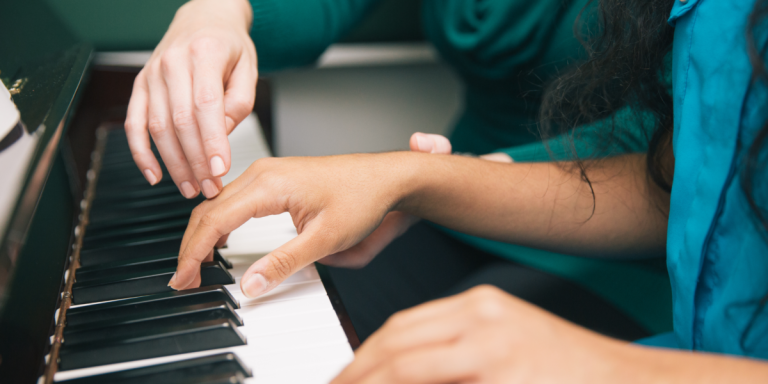
To play these notes correctly, you must avoid “flat fingers.” Experts recommend imagining you are holding a small orange or a tennis ball. This curves the fingers so that you strike the keys with the tips of fingers 2-5 and the side-tip of the thumb.
4. Advanced Movement
The piano has 88 keys, but you only have five fingers per hand. To play a scale like C Major, which has eight notes, you must use a technique called “crossing over” or “tucking under”.
The Thumb Tuck (Thumb-Under)
In a C Major scale (Right Hand), you play C-D-E with fingers 1-2-3. To reach the F, you “tuck” your Thumb (1) under your middle finger. This allows you to reset your hand position and continue the scale smoothly up to the next C.
The Finger Cross (Finger-Over)
When descending in the left hand, you might play G-F-E (Sol-Fa-Mi) with fingers 1-2-3. To continue down to D (Ré), you “cross” your Middle Finger (3) over your thumb to land on the D.
The C Major Scale Fingering (Right Hand)
To play the C major scale (C-D-E-F-G-A-B-C) ascending:
- Play fingers 1, 2, and 3 (C, D, E or Do, Ré, Mi).
- As finger 3 is playing E, the thumb (1) tucks underneath to play F.
- The rest of the hand then follows, with fingers 2, 3, 4, and 5 playing G, A, B, and C.
This “1-2-3, 1-2-3-4-5” pattern is the standard fingering for many major scales starting on white keys. For the left hand, the pattern is mirrored: 5-4-3-2-1, then the 3 crosses over the thumb to finish the scale.
Arpeggios and Chord Inversions
Arpeggios are “broken chords” where the notes are played one after another rather than simultaneously. Because arpeggios often span multiple octaves, the use of fingers 1, 2, and 3 (or 1, 2, and 4) is crucial for a smooth lateral shift across the keyboard.
| Chord Type | Root Position Fingering (RH) | 1st Inversion Fingering (RH) | 2nd Inversion Fingering (RH) |
| C Major (C-E-G) | 1 – 3 – 5 | 1 – 2 – 5 | 1 – 3 – 5 |
| A Minor (A-C-E) | 1 – 3 – 5 | 1 – 2 – 5 | 1 – 3 – 5 |
| D Major (D-F#-A) | 1 – 3 – 5 | 1 – 2 – 5 | 1 – 3 – 5 |
Selecting the correct finger for an inversion (e.g., using finger 2 instead of 3 for the middle note of a first inversion chord) is determined by the interval distance. In a first inversion chord (E-G-C), the distance between E and G is a minor third (3 half steps), while the distance between G and C is a perfect fourth (5 half steps). Using finger 2 for the G provides a more comfortable reach to the top C.
5. Common Pitfalls and How to Avoid Them
The most frequent mistakes made by beginners involve a lack of discipline in following finger numbers. This leads to what teachers call “random fingering,” which is the death of consistent progress.
- The “Pointer Finger” Reliance: Beginners often try to play everything with finger 2. While finger 2 is highly coordinated, this limits speed and creates a “clunky” sound. The solution is to force the use of fingers 4 and 5 through five-finger scales.
- Collapsing the Thumb: Finger 1 has a tendency to go “flat” and hit the side of the key. Maintaining a slight curve in the thumb is essential for the “thumb-under” maneuvers required in scales.
- Inconsistent Muscle Memory: Playing a piece with different fingers every time prevents the brain from automating the movement. Even if it feels slower, strictly adhering to the numbers in the sheet music is the only way to achieve mastery.
6. Identifying Finger Numbers in Sheet Music
In beginner sheet music, finger numbers appear as small Arabic numerals above the treble staff or below the bass staff.
- Explicit Fingering: When a number is written, it is a direct instruction. You must use that finger to ensure the following notes are reachable.
- Implicit Fingering: In advanced music, numbers are only provided for “tricky” transitions. The pianist is expected to infer the rest based on standard hand positions.
The Role of Clefs and Staves
The musical staff consists of five lines and four spaces. The Treble Clef (the G-clef) generally indicates notes played by the right hand, while the Bass Clef (the F-clef) indicates notes played by the left hand. When finger numbers are provided, they are not strictly mandatory but are considered the most “economical” way to play the passage.
In beginner method books, such as those by Alfred or Faber, finger numbers are used frequently to help the student find their initial hand position. As the student moves into intermediate repertoire, these numbers become sparse, appearing only at “pivot points” where the hand must shift position or tuck the thumb.
Reading the “Breadcrumbs”
For a beginner, these numbers are like breadcrumbs. A “1” appearing over a Middle C tells the student that the thumb should be the digit to strike that key. If the next note is an E with a “3” over it, the student knows to keep their hand in the established position and use the middle finger. This prevents the common beginner mistake of “hunting and pecking” with only the index finger.
Common Notation Symbols
- Parentheses (2): Sometimes used for optional fingering or to indicate a finger change while holding a note.
- Hyphen 1-2: Indicates you should slide from one finger to another on the same note to prepare for a wide leap.
7. Examination Requirements: ABRSM and RCM Standards
For students in the UK, Canada, and the USA, formal examinations by the Associated Board of the Royal Schools of Music (ABRSM) and the Royal Conservatory of Music (RCM) provide a structured pathway for learning. For Grade 1, these boards have specific technical requirements involving finger numbers and scales.
| Board | Grade 1 Scale Requirement | Tempo (BPM) | Note Value |
| ABRSM | C, G, D, F Major; A, D Minor | 60 BPM | 8th notes |
| RCM | C, G, F Major; A, E, D Minor | 69 BPM | 8th notes |
| ABRSM | Broken Triads (Various) | 46-50 BPM | 8th note triplets |
| RCM | Contrary Motion (C Major) | 69 BPM | 8th notes |
Adhering to correct fingering is a graded component of these exams. A student may play the correct notes, but if they use inconsistent or inefficient fingering, they will lose marks for poor technical foundation.
8. Daily Drills for Finger Strength and Independence
To transition finger numbers from conscious effort to subconscious habit, the following exercises are recommended by pedagogical experts.
The Table-Tapping Drill
This can be performed anywhere. Place the hand flat on a table in the “curved” position. Lift each finger individually (1, then 2, then 3, etc.) while keeping the other four fingers in contact with the surface. Pay special attention to finger 4, as its anatomy makes it the most difficult to lift independently.
Five-Finger “Mirror” Patterns
Using both hands, play the C-D-E-F-G pattern simultaneously. This forces the brain to coordinate different fingers for the same pitch (e.g., finger 1 in the right hand and finger 5 in the left hand both playing C). This contrary motion exercise is a hallmark of RCM Grade 1 prep.
Hanon No. 1 for Finger Expansion
The first Hanon exercise involves a pattern that skips a key between the first two fingers. This builds the stretch between finger 1 and 2, which is vital for playing chords larger than an octave.
As an Amazon Associate I earn from qualifying purchases.
Recommended Resources for Beginners
To accelerate your learning, we recommend the following pedagogical resources available on the market (including those from our partner list):
- Music Theory For Dummies by Michael Pilhofer: A comprehensive deep-dive into the “why” behind piano technique, including rhythm and harmony.
As an Amazon Associate I earn from qualifying purchases.
- Music Theory: From Beginner to Expert – The Ultimate Step-By-Step Guide: focusing on the visual layout of the keyboard and step-by-step exercises.
As an Amazon Associate I earn from qualifying purchases.
- Yamaha P-Series Digital Pianos: We recommend a weighted-key keyboard (like the P-125 or P-45) to ensure your fingers develop the necessary strength to handle the 1-5 numbering system correctly.
As an Amazon Associate I earn from qualifying purchases.
- Korg MA2 Metronome: To master the “Pulse” and “Tempo” mentioned in theory, a reliable metronome is essential for consistent practice.
As an Amazon Associate I earn from qualifying purchases.
Conclusion: Your Fingers, Your Future
Piano finger numbers are the bridge between a static piece of paper and a living, breathing performance. By respecting the 1-5 map, you are not just following rules; you are honoring the biomechanical design of your body and the centuries of musical tradition that came before you.
The next time you sit at the keys, take a moment to look at your hands. They are your most versatile tools. Treat Finger 1 (the thumb) as your power source and Finger 5 (the pinky) as your delicate guide. With patience and consistent use of correct fingering, those tiny numbers on the page will fade away, leaving only the music behind.
Ready to take the next step? Start your daily practice with the C-Major five-finger pattern and focus on maintaining that “orange grip.” Your future self, the one playing effortlessly in front of an audience, will thank you for the discipline you show today.
Why do both hands use the same numbers?
The 1-5 system is based on anatomy, not the layout of the piano. Since humans have two symmetrical hands, it is logically simpler to remember that the thumb is always 1, regardless of which hand is playing.
Should I look at my fingers while I play?
Initially, yes. However, the goal of learning finger numbers is to build enough muscle memory so that you can keep your eyes on the sheet music. This is known as “sight-reading”.
What if a suggested fingering feels uncomfortable?
Most suggested fingerings are designed for average adult hand sizes. If you have very small or very large hands, you may occasionally need to adapt. However, beginners should stick to the written numbers as they are designed to teach fundamental transitions.
What is the most important finger to focus on for beginners?
While all are important, finger 2 (the index) is the most visually and neurologically connected finger. Using it as a “guide” can help align the rest of the hand. However, finger 4 (the ring finger) requires the most intentional exercise to build independence.
Do I have to follow the finger numbers in my sheet music?
Yes, especially as a beginner. These numbers represent the “Economy of Motion.” Changing them often leads to technical “dead ends” where you run out of fingers before a musical phrase is finished.
Can I learn finger numbers without a piano?
Yes. Table-tapping exercises and hand-tracing are effective “off-bench” activities that reinforce the numerical mapping in the brain, allowing you to focus on musical expression once you return to the keys.
Sources & References
Martin, Lawrence. Basic Music Theory for Adult Beginner-Level Piano Players (Piano Syllabus). Lakeside Press. This source was the primary reference for the “C Position” (Pentascale) configurations and the mirror symmetry of the 1-5 numbering system between the left and right hands.
Feezell, Mark. Music Theory Fundamentals (High-Yield Music Theory, Vol. 1). LearnMusicTheory.net. Utilized for the technical definitions of the staff, clefs, and the integration of fingering numbers within standard musical notation.
Pilhofer, Michael & Day, Holly. Music Theory For Dummies. Wiley Publishing, Inc. This text provided the pedagogical background on the “Economy of Motion” and the historical transition from intuitive fingering to the standardized modern system.
ABRSM (Associated Board of the Royal Schools of Music) & RCM (Royal Conservatory of Music): Technical requirements for Grade 1 Piano (Scales, Arpeggios, and Contrary Motion) were sourced directly from the 2023-2024 Examination Syllabi to ensure accuracy for students in the UK, USA, and Canada.
Hanon, Charles-Louis. The Virtuoso Pianist in 60 Exercises. Reference for the “Weak Finger” (4 and 5) isolation drills and the biomechanical “Orange Grip” philosophy.