As an Amazon Associate, PianoMode earns from qualifying purchases. Recommendations are made on their merits; the price you pay is the same.
When I first sat down in front of a score, the maze of symbols, lines, and mysterious Italian terms felt completely overwhelming. It looked less like music and more like a secret code. If you’re staring at a piece of sheet music right now, feeling a mix of curiosity and intimidation, I want you to know one thing: you are not alone, and this is a code you can learn to crack.
Once I broke it down step by step, reading piano sheet music became not just manageable, but empowering. It was the moment I realized I wasn’t just learning to copy what I saw on a screen; I was learning to speak the language of music.
If you’re starting from scratch, this guide is designed for you. We will go through every single symbol, line, and concept, one building block at a time. This isn’t a quick-fix article; it’s a comprehensive lesson.
By the end of this guide, you will be able to look at a piece of beginner piano music, understand what every symbol means, and know exactly how to translate those symbols into sound at the keyboard. This guide is updated with the most effective learning techniques and digital tools, tested by educators and musicians, to get you fluent, faster.
Why Learn to Read Piano Sheet Music?
In an age of YouTube tutorials, “glowing-key” apps, and visual-learning tools like Synthesia, you might wonder, “Is learning to read sheet music even necessary anymore?”
The short answer is a resounding yes.
Think of it this way: YouTube tutorials are like asking someone to tell you a story, one sentence at a time. You can repeat the story, but you can’t read it yourself. Learning to read sheet music is like learning to read the book. It gives you access to every story ever written, exactly as the author intended.
Reading sheet music is the single most powerful skill that separates a “piano player” from a “musician.” It unlocks independence, accuracy, and a deep understanding of why the music sounds the way it does.
Here are the specific benefits you’ll gain:
- You Unlock Unlimited Repertoire: Every song, from a 300-year-old Bach fugue to the latest pop ballad, is available to you. You are no longer dependent on someone making a tutorial for the specific song you want to learn.
- You Learn Pieces Faster and More Accurately: Tutorials teach you what to play, but sheet music tells you how to play it, the precise rhythm, the exact volume, and the intended expression. You’ll spend less time guessing and more time playing.
- You Understand Musical Structure: You’ll start to see the patterns, the “why” behind the “what.” You’ll understand chords, harmony, and song structure, which is the gateway to improvising, composing, and playing by ear.
- You Can Communicate with Other Musicians: Sheet music is the universal language. It’s how a guitarist, a singer, and a pianist who have never met can play a song together perfectly on the first try.
- You Will Be Able to Sight-Read: This is the ultimate goal for many. Sight-reading is the ability to sit down at a piano with a piece of music you’ve never seen before and play it. This skill is developed through practice, and it’s one we’ll focus on in this guide.
1. The Foundation – The Staff and Clefs
Before you can play a single melody, you must understand the “grid” upon which all Western music is built. The staff is not just a collection of lines; it is a vertical graph of pitch and a horizontal graph of time. All music is written on a staff (or stave). For piano, we use a special system called the Grand Staff.
The Staff
Musical notation is grounded in the staff (plural: staves), which uses five parallel horizontal lines and four spaces to indicate pitch.
A. Numbering and Orientation
Lines and spaces are always counted from the bottom up. The lowest line is Line 1, and the highest is Line 5. Similarly, the first space is at the bottom, and the fourth is at the top.
B. Pitch Representation
Higher-pitched notes are placed higher on the staff, while lower-pitched notes sit on the bottom lines. Each step from a line to an adjacent space represents a movement of one letter in the musical alphabet.
The Grand Staff
A piano has 88 keys, a massive range of notes. A single 5-line staff isn’t enough to hold all those notes. Therefore, piano music uses two staves joined together by a bracket on the left. This is the Grand Staff. This system allows you to see exactly what both hands should be doing simultaneously.
Think of the Grand Staff as your musical map:
- The top staff is usually for the higher notes, played by your right hand.
- The bottom staff is usually for the lower notes, played by your left hand.
The Clefs: Your Map Legend
At the beginning of each staff, you’ll see a large symbol called a clef. The clef is the “legend” for your map. It tells you which notes the lines and spaces represent. For piano, we use two main clefs.
1. The Treble Clef (or G-Clef)
This is the top staff symbol, the one that looks like a fancy, swirly “G.”
- What it does: It’s called the G-Clef because its large curl wraps around the second line from the bottom, establishing that line as the note G (specifically, the G above Middle C).
- Who uses it: The right hand.
To remember the notes on the Treble Clef, we use mnemonics:
- The 5 Lines:E – G – B – D – F
- Mnemonic: Every Good Boy Deserves Fudge
- The 4 Spaces:F – A – C – E
- Mnemonic: It spells the word FACE (from bottom to top)
2. The Bass Clef (or F-Clef)
This is the bottom staff symbol, the one that looks like a backward “C” with two dots.
- What it does: It’s called the F-Clef because its two dots surround the fourth line from the bottom, establishing that line as the note F (the F below Middle C).
- What it’s for: The left hand.
To remember the notes on the Bass Clef, we also use mnemonics:
- The 5 Lines:G – B – D – F – A
- Mnemonic: Good Boys Deserve Fudge Always
- The 4 Spaces:A – C – E – G
- Mnemonic: All Cows Eat Grass
Pro Tip: Don’t try to memorize all 18 notes at once. Start by memorizing just the “landmark” notes: Treble Clef G (the “clef” line) and Bass Clef F (the “clef” line). Then, you can figure out the others by counting up or down.
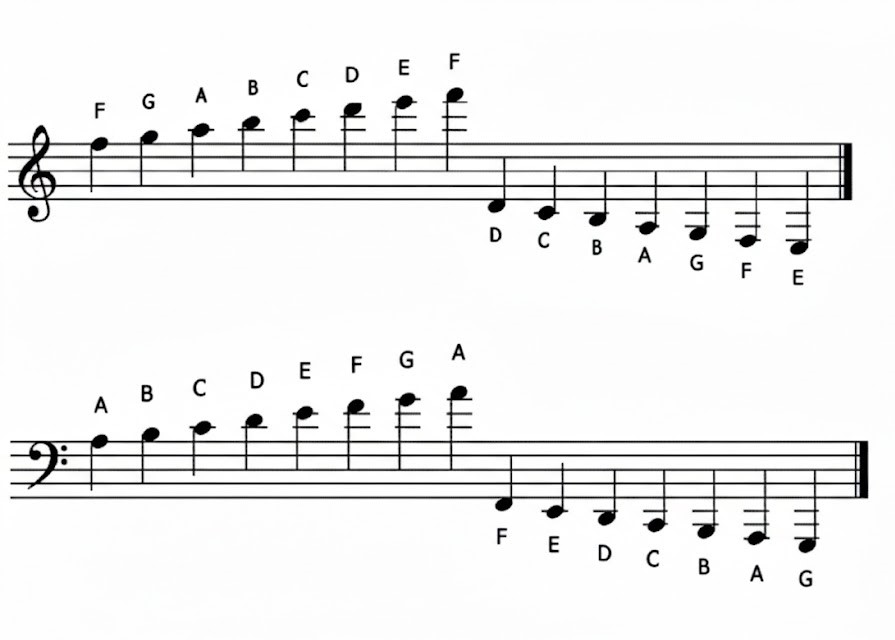
Ledger Lines
What about notes that are too high or too low to fit on the five lines? We use Ledger Lines, small horizontal lines “ledgers” that extend the staff up or down.
A. Individual Extensions
Ledger lines are small, temporary horizontal lines that act as extensions of the staff. Unlike the main staff lines, they belong only to a single note and do not connect to surrounding notes.
B. Middle C as the Bridge
The most famous ledger line note is Middle C. It sits on its own short line in the “gap” between the Treble and Bass staves, acting as the physical and conceptual bridge between your two hands.
2. Connecting the Staff to the Keyboard
Now you know the “map.” Let’s find the “locations” on your keyboard.
The Musical Alphabet
The piano keyboard is a repeating pattern. There are only 7 white keys, named after the first 7 letters of the alphabet:
A – B – C – D – E – F – G
After G, the pattern repeats, starting back at A. An octave is the distance from one note to the next note with the same name (e.g., from one C to the next C).
Quick Keyboard Guide:
- Look at the black keys. You’ll see a repeating pattern of 2 black keys, then 3 black keys.
- The white key just to the left of the group of 2 black keys is always C.
- The white key just to the left of the group of 3 black keys is always F.
Middle C: Your Anchor Point
The single most important note for a beginner is Middle C.
- On the Keyboard: It’s the C that is closest to the middle of your piano.
- On the Grand Staff: Middle C is so central that it doesn’t live in either staff. It’s written on the first ledger line below the Treble Clef (right hand) or the first ledger line above the Bass Clef (left hand). It’s the single note that connects your two hands.
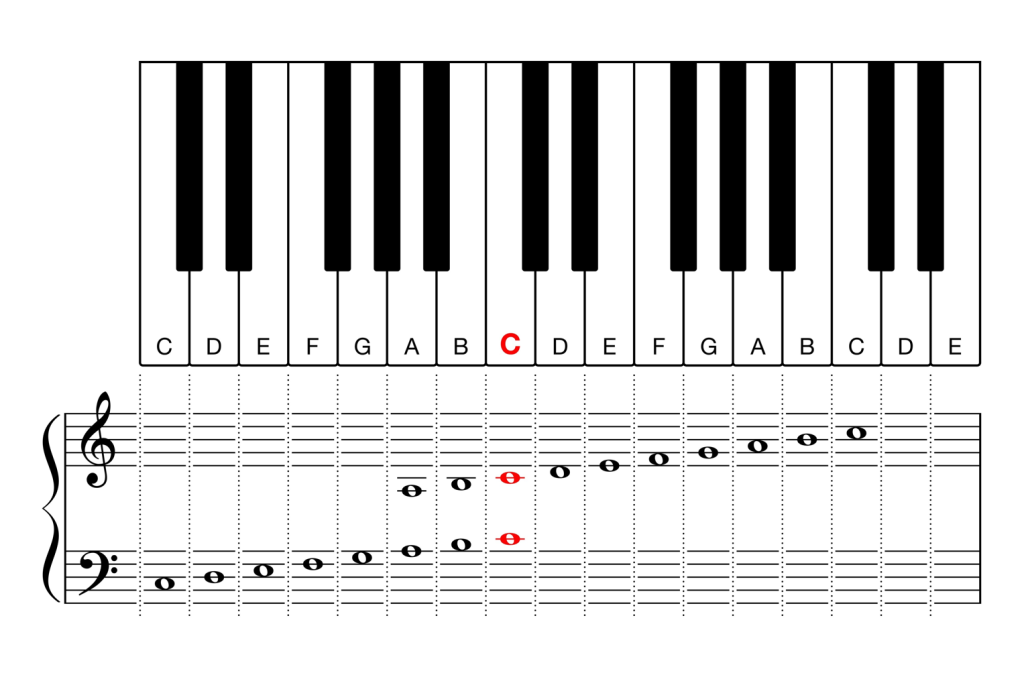
Your First Task: Sit at your piano right now.
- Find all the “C”s on the keyboard (left of the 2 black keys).
- Find the one closest to the center. That’s your Middle C.
- Look at the Treble Clef. Find the “FACE” in the spaces. Play F-A-C-E with your right hand.
- Look at the Bass Clef. Find “All Cows Eat Grass” in the spaces. Play A-C-E-G with your left hand.
You are now officially reading music.
3. Rhythm – The “When” of Music
If notes tell you what key to play, rhythm tells you how long to hold it.
Music is organized into “beats,” which are the steady pulse you tap your foot to. The shape of a note tells you how many beats it gets.
This is often called the “Note Tree” or “Rhythm Pyramid.”
- Whole Note (𝅝): 4 Beats
- Looks like: An empty oval. “The “hole” note.”
- Action: Hold the key down for 4 full counts. (e.g., “one-two-three-four”)
- Half Note (𝅗𝅥): 2 Beats
- Looks like: An empty oval with a stem.
- Action: Hold the key down for 2 counts. (e.g., “one-two”)
- Quarter Note (♩): 1 Beat
- Looks like: A solid (filled-in) oval with a stem.
- Action: This is your most common note. It gets 1 full count. (e.g., “one”)
- Eighth Note (♪): ½ Beat
- Looks like: A solid oval with a stem and one “flag.”
- Action: It gets half a beat. You fit two of them into a single count. (e.g., “one-and”)
- Sixteenth Note (𝅘𝅥𝅯): ¼ Beat
- Looks like: A solid oval with a stem and two “flags.”
- Action: It gets a quarter of a beat. You fit four of them into a single count. (e.g., “one-e-and-a”)
Beaming: When you have multiple eighth or sixteenth notes in a row, we “beam” them together with a thick horizontal line instead of using individual flags. This makes the music much less cluttered and easier to read.
[Image showing two eighth notes (♪ ♪) and how they become beamed (♫)]
Dotted Notes
This is a simple but crucial concept. If you see a dot next to a note, it means “add half of the note’s original value.”
- Dotted Half Note: A Half Note (2 beats) + half of its value (1 beat) = 3 beats total.
- Dotted Quarter Note: A Quarter Note (1 beat) + half of its value (½ beat) = 1 ½ beats total.
Rests: The Sound of Silence
Music is just as much about the silence between notes as the notes themselves. For every note value, there is a corresponding rest symbol that tells you to be silent for that duration.
| Duration | Note | Rest Symbol |
| 4 Beats | Whole Note (𝅝) | Whole Rest (hangs down from a line) |
| 2 Beats | Half Note (𝅗𝅥) | Half Rest (sits up on a line) |
| 1 Beat | Quarter Note (♩) | Quarter Rest (looks like a squiggly ‘Z’) |
| ½ Beat | Eighth Note (♪) | Eighth Rest (one flag) |
| ¼ Beat | Sixteenth Note (𝅘𝅥𝅯) | Sixteenth Rest (two flags) |
Pro Tip: Beginners always rush the rests. Don’t. Count the rests with the same precision you count the notes. Silence is part of the music.
4. Time Signatures and Measures
Now we combine our notes and rests into a structure.
Measures (or Bars)
If you look at sheet music, you’ll see vertical lines that cross the staff, dividing it into small sections. These sections are called Measures or Bars. These Bar Lines help organize the music into small, digestible chunks.
Time Signatures
At the very beginning of a piece, after the clef, you’ll see two numbers stacked like a fraction. This is the Time Signature.
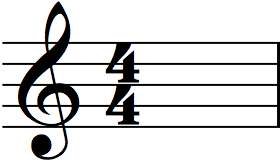
- Top Number: Tells you HOW MANY beats are in each measure.
- Bottom Number: Tells you WHAT KIND of note gets one beat.
- 4 = Quarter note (♩)
- 2 = Half note (𝅗𝅥)
- 8 = Eighth note (♪)
The 3 Most Common Time Signatures:
- 4/4 (Common Time):
- This is the most common time signature in all of music. It’s so common, it’s often written as a large “C” (for “Common Time”).
- It means: 4 beats per measure, and the quarter note gets one beat.
- You’ll count: “1 – 2 – 3 – 4” in every single measure. The note values in each measure must add up to 4. (e.g., four quarter notes; or two half notes; or one whole note).
- 3/4 (Waltz Time):
- It means: 3 beats per measure, and the quarter note gets one beat.
- This has a strong “ONE-two-three, ONE-two-three” feel, characteristic of a waltz.
- 6/8 (Compound Time):
- This one is a little different. It means: 6 beats per measure, and the eighth note gets one beat.
- It’s usually felt in two larger pulses of three eighth notes each: “ONE-two-three-FOUR-five-six.” It has a flowing, “rolling” feel, common in lullabies and ballads.
5. Key Signatures and Accidentals
So far, we’ve only talked about the white keys (the “natural” notes). The black keys are introduced using symbols called Accidentals.
There are two types of accidentals: “global” (Key Signatures) and “temporary” (in-measure accidentals).
Temporary Accidentals
These symbols appear next to a note in the music. They change the pitch of that specific note for the entire rest of the measure.
- ♯ (Sharp): Raises a note by a half-step (usually to the nearest black key to the right). F becomes F-sharp.
- ♭ (Flat): Lowers a note by a half-step (usually to the nearest black key to the left). B becomes B-flat.
- ♮ (Natural): Cancels a previous sharp or flat. It returns the note to its “natural” white-key state for the rest of the measure.
Key Signatures (Global Accidentals)
If a song uses a B-flat every single time a B appears, it would be messy to write a ♭ symbol every time. To fix this, composers use a Key Signature.
This is a cluster of sharps or flats placed at the very beginning of the staff, right after the clef. It’s a “global” rule for the entire piece.
- How to read it: If you see a ♭ on the “B” line (as in the image), it means every single B in the entire piece, in any octave, is automatically played as a B-flat, unless you are told otherwise by a natural (♮) sign.
Your Starting Point: Don’t worry about memorizing all 12 key signatures. As a beginner, you will start in the Key of C Major (or its relative, A Minor), which has no sharps or flats. It is the “home base” for learning piano, using only the white keys.
6. Practice Sight-Reading (The Smart Way!)
You now know the “what” (notes), the “when” (rhythm), and the “how” (keys). Now comes the most important part: practice.
Sight-Reading is the skill of playing a piece of music on the first try. It’s a skill that must be trained separately from learning a piece. When you learn a piece, you memorize it. When you sight-read, you are processing the information in real-time.
This is, without a doubt, the fastest way to become fluent. But it has one major problem: you need a constant supply of new, easy music. If you practice the same piece twice, you’re no longer sight-reading; you’re practicing.
Why Traditional Practice Fails (at first)
A beginner buys a book of 50 easy songs. They practice Song #1 until it’s perfect. But they only sight-read it once. By the time they get to Song #50, their practicing skill is high, but their reading skill is still at Song #1 level. This is why many pianists can play difficult, memorized pieces but freeze when you put a simple new song in front of them.
The Solution: Modern Sight-Reading Apps
This is where technology changes the game. Apps designed for sight-reading solve the “unlimited material” problem.
App Spotlight: SightReadingFactory
If you are serious about learning to read music, SightReadingFactory (SRF) is the single most powerful tool I can recommend. I am highlighting it specifically because it is built from the ground up to solve the exact problem we just discussed.
- What it is: It’s not a game; it’s a dedicated training tool. It uses an algorithm to generate a near-infinite amount of brand-new, original music for you to read.
- How it works:
- You choose your instrument (Piano) and your exact skill level (e.g., Level 1, Treble Clef only).
- You choose your time signature (e.g., 4/4) and key signature (e.g., C Major).
- You hit “Generate,” and a brand-new, musically-correct piece of music appears on your screen.
- You play it (once).
- You hit “Generate” again, and a completely different piece appears.
- Why it’s the “Article of the Year” recommendation: SRF trains the actual skill of reading. It has MIDI-input compatibility, so it can listen to you play and give you real-time feedback on note and rhythm accuracy. It has customizable assignments and practice logs. It forces your brain to read, not memorize.
Practice Tip: Spend just 5-10 minutes per day on SightReadingFactory.com before you practice your “real” songs. Do this consistently, and your reading ability will skyrocket in a matterof months.
Other Great Learning Apps:
- Piano Marvel: A fantastic, comprehensive curriculum that heavily features sight-reading. Its “SASR” (Standard Assessment of Sight Reading) test is a brilliant tool for tracking your progress.
- Flowkey & Simply Piano: These are excellent for “learning-by-playing-songs.” They are less about pure sight-reading and more about a guided, visual way to learn popular songs, which is also highly motivating for beginners.
7. Decode Dynamics and Articulations
The notes and rhythms are the “what” and “when.” Dynamics and articulations are the “how”, they are the instructions for expression that turn a series of notes into music.
Dynamics (Volume)
These are usually written in Italian, in small letters under the staff.
- p (piano) = Soft
- f (forte) = Loud
- mp (mezzo-piano) = Moderately soft
- mf (mezzo-forte) = Moderately loud
- pp (pianissimo) = Very soft
- ff (fortissimo) = Very loud
Gradual Changes in Volume:
- Crescendo (cresc. or <): Gradually get louder.
- Decrescendo / Diminuendo (dim. or >): Gradually get softer.
Articulations (Touch)
These are symbols written above or below the notehead, telling you how to attack and release the key.
- Staccato (·): A dot above or below the note (not beside it!). It means to play the note short and detached. Think “hot potato.”
- Legato (Slur Line): A curved line over a group of different notes. It means to play them smoothly connected, with no silence in between. Think of it as one single “breath” or motion.
- Accent (>): Play this note stronger or with more emphasis than the notes around it.
- Tenuto (–): A small horizontal line. It means to hold the note for its full value, or even slightly longer. It’s the opposite of staccato.
- Fermata (an eye with an eyebrow): Hold this note (or rest) for longer than its written value. The conductor or performer decides how long to “pause.”
8. Your 8-Step Process for Learning Any New Piece
You’ve learned all the elements. How do you put them together to tackle a brand-new song? Don’t just start at the beginning and hope for the best. Use a professional’s workflow.
- The Pre-Scan (Your “GPS”): Before you play a single note, look at the “map.”
- What are the Clefs? (Treble and Bass)
- What is the Key Signature? (e.g., “Okay, no sharps or flats. White keys only.”)
- What is the Time Signature? (e.g., “4/4. Four beats per measure.”)
- Rhythm First (Clap it Out): Ignore the notes and only look at the rhythm. Tap or clap the rhythm of the first few measures. If you can’t clap it, you can’t play it.
- Note Mapping (Find the Hazards): Scan the music for “hazards.”
- What’s the highest note? What’s the lowest?
- Are there any accidentals (sharps/flats) you didn’t expect?
- Are there any big “jumps” in the melody?
- Hands Separate (The Golden Rule): This is the most important rule. Practice each hand’s part separately. Your brain can only handle so much new information. Master the right hand, then master the left hand.
- Hands Together (SLOWLY): Now, combine them. Play the piece so slowly it feels painful. This is not an exaggeration. Play at a “snail’s pace.” Your goal is accuracy, not speed. Speed is a byproduct of accuracy.
- Chunking: Don’t try to play the whole song. Master the first four measures. Then master the next four. Then, connect those two chunks. You are building a chain, one link at a time.
- Add Expression: Once the notes and rhythms are secure, go back and add the dynamics and articulations. Make the loud parts loud, the soft parts soft, and the staccato notes “pop.”
- Polish and Review: Use a metronome to ensure your tempo is perfectly steady. This is where you turn a “correctly-played” piece into a “well-played” piece.
Recommended Books & Essential Gear
While apps are amazing, you still need a physical setup. Here are the best-in-class resources to build your foundation.
The Best Beginner Method Books
A method book will guide you, lesson by lesson, from “what is a C” to playing your first songs.
- The Classic Choice: Alfred’s Basic Adult All-in-One Piano Course, Book 1
- Why: This is the best-selling, most-trusted piano method for a reason. It integrates theory, technic, and repertoire into one logical, easy-to-follow book. Its pacing is perfect for adult beginners.
As an Amazon Associate I earn from qualifying purchases.
- The Chord-Based Choice: Bastien Piano Basics – Primer Level
- Why: If you’re more interested in learning to play chords and pop music, Bastien is a fantastic alternative. Many teachers love its emphasis on harmony and its less-rigid, more diverse set of pieces from the very beginning.
As an Amazon Associate I earn from qualifying purchases.
- The Theory Supplement: Music Theory for Beginners
- Why: If you want to go deeper into the “why” of music, a dedicated theory book is a great companion. This one by Jason W. Smith is clear, concise, and written for the absolute beginner.
As an Amazon Associate I earn from qualifying purchases.
 Kindle editionRead on Kindle ›
As an Amazon Associate I earn from qualifying purchases.
Or the classic
 Kindle editionRead on Kindle ›
As an Amazon Associate I earn from qualifying purchases.
Essential Tools for Your Piano Journey
You don’t need much, but these items are non-negotiable for serious learning.
- A Digital Piano with 88 Weighted Keys
- Why: You must have 88 keys (the full size) and weighted keys. Weighted keys simulate the feel and resistance of an acoustic piano, which is essential for building proper finger strength and technique.
- Top Beginner Picks:
- Roland FP-30X: Often cited as the best-in-class for beginners, with a superior “ivory-feel” key action (PHA-4) and a more realistic sound engine (SuperNATURAL)
As an Amazon Associate I earn from qualifying purchases.
- Yamaha P-125: The industry-standard classic. You can’t go wrong with its reliable GHS action and high-quality sound samples.
As an Amazon Associate I earn from qualifying purchases.
- A Foldable Music Stand
- Why: Don’t hunch over your piano or prop your book on the wall. A dedicated stand puts the music at the perfect eye level, which is critical for good posture and fast reading.
- A Bluetooth Page Turner Pedal
- Why: Once you start using apps like SightReadingFactory or reading digital sheet music (e.g., on an iPad), this is a life-saver. It’s a foot pedal that lets you “turn the page” on your screen, so you never have to take your hands off the keys.
- Top Picks: AirTurn DUO 500 or PageFlip Firefly.
As an Amazon Associate I earn from qualifying purchases.
Final Thoughts: Reading Music Unlocks Musical Freedom
Learning how to read piano sheet music is one of the most empowering steps you will ever take. From my own personal experience, I can tell you: it starts slow. You will feel like you’re deciphering a code, one note at a time. It will be frustrating.
But then, one day, it clicks.
You’ll stop seeing “E-G-B-D-F” and you’ll just see music. You’ll stop translating and you’ll just start reading. You’ll sit down at a piano, open a book, and for the first time, you’ll just… play.
That moment of freedom, the moment you unlock a language that has connected humanity for centuries, is worth every second of practice.
So grab a score, fire up an app like SightReadingFactory, and take it one measure at a time. The joy of reading and playing music is waiting for you.
What is the easiest way to memorize piano notes on the staff?
The most effective way to memorize notes is by using mnemonic devices for the lines and spaces of the Treble and Bass clefs. These memory aids act as mental anchors, allowing you to identify pitches instantly without counting from Middle C every time.
- Treble Clef (Right Hand): * Spaces: F-A-C-E (spells the word “Face”).
- Lines: E-G-B-D-F (Every Good Boy Deserves Fudge).
- Bass Clef (Left Hand): * Spaces: A-C-E-G (All Cows Eat Grass).
- Lines: G-B-D-F-A (Good Boys Deserve Fudge Always).
Why should I learn to read sheet music instead of using YouTube “glowing-key” tutorials?
Learning to read sheet music grants you musical independence and access to the full intentions of the composer, which visual tutorials cannot provide. While “glowing-key” apps (like Synthesia) are helpful for quick memorization, they fail to teach rhythmic precision, musical structure, and articulation. Reading sheet music allows you to learn any piece in history, not just those with existing tutorials, and enables you to communicate professionally with other musicians using the universal language of notation.
What do the top and bottom numbers in a time signature mean?
In a time signature, the top number indicates the number of beats per measure, while the bottom number determines which note value receives one beat. For example, in 4/4 time (Common Time):
- Top Number (4): There are four beats in every measure.
- Bottom Number (4): The quarter note (♩) represents one beat. In 6/8 time, the top number tells you there are six beats, but the “8” indicates that the eighth note (♪) receives the beat, creating a rolling, triplet-based feel.
How do I read notes that are placed above or below the five lines of the staff?
Notes located outside the standard five-line staff are written on Ledger Lines. These are small, temporary horizontal lines that extend the range of the staff upward or downward. The most famous example is Middle C, which sits on a single ledger line between the Treble and Bass staves. To read them, simply continue the musical alphabet (A-B-C-D-E-F-G) in sequence from the nearest staff line.
What is the best way to practice sight-reading for beginners?
The “Gold Standard” for improving sight-reading is practicing with “infinite” new material to prevent your brain from relying on memory. Unlike practicing a repertoire piece, sight-reading requires real-time decoding. We highly recommend using a dedicated tool like SightReadingFactory.com. It uses an algorithm to generate endless, level-appropriate exercises that force you to read “at sight” rather than memorizing patterns. Spending just 5–10 minutes a day on this type of deliberate practice will accelerate your fluency faster than any other method.