As an Amazon Associate, PianoMode earns from qualifying purchases. Recommendations are made on their merits; the price you pay is the same.
Imagine sitting down at a beautifully tuned piano, the sunlight hitting the keys, and your favorite sheet music waiting on the stand. You reach out to play that first chord, but your hands feel like lead. Your fingers are slow, unresponsive, and a nagging stiffness in your joints makes the simple act of pressing a key feel like a chore. This is a common frustration for many adult learners between the ages of 35 and 65, where the physical demands of a new hobby clash with the physiological realities of aging or repetitive strain from daily life. However, finger stiffness is not an insurmountable barrier; it is a physiological signal indicating that the force-based techniques often taught to children are no longer appropriate for the adult neuromuscular system.
By shifting the pedagogical focus from digital strength to skeletal alignment and the efficient use of arm weight, the adult beginner can bypass pain and unlock a fluid, expressive technique.
This study explores the multifaceted causes of joint stiffness, the ergonomic adjustments necessary for long-term health, and five core exercises specifically calibrated to restore mobility to the hand.
You will learn the biological mechanisms behind age-related hand tension, the critical role of bench height in digital fluidity, five therapeutic exercises to improve finger independence, and how to leverage music theory to reduce physical gripping at the instrument.
To practice piano with stiff fingers, you must prioritize an ergonomic setup that aligns the elbows level with the keyboard to facilitate the use of arm weight rather than brute finger force. Adopting a weight-based approach allows the fingers to drop naturally into the keys, significantly reducing the “co-contraction” of opposing muscle groups that causes the sensation of stiffness. Integrating gentle exercises, such as the Neighbor, Pivot, and Waterfall drills, alongside a “little and often” practice schedule with mandatory breaks every 25 minutes ensures that joint flexibility is maintained and that cognitive fatigue does not manifest as physical tension.
1. Why Do Adult Beginners Experience Finger Stiffness?
Finger stiffness is a complex manifestation involving musculoskeletal changes, neurological factors, and environmental stressors. It is not a sign that one is “too old” to play. Rather, it is often a combination of physiological factors and technical habits. For many adults, stiffness is caused by:
- Reduced synovial fluid: As we age, the fluid that lubricates our joints can decrease, leading to a “tight” feeling in the morning or after periods of inactivity.
- Tension patterns: Adult beginners often compensate for lack of familiarity with the keyboard by “gripping” the keys, which causes muscular tension to travel up the arm.
- Environmental factors: Cold weather or air conditioning can constrict blood flow to the extremities, making the small muscles in the hands less pliable.
Understanding these factors is the first step toward overcoming them. Instead of trying to “push through” the stiffness, the goal is to invite blood flow and relaxation into the hands.
Furthermore, adult learners and beginners are more susceptible to co-contraction, the simultaneous activation of agonist and antagonist muscles. This often occurs when a player lacks confidence in the notes, causing the hand to “lock” in a defensive posture. This neurological response inhibits the fluid movement necessary for scales and arpeggios.
Be careful, the sensation of stiffness is often more than mere fatigue; but it can be symptomatic of chronic conditions, like osteoarthritis or repetitive strain injury.
2. The Role of Ergonomics and Hand Position
Before attempting any exercise, the physical setup must be correct. Proper ergonomics are essential for avoiding long-term injury and immediate discomfort.
The Role of Bench Height and Alignment
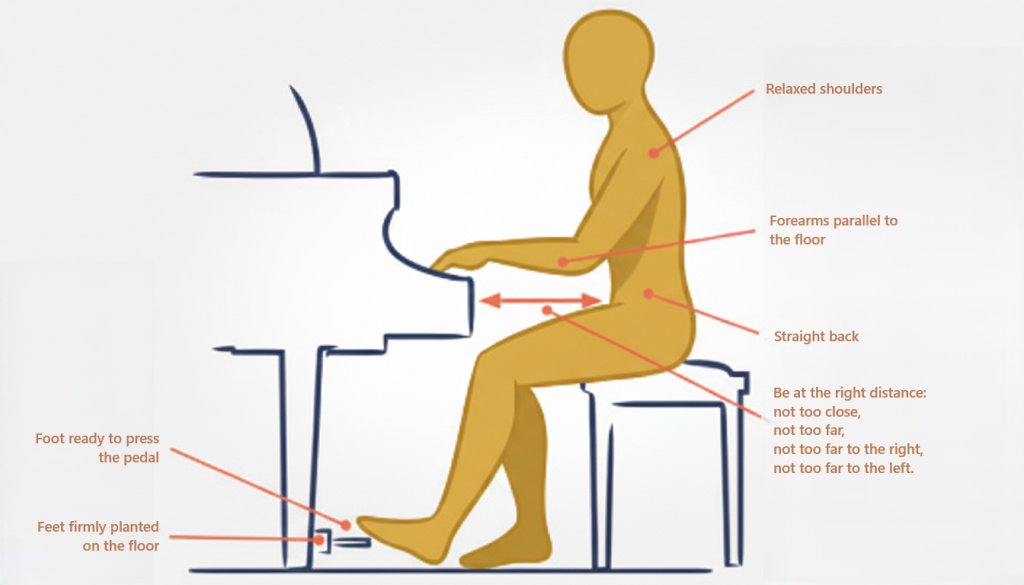
Poor bench height is cited as the primary culprit for tension in adult learners. When a bench is too low, the pianist is forced to lift the shoulders and press down with excessive force, straining the tendons around the wrist. Conversely, a bench that is too high prevents the student from using the natural weight of the arm, forcing the small muscles of the fingers to do all the work.
To achieve an optimal playing position:
- Elbow level: The elbows should be aligned with or slightly above the keyboard to provide maximum mechanical leverage.
- Distance: The pianist must sit far enough from the instrument so that the elbows hang naturally at the sides. Sitting too close leads to “backward-pointing elbows,” which creates tension in the shoulder girdle.
- Stability: Both feet should be planted firmly on the floor. Sitting cross-legged or tucking feet under the bench destabilizes the spine and forces the arms to carry the weight of the torso, leading to early onset stiffness.
The Alexander Technique for Piano
The Alexander technique is a system of mental and physical retraining that emphasizes the relationship between the head, neck, and spine to improve movement efficiency.
- Neck alignment: A “forward neck” position, common when straining to read a score, places a heavy load on the spine and rounds the shoulders. One should imagine a string pulling the crown of the head upward, releasing the tension in the cervical spine.
- Sit bones: The weight should be centered on the two bony protrusions at the bottom of the pelvis (the sit bones). Balancing on these round bones allows the hips to move freely while sitting.
- Constructive rest: Lying in a semi-supine position on the floor for even 60 seconds before a practice session allows the back muscles to release, a sensation that can be recalled at the piano to prevent slouching.
3. 5 Gentle Exercises for Stiff Fingers
The following exercises are designed specifically for the adult neuromuscular system. They emphasize control and mindfulness over speed, aiming to dissolve the co-contraction patterns that lead to stiffness.
The Neighbor Drill For Digital Independence
This exercise addresses the “flying finger” syndrome, where non-playing fingers stiffen or rise off the keys involuntarily.
To perform the Neighbor drill, place your hand in a standard five-finger C major position. Press all five keys down gently. Focus on lifting only the second finger (index) and playing the D key while the other four fingers remain completely relaxed and in contact with their respective keys. Repeat with the third, fourth, and fifth fingers individually.
- Mechanism: This drill retrains the brain to isolate movements. The fourth and fifth fingers are anatomically linked by shared tendons, making them the most prone to stiffness. By focusing on a “lazy” hand where each finger does the absolute minimum work, you reduce the workload of the forearm muscles.
The Pivot Drill For Expanding Lateral Reach
Your hands often feel restricted when reaching for intervals larger than a fifth. The Pivot drill improves the lateral mobility of the basal joints of the fingers.
Place the thumb on Middle C. Play C, then play D with the second finger. Return to C. Then play C, followed by E with the third finger. Continue this “pivoting” action from the thumb anchor out to the G (a fifth) and beyond if comfortable.
- Insights: Research shows that the lateral movement of fingers 2, 3, 4, and 5 is one of the first functions to decline with age. This drill uses the thumb as a fulcrum to gently stretch the interosseous muscles without the strain of static holding.
3. The Trio Grouping For Rhythmic Fluidity
Stiffness often disrupts the rhythmic “pulse” of a piece. The Trio exercise uses melodic figures in groups of three to foster evenness of touch.
Play the sequence C-D-E, D-E-F, E-F-G using fingers 1-2-3, 2-3-4, and 3-4-5 respectively. Focus on maintaining a consistent eighth-note rhythm.
- Analysis: This exercise is particularly effective for strengthening the connection between the brain and the weaker 4th and 5th fingers. By reversing the grouping (G-F-E), the player challenges the “enslaving” behavior of the fingers, where the movement of one finger forces the others to move.
4. The Skipper For Interval Recognition
The Skipper uses intervals of a “third” (skipping one letter name) to develop digital precision without the need for large, stressful leaps.
Start with the thumb on C and “skip” D to play E with the third finger. Then play D with the second finger, skipping E to play F with the fourth finger.
- Your goal: This develops a tactile connection with the instrument. By positioning the hands far apart, four or more octaves, you are forced to develop proprioception (the sense of position) without relying on visual confirmation, which often causes the neck to slump and create tension.
5. The Waterfall Technique For Gravity and Arm Weight
The Waterfall is a mindfulness-based technique that solves technical problems by using gravity rather than muscular force.
Imagine the arm is a puppet with the strings holding it up. Imagine someone cuts the strings, and the arm falls limp into the lap. Apply this “limp” sensation to the keyboard: allow the arm, hand, and fingers to “fall” into a C major triad (C-E-G).
- Insights: The wrist acts like a “trampoline” or an “open channel” for the back’s energy to flow into the keys. By simply “falling” and letting the wrist rebound, the fingers are relieved of the burden of “pushing” the key down, which is the primary source of adult joint pain.
4. The Role of Temperature and Therapeutic Heat
Cold muscles are physiologically stiffer because the viscosity of the synovial fluid in the joints increases at lower temperatures. Temperature management is a critical pre-practice step.
Environment matters. A practice room that is too cold will negatively influence practice habits and increase compensatory tension.
- Contrast bath therapy: Dipping the hands alternately in warm and cold water for 10-12 minutes can stimulate blood flow and reduce stiffness.
- Soft tissue release: Gentle circular massage of the tendons in the wrist (myofascial release) can help drain excess fluid and lubricate the joints.
5. The 30-Minute Rule: Managing Cognitive and Muscular Fatigue
Concentration begins to wane significantly after 25-30 minutes of focused activity. For the adult learner, this “mental depletion” makes it harder to monitor and inhibit physical tension.
The Ideal Practice Structure
- 25 Minutes: Focused practice on a specific section or drill.
- 5 Minutes: Mandatory break (standing up, stretching, “shaking out” the arms).
- Repeat: Perform a maximum of 3-4 cycles per day.
Sudden significant increases in practice time are a leading risk factor for RSI and chronic stiffness. The “little and often” approach ensures that the neuromuscular system has time to recover and consolidate the “muscle memory” developed during the session.
6. Off-Keyboard Exercises
Developing digital independence does not always require a piano. Exercises performed on a flat table allow the learner to focus exclusively on the mechanics of the fingers without the distraction of sound or key resistance.
The Table Lift Drill
- Place the hand flat on a table, palm down, with fingers naturally curved (imagine holding an egg).
- Starting with the thumb, lift each finger slowly off the table one at a time.
- Hold for 2 seconds and lower it smoothly.
- The challenge: Try to lift the 4th finger without the 3rd or 5th fingers moving. This is a primary test of motor control and helps combat “enslavement”.
The Spider Walk
- Place the index finger on a “fret” (or marked spot) on the table.
- Follow with the middle, ring, and pinky in a 1-2-3-4 sequence.
- Reverse the order. Focus on keeping the fingertips hovering close to the surface—no wild flailing or “flying fingers”.
Recommended Gear
To support a sustainable, pain-free practice, the following products are highly recommended based on ergonomic research and musician feedback:
Hydraulic Adjustable Piano Bench: The Stage KB9503B or similar hydraulic models allow for effortless height adjustment. Standard knob-based benches often go unused because the mechanical rotation is too taxing for stiff wrists.
As an Amazon Associate I earn from qualifying purchases.
Electric Rechargeable Hand Warmers: The Beskar rechargeable units reach therapeutic temperatures (110F) quickly. Using these for 5 minutes before practice “thaws” arthritic joints more effectively than a standard room heater.
As an Amazon Associate I earn from qualifying purchases.
Digital Metronome: Maintaining a “steady beat” is easier when you can start very slowly and gradually increase speed as your fingers loosen up.
As an Amazon Associate I earn from qualifying purchases.
Conclusion
Finger stiffness does not have to be an end-point for your musical journey. By viewing the piano as a “universal tool” that rewards relaxation and correct alignment, you can overcome physical barriers.
Incorporating the Gravity Drop and slow chromatic movements into your daily routine will build the “personal discipline” needed to master the keys.
Remember, the goal of music theory and practice is to “communicate better” and find joy in the sound you create. Start your next session with warmth, breathe deeply, and let gravity do the work.
Is it normal for my fingers to hurt after only 15 minutes of playing?
While some adaptation is normal, sharp pain or persistent aching is a sign of improper technique or excessive force. You should evaluate your bench height and ensure your elbows are not below the keyboard level.
How long should I warm up before playing pieces?
For adult beginners, a 10-minute warm-up is recommended. Spend 5 minutes on off-keyboard stretches (like wrist circles) and 5 minutes on slow scales or five-finger patterns to ensure your hands are ready for the physical demands of your repertoire.
Can I play piano if I have arthritis in my knuckles?
Yes. Moderate, gentle playing is often recommended as therapy for osteoarthritis. Use a “lighter” touch, avoid large stretches, and consider using electronic hand warmers before your session to increase flexibility.
Why do I feel more stiff at the piano than when I am doing other tasks?
Piano requires a unique combination of high-speed motion and static force. If you are “key-bedding” (pressing hard after the note sounds), you are creating static tension that doesn’t exist in everyday tasks like typing.
What is the most important piece of gear for a beginner with joint pain?
A height-adjustable bench. Without the correct height, all other ergonomic efforts are undermined by a lack of mechanical leverage.
Does the type of piano matter for finger stiffness?
Yes. Acoustic pianos and high-end digital pianos have “weighted actions” that mimic the feel of a real hammer striking strings. While this requires more strength than a cheap plastic keyboard, it actually provides better tactile feedback, which can help you learn to use arm weight more effectively.