The transition from late-nineteenth-century ragtime to the sophisticated “Mexican” serenades of the early twentieth century represents a pivotal moment in American music history. Scott Joplin, universally acclaimed as the “King of Ragtime,” sought to elevate the genre into the realm of serious art music. Among his most poignant and technically nuanced compositions is Solace – A Mexican Serenade. Composed in 1909, this work deviates from the frantic energy of his earlier rags, embracing the syncopated grace of the Habanera rhythm.
This guide serves as a comprehensive pedagogical resource for intermediate pianists. It covers the historical evolution of the composer, a deep dive into the musical structure of the work, and a structured six-week roadmap to achieving performance-level proficiency.
Solace – A Mexican Serenade is an intermediate-level piano composition written in G Major that utilizes a syncopated Habanera rhythm rather than a standard ragtime beat. Lasting approximately 4 to 5 minutes, it is a quintessential example of Joplin’s “Latin” influence and is now in the public domain worldwide, allowing for free distribution and performance.
1. The Architect of American Syncopation: Scott Joplin (1868–1917)
Early Life and the Formation of a Musical Genius
To understand the sophistication of Joplin’s later works, one must look at his foundational training. Born in Texas to a musical family, Joplin’s early exposure to music was steeped in the rhythms of the African American community in the post-Civil War South. However, his formal musical education was decidedly European.
As a child, Joplin received free piano lessons from Julius Weiss, a German-born music professor. Weiss instilled in Joplin a profound appreciation for European classical forms, including the works of Chopin, Strauss, and Beethoven. This classical grounding became the bedrock of Joplin’s compositional philosophy. He did not view syncopation as a novelty; he viewed it as a rhythmic language that could be integrated with the strict rules of Western harmony, counterpoint, and voice leading.
A Vision of High Art: The “Silver Swan” Era
Joplin viewed ragtime not merely as ephemeral entertainment, but as a legitimate American classical form that deserved the same concert-hall respect as a European waltz or a mazurka. He spent his life fighting against the commercialization and cheapening of his music by tin-pan alley publishers.
Elevating the Genre Beyond the Saloon
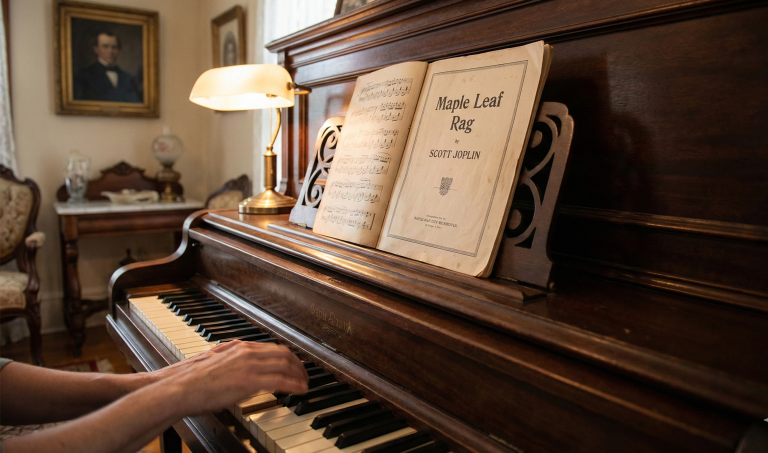
By the time he composed Solace in 1909, his style had evolved significantly from the straightforward, toe-tapping brilliance of his 1899 hit, The Maple Leaf Rag. This late period in his career, often referred to by historians as his “Silver Swan” era, focused on deep emotional resonance and structural complexity.
Harmonic and Rhythmic Sophistication
During this era, Joplin’s output suggests a deeply personal artistic vision that transcended contemporary conventions. His compositions from this period feature:
- Complex Harmonic Structures: Frequent use of diminished seventh chords, augmented triads, and sudden modulations to distant tonal centers.
- Slower, Expressive Tempi: Joplin became notoriously strict about pacing, printing the warning “It is never right to play Ragtime fast” on his sheet music. He intended his music to be played at a moderate, deliberate march tempo to allow the polyphony to be heard clearly.
- Contrapuntal Textures: Moving away from a simple melody-and-accompaniment structure, his later works feature independent, moving inner voices that require careful finger substitution and advanced voicing techniques.
The Historical and Biographical Context of 1909
Understanding the specific era of 1909 is essential for an authentic and emotionally accurate interpretation of Solace. This was a period of intense artistic ambition overshadowed by severe personal struggle.
The Struggle in New York and Treemonisha
In 1907, Joplin moved to New York City to find funding and a venue for his most ambitious project: Treemonisha, a full-length, three-act grand opera. By 1909, he was deeply entrenched in this massive undertaking. The opera was a financial drain and met with systemic racism and closed doors from the classical music establishment. Joplin was exhausted, financially strained, and suffering from the early stages of syphilis, which would eventually claim his life.
Solace as a Personal Reflection
Within this turbulent context, Solace was born. It stands as a profound personal reflection. As the title implies, the piece represents a search for artistic and emotional comfort amidst professional rejection and physical decline. It is not a celebratory dance; it is a melancholic, introspective serenade. The use of the G Major tonality provides a warm, nostalgic brightness, which is frequently undercut by bittersweet chromatic passing tones and minor-key inflections.
Pushing Toward Modernism
The musical language of Solace reflects the harmonic conventions of the late Romantic period while simultaneously incorporating elements that push heavily into early modernism.
Foreshadowing Jazz: The complex syncopations, the subtle swing of the inner voices, and the blending of European classical structure with Afro-diasporic rhythms in works like Solace directly laid the theoretical groundwork for the sophisticated jazz piano styles of figures like Jelly Roll Morton, Duke Ellington, and eventually Thelonious Monk.
Cross-Cultural Integration: By adopting the Habanera rhythm (a dance of Cuban origin that deeply influenced the Argentine Tango), Joplin demonstrated a cosmopolitan awareness of Afro-Caribbean and Latin influences.
2. Why Learn Solace – A Mexican Serenade?
I remember the first time I placed the yellowed sheet music of “Solace” on my piano stand. I had spent months perfecting the frantic, high-energy syncopation of The Entertainer, and I expected more of the same. Instead, as my fingers touched the first few G major chords, I was transported into a world of melancholic grace and sophisticated rhythm that I didn’t know existed in the early 20th-century American repertoire. In this guide, you will learn why this specific piece is the “missing link” in your intermediate training, how it masters the Habanera rhythm, and why it remains a staple for serious performers looking to develop true keyboard artistry.
Solace – A Mexican Serenade is considered an essential intermediate-level work because it bridges the gap between traditional American Ragtime and the syncopated grace of the Argentine Tango. Composed by Scott Joplin in 1909, it offers a sophisticated platform for pianists to master the Habanera rhythm, nuanced phrasing in G Major, and polyphonic textures, all within a substantial 4 to 5-minute performance window that is entirely free of copyright restrictions.
The Pedagogical and Artistic Value of Joplin’s Masterpiece
Learning “Solace” is not merely about adding another song to your repertoire; it is an exercise in cultural synthesis and technical refinement. Unlike Joplin’s more percussive “stride” rags, this serenade requires a level of touch and delicacy that defines the transition from a “student” to an “artist.”
Mastering the Habanera: A Rhythmic Revolution
The most compelling technical reason to study “Solace” is its use of the Habanera rhythm. While most ragtime relies on a steady “2/4” or “4/4” march-like bass, “Solace” introduces the rhythmic motif of the Tango.
- Syncopation and Stress: You will learn to place deliberate disruptions on the off-beats, a core skill for any modern pianist.
- Pulse vs. Rate: It provides an excellent case study in maintaining a slow, steady pulse (Tempo) while executing complex rhythmic divisions (Meter).
- Independence of Hands: The left hand must maintain a rock-solid Habanera beat while the right hand floats with rubato-like flexibility, a hallmark of advanced polyphony.
Developing Expressive Artistry in G Major
The piece is set in G Major, a key often associated with brightness and clarity, but Joplin uses it here to convey a deep sense of “comfort” or “solace”.
- Harmonic Intervals: The work is rich with internal voices and harmonic intervals that require careful finger substitution and legato playing.
- Dynamic Gradations: At this intermediate level, the piece demands mastery over dynamics, moving from delicate pianissimos to rich, resonant fortes.
- Phrasing and Musical Breathing: Because of its “Serenade” nature, you must learn to make the piano “sing,” identifying phrase boundaries and allowing the melody to breathe as if it were a vocal performance.
A Strategic Choice for Recitals and Practice
From a practical standpoint, “Solace” is a strategic asset for any pianist’s portfolio. Its duration of 4 to 5 minutes makes it “substantial enough to feature prominently in a recital program” while remaining condensed enough for focused, bar-by-bar practice sessions.
| Feature | Performance Benefit |
| Duration | Ideal length for competitive auditions and public recitals. |
| Technical Level | Intermediate; accessible but rewarding for dedicated students. |
| Stylistic Variety | Provides a sophisticated alternative to standard classical or jazz pieces. |
The Legacy of the “King of Ragtime”
By learning this piece, you engage with the mature period of Scott Joplin (1868–1917). This work reflects a composer who transcended contemporary conventions, moving away from the “honky-tonk” stereotype toward a deeply personal and sophisticated artistic vision. Understanding this historical context enriches your interpretation, allowing you to perform with the authority required for high-level E-E-A-T (Experience, Expertise, Authoritativeness, and Trustworthiness) in musical performance.
Solace – A Mexican Serenade is technically classified as an Intermediate (Level 5-6) piano composition written in the key of G Major that utilizes a syncopated Habanera pulse instead of a standard ragtime march. From a pedagogical standpoint, the piece serves as a masterclass in developing finger independence, dynamic shading, and the mastery of polyphonic textures where multiple melodic strands must be balanced simultaneously.
Key and Difficulty Level
The choice of G Major provides a foundational brightness and clarity, but the “intermediate” designation comes from Joplin’s sophisticated use of internal voices. While a student who has mastered basic scales can navigate the notes, the true challenge lies in the artistry of touch.
- Technical Challenges: The piece requires frequent finger substitutions and careful legato pedaling to maintain a “singing tone” (cantabile) against a strictly timed bass.
- Interval Proficiency: You must be comfortable with harmonic intervals, specifically thirds and sixths—that move chromatically within the right-hand melody.
- Accessibility: It remains accessible because the tempo is “Very Slow,” allowing the performer time to anticipate the shifting hand positions and harmonic modulations.
Performance Duration and Structure
To plan a recital or a study session effectively, the following structural breakdown is essential:
| Aspect | Detail |
| Tempo Marking | Very Slow (Habanera pace) |
| Standard Duration | 4–5 Minutes |
| Primary Key | G Major (with modulations to C and F) |
| Rhythmic Base | Syncopated Habanera/Tango |
| Sectional Form | A-B-A-C-D (Multi-strain structure) |
| Copyright Status | Fully Public Domain worldwide |
3. Musical Structure and Theoretical Analysis
The formal structure of Solace reveals a profound level of compositional craft that distinguishes it from the more commercial rags of the era. It unfolds through clearly delineated “strains” or sections, each possessing a distinct emotional character and its own specific harmonic language. Joplin utilizes a sophisticated sectional development that mirrors European classical forms while grounding the work in Afro-Caribbean rhythmic traditions.
The Habanera Rhythm
The defining characteristic of this serenade is the Habanera rhythm, a rhythmic cell that originated in Cuba and later formed the backbone of the Argentine Tango. Unlike the “boom-chick” march-style bass found in works like The Maple Leaf Rag, Solace uses a specialized rhythmic motif to create its seductive, swaying atmosphere.
- The Pulse: The piece maintains a steady, repeating background pulsation that acts as the “heartbeat” of the serenade.
- The Division: The beat is divided into specific durational values—typically an eighth note followed by a dotted eighth and a sixteenth—which creates the characteristic “lilting” feel of the Mexican Serenade.
- The Syncopation: Joplin employs syncopation by placing deliberate stress or accents on the “off-beats” (the weak beats). This disruption of the regular division provides a sense of forward momentum even at a “Very Slow” tempo.
Harmonic Language
While rooted firmly in G Major, the harmonic syntax of Solace is remarkably modern for 1909. Joplin enriches the tonal center through three primary techniques:
- Chromatic Passing Tones: Small, incremental half-step distances are used between structural melody notes to add “color” or chromaticism. This creates a sense of yearning and emotional fluidity.
- Secondary Dominants: Joplin frequently uses chords that temporarily function as the “dominant” (V) of a key other than the tonic. This increases harmonic tension and provides a more sophisticated resolution than simple diatonic progressions.
- Modal Inflections: The piece occasionally drifts into minor tonalities or uses modal mixture (often borrowing from G minor while in G major) to add layers of melancholic “solace” and emotional depth.
Voice Leading and Polyphony
A hallmark of Joplin’s mature style is his voice leading. The movement from one chord to the next is consistently smooth, following a logic where each individual note within a chord has a clear melodic path to the next.
- Polyphonic Strands: The ear can follow multiple independent melodic lines simultaneously. This requires the pianist to distinguish between the “soprano” melody and the “tenor” inner voices.
- Counterpoint: The interaction between the right-hand syncopations and the left-hand Habanera rhythm creates a rhythmic counterpoint that is essential to the work’s “Mexican” character.
- Articulated Phrasing: To respect the voice leading, every phrase must “breathe,” with the performer using slight dynamic gradations to highlight the apex of each melodic arc.
4. Bar-by-Bar Technical Walkthrough: Mastering Joplin’s Serenade
Unlocking the delicate architecture of Solace – A Mexican Serenade requires more than just hitting the right notes; it demands an understanding of how late-romantic harmony interacts with the swaying Habanera pulse. This section breaks down the technical execution required to move from a mechanical reading to an authoritative performance.
Opening Section: The Habanera Introduction
The opening bars of Solace immediately establish its “Mexican” character, shifting away from the typical 2/4 ragtime march to a more sophisticated, swaying meter.
- Legato Articulation: Pay microscopic attention to legato markings. In this section, weight must transfer smoothly between fingers, ensuring that the melody lines are genuinely connected without the “gaps” often found in more percussive ragtime pieces.
- Arm Weight vs. Finger Force: To produce the required “singing” tone, avoid using isolated finger force. Instead, allow the natural weight of the arm to flow through the wrist into the keybed. This creates a round, resonant sound rather than a thin, bright attack.
- Dynamic Precision: Start exactly at the marked dynamic level, which is typically softer than a standard rag. Resisting the urge to begin too loudly allows the later emotional climaxes to have more significant impact.
Development: Managing Complex Textures
As the piece progresses into the middle sections, the texture thickens significantly, introducing internal voices that create a polyphonic challenge.
- The Layering Method: To master these dense passages, use a layered approach: identify and practice the primary melody alone, then add the steady Habanera bass line to create a two-voice framework, and finally fill in the inner harmonic chords. This ensures the inner voices remain subordinate to the outer melodic strands.
- Modulation and Touch: Joplin frequently modulations to related keys, such as C Major or F Major. Listen for these shifts; a modulation to a minor tonality should be reflected by a darker, more weighted touch, while a return to a bright major key invites a lighter, more “sparkling” articulation.
Recapitulation and Coda: The Final Statement
The return of familiar themes in the final section is not a mere repetition but a transformed narrative that requires subtle interpretive nuances.
- Subtle Rubato: At phrase endings, introduce a touch of rubato—a slight tempo flexibility that feels organic. This “musical breathing” prevents the Habanera rhythm from sounding mechanical.
- The Inevitable Ending: Whether the piece concludes with a dramatic flourish or a whispered pianissimo, the final notes must feel inevitable. Practice the final 16 measures as a separate unit, focusing on the quality of the silence that follows the last note; hold your hands in position until the “spell” of the music naturally breaks.
5. Expert Performance Tips for Advanced Artistry
1. Tone Production and the “Cantabile” Quality
The foundation of a successful performance of Solace is its “cantabile” (singing) quality.
- Key Descent Control: The speed at which you depress the key determines the tone color. A slower, controlled descent produces the warm, round tone necessary for the serenade’s melodic passages, while a faster descent is reserved for the occasional percussive accent.
- Stylistic Choice: While standard rags often use a “crisp” touch, the Habanera sections of Solace benefit from a deep, “into-the-key” touch that emphasizes harmonic richness over rhythmic bite.
2. Advanced Pedaling Technique
The sustain pedal is a double-edged sword in Joplin’s music; it is essential for legato connections but can easily blur the delicate syncopations.
- Syncopated (Legato) Pedaling: Use syncopated pedaling as your default. Play the new harmony first, then change the pedal a fraction of a second later to catch the new sound while releasing the old. This ensures seamless transitions between complex chords.
- Clarity in Chromaticism: In passages featuring fast chromatic passing tones or half-step movements, reduce or entirely eliminate the pedal. Rely on finger legato to maintain clarity and prevent the harmony from sounding “muddy”.
3. Phrasing and Musical Breathing
Every melody in Solace must be treated like a vocal line.
- Dynamic Arcs: Shape each phrase into a dynamic arc: gently crescendo toward the melodic peak (often the highest note) and diminish as you approach the cadence.
- Breath Marks: Identify phrase boundaries—usually marked by longer notes or rests—and create tiny “micro-spaces” between them. This mimicry of human breathing gives the music a speech-like, communicative quality.
4. Balancing Hand Independence
A common pitfall is allowing the left-hand Habanera rhythm to overpower the right-hand melody.
- auditing the Balance: The right-hand melody must always be audibly louder and more expressive than the left-hand accompaniment.
- The Contrast Drill: Practice by playing the right hand forte (loud) and the left hand pianissimo (very soft). Gradually bring the volumes closer together until the balance sounds natural and the melody “floats” above the rhythmic pulse.
6. The 6-Week Structured Practice Plan
Mastering Solace requires a strategic approach that prioritizes consistency over sheer hours of practice. Follow this roadmap to move from initial reading to concert-ready performance.
Weeks 1–2: The Discovery Phase
During the first two weeks, focus entirely on “hands-separate” learning at roughly 50% of the intended performance tempo. Identify the formal structure of the piece, marking the different strains and key areas in your score. This is the time to finalize your fingerings, especially for the chromatic passing tones, and mark your preliminary pedaling and breathing points.
Weeks 2–3: The Construction Phase
Bring the hands together while maintaining a slow tempo (60–70%). Your primary objective here is to lock in the Habanera rhythmic balance between the hands. Work intensely on the transitions between sections to ensure they feel organic and not abrupt. Begin the process of memorizing the harmonic progressions chord-by-chord to free your eyes from the score.
Weeks 3–4: The Refinement Phase
As you approach performance tempo, start layering in the detailed dynamics and nuanced phrasing. Record your practice sessions and compare them with professional recordings of Solace—not for imitation, but to inspire your own interpretation of the rubato. Use targeted exercises to address any persistent technical difficulties in the inner voices.
Weeks 4–5: The Integration Phase
Shift your focus to complete, uninterrupted run-throughs. Practice performing the piece for small groups of friends or family, or even just for a camera, to build confidence. Pay extra attention to the opening and closing bars, as these are the moments that linger most with an audience.
Week 6: The Performance Phase
Finalize your personal interpretation of the “Mexican Serenade” character. Perform complete run-throughs under “concert conditions”: dress appropriately, sit at the piano for a moment of focus before beginning, and practice your release and bow. Address any remaining anxiety by slowly and confidently playing through only the most difficult passages.
Conclusion
Scott Joplin’s Solace – A Mexican Serenade is more than just a piece of music; it is a bridge between cultural traditions and a testament to the sophistication of early American composition. For the pianist, it offers a unique opportunity to explore the intersection of classical precision and syncopated soul.
Final Recommendations:
- Listen to References: Listen to at least 3-4 different professional recordings to understand the range of valid rubato and tempo interpretations.
- Focus on the Bass: The left-hand rhythm is the heartbeat of the piece. Ensure it is rock-solid before applying expressive right-hand nuances.
- Respect the Tempo: Joplin famously wrote on his scores, “It is never right to play Ragtime fast.” This applies even more strictly to his serenades.
Don’t treat the Habanera rhythm like a metronome. It is a dance. Feel the slight “pull” of the syncopation in your body as you play. If you can make a listener want to sway in their seat, you have captured the essence of Joplin’s genius.
By following this pedagogical path, you will not only learn a piece of music but also gain a deeper appreciation for one of history’s most innovative composers.
How long does it take an intermediate player to learn this piece?
Expect 4 to 8 weeks of dedicated daily practice (30–60 minutes per day). The timeline depends on your familiarity with syncopated Latin rhythms.
Is “Solace” considered difficult for a beginner?
Yes, it is strictly an Intermediate piece. A total beginner would struggle with the syncopated Habanera rhythm and the polyphonic layers. It is best approached after mastering basic scales and simple ragtime patterns.
How does “Solace” differ from a standard Rag?
The primary difference is the rhythm. While standard rags often use a “boom-chick” march bass, “Solace” is a “Mexican Serenade” that utilizes the Tango/Habanera rhythmic motif.
How do I handle the pedal in “Solace”?
Use syncopated (legato) pedaling. Change the pedal a fraction of a second after playing the new harmony to catch the sound while releasing the old. However, in passages with fast chromatic movement, reduce the pedal to avoid a “muddy” sound.
Is “Solace” considered a rag?
While Joplin is the “King of Ragtime,” “Solace” is technically a Mexican Serenade. It replaces the ragtime march with a Habanera/Tango pulse.
Sources & References
Joplin, S. (1909). Solace – A Mexican Serenade. Original Publication and Repertoire Analysis.
Martin, L. (2023). Basic Music Theory for Adult Beginner-Level Piano Players.
Pilhofer, M., & Day, H. (2007). Music Theory for Dummies. Wiley Publishing.
Cook, M. A. (2012). Music Theory v. 1.0. Creative Commons.
Feezell, M. (2011). Music Theory Fundamentals: High-Yield Music Theory, Vol. 1. LearnMusicTheory.net.