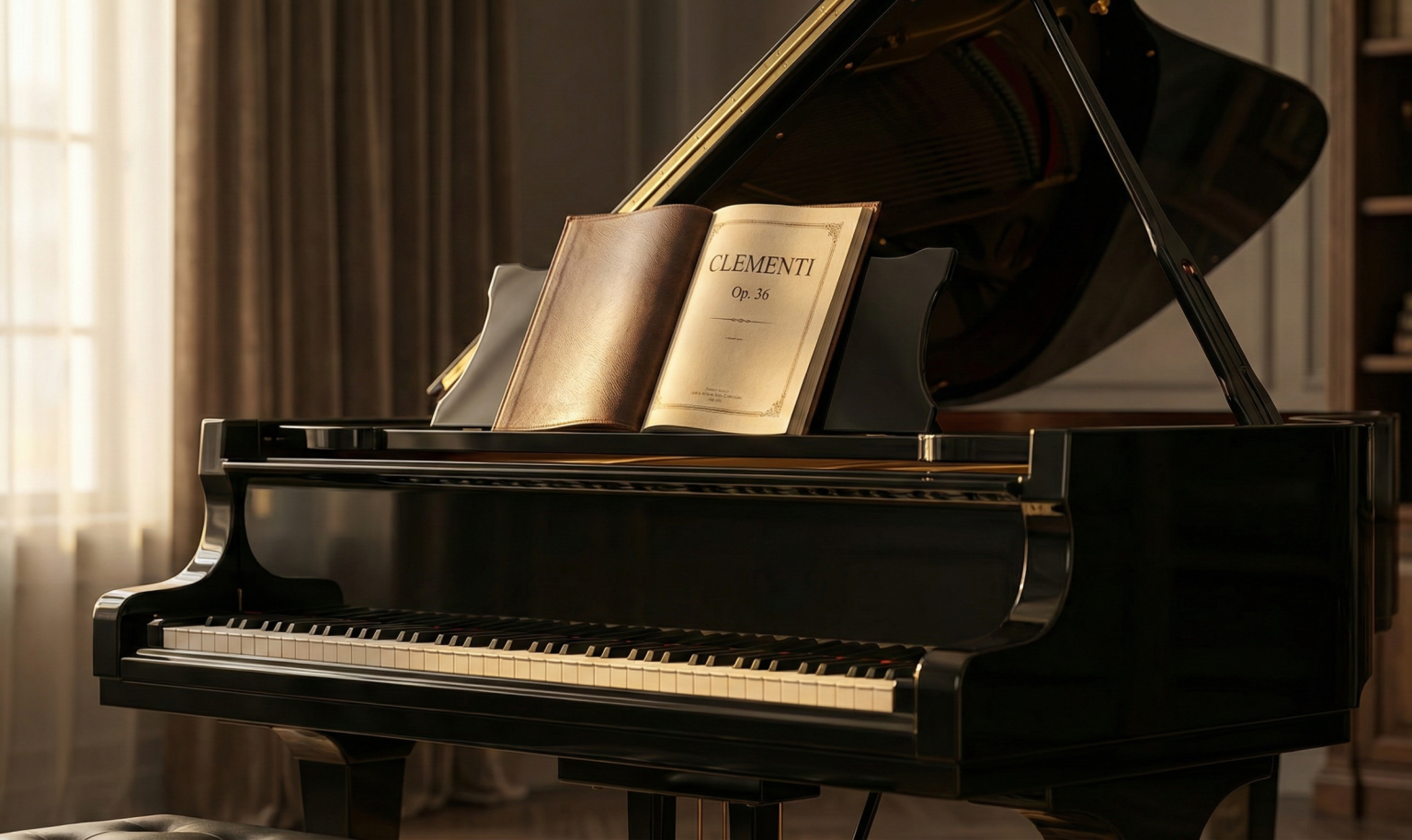
Introduction: My First Encounter with the “Father of the Piano”
The Six Progressive Sonatinas Op. 36 are not merely “student pieces”; they are a distilled essence of the High Classical style. To play them well is to understand the very mechanics of piano playing as established by the “Father of the Piano” himself. They were miniature masterpieces of clarity, balance, and classical elegance. They taught me how to make a piano “sing” while maintaining the precision of a clockmaker.
In this guide, you will discover why these sonatinas are the cornerstone of piano pedagogy, the fascinating history of the man who championed the piano over the harpsichord, and specific technical tips for mastering each piece. Whether you are a student preparing for an exam or a teacher looking for the sheet, this article available here on PianoMode, is your roadmap to classical excellence.
What are Clementi’s Six Progressive Sonatinas Op. 36?
Muzio Clementi’s Six Sonatinas Op. 36 are a collection of instructional piano pieces published in 1797. They are titled “progressive” because they increase in technical and musical difficulty from the first to the sixth. These works are designed to introduce intermediate students to the Sonata Form (Exposition, Development, and Recapitulation) while developing essential skills such as finger independence, scale runs, and precise articulation.
1. The History of the Piece and the Man Behind it
Muzio Clementi: The “Father of the Piano”
Muzio Clementi (1752–1832) was a titan of the piano world. Born in Italy but spending most of his life in England, he was a triple threat: a virtuoso performer, a prolific composer, and a successful piano manufacturer. Unlike his contemporary, Mozart, who often favored the lighter touch of the early fortepiano, Clementi pushed for a more robust, “legato” style that utilized the full mechanical potential of the evolving instrument.
His influence was so profound that even Beethoven, known for his critical nature, held Clementi’s compositions in higher pedagogical regard than those of Mozart. Clementi’s most famous contribution, the Gradus ad Parnassum, remains a staple for advanced pianists, but it is the Opus 36 that has introduced millions of beginners to the beauty of the classical era.
The Purpose of Op. 36
In the late 18th century, piano playing was becoming a standard part of a “proper” education. Clementi saw a gap in the market for music that was educational but still musically sophisticated. He revised the Op. 36 several times during his life, refining the fingerings and articulations to ensure they remained the gold standard for teaching.
2. Playing Tips & Analysis of the Six Sonatinas
Sonatina No. 1 in C Major – The Architectural Foundation
This sonatina is the “gateway” to classical literature. While it appears simple, it demands a high level of transparency. There is nowhere to hide behind a pedal or complex harmonies.
Movement I: Spiritoso (C Major)
The term Spiritoso implies a spirited, energetic, but not rushed character.
- The Alberti Bass: The primary challenge here is the left-hand accompaniment. An Alberti Bass consists of broken chords (lowest, highest, middle, highest).
- Pedagogical Tip: Do not play the left hand with individual finger stabs. Instead, use a gentle rotational movement of the wrist. Imagine you are turning a doorknob. This keeps the hand relaxed and the volume consistent.
- Coordination: Ensure the right-hand scales align perfectly with the left-hand eighth notes. Practice in “staccato” to ensure finger independence.
Movement II: Andante (F Major)
Clementi shifts to the subdominant key (F Major) to provide a warmer, more singing tone.
- The Cantabile Style: “Cantabile” means “in a singing style.” Your right hand must mimic a soprano vocalist.
- Technical Tip: Use overlapping legato (finger substitution) to ensure there are no gaps between the melodic notes. The left-hand chords should be felt as “sighs”, slightly emphasized on the first beat and trailing off on the second.
Movement III: Vivace (C Major)
A lively 3/8 meter dance.
- Rhythmic Drive: The 3/8 time signature requires a “one-beat-per-measure” feel. If you count “1, 2, 3” too strictly, it will sound heavy.
- Performance Tip: Focus on the downbeat. The sixteenth-note runs should lead directly into the next measure’s first beat.
Sonatina No. 2 in G Major – The Study of Articulation
In No. 2, Clementi introduces the “sharp” key of G Major and focuses heavily on the contrast between different touch types.
Movement I: Allegretto (G Major)
- Dot-Staccato vs. Slurs: This movement is a masterclass in Classical articulation.
- Technical Tip: Clementi often places a slur over two notes followed by two staccato notes. The first note of the slur should have a slight “drop” of arm weight, and the second should be a light “lift.”
- Grace Notes: Ensure the appoggiaturas (grace notes) are played on the beat, not before, to maintain the harmonic integrity of the era.
Movement II: Allegretto (G Major)
A more reflective, almost conversational movement.
- Echo Effects: There are several phrases that repeat. Use Terraced Dynamics (playing the first phrase mf and the second p) to create a sense of perspective and depth.
Movement III: Allegro (G Major)
A high-energy finish requiring finger independence.
- Sixteenth-Note Clarity: The right hand features rapid figurations.
- Drill Tip: Practice these in “rhythms” (long-short, short-long) to “lock” the notes into your muscle memory.
Sonatina No. 3 in C Major – Agility and Brilliance
This is where the “Progressive” nature of Op. 36 becomes evident. The technical demands increase significantly, particularly in terms of scale velocity.
Movement I: Spiritoso (C Major)
This movement is famous for its long, ascending and descending scales.
- The Thumb Tuck: To play these scales smoothly, the thumb must remain “invisible.”
- Expert Advice: Avoid “winging” the elbow out when the thumb passes under. Keep the elbow quiet and move the thumb early toward its next note.
- Dynamic Shaping: A scale should never be flat. Always crescendo as you go up and decrescendo as you come down to give the music “shape.”
Movement II: Un poco adagio (G Major)
A rare moment of deep introspection in the set.
- Subdivided Pulse: Because the tempo is slow, it is easy to lose the beat. Mentally subdivide the quarter notes into eighth notes to ensure your ornaments (turns and trills) are rhythmically precise.
Movement III: Allegro (C Major)
- Syncopation: Clementi introduces off-beat accents here. Ensure the left hand remains a steady “metronome” so the right hand’s syncopations don’t cause the tempo to drag.
Sonatina No. 4 in F Major – The Lyricism of the Romantic Precursor
Many scholars see the seeds of Romanticism in this sonatina. It is longer, more developed, and deeply expressive.
Movement I: Con spirito (F Major)
- Expansion of Form: This movement is longer than those in the previous sonatinas. It requires the pianist to maintain a “narrative thread” throughout the exposition and development.
- Double Notes: Watch for passages where the right hand plays intervals (thirds or sixths). Keep the fingers close to the keys to avoid a “clunky” sound.
Movement II: Andante con espressione (B-flat Major)
One of the most beautiful movements in all of Clementi’s pedagogical works.
- Phrasing as Breathing: Imagine you are a singer. Where would you take a breath?
- Technical Tip: Use a “wrist lift” at the end of each four-measure phrase. This creates a natural “comma” in the music, making it sound more human and less robotic.
Movement III: Rondo (F Major)
- The Rondo Form: A-B-A-C-A. The challenge is making the “A” theme sound fresh every time it returns. Try subtle changes in dynamics or articulation with each repetition.
Sonatina No. 5 in G Major – The Virtuoso Challenge
This sonatina is often the “hurdle” for intermediate students because of the speed required in the first movement.
Movement I: Presto (G Major)
- Velocity and Stamina:Presto means “very fast.”
- Training Tip: Do not start practicing at full speed. Use the “Add-a-note” method: practice one measure plus the first note of the next, then stop. This ensures your brain can process the rapid sixteenth notes before your fingers execute them.
- Non-Legato Touch: At this speed, a pure legato can sound muddy. Use a “pearly” non-legato touch (slightly detached) to ensure every note is heard clearly.
Movement II: Air Suisse (G Major)
A charming “theme and variations” style movement based on a Swiss folk tune.
- Character Changes: Each section has a slightly different mood. The ornaments here act as “jewelry”—they should enhance the melody, not distract from it.
Movement III: Rondo (G Major)
- Large Leaps: The right hand frequently jumps across octaves.
- Pro Tip: Move your hand to the new position before you need to play the note. “Prepare, then play.”
Sonatina No. 6 in D Major – The Grand Finale
The final sonatina is the most sophisticated, preparing the student for the full-scale sonatas of Haydn and Mozart.
Movement I: Allegro con spirito (D Major)
- Orchestral Thinking: Imagine this movement played by an orchestra. The opening chords are the “tutti” (full orchestra), and the running passages are the violins.
- Bravura Style: This movement demands a certain “swagger.” Don’t be afraid to use a broader dynamic range (from pp to ff).
Movement II: Rondo (D Major)
- Sophisticated Articulation: This movement features complex slurring and staccato patterns that require high-level coordination.
- The Finish: The ending should be played with a sense of triumph. Ensure the final D Major chords are perfectly synchronized between both hands for a clean, professional finish.
3. Comparison Table: Difficulty and Focus
| Sonatina | Key | Difficulty | Primary Technical Focus |
| No. 1 | C Major | Beginner | Alberti Bass & Basic Phrasing |
| No. 2 | G Major | Beginner+ | Articulation (Staccato/Legato) |
| No. 3 | C Major | Intermediate- | Scale Velocity & Thumb Passage |
| No. 4 | F Major | Intermediate | Expressive Phrasing & Dynamics |
| No. 5 | G Major | Intermediate | Tempo Stability & Ornamentation |
| No. 6 | D Major | Intermediate+ | Bravura Style & Rhythmic Drive |
Conclusion: Your Path to Mastery
Muzio Clementi’s Six Sonatinas Op. 36 are more than just historical artifacts; they are vital tools for any aspiring pianist. They teach you the “grammar” of classical music, how to structure a phrase, how to balance your hands, and how to execute technical passages with grace.
Muzio Clementi’s Six Sonatinas Op. 36 are a rite of passage. They are the “DNA” of piano playing. By mastering the technical tips outlined above, from the rotational wrist in No. 1 to the bravura spirit of No. 6, you are building the foundation required to tackle the greatest works in the piano repertoire. As you download it and begin your journey through these six works, remember to play with your ears as much as your fingers. Listen for the clarity of each note and the elegance of each cadence. These sonatinas are the bridge to the great masterworks of the piano repertoire.
Ready to start? Download the Clementi Op. 36 PDF Score here on PianoMode and begin your classical transformation today!
What level of piano is Clementi Op 36?
The sonatinas range from RCM Level 3 to Level 6 (or ABRSM Grade 3 to 5). No. 1 is the easiest, while No. 6 is the most challenging.
Why are these called “Progressive” Sonatinas?
Because they are ordered by difficulty. Clementi designed them to lead a student step-by-step through the increasing demands of classical piano technique.
Is Clementi better than Mozart for learning?
For technical foundation, many teachers prefer Clementi. His writing is more “pianistic” and addresses specific finger patterns that prepare students for the heavy demands of Beethoven and Liszt.
Should I use the pedal for Clementi’s Sonatinas?
Use it very sparingly, if at all. In Clementi’s time, the sustain pedal (damper pedal) was used as a special effect, not a constant wash. For Op. 36, focus on “finger legato” to connect notes. If you do use the pedal, use it only to enhance the resonance of long chords or in the Andante movements to help with phrasing, but never during fast scale passages.
Why does my hand hurt when playing the Presto of No. 5?
You are likely “locking” your wrist. Tension is the enemy of speed. When playing rapid passages, your wrist must remain loose and slightly bouncy. If you feel pain, stop immediately and practice the passage slowly, focusing on releasing the weight of your arm into the key bed.
How do I make these “simple” pieces sound professional?
The difference between a student and a professional performance of Clementi is dynamic range and articulation. A pro will have a clear distinction between a piano and a pianissimo, and their staccatos will be uniform in length. Record yourself and listen for “uneven” notes in your scales.