
There are few piano pieces that conjure such immediate recognition and toe-tapping joy as Scott Joplin’s “The Entertainer.” Whether heard on the radio, in old-time movie soundtracks, or through generations of piano students tapping it out on upright pianos, this tune has become one of the most iconic and accessible works in American music history. It’s charming, witty, and rhythmic, yet surprisingly intricate when you dive into the details. For intermediate pianists, learning “The Entertainer” offers a rewarding challenge: the chance to explore syncopated rhythms, stride bass, hand coordination, and a distinctive musical style that bridges classical precision and jazz spirit.
This article is a complete walkthrough of “The Entertainer,” tailored for developing pianists. We will explore its historical context, analyze its structure and musical language, and offer clear, practical playing advice, from fingering and coordination tips to dynamics, phrasing, and articulation. By the end of this guide, you’ll not only be able to play “The Entertainer” with style and accuracy, but you’ll also understand its place in music history and its enduring popularity.
“The Entertainer” is a classic piano rag composed by Scott Joplin in 1902, characterized by its 2/4 march-like meter and sophisticated syncopation. It is a multi-strain work (A-B-A-C-D) that blends African-American rhythmic innovations with European harmonic structures. For the modern pianist, it serves as a bridge between classical precision and the improvisational spirit of early jazz, requiring mastery of hand independence and wide-interval leaps.
History of the Piece and the Composer Behind It
Ragtime is a musical genre that enjoyed its peak popularity between 1895 and 1918. Its main characteristic is its syncopated, or “ragged,” rhythm.
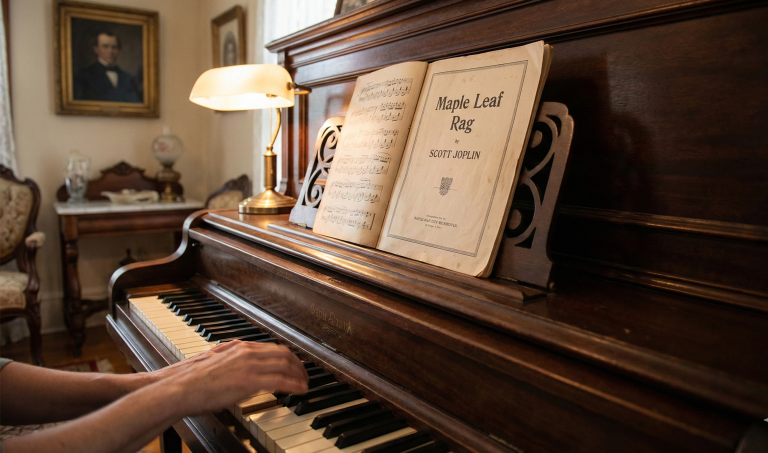
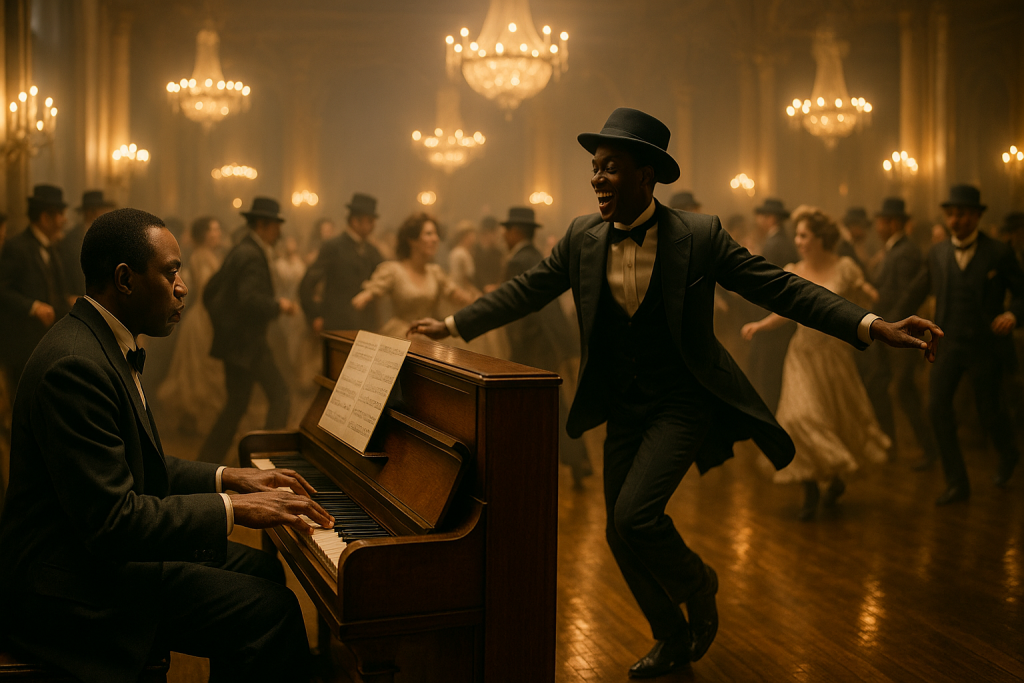
Scott Joplin composed “The Entertainer” in 1902, during the golden age of ragtime music. At that time, ragtime was America’s hottest musical trend – a syncopated piano style that brought together African-American rhythmic innovations with a march-like beat. Joplin, an African-American composer and pianist born in 1868, was by then already famous as the “King of Ragtime”, having published the blockbuster hit Maple Leaf Rag in 1899. “The Entertainer” was part of Joplin’s effort to capitalize on and elevate the ragtime genre. It was published by John Stark & Son in St. Louis (the same publisher of Maple Leaf Rag) and subtitled “A Rag Time Two Step,” indicating it was meant to accompany a popular two-step dance. Like many rags of the era, the sheet music cover billed Joplin’s latest piece as a danceable number suitable for social halls and parlors.
From the start, The Entertainer was well-received for its catchy melodies and “euphonious” character. A contemporary review in the St. Louis Globe-Democrat hailed it as Joplin’s best composition up to that point. The reviewer, Monroe H. Rosenfeld, described the piece as “a jingling work of a very original character” whose various musical strains “set the foot in spontaneous action” – in other words, it was irresistibly toe-tapping. This quality of infectious rhythm and hummable melody was exactly what made ragtime pieces the pop hits of their day. Joplin dedicated The Entertainer to “James Brown and his Mandolin Club,” a detail which led some to speculate that parts of the tune mimic the plucked tremolo sound of mandolins. In fact, the piece was soon arranged for two mandolins and guitar by Stark’s company, indicating its immediate popularity beyond solo piano circles.
Scott Joplin’s own story provides important context for The Entertainer. Born into a musical family in Texarkana, Joplin was a classically trained pianist who fused classical techniques with African-inspired rhythms. By the early 1900s, he had composed dozens of rags and earned national renown. Stark promoted him as the “King of Ragtime Writers,” a title reflecting both Joplin’s prolific output and the high regard for his craft. Joplin took ragtime seriously as an art form, writing in 1908 that “ragtime should never be played fast” and attempting to develop ragtime opera and ballet. The Entertainer was written during Joplin’s St. Louis period, a time when he was producing many classic rags. The copyright was registered on December 29, 1902, alongside two other Joplin rags (A Breeze from Alabama and Elite Syncopations), confirming how busy and creative Joplin was in that period.
However, musical tastes changed rapidly in the early 20th century. By 1917 (the year Joplin died), ragtime had begun to fade from mainstream popularity, overtaken by jazz and swing. The Entertainer, like most ragtime pieces, slipped into relative obscurity for a few decades. It was kept alive mainly by ragtime enthusiasts and piano roll recordings (indeed, The Entertainer was issued on piano rolls in the 1910s for player pianos). Joplin himself died in poverty, never imagining the resurgence his music would have.
Fast forward to the 1970s, a full-fledged ragtime revival was underway. In 1970, pianist Joshua Rifkin released an album of Scott Joplin’s piano rags that became a surprise best-seller on the classical charts. But the real catalyst for The Entertainer’s modern fame was the 1973 film The Sting. Marvin Hamlisch’s adaptation of The Entertainer was used as the movie’s theme music, bringing Joplin’s rag to an international audience. Hamlisch’s version, arranged for orchestra, became a pop hit: it reached No. 3 on the Billboard Hot 100 in 1974. Suddenly, a new generation was whistling this old ragtime tune. The New York Times noted that “the whole nation has begun to take notice” of Joplin’s music. Thanks to The Sting, The Entertainer became one of the most recognizable piano pieces in the world. In 2002, the Recording Industry Association of America even ranked it #10 on its “Songs of the Century” list, a remarkable honor for an instrumental rag.
Today, The Entertainer endures as the quintessential ragtime piece, often the first rag that piano students learn. It evokes the spirit of the early 1900s with its jaunty, vaudeville charm and cakewalk syncopations. Hearing its opening bars can transport listeners to a turn-of-the-century saloon or a carnival show, in fact, its jaunty style and title likely refer to the traveling entertainers of that era. For Joplin, the piece represented his mission to make ragtime both entertaining and artistically respectable. Little could he know that over a century later, this composition would still entertain millions and stand as a joyful ambassador of ragtime music around the globe.
Musical Structure and Style of “The Entertainer”
To play this piece with authority, you must understand its “grammar.” Ragtime is built on a specific set of rules regarding rhythm and harmony.
1. The Power of Syncopation
Syncopation is a disturbance or interruption of the regular flow of rhythm; a placement of rhythmic stresses or accents where they wouldn’t normally occur.
In “The Entertainer,” syncopation is the lifeblood of the melody. Joplin’s score is full of ties and accented notes that fall between the main beats (the “and” of the beat). This “off-beat” bounce creates the “ragged” feel. To master this, you must keep the left hand strictly on the beat while the right hand “dances” around it.
2. The Stride Bass (Oom-Pah)
The left hand in ragtime typically alternates between low bass notes (or octaves) on the strong beats (1 and 2) and mid-range chords on the weak beats (the “and” or the upbeat). This is often called the stride bass or oom-pah pattern.
In “The Entertainer,” the left hand acts like a metronome. It provides the steady, march-like foundation that allows the right hand to be syncopated.
3. Harmonic Progressions: The I-IV-iv-I Cadence
One of the most charming elements of “The Entertainer” is its use of the “Subdominant Minor” chord.
- The Progression: In the A section, Joplin moves from C major (I) to F major (IV), then to F minor (iv), before returning to C.
- The Effect: This brief shift to the minor key provides a “bluesy,” nostalgic, or vaudevillian flavor that is a hallmark of Joplin’s sophisticated style.
Detailed Analysis of the Piece’s Structure
“The Entertainer” follows a standard ragtime form. It is written in 2/4 time and consists of multiple 16-bar sections called “strains.”
| Section | Key | Character |
| Intro | C Major | Bold, unison fanfare. |
| A Strain | C Major | The famous “hum-able” main theme; jaunty and soft. |
| B Strain | C Major | Higher energy; repeated an octave higher (8va). |
| A Reprise | C Major | Return of the main theme (usually no repeat). |
| C (Trio) | F Major | Lyrical, “singing” quality; modulation to the subdominant. |
| Intro 2 | Transition | Moves the harmony from F Major back to C Major. |
| D Strain | C Major | The technical climax; octave-heavy and rousing. |
In summary, the structure of The Entertainer is straightforward to map out (Intro, four strains, with repeats and a key change in the middle), but within that structure Joplin creates variety through melodic invention, rhythmic syncopation, and dynamic contrasts. The piece exemplifies ragtime’s blend of order and whimsy: orderly march-like form and chord progressions on one hand, and whimsical off-beats and catchy tunes on the other. Understanding this balance is key to learning how to play it well. Now that we’ve surveyed the musical makeup of The Entertainer, let’s move on to practical aspects of playing it – from mastering those leaps and syncopations to shaping the music so that it truly entertains.
Playing Tips
The Entertainer may sound light and fun – and it is! – but from a pianist’s perspective it presents a series of technical challenges. It’s often classified as an early-advanced piece (around Grade 8 standard in classical piano exams), meaning it’s approachable for a solid intermediate player but not suitable for total beginners. Don’t let the jaunty tune fool you: Joplin’s original score is quite demanding, with big jumps in both hands, syncopated rhythms that require hands to be independently strong, and sections that test your octave technique. But fear not, with a systematic approach, an intermediate pianist can absolutely learn this rag and have a great time doing so. Below are comprehensive tips on interpretation and technique, covering fingering, hand coordination, rhythm and syncopation, articulation, dynamics, pedaling, and practice strategies.
Mastering Fingering and Wide Leaps
Secure fingering is critical because of the wide leaps. In the A theme, you will encounter chords that span a tenth (an octave plus a third).
- Pro Tip: If your hand cannot reach a tenth (C to E an octave above), do not strain. Instead, roll the chord quickly from bottom to top.
- The Pivot: When leaping between octaves, keep your wrist loose. Move your arm as a single unit rather than reaching with just your fingers.
Articulation: Staccato vs. Legato
Ragtime articulation is distinct from classical legato.
- Left Hand: Play the bass notes and chords short and detached. Think of a tuba in a marching band. This prevents the sound from becoming “muddy.”
- Right Hand: Most of the melody should be crisp, but the Trio (C section) can be played more legato to emphasize its singing quality.
The “Not Fast” Rule
Joplin famously wrote on his scores: “It is never right to play ragtime fast.”
Why? If played too fast, the syncopations lose their “hook,” and the intricate inner harmonies become a blur. A steady, moderate march tempo is much more “entertaining” than a frantic race.
Target Tempo: Aim for ♪ = 100–120 (quarter notes per minute).
Bar-by-Bar Technical Walkthrough
Measures 1–4: The Introduction
The piece begins with both hands in unison. This is a fanfare.
- Focus: Precision. Both hands must hit the notes at the exact same micro-second.
- Technique: Use “wrist staccato.” Let the wrist bounce slightly to give the chords a crisp, “biting” quality.
Measures 5–20: The A Strain (The Main Theme)
This is where you introduce the world-famous melody.
- Dynamics: Joplin marks this piano (soft) and dolce (sweetly).
- Technical Challenge: The right hand must jump between octaves. Use your peripheral vision to “spot” the next note before you jump.
- The Cadence: In bars 13–15, pay attention to the B-flat. This is your first “blue note.” Lean into the F minor chord in bar 14 to bring out that nostalgic Joplin sound.
Measures 21–36: The B Strain
This section provides a rhythmic contrast.
- 8va Instruction: The first time through, play as written. On the repeat, take the right hand up an octave.
- Left Hand: The bass jumps are a bit wider here. Practice the left hand alone until you can hit the “oom-pah” pattern without looking at your hand.
Measures 53–68: The Trio (C Section)
We modulate to F Major.
- The Mood: This is the “heart” of the rag. It’s more lyrical and sentimental.
- Note: Watch the B-flats in the key signature!
- Technique: This is a great place to use a tiny bit of “finger legato”—connecting the melody notes with your fingers rather than the pedal.
Measures 73–88: The D Strain (The Grand Finale)
Back in C Major, this is the техническая climax.
Energy: This is the only part where you should truly play forte (loud). Drive the piece toward the final “button”—that last, jaunty C major chord.
Octave Workout: The right hand is often playing full octaves. Keep your hand in a “frozen” octave shape but keep the wrist flexible to absorb the impact.
Recap & Practice Pointers: Each section of The Entertainer has its own challenges, but you probably noticed some themes: leaps, syncopation, and clarity. A productive way to practice is to tackle these elements separately. For leaps: spend some time just on right-hand leaps (like those in the A section), playing them in slow motion accurately, then speeding up. For syncopation: practice hands together but focus on the timing – sometimes playing just the rhythm on a single note helps (tap the rhythm that both hands produce without worrying about pitches). For clarity: practice with and without pedal to ensure you can hear each note. Also, record yourself occasionally – you might catch a rushed spot or a too-loud left hand that you wouldn’t notice while playing.
Lastly, remember to practice section transitions (Intro -> A, A -> B, B -> A, A -> Trio, Trio -> D). Smooth transitions make the whole rag sound polished. If one section starts differently (like new key or new hand position), drill the last bar of the previous section into the first bar of the next repeatedly.
With these bar-by-bar tips, you should be equipped to learn “The Entertainer” step by step. It’s a piece that rewards patient, focused practice, gradually you’ll hear the rag come to life under your fingers. And once you’ve got it, you’ll have a showpiece that truly entertains!
Conclusion
Scott Joplin’s “The Entertainer” is more than just a catchy tune; it’s a masterclass in rhythm and a cornerstone of American culture. It challenges your precision, your hand independence, and your sense of timing. But more importantly, it teaches us that music can be technically rigorous while remaining fundamentally fun.
When you finally sit down and nail that first syncopated leap, you aren’t just playing notes; you are stepping into a lineage of musicians who brought joy to saloons, parlors, and concert halls across the world.
My Final Recommendation: Don’t rush the process. Master one “strain” at a time. Start with the A section, get the rhythm “in your bones,” and only then move to the B section. And remember Joplin’s gold rule: Slow down! The beauty of ragtime is in the “swing” of the syncopation, not the speed of the notes.
Now, go to your piano, open the score, and let the King of Ragtime guide your fingers. Happy practicing!