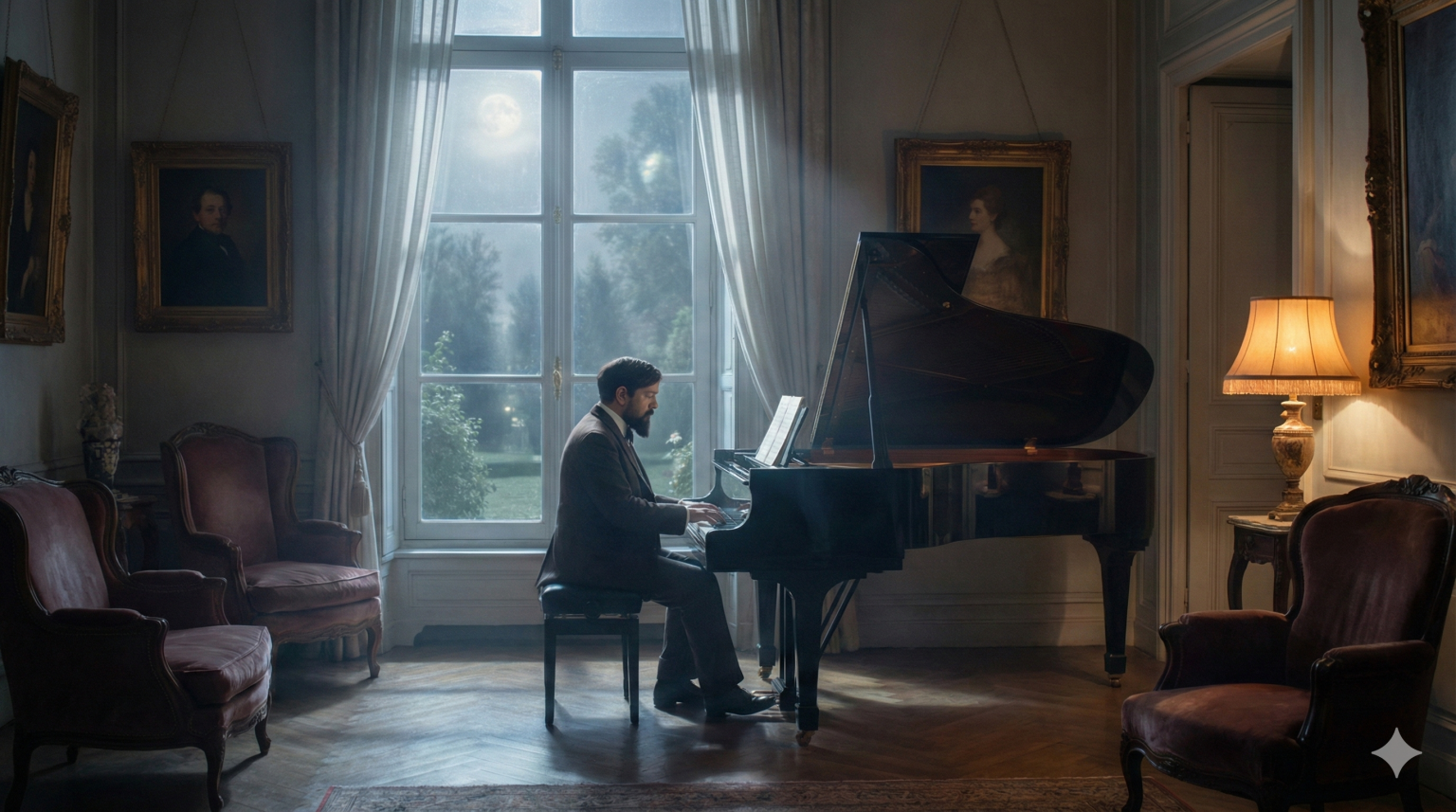
There is a singular, ethereal moment in every pianist’s development when they first lay hands on the opening chords of Claude Debussy’s “Clair de Lune”. This piece, arguably the most famous work of French Impressionism, does not merely sit on the keys; it floats above them, evoking the silver-hued stillness of a moonlit garden. As the third movement of the Suite Bergamasque, “Clair de Lune” has transcended the world of classical piano to become a universal symbol of beauty, peace, and introspection. For the intermediate to advanced pianist, it offers a gateway into a new world of sound, one where atmosphere is more important than melody, and where the “color” of a chord matters as much as its resolution.
In this exhaustive guide, we will provide you with the definitive PDF sheet music for “Clair de Lune” and an in-depth exploration of how to master it. We will begin with the historical genesis of the work, tracing its 15-year journey from a young composer’s sketch to a global masterpiece. We will then dive into a stylistic and structural analysis, examining how Debussy used the D-flat major scale and 9/8 time to create a sense of weightlessness. Finally, we provide a comprehensive technical walkthrough, covering everything from “syncopated pedaling” to the “two-against-three” polyrhythms that define the middle section. By the end of this article, you will have the tools to move beyond the notes and capture the true “light of the moon.”
What is “Clair de Lune” by Claude Debussy?
Direct Definition: Clair de Lune is the third movement of the Suite Bergamasque, a four-movement suite for solo piano by French composer Claude Debussy. Written in the key of D-flat major and set in a compound triple meter (9/8 time), it is the quintessential example of Musical Impressionism. The piece is inspired by Paul Verlaine’s 1869 poem of the same name and is celebrated for its atmospheric harmonies, delicate textures, and revolutionary use of the piano’s resonance.
The History of the Piece and the Composer Behind It
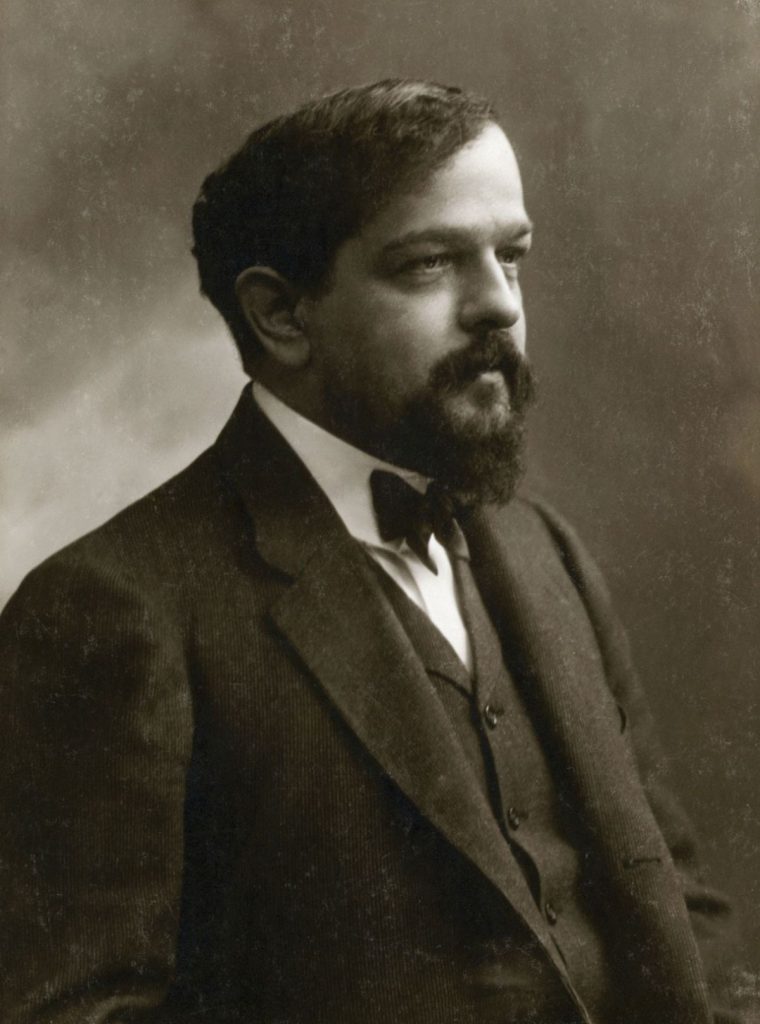
Claude Debussy composed the initial versions of the Suite Bergamasque around 1890, when he was just 28 years old. However, the version of “Clair de Lune” that the world knows today was not published until 1905. This 15-year gap is crucial to understanding the piece. During this time, Debussy underwent a radical artistic evolution, moving away from the heavy, dramatic traditions of Romanticism toward a style that emphasized “suggestion” over “statement.” When he finally returned to his early sketches of the suite, he significantly revised “Clair de Lune,” refining its harmonies to achieve a more polished, ethereal quality.
The title “Clair de Lune” (Moonlight) was a last-minute change. In his early drafts, Debussy had titled the movement “Promenade Sentimentale.” His decision to rename it was a direct homage to the poet Paul Verlaine. Verlaine’s poem “Clair de Lune” describes a “landscape of the soul” where masked dancers play lutes and sing in a minor key, appearing almost sad despite their beautiful surroundings. This connection to Symbolist poetry is essential; just as Verlaine used words to evoke moods rather than tell a literal story, Debussy used sound to paint a picture of light and shadow.
The Suite Bergamasque as a whole takes its name from the “Bergomask” dancers mentioned in Verlaine’s poetry, a reference to the Commedia dell’arte tradition of Bergamo, Italy. While the other movements of the suite (Prélude, Menuet, and Passepied) lean into a more neo-classical, rhythmic style, “Clair de Lune” stands out as the emotional heart of the work. By the time it was published in 1905, Debussy was already a controversial figure in Paris, having challenged the strict rules of the Conservatoire. “Clair de Lune” became his most accessible bridge to the public, eventually becoming a staple of the concert hall and, much later, a favorite of Hollywood cinema (appearing in everything from Fantasia to Ocean’s Eleven).
The Rise of Impressionism in Piano Literature
To play “Clair de Lune” is to step into the world of Musical Impressionism. This movement, which flourished in the late 19th and early 20th centuries, sought to replicate the effects of light and atmosphere found in the paintings of Claude Monet or Camille Pissarro.
Key Characteristics of the Style:
- Tonal Ambiguity: Unlike the works of Beethoven or Brahms, where every chord leads clearly to the next, Impressionist music often uses parallel chords and extended harmonies (9ths, 11ths, and 13ths) that seem to “hover.”
- The Pentatonic Scale: Debussy frequently used the five-note pentatonic scale, which lacks the “leading tones” of Western major scales, creating a more open, ancient, or exotic sound.
- Focus on Timbre: In Impressionism, the sound itself, the vibration and decay of the strings, is as important as the melody.
- Rhythmic Fluidity: The music avoids strong, driving pulses. Instead, it feels as though it “wafts” or “drifts,” often achieved through ties over the bar line and the avoidance of the first beat.
By the time Debussy perfected “Clair de Lune,” he had essentially transformed the piano from a percussive instrument into a harmonic harp. He demanded a touch that was “without hammers,” asking the pianist to coax sound out of the instrument rather than striking it. This legacy redefined how the piano was played in the 20th century.
Musical Structure and Stylistic Analysis
Form and Melodic Design
“Clair de Lune” is written in a Ternary (A-B-A’) Form, which creates a perfect sense of balance and return.
| Section | Measures | Key Center | Character |
| A Section | 1–26 | D-flat Major | Ethereal, slow, descending thirds. |
| B Section | 27–50 | Various (Moving) | Un poco mosso, flowing arpeggios, intense. |
| A’ Section | 51–65 | D-flat Major | The return of theme A with B’s texture. |
| Coda | 66–72 | D-flat Major | A final fading “sigh” into silence. |
The A Section is defined by its opening intervals of thirds. The melody starts on the “weak” part of the beat, creating a sensation of floating. The harmony is deeply lush; Debussy makes extensive use of the major seventh chord, which provides a bittersweet, nostalgic quality.
The B Section (Un poco mosso) introduces the first real sense of forward motion. Here, the left hand provides a constant stream of eighth-note arpeggios. The music becomes more “linear” here, as the right hand sings a melody that rises and falls with more passion than the opening. This is the “soul” of the poem—the part where the music becomes “sad and beautiful” beneath the moonlight.
The 9/8 Meter and Rhythmic Tension
The choice of 9/8 time is vital. 9/8 is a compound triple meter (three beats per measure, each divided into three). However, Debussy constantly undermines this by using duplets (two notes in the space of three). This creates a rhythmic friction, a “pulling” against the natural pulse that creates the piece’s famous rubato feel even when played strictly in time.
Playing Tips: Interpretation and Technique
1. Fingering and Phrasing
In “Clair de Lune,” the melody often moves in thirds or chords. To achieve a true legato, you must use finger substitution (changing fingers while a key is held down).
- The “Vocal” Line: Imagine the top note of every chord is being sung by a soprano. You must “voice” your hand so that your 4th and 5th fingers are slightly firmer than your thumb and index finger.
- B Section Fingering: In the Un poco mosso arpeggios, keep your thumb very light. If the thumb is too heavy, the “moonlight” effect is ruined by a rhythmic thud.
2. Tempo and Rubato
The marking is Andante très expressif. This should not be played too slowly; it is a “walking” pace, but a very relaxed one.
- Avoid the “Drunken” Rubato: Many students play the opening so freely that the rhythm is lost. First, practice with a metronome to understand the 9/8 subdivisions. Once you know the pulse, you can “steal” time (rubato) at the peaks of phrases, provided you “pay it back” at the ends of the phrases.
3. Left-Hand Voicing and Pedaling
This is arguably the most pedal-heavy piece in the standard repertoire.
- Syncopated Pedaling: You must change the pedal after you strike the new bass note, never at the same time. This ensures a seamless transition of sound without “holes” or silence.
- The Una Corda (Soft) Pedal: Use the left pedal for the entire opening and closing sections. It changes the color of the piano, making it sound more distant and “veiled.”
- Half-Pedaling: In the more complex harmonic sections, don’t lift the pedal all the way. A “flutter” of the foot can clear the high notes while keeping the deep bass notes vibrating.
Bar-by-Bar Technical Walkthrough
Measures 1–14: The Descent into the Garden
The piece begins with an F and Ab. Notice the pianissimo (pp) marking. These first notes must be dropped into from a relaxed wrist.
- The “Missing” Beat: The first note is an eighth rest. Do not play the first chord on the downbeat. The silence is the first note.
- Measure 3: The melody moves to a Db and F. Make sure the Bb in the left hand (measure 2) is held for its full value to provide the harmonic base.
Measures 15–26: The “Calmato” Transition
Here, the music becomes more chordal. In Measures 15-18, the right hand has a series of large chords.
- Tip: Reach for the bottom notes of the chords with a very soft thumb. The beauty here is in the “middle” of the chord—the inner voices should glow softly.
Measures 27–36: Un poco mosso (The Heartbeat)
This is where the arpeggios begin.
- Left Hand: Practice these eighth notes until they are perfectly even. They should sound like a harp.
- Measure 33: This is one of the most beautiful modulations in the piece. The key shifts momentarily, and the right hand enters with a triplet melody against the eighth-note left hand.
- Polyrhythm Tip: To play 2-against-3, think of the phrase “Not Dif-fi-cult” (Not [Both] – Dif [Right] – fi [Left] – cult [Right]).
Measures 37–50: En animant (The Climax)
The music builds in intensity. Measure 41 and 42 represent the emotional peak.
- Dynamic Control: Do not play “loud.” Play “deep.” Use the weight of your whole arm to push into the keys for the Crescendo.
- Measure 43: The diminuendo molto happens quickly. You must suddenly pull back the energy, returning to the ethereal world of the opening.
Measures 51–65: The Return (A’)
This is the most technically demanding section. You are playing the original theme, but with the rolling arpeggio accompaniment.
- Layering: You must balance three layers of sound. 1. The high melody (Loudest). 2. The deep bass notes (Medium). 3. The inner arpeggios (Softest).
- Fingering: Use your 5th finger to “hook” the melody notes so they sustain over the moving middle notes.
Measures 66–End: The Coda
The music settles into a deep D-flat major.
- The Final Run: The final descending arpeggio should be played perdendosi (dying away).
- Silence: When you play the final chord, do not lift your hands or the pedal immediately. Let the sound fade to absolute zero. The silence at the end is as much a part of the piece as the first note.
Conclusion: A Masterpiece of Light and Sound
Claude Debussy’s “Clair de Lune” is more than just a piece of music; it is a sensory experience. It challenges the pianist to stop thinking about “hitting keys” and start thinking about “painting with sound.” From the delicate descending thirds of the opening to the passionate swells of the middle section, it remains a testament to the power of the piano to evoke the natural world. By mastering the technical nuances of the 9/8 meter, the “without hammers” touch, and the sophisticated pedaling required, you will not only be learning a classic piece of repertoire—you will be learning the very language of Impressionism.