
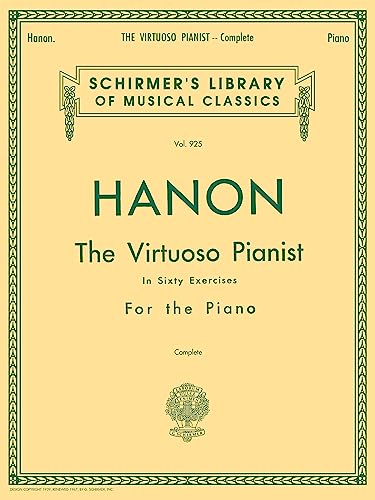
There are books in piano pedagogy that transcend the role of mere collections of exercises and become part of the very identity of pianistic training. The Virtuoso Pianist in 60 Exercises by Charles-Louis Hanon, first published in 1873, belongs firmly to this category. On the surface, it is a utilitarian volume, pages of finger drills, patterns, and repetitive sequences. Yet for generations of pianists, these exercises have been both a rite of passage and a source of discipline, helping to form the foundation on which artistry can later be built.
Hanon’s work is not about performance in the concert hall but about preparation. It is about transforming awkward, untrained fingers into supple, balanced, and independent tools of expression. To approach Hanon is to step into a long tradition of piano study, one that prizes clarity of technique, evenness of touch, and strength that does not sacrifice musicality.
 Kindle editionRead on Kindle ›
As an Amazon Associate I earn from qualifying purchases.
The History of the Piece and the Man Behind It
Charles-Louis Hanon: Teacher and Visionary
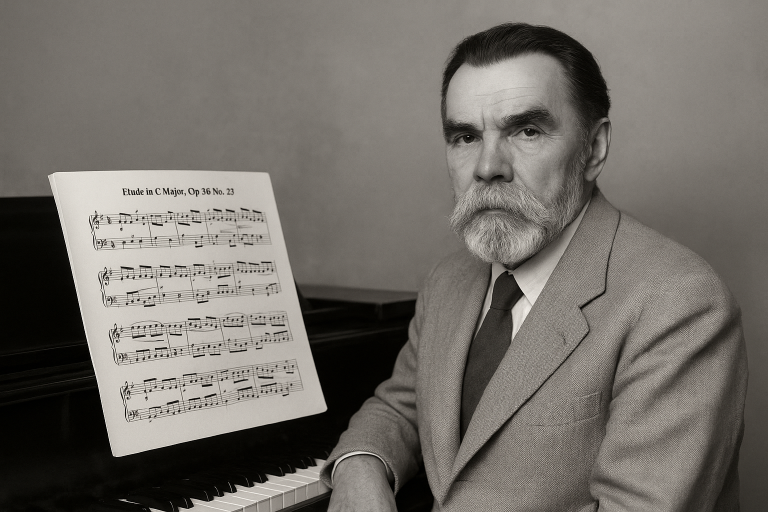
Charles-Louis Hanon (1819–1900) was not a virtuoso pianist in the sense of Franz Liszt or Frédéric Chopin. Instead, he devoted his life to teaching, composing practical studies, and developing a systematic approach to technique. Born in northern France, he worked largely as a church organist and pedagogue. His fame today rests almost entirely on The Virtuoso Pianist, which has been translated, reprinted, and disseminated worldwide.
Hanon’s central belief was that technique could be methodically trained, much like an athlete conditions the body. He observed that many beginners lacked finger independence and that even advanced students struggled with consistency across all five digits. His solution was radical in its simplicity: a progressive sequence of exercises designed to isolate, strengthen, and equalize each finger.
Publication and Reception
The collection was first issued in 1873, and it quickly gained popularity in conservatories and teaching studios. Unlike some earlier collections of études that doubled as concert repertoire (such as Czerny’s or Chopin’s studies), Hanon’s book had a purely functional aim. Teachers adopted it because it provided a clear, progressive path, from basic patterns in Part I to virtuosic scales, arpeggios, and trills in Part III.
Over time, the book has acquired both admirers and detractors. Admirers praise its efficiency: a short daily routine can yield measurable improvements in strength and agility. Critics argue that the mechanical repetition risks producing lifeless playing if not complemented with real music. Despite this debate, its endurance over 150 years testifies to its usefulness.
Musical and Technical Structure of the Exercises
Part I: Building the Foundation
The first twenty exercises are perhaps the most famous. They consist of short patterns, usually spanning one or two octaves, that move stepwise up and down the keyboard. Each pattern forces the pianist to use all five fingers equally, avoiding the tendency to rely on stronger digits. The goal is evenness: every note should sound with the same clarity and weight.
Technical focus:
- Independence of fingers, especially the weaker fourth and fifth.
- Developing equal tone across the hand.
- Coordination between hands when played simultaneously.
Part II: Expanding the Reach
Exercises 21–43 introduce arpeggios, repeated notes, and wider patterns. These studies demand greater flexibility of the wrist and a freer arm movement. The aim is to bridge the gap between finger drills and real passagework found in repertoire.
Technical focus:
- Smooth execution of broken chords.
- Developing velocity without tension.
- Strengthening endurance for repeated patterns.
Part III: Virtuosic Flourishes
The final group, exercises 44–60, brings in scales in all keys, octaves, tremolos, and trills. These are the finishing touches of virtuosity, preparing a pianist to tackle repertoire by Liszt, Rachmaninoff, or Prokofiev.
Technical focus:
- Speed and brilliance in scales.
- Coordinating large leaps and rapid alternations.
- Mastery of ornamentation at concert tempo.
Playing Tips for Greater Impact
- Quality over Quantity
It is tempting to rush through many exercises, but the true value lies in mindful repetition. Aim for absolute evenness and clarity before increasing speed. - Use a Metronome
Steady rhythm is essential. Begin slowly with a metronome, then gradually raise the tempo. This prevents uneven development and builds reliable technique. - Relaxation is Key
The exercises are not meant to induce stiffness. Shoulders, arms, and wrists must stay relaxed; otherwise the training can lead to injury rather than progress. - Vary Dynamics and Articulations
Though written plainly, the exercises can be transformed by practicing staccato, legato, forte, or piano. This not only prevents boredom but also strengthens control. - Integrate with Repertoire
Hanon should not replace musical study. Instead, let it serve as a warm-up or supplement. Apply the evenness gained here to Mozart runs, Chopin arpeggios, or Debussy textures.
Conclusion: Your Goal with Hanon
The Virtuoso Pianist in 60 Exercises is not music in the poetic sense but rather a gymnasium for the hands. Its purpose is to make technique second nature, so that when a pianist turns to Bach, Beethoven, or Ravel, the fingers respond instantly to the demands of the score.
Your goal with Hanon is not only to strengthen the hand but to discipline the mind. By approaching the exercises with patience, precision, and musical imagination, you turn mechanical drills into the groundwork of artistry. Every pianist who has touched these pages joins a lineage of students stretching back to the 19th century, all working toward the same aim: freedom of expression through mastery of the instrument.
In the end, Hanon’s legacy is not the patterns themselves but the countless performances they have enabled. Behind every fluid scale, every seamless trill, and every balanced chord, there is often a trace of these deceptively simple pages.
Kindle editionRead on Kindle ›As an Amazon Associate I earn from qualifying purchases.