As an Amazon Associate, PianoMode earns from qualifying purchases. Recommendations are made on their merits; the price you pay is the same.
Sitting down in front of a piano for the first time is a paradox of emotions. There is the undeniable thrill of those 88 keys, a vast landscape of musical possibility, but there is also the silent weight of expectation. For many, the dream of playing fluid, moving melodies is quickly met with the reality of stiff fingers, confusing notation, and the “wall of theory” that seems to guard the entrance to true musicianship. The transition from admirer to player is often the hardest part of the journey.
The mistake most beginners make isn’t a lack of talent; it is a lack of the right repertoire. Spending weeks on dry finger drills and abstract scales can drain the joy out of learning before you’ve even played your first chord. Music is a language, and just as we learn to speak before we learn to spell, the most effective way to master the piano is to start playing songs that resonate with your ears and your heart. By engaging with familiar melodies, you bypass the frustration of “robotic” practice and begin building the tactile coordination and emotional expression that define a true pianist.
In this comprehensive guide, you will discover:
The Top 10 Beginner-Friendly Tracks: A curated selection of pop, classical, and traditional songs that focus on foundational patterns.
Step-by-Step Mini-Tutorials: Technical breakdowns for each hand, designed to get you playing within minutes.
Theoretical Insights: Clear explanations of the intervals, chord structures, and rhythms that make these songs work.
Performance Secrets: Professional tips on dynamics, phrasing, and pedaling to make “simple” songs sound sophisticated.
What Makes a Song “Easy” for a Newbie?
Beginner piano songs are musical compositions specifically structured to minimize technical hurdles while maximizing harmonic impact. These pieces typically feature diatonic melodies (staying within a single key, usually C Major or G Major), repetitive rhythmic motifs, and conjunct motion (where notes move in small steps rather than large, difficult jumps). By focusing on these elements, a new player can develop essential “proprioception”, the ability to sense where their fingers are on the keyboard without looking, while simultaneously training their ear to recognize standard chord progressions like the I-IV-V-vi.
The PianoMode Philosophy: Technical exercises have their place, but songs are the soul of the instrument. Playing real music provides the immediate feedback loop necessary to sustain motivation and build a lifelong bond with the piano.
1. Imagine – John Lennon
The Essential Lesson in Harmonic Stability
Few songs are as globally recognized or as perfectly suited for the piano as John Lennon’s “Imagine.” It is the ultimate study in creating a profound atmosphere using very few moving parts. For a newbie, it provides a stable environment to practice the “pulse” of a song, the steady, rhythmic heartbeat that keeps the music alive. You don’t need a lot of fancy finger work to play the intro and verse. The chord progression is repetitive, so once I got the hang of the first few bars, the rest followed easily. Playing this song taught me how emotional expression can come through even the simplest notes.
The Tutorial: Breaking it Down
- The Right Hand (Chords): The song is centered around a C Major triad (C-E-G). The signature sound comes from the “Major 7th” transition. You play the C Major chord, then simply move your thumb or pinky to hit the B note, creating a Cmaj7. This teaches you how changing just one note can shift the entire emotional color of a piece.
- The Left Hand (The Foundation): The left hand plays a very simple, alternating bass line between C and F. This is the perfect time to practice “octaves” if your hand is large enough; if not, a single solid note on the beat is enough to provide the “anchor” the melody needs.
- The Bridge: The transition to “You may say I’m a dreamer” introduces the F and G chords. This is a classic IV-V progression, the most common transition in Western music.
How to Elevate Your Performance
- Master the “Weight-Drop”: Avoid “poking” the keys with your fingers. Instead, let the weight of your arm drop into the C Major chord. This produces a warm, “Lennon-esque” tone rather than a harsh, percussive one.
- Sustain Pedal Control: Use the right-most pedal to “glue” the chords together. Lift your foot and re-press it exactly when you change from the C chord to the F chord. This prevents the notes from blurring into a muddy mess.
As an Amazon Associate I earn from qualifying purchases.
2. Row, Row, Row Your Boat
A Masterclass in Rhythmic Precision
This childhood favorite may seem overly basic, but it’s a brilliant introduction to melodic structure. I played “Row, Row, Row Your Boat” in the early days of learning to move across the keyboard without looking down constantly. Its repetitive notes helped me build familiarity with finger placement and timing. What’s more, it’s a great first tune to practice playing by ear, which can develop your musical intuition quickly. Furthermore, it introduces the dotted rhythm, which is a “long-short” pattern that is fundamental to everything from Jazz to Baroque music.
The Tutorial: Breaking it Down
- Finger Positioning: Place your right hand in the “Middle C Position.” This means Finger 1 (thumb) is on C, Finger 2 on D, and so on. The entire melody fits within this five-finger span, so you don’t have to move your hand at all.
- The Rhythmic Hook: The “Merrily, merrily, merrily” section requires three notes to be played in the space of one beat (triplets). This is often the first time a newbie learns to move their fingers quickly while maintaining a steady tempo.
- The Melodic Leap: The final “Life is but a dream” requires a jump to the G above. This teaches your brain to associate a physical distance on the keys with a specific musical interval (a Perfect 5th).
How to Elevate Your Performance
- Legato vs. Staccato: Try playing the first half of the song legato (smooth and connected) and the “Merrily” section staccato (short and bouncy). This contrast makes a simple nursery rhyme sound like a professional technical etude.
3. Stay With Me – Sam Smith
The Power of the 4-Chord Gospel Loop
“Stay With Me” was the first modern ballad I felt proud of playing. The song is carried by a minimal chord progression that sounds beautiful even in a simplified arrangement. It gave me the chance to explore the power of chords and how simple progressions can support a powerful vocal line. For beginners, this song offers a practical way to develop timing and hand coordination while playing something emotional and current.
Once you master the primary 4-bar progression, you have effectively learned the entire song. This track, in particular, teaches you about “Aolian” or Minor harmony, giving you a moodier, more soulful palette to work with.
The Tutorial: Breaking it Down
- The Progression: The song follows a simple Am – F – C loop.
- A Minor (Am): A-C-E
- F Major (F): F-A-C
- C Major (C): C-E-G
- Hand Independence: Start by playing the chords in the right hand and only the root note (the “name” of the chord) in the left hand. Play them simultaneously on beat 1.
- The Rhythm: The chords should feel like they are “sighing.” Don’t rush them; let the C Major chord ring out for two full beats.
How to Elevate Your Performance
- Voice Leading: Instead of jumping your hand from the A Minor shape to the F Major shape, notice that both chords share the notes A and C. You only need to move your “pinky” from the E to the F. This is called efficient fingering, and it is the secret to playing fast and smooth.
4. Mary Had a Little Lamb
Developing Spatial Awareness & Proprioception
This song is the “Gold Standard” for teaching finger independence. Because the melody is so familiar, your ear will immediately tell you if you’ve hit the wrong key, allowing you to self-correct without needing to look at a score.
The Tutorial: Breaking it Down
- The 3-2-1 Pattern: The melody starts on the 3rd finger (Middle finger). E – D – C – D – E – E – E. This sequence forces you to use your “weaker” fingers (2 and 3) in coordination with your thumb.
- Steady Tempo: Use a metronome or a simple beat-track set to 80 BPM. The goal here isn’t speed; it’s the absolute consistency of the quarter notes.
- Left Hand Accompaniment: Once the right hand is automatic, add a single “C” note in the left hand at the start of every measure.
How to Elevate Your Performance
- The “Singing” Tone: Piano keys aren’t just buttons; they are levers. Try to “sing” through the keys by pressing them with a firm but flexible wrist. This prevents the “clunky” sound that often plagues new players.
5. All of Me – John Legend
Exploring Emotional Dynamics and Phrasing
This is perhaps the most requested song for new pianists. While the original has a lush, full sound, the core of the song is a simple four-chord progression that can be easily simplified without losing its romantic “soul.”
The Tutorial: Breaking it Down
- The Simplified Key: While the original is in Ab Major (lots of black keys), most newbies should start in G Major. The progression becomes Em – C – G – D.
- The Right Hand Syncopation: The melody often falls “between” the beats. Practice singing the melody while just tapping the rhythm on the piano lid before you try to play the notes.
- The Pedal: This song requires heavy use of the sustain pedal. Ensure you “clear” the pedal (lift and re-press) every time the chord changes to keep the harmony clean.
How to Elevate Your Performance
- Dynamic Arching: Start the verse very softly (pianissimo). As you approach the chorus, gradually increase the pressure on the keys (crescendo). This “arch” is what makes a performance sound professional rather than amateur.
 Kindle editionRead on Kindle ›
As an Amazon Associate I earn from qualifying purchases.
6. The First Noel
“The First Noel” is a timeless English carol that introduces the beginner to the “Waltz” or Triple Meter (3/4 time). Unlike the 4/4 time found in most pop songs, 3/4 time requires a different rhythmic emphasis, usually described as “Strong-weak-weak.”
The Tutorial: Breaking it Down
- The Anacrusis (Pickup Note): The song does not start on beat 1. It starts on beat 3. Count: “One, Two, [Play on Three].” This is crucial for maintaining the correct flow of the melody.
- The Right Hand (Scale Movement): The melody is largely “conjunct,” meaning it moves up and down the scale in steps (D-E-F#-G). Use fingers 1 through 5, and when you reach the end of your hand’s reach, practice the “thumb-under” technique to continue the scale.
- The Left Hand (The Waltz Bass): Play a low C on beat 1, then the E-G interval (part of the C chord) on beats 2 and 3. This creates the classic “Oom-pah-pah” feel.
How to Elevate Your Performance
- Musical Phrasing: Think of each line of the song as a physical “arc.” Start the phrase softly, reach a peak in volume in the middle, and taper off at the end. This prevents the song from sounding like a mechanical exercise.
- The Leading Tone: Pay close attention to the B note leading back to C. Play it with a slight “lean” to emphasize the resolution back to the “home” key.
7. Can’t Help Falling in Love – Elvis Presley
Introduction to Arpeggios (Broken Chords)
This iconic ballad is the perfect gateway to Arpeggio playing. Instead of striking all notes of a chord simultaneously (Block Chords), you play them sequentially. This creates a flowing, water-like texture that is a staple of romantic piano music.
The Tutorial: Breaking it Down
- The “Six-Eight” Feel: Technically in 6/8 or a slow 4/4 with triplets, the left hand should follow a rolling pattern: Root – Fifth – Third. For a C Major chord, play C (low), G, then E (high).
- The Chord Shift: The progression moves from C to Em to Am. Notice how your left hand can stay in a relatively similar “anchor” position while only the top notes change.
- The Right Hand: The melody consists of long, sustained notes. Hold them for their full value while the left hand continues its rolling pattern underneath.
How to Elevate Your Performance
The Sustain Pedal: Change the pedal on every new chord (every 3 or 6 beats). If you hold it too long, the “broken” notes will clash and create dissonance.
Left Hand Subtlety: The arpeggios in the left hand should be like a soft background painting. Keep them significantly quieter than the right-hand melody. This is called hand-to-hand balance, and it is what separates a newbie from an intermediate player.
8. Frère Jacques
Your First Step into Polyphony and Counterpoint
While it seems simple, “Frère Jacques” is the easiest way to understand Polyphony—the concept of two or more independent melodies playing at once. In music theory, this is often played as a “Round.”
The Tutorial: Breaking it Down
- The Basic Sequence: The song is built on four distinct phrases, each repeated:
- C-D-E-C
- E-F-G
- G-A-G-F-E-C
- C-G(low)-C.
- The Perfect 5th Leap: The “Ding, Dang, Dong” section requires a jump from C down to G. This is a “Perfect 5th” interval. Practice the distance without looking at your hands to build “spatial memory.”
- Two-Hand Independence: Try playing the melody in the right hand and a constant “C” drone (repeating C on every beat) in the left hand. This is the first step toward playing different rhythms in each hand.
How to Elevate Your Performance
Playing in a Round: Record yourself playing the melody. Then, play along with the recording, but start your live performance exactly two measures late. This will train your brain to keep your own rhythm while hearing a competing melody.
The “Bell” Effect: On the final “Ding, Dang, Dong,” play the notes with a slightly sharper attack to mimic the sound of church bells.
9. Sky Full of Stars – Coldplay
Rhythmic Stamina and Percussive Touch
Coldplay’s piano style is unique because it treats the piano as a percussion instrument. For a newbie, this song is about building rhythmic stamina and learning to play with energy without tensing up.
The Tutorial: Breaking it Down
- The “Four-Chord” Anthem: The song uses Ebm – B – Gb – Db. To make it “newbie-friendly,” we transpose it to Em – C – G – D.
- The Eighth-Note Pulse: Your right hand plays the chord repeatedly in a steady rhythm: “1-and-2-and-3-and-4-and.”
- The Left-Hand Anchor: The left hand plays a single low note on the “1” of every measure. This helps you keep your place while the right hand is “drumming” the chords.
How to Elevate Your Performance
The “Build-Up”: Start the song softly. As you get to the “chorus” section, increase the weight of your arms to make the piano sound “fuller” and more “epic.”
Wrist Relaxation: Playing repetitive eighth notes can cause “Newbie Tension.” Keep your wrist flexible and “bouncy.” Imagine your hand is a rubber ball bouncing on the keys; let the physics do the work, not your muscles.
10. Ode to Joy – Ludwig van Beethoven
The Ultimate Introduction to Classical Phrasing
Beethoven’s “Ode to Joy” is arguably the most famous melody in Western civilization. Its genius lies in its simplicity, it is almost entirely “step-wise,” making it the perfect final song for this list.
The Tutorial: Breaking it Down
- The Five-Finger Position: Place your right hand in “G Major Position” (Thumb on G, Pinky on D). You don’t need to move your hand once during the entire main melody.
- Step-wise Movement: Notice the pattern: 3-3-4-5-5-4-3-2-1-1-2-3-3-2-2. (Where 1 is thumb). This builds incredible finger coordination.
- The Cadence: The end of the phrase (3-2-2) is a “Half Cadence,” and the second ending (2-1-1) is a “Perfect Authentic Cadence.” This is how music “breathes” and “resolves.”
How to Elevate Your Performance
The “Heroic” Dynamic: Beethoven is known for power. Play this with a sense of triumph. Keep your shoulders down, your back straight, and let the energy flow from your core into your fingertips.
Clean Articulation: In classical music, every note must be “crystalline.” Avoid using the sustain pedal at first. Focus on lifting your finger precisely when the next note starts.
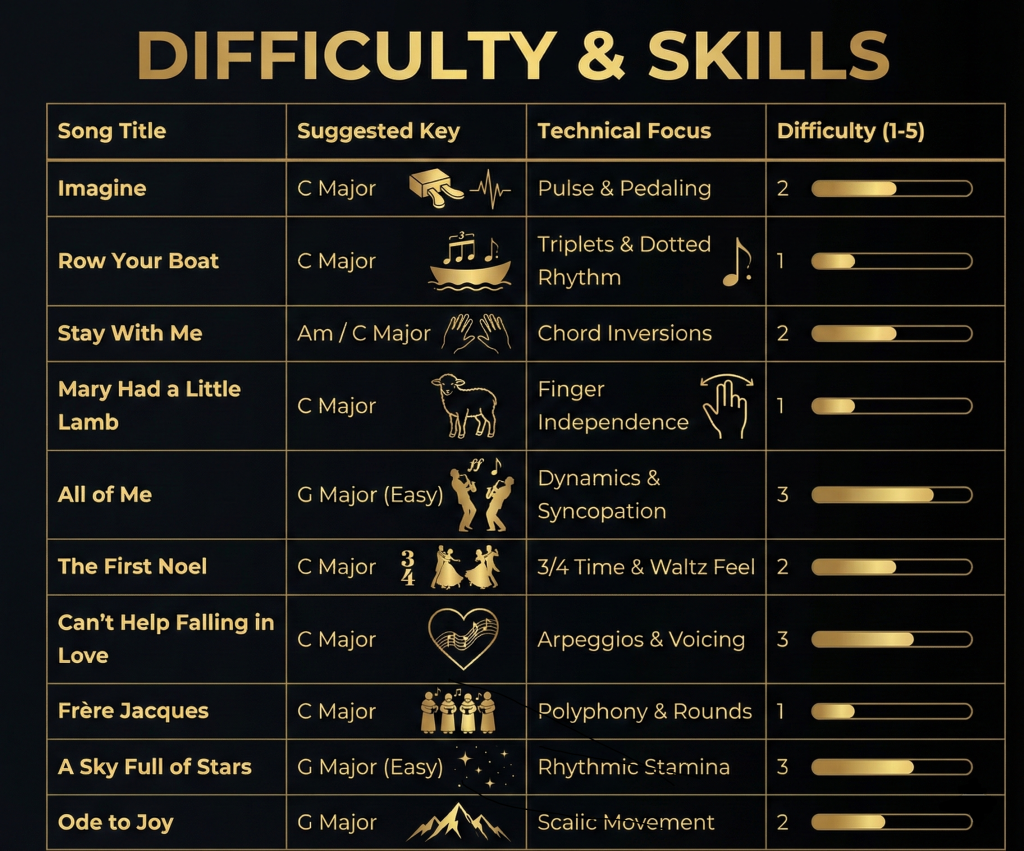
11. Why These Songs Are Ideal for Beginners
Selecting the right repertoire is the most critical step for any novice pianist. The songs listed above are not chosen at random; they are pedagogically curated based on specific structural characteristics that facilitate rapid skill acquisition.
What defines a “Beginner-Friendly” song? A beginner-friendly piano song is a composition that utilizes diatonic melodies, repetitive harmonic structures, and a limited physical range on the keyboard. These elements allow a student to focus on basic tactile coordination without the cognitive interference of complex accidentals or large interval leaps.
- Diatonicism: Most of these tracks stay within the “white keys” (C Major or A Minor), reducing the risk of hitting wrong notes and allowing the player to focus on finger strength.
- Predictable Harmonic Patterns: By using standard progressions—such as the I-IV-V-vi—students subconsciously learn the “grammar” of Western music, making it easier to memorize future pieces.
- Moderate Tempos: Slower pieces provide the brain with the necessary “processing time” to translate visual notation or mental memory into physical movement.
- Melodic Familiarity: Playing a recognizable tune provides immediate auditory feedback. If a note is missed, the brain corrects it instantly because it knows how the melody should sound.
The Value of Learning Songs Over Scales Early On
There is a long-standing debate in music education regarding the priority of technical drills versus repertoire. While scales and arpeggios are the building blocks of virtuosity, focusing exclusively on them during the first few months can lead to “practice fatigue” and a loss of interest.
The Application-Based Learning Model Learning through songs follows an application-based model. Instead of practicing a C Major scale in a vacuum, a student learns that same scale while playing the melody of Ode to Joy. This provides harmonic context, making the technical movement meaningful rather than mechanical.
- Increased Motivation: Completing a song provides a sense of achievement (Dopamine reward) that a perfectly played scale rarely offers.
- Musicality and Phrasing: Technical drills do not teach “storytelling.” Only through songs can a newbie learn Dynamics (loud/soft) and Articulations (smooth/bouncy) that make an instrument sound human.
- Contextual Theory: It is much easier to explain what a “Major 7th chord” is when the student can actually hear it and feel it in a song like Imagine.
Methodical Practice: How to Master These Songs Effectively
Mastery on the piano is not a result of “playing through” a song 100 times. It is the result of deliberate practice. To master the 10 songs in this guide, a structured approach is required to build the necessary neural pathways.
1. Hands-Separate Practice (Proprioception)
The greatest challenge for any newbie is Hand Independence. To overcome this, one must isolate the hands.
- Right Hand (Melody): Practice until the fingers move without hesitation.
- Left Hand (Harmony): Practice until the chord changes feel automatic. Only when each hand can perform its task with minimal conscious effort should they be combined. This builds proprioception, the ability to know where your hand is in space without looking at it.
2. Micro-Looping (Sectional Isolation)
The human brain processes information more efficiently in “chunks.” Instead of playing a song from start to finish, identify the most difficult two bars (the “problem area”) and loop them.
- The 5-Time Rule: Play the difficult section 5 times perfectly in a row. If a mistake is made on the 4th time, the count restarts at zero. This cements the correct muscle memory.
3. Slow Practice and Intentionality
Speed is a byproduct of accuracy. Playing slowly gives the central nervous system the time to map the distance between keys.
- Technical Tip: Practice at 50% of the target tempo. If you cannot play it perfectly at a slow speed, you will never be able to play it correctly at full speed.
4. Objective Auditory Analysis (Recording)
When playing, the brain is often too busy with physical execution to truly “hear” the output. Recording your practice sessions allows you to listen as a critic.
- Listen for rhythmic inconsistencies, uneven dynamics, or blurred pedaling. This objective feedback is often more valuable than an hour of unmonitored practice.
Building Confidence and Repertoire
Each successfully learned song acts as a “tangible victory.” For a newbie, the psychological barrier of “I can’t play piano” is broken the moment a recognizable melody emerges from their fingertips.
These 10 songs provide the foundational “vocabulary” required for more complex music. They establish the hand positions, rhythmic patterns, and chord shapes that appear in 90% of popular and classical music. By mastering this starter kit, you are not just learning 10 songs; you are installing the Operating System of a pianist.
Ready to accelerate your progress?
- Get the Scores:
 Kindle editionRead on Kindle ›
As an Amazon Associate I earn from qualifying purchases.
Kindle editionRead on Kindle ›As an Amazon Associate I earn from qualifying purchases.
As an Amazon Associate I earn from qualifying purchases.
- Deepen Your Knowledge and Master Your Chords: Dive into the mechanics of melody
As an Amazon Associate I earn from qualifying purchases.
 Kindle editionRead on Kindle ›
As an Amazon Associate I earn from qualifying purchases.
 Kindle editionRead on Kindle ›
As an Amazon Associate I earn from qualifying purchases.
 Kindle editionRead on Kindle ›
As an Amazon Associate I earn from qualifying purchases.
The keys are waiting. What story will you tell today?
Conclusion
Mastering these 10 easy songs to play on piano as a newbie is more than just a hobbyist’s checklist; it is the construction of your musical foundation. Each track, from the soulful chords of John Lennon to the structured brilliance of Beethoven, has taught you a specific, high-yield skill: pedaling, rhythm, hand independence, and emotional expression.
The piano is an instrument of infinite depth, but it is also a source of immediate, tangible joy. Don’t wait until you “know everything” to start performing. Play these songs for your friends, record them for yourself, and embrace the small victories. Every mistake is a data point, and every correct note is a step toward mastery.
How long should I practice each song before moving on?
You don’t need to reach “perfection” to move to the next song. Once you can play a song at 80% speed without stopping, you have likely gained the technical benefit of that piece. Feel free to rotate between 2 or 3 songs to keep your mind fresh.
My left hand is much weaker than my right. Is that normal?
Absolutely. For most people, the non-dominant hand lacks the “dexterity” of the dominant one. This is why we recommend practicing each hand separately for at least 10 minutes before trying to put them together.
What is the most important piece of theory for a newbie?
Understanding Intervals (the distance between two notes). If you can visualize the distance between a C and a G without counting the keys, your sight-reading and “playing by ear” will improve exponentially.