
There’s a moment in nearly every pianist’s journey when the notes of “Für Elise” begin to echo from the fingers for the very first time. It’s almost a rite of passage, that lilting opening motif, hypnotic and nostalgic, so simple yet immediately unforgettable. “Für Elise” is more than a piece. It’s a doorway into the world of classical piano. And whether you’re eight or eighty, the pull of this music is undeniable.
I still remember the first time I stumbled through those initial bars. It felt like learning a language I already knew in my bones. But as familiar as the piece may be, and let’s admit it, it’s been played to the point of cliché . There is immense value in returning to it with fresh ears and an open mind.
This article is a deep dive into one of the most beloved solo piano pieces of all time. We’ll explore the story behind “Für Elise”, the mystery surrounding its title, the structure and musical techniques embedded in the score, and how to approach it as a pianist, whether you’re playing it for the first time or rediscovering it after years.
The history of the piece and the man behind it
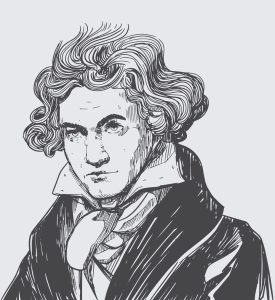
“Für Elise” is the name we all know, but technically speaking, it’s a nickname, an unofficial one at that. The piece’s true title is Bagatelle in A minor, WoO 59, and it wasn’t even published during Beethoven’s lifetime. It was discovered forty years after his death, tucked away among his papers by a musicologist named Ludwig Nohl, who found the manuscript in 1867 and decided to bring it to light.
This alone already adds an air of mystery to the piece. Why was it never published by Beethoven himself? Was it unfinished? Was it a sketch? Or perhaps it was simply a personal piece, written as a gift or memento.
The name Für Elise means “For Elise,” but here again, the mystery deepens. We don’t know for certain who “Elise” was. Some speculate it was Elisabeth Röckel, a soprano Beethoven admired and may have proposed to. Others argue that Nohl misread Beethoven’s handwriting, and that the title was actually Für Therese, referring to Therese Malfatti, another woman to whom Beethoven was close and perhaps even proposed. The truth remains lost to history, but the sentiment remains: this is a piece written for someone, and that intimacy is part of its enduring charm.
Beethoven composed the piece in 1810, during his middle period, a time when his music was becoming increasingly emotional, introspective, and exploratory. Though we often associate Beethoven with his symphonies and large-scale works, he had a lifelong love for smaller forms, the bagatelles, which he often used to capture fleeting ideas or moods, almost like a musical diary.
“Für Elise” fits this mold. It is delicate, simple on the surface, yet deeply expressive. It has the feel of a sketch, but within that simplicity lies its genius.
Musical and technical structure of “Für Elise”
When a piece becomes this famous, it’s easy to take its structure for granted. But there is something wonderfully effective and economical about the way Beethoven constructs this music. It’s a lesson in contrast, repetition, and surprise. All within a compact three-minute form.
Let’s take it apart.
1. The main theme (A section)
The opening is as iconic as it gets. In A minor, the right hand sings a haunting melody that dances between E and D sharp before descending into the tonic. The grace note that begins the phrase is more than a decoration. It gives the music its gentle flicker, its almost hesitant quality.
What makes this theme stick is its use of repetition and variation. The motif repeats several times, with slight changes in harmony and phrasing. The left hand offers a simple broken chord accompaniment, creating a hypnotic foundation.
It’s easy to overlook, but Beethoven’s genius here is subtle. He creates tension not through complexity but through timing, the small delays, the unexpected resolutions, the hint of playfulness hidden within the melancholy.
2. The first contrasting section (B section)
After the opening theme repeats, we transition into a brighter, more animated section in F major, the relative major of A minor. The texture thickens. The left hand becomes more rhythmic, and the right hand starts to climb with energy.
This shift is like sunlight breaking through clouds. It’s optimistic, more vertical in movement, with arpeggios and scalar runs that build tension. But it doesn’t last long. Beethoven brings us back quickly to the original theme, as if reminding us not to stray too far from that intimate opening.
3. The second contrasting section (C section)
Later in the piece, a more turbulent passage emerges. This time we’re thrust into C major, then quickly back to A minor with insistent staccato chords and a more dramatic flair. This section is more virtuosic, more rhetorical. It brings a surge of emotional energy before the final return of the theme.
In just three sections, A, B, and C, Beethoven creates an emotional arc: tenderness, lightness, then tension, all wrapped around that unforgettable melody.
Your goal with “Für Elise”
It’s easy to dismiss “Für Elise” as overplayed. We’ve all heard it in elevators, doorbells, ringtone apps and tourist shops. But the real music, the true emotional language Beethoven wrote into these notes, still waits quietly behind the noise. Your goal, if you choose to study this piece, is to rediscover its sincerity.
Approach it not like a crowd-pleaser, but like a letter never sent, written by a man who couldn’t bring himself to say what he felt aloud. Each phrase is an intimate confession, each return to the theme a sigh of remembrance.
Technically, this piece will challenge you in subtle ways, hand independence, voicing, control over rubato, balance between melody and accompaniment. But more than anything, it will challenge your ability to listen deeply.
And if you let it, it will reward you. Because in those first few bars, so simple, so haunting, lies a reminder of why we play the piano in the first place: to connect. To feel. To remember.