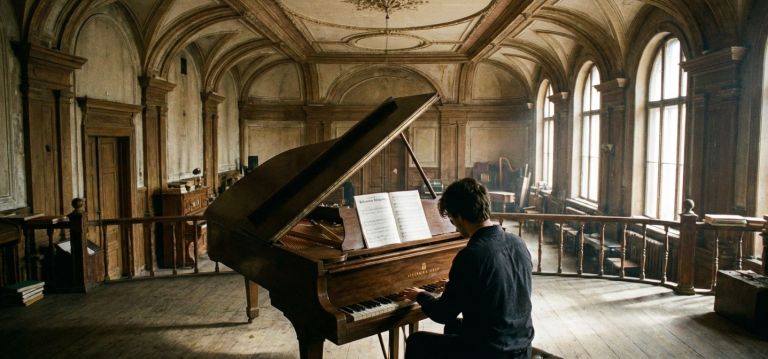
Seeing myself playing “All of Me” by John Legend on the piano, I knew I wanted a clear, step-by-step approach that would help me understand every part of the song thoroughly. I remember the first time I sat down to play “All of Me”. The room was quiet, the gold light of the sunset was hitting the keys, and I wanted to capture that exact soulful vulnerability I heard in the original recording. I didn’t just want to play the notes; I wanted to feel the weight of every chord. This tutorial is born from that experience, a desire for a clear, step-by-step approach that moves beyond simple finger placement into true musicality. Over the years, I’ve found that breaking down songs into their core harmonic and rhythmic components leads to the most enduring results. Whether you are navigating the gentle intro or the powerful resonance of the chorus, this guide will provide the technical authority you need to master this modern classic.
“All of Me” by John Legend is a soulful pop ballad written in the key of Ab Major (or F Minor, its relative minor) with a standard 4/4 time signature. The song is famous for its “vi – IV – I – V” chord progression (Fm – Db – Ab – Eb), which provides the emotional foundation for the entire piece. To play it effectively, a pianist must master the Ab Major key signature (which contains four flats: Bb, Eb, Ab, and Db), utilize homophonic textures (melody in the right hand, accompaniment in the left), and apply nuanced sustain pedal techniques to achieve a legato, resonant sound.
Official High Quality PDF
Instant Download • Virtual Sheet Music
Understanding the Foundation: Key Signature and Theory
Before pressing a single key, you must understand the "language" this song speaks. In music theory, the key signature tells us which notes are automatically sharp or flat throughout the piece.
The Key of Ab Major
“All of Me” is primarily performed in Ab Major. According to the Circle of Fifths, Ab Major contains four flats: Bb, Eb, Ab, and Db.
- The Scale: Ab - Bb - C - Db - Eb - F - G - Ab.
- Relative Minor: F Minor (F - G - Ab - Bb - C - Db - Eb - F).
- Pitch Class: Each of these notes belongs to a specific pitch class used to build the harmonic structure of the song.
The Core 4-Chord Progression
Most of the song relies on a recurring cycle of four triads—chords consisting of three notes built in thirds. Using Roman Numeral Analysis, the progression is typically viewed as:
- vi (F Minor): F - Ab - C
- IV (Db Major): Db - F - Ab
- I (Ab Major): Ab - C - Eb
- V (Eb Major): Eb - G - Bb
This progression creates a sense of "tension and release" that is characteristic of modern pop ballads. By understanding these harmonic intervals, you can better anticipate the hand movements required for smooth transitions.
Technical Preparations for Success
1. Master the Ab Major Scale
To play the melody with fluid articulation, practice your Ab Major scale across two octaves. Focus on the "thumb tuck" under the third and fourth fingers to maintain a seamless legato.
2. Hand Independence and Texture
This piece uses a homophonic texture, where the right hand provides the lyrical melody and the left hand provides the harmonic support (chords or arpeggios).
- Right Hand: Focus on "singing" through the keys.
- Left Hand: Maintain a steady pulse and rhythm.
3. Rhythm and Meter
The song is in Common Time (4/4), meaning there are four beats per measure. Many phrases in the melody are syncopated, meaning they fall off the main beat to create a more natural, vocal-like feel.
Section-by-Section Breakdown
Phase 1: The Iconic Intro
The introduction sets the emotional "atmosphere." It utilizes broken chords (arpeggios) in the left hand.
- Left Hand Technique: Instead of playing all notes of the Fm chord at once, play them sequentially (F -> C -> F). This creates a "rolling" sound.
- Dynamic Control: Start Piano (soft) and gradually build as you move toward the verse.
Phase 2: The Verses
The verses are where the storytelling happens. The right hand plays a repetitive, rhythmic melody.
- Fingering Tip: Keep your hand in a "five-finger position" around the Ab and C keys to minimize unnecessary movement.
- The "vi - IV - I - V" Loop: Focus on the transition from Db Major to Ab Major. Since both chords share the note Ab, use that note as a "pivot" to keep your hand stable.
Phase 3: The Pre-Chorus (Building Tension)
The pre-chorus introduces more diatonic chords and increases the rhythmic density.
- The Build-up: Increase your velocity (how hard you hit the keys) to create a Crescendo.
- Pedal Work: Ensure you clear the sustain pedal every time the chord changes to avoid "muddiness" or dissonance.
Phase 4: The Chorus (The Emotional Climax)
This is the "All of me loves all of you" section. It requires the most power and dynamic range.
- Right Hand: Play the melody in octaves if you want a fuller, more "professional" sound.
- Left Hand: Transition from broken chords to block chords (playing all notes simultaneously) for a grounded, authoritative feel.
Expressive Techniques: Playing with Soul
To move from "playing notes" to "making music," you must apply specific expressive techniques:
| Technique | Description | Application in "All of Me" |
| Rubato | Slight speeding up or slowing down. | Use at the end of the bridge to add emotional weight. |
| Sustain Pedal | Holding the damper off the strings. | Depress on beat 1, lift and re-press on every chord change. |
| Dynamic Phrasing | Varying volume within a phrase. | Mimic John Legend’s vocal breath by tapering off at the end of sentences. |
| Voice Leading | Moving notes in a chord to the nearest note in the next chord. | Helps in making chord transitions smooth and professional. |
Conclusion
Learning “All of Me” is a rite of passage for many modern pianists. It teaches you how to balance technical precision with raw emotional delivery. By focusing on the Ab Major key signature, mastering the vi-IV-I-V progression, and using the sustain pedal with intention, you are building a foundation that applies to thousands of other songs in the pop and soul genres.
Remember, the goal isn't just to be a "human jukebox" but to tell a story. Sit at your piano, feel the texture of the keys under your fingers, and let the music flow. If you found this tutorial helpful, consider checking out our other guides on Sight-Reading and Chord Inversions to further your mastery of the instrument.
Ready to start? Grab your piano sheet and let's bring "All of Me" to life!
Get the Piano Sheet first !
Kindle editionRead on Kindle ›
Best of John Legend: Easy Piano (including All Of Me) on Amazon !𝄞As an Amazon Associate I earn from qualifying purchases.
Gear and Resources for Your Piano Journey
To truly master this piece, having the right tools is essential. I personally recommend the following resources (available on Amazon or Thomann):
1. Essential Sheet Music
- "John Legend - Love in the Future" Songbook: This contains the official, accurate transcription of "All of Me." Having the physical notes helps with sight-reading development.
- The Giant Book of Pop & Rock Sheet Music: A great resource for other similar ballads like "A Thousand Years."
2. Pianos and Hardware
- Yamaha P-145 Digital Piano: An industry standard for beginners and intermediates. Its "Weighted Hammer Action" keys mimic a real grand piano, which is vital for the dynamic control needed for this song.
As an Amazon Associate I earn from qualifying purchases.
- Roland FP-30X: Known for its superior piano sounds and Bluetooth connectivity for learning apps.
As an Amazon Associate I earn from qualifying purchases.
- M-Audio SP-2 Universal Sustain Pedal: If your keyboard pedal feels like a "toy," upgrade to this for a more authentic piano feel.
As an Amazon Associate I earn from qualifying purchases.
3. Practice Tools
- Metronome: To ensure your pulse and tempo remain consistent.
Is "All of Me" difficult for a total beginner?
It is "intermediate-beginner." The 4-flat key signature (Ab Major) can be intimidating, but the repetitive 4-chord progression makes it much easier to memorize than many other pop songs.
Why does my playing sound "blurry" or "muddy"?
This usually happens because of poor sustain pedal technique. You must "reset" the pedal by lifting your foot and immediately pressing it down again exactly when you play a new chord.
Can I play this song in a simpler key like C Major?
Yes, you can transpose it. In C Major, the chords would be Am – F – C – G. However, you will lose the dark, warm resonance that the key of Ab Major provides.
What are the main intervals used in the melody?
The melody relies heavily on Major and Minor Thirds and Perfect Fourths, which create a lyrical and "singable" quality.