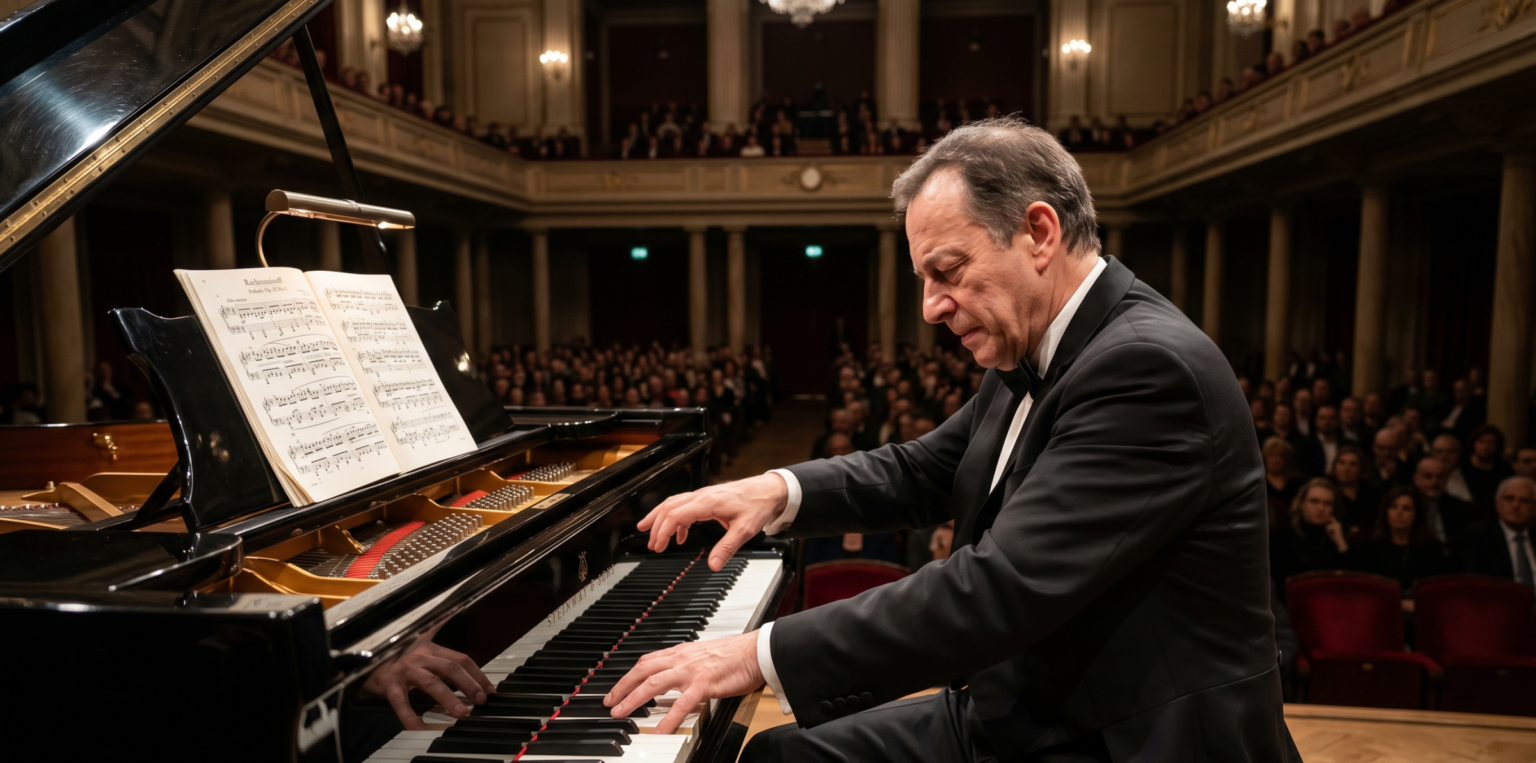
The Prelude in G Minor, Op. 23 No. 5 is one of the most iconic works in the piano repertoire. Composed by Sergei Rachmaninoff in 1901, it is celebrated for its rhythmic drive, martial character, and the lush, Romantic lyricism of its middle section. For advanced pianists, this piece is an essential milestone that demands a mastery of large chordal leaps, polyphonic voicing, and dynamic control.
This guide provides a comprehensive pedagogical breakdown, technical analysis, and strategic practice plan for mastering this masterpiece. Whether preparing for a conservatory audition or a professional recital, the following sections offer the authoritative insight required to navigate the complexities of Op. 23 No. 5.
What is Rachmaninoff’s Prelude in G Minor, Op. 23 No. 5?
Rachmaninoff’s Prelude in G Minor, Op. 23 No. 5 is a piano solo composed in 1901 (completed in 1903) that follows a traditional Ternary (A-B-A) form. It is characterized by its “Alla marcia” (march-like) opening, featuring rhythmic staccato chords and wide leaps, followed by a contrasting “Poco meno mosso” section that showcases the composer’s signature Russian lyricism. It is widely considered an Advanced (Grade 8+ / Associate level) work due to its significant technical demands and sophisticated interpretive requirements.
1. Why Learn Prelude in G Minor, Op. 23 No. 5?
The Prelude in G Minor, Op. 23 No. 5 is more than just a famous concert piece; it is a fundamental pedagogical bridge for advanced pianists transitioning into the high-virtuosity works of the Late Romantic era. Learning this work is essential for any pianist looking to master orchestral piano textures, lateral keyboard agility, and polyphonic melodic projection.
Technical Mastery and Skill Acquisition
This prelude serves as a comprehensive “technical encyclopedia” for the Rachmaninoff style. Unlike mechanical etudes, it integrates complex physical challenges into a compelling musical narrative. By studying this piece, a pianist acquires several elite-level skills:
- Lateral Precision (The “Rachmaninoff Jump”): The opening “Alla marcia” requires large, rapid leaps in the left hand. This develops a “spring-like” wrist and the ability to find target notes without visual dependency.
- Chordal Voicing and Weight: The thick, multi-layered chords demand a sophisticated distribution of arm weight. Pianists learn how to project the top melodic note of a four-note chord while keeping the inner voices supportive rather than intrusive.
- Cantabile in Complex Textures: The middle section (Poco meno mosso) is a masterclass in Legato playing. It forces the performer to sustain a long, singing melody in the right-hand thumb and index finger while the other fingers manage undulating accompaniment figures.
- Dynamic Endurance: With its frequent fortissimo climaxes and driving rhythms, the piece tests a performer’s physical stamina and their ability to produce massive sound without creating tension or “harshness.”
Strategic Repertoire Value
From a career and academic perspective, this prelude is a “high-yield” asset. At approximately 3.5 to 4 minutes, it provides maximum audience impact for a relatively short performance duration.
Gateway to the Concertos: Mastering the technical demands of this prelude is the best preparation for Rachmaninoff’s larger works, specifically the Second and Third Piano Concertos, which utilize similar chordal and arpeggiated patterns.
Standard Exam Repertoire: It is a frequent requirement for Level 10 (RCM) and Grade 8/Diploma (ABRSM) exams, serving as a globally recognized benchmark of advanced proficiency.
Recital Versatility: Its recognizable melody and driving energy make it a perfect “showstopper” or encore. It sits comfortably between a Classical sonata and a modern contemporary work in a standard program.
2. Historical Context and Significance
Sergei Rachmaninoff (1873–1943) was a titan of the Late Romantic period. The Ten Preludes, Op. 23, were written during a period of creative resurgence for the composer, following the massive success of his Second Piano Concerto.
The G Minor Prelude stands out as a “Character Piece” that transcends the simple definition of a prelude. While Bach used preludes to introduce fugues, Rachmaninoff followed the tradition of Chopin and Scriabin, treating the prelude as a standalone atmospheric work. The Op. 23 No. 5 was premiered by Rachmaninoff himself in Moscow on February 10, 1903, and quickly became a staple of his own concert programs.
| Feature | Specification |
| Key | G Minor |
| Tempo | Alla marcia (Opening), Poco meno mosso (Middle) |
| Era | Late Romantic |
| Difficulty | Advanced (RCM Level 10+, ABRSM Grade 8+) |
| Structure | Ternary (A-B-A) |
| Primary Challenge | Chordal leaps and polyphonic phrasing |
The Composer: Sergei Rachmaninoff (1873–1943)
Sergei Rachmaninoff occupies a distinctive position in Western music history. As a composer working within the Late Romantic tradition, their output reflects both the aesthetic ideals of their era and a deeply personal artistic vision that transcended contemporary conventions. Their keyboard works in particular demonstrate an intimate understanding of the piano’s capabilities, the singing tone of the upper register, the resonant power of the bass, and the infinite gradations of touch and dynamics that the instrument makes possible.
The compositional output spans multiple genres and forms, but the solo piano works hold a special place in the catalog. They range from technical studies and teaching pieces to large-scale concert works of the highest ambition, all unified by an unwavering commitment to musical expressiveness. The specific work under consideration here represents one facet of this larger creative project, a piece that, within its particular scope, achieves a completeness of expression that rewards repeated study and performance.
Understanding the historical and biographical context enriches any interpretation. The musical language reflects the harmonic and structural conventions of the Late Romantic period while also incorporating elements that push beyond those conventions. This tension between tradition and innovation is what makes the music enduringly fascinating for performers and listeners alike.
About Prelude in G Minor, Op. 23 No. 5
This work was composed in the key of G Minor and belongs to the Late Romantic tradition of piano composition. At the Advanced level, it occupies a pedagogically important position: challenging enough to develop significant technical and musical skills, yet accessible enough for dedicated students who have mastered the fundamentals of piano playing. The estimated performance duration of 3.5–4 minutes places it comfortably within the range of both practice repertoire and concert programming.
The piece has maintained its place in the standard repertoire for compelling reasons. It addresses fundamental pianistic skills — tone production, dynamic control, rhythmic precision, phrasing, pedaling — within a musically satisfying framework. Unlike purely technical exercises, which can feel mechanical and uninspiring, this work integrates technical challenges into a genuine artistic statement. Every passage serves both a technical and a musical purpose, making practice feel like artistic exploration rather than rote drilling.
3. Technical Analysis: The Architecture of the Piece
The “Alla Marcia” Section (A Section)
The opening section is defined by its rhythmic precision and martial energy. The primary challenge here is the staccato chordal leaps.
- Rhythmic Vitality: The core motif relies on an eighth-note followed by two sixteenth-notes. This must remain crisp and never “mushy.”
- The “Spring” Technique: To master the leaps in the left hand, the pianist must use a “lateral spring” from the elbow. The wrist should remain flexible, acting as a shock absorber to prevent a harsh, percussive tone.
- Dynamic Layering: Despite the fortissimo climaxes, the initial statement should have a controlled, menacing quality. Rachmaninoff uses piano markings frequently to build tension before the explosive resolutions.
The “Poco Meno Mosso” Section (B Section)
The middle section shifts to the relative major (B-flat Major) and introduces a sweeping, melancholic melody.
- Polyphonic Voicing: The melody is often embedded within arpeggiated figures. The pianist must use weight transfer to highlight the top melodic line while keeping the undulating triplets in the background.
- Left-Hand Arpeggios: These require a “rolling” wrist motion. The thumb should be treated as a pivot point to ensure smoothness across the wide intervals.
- Cantabile Tone: Achieving a “singing” tone requires staying deep in the keys. Avoid “key-slapping”; instead, use arm weight to depress the keys slowly for a rounder, more resonant sound.
The Return and Coda
When familiar material returns, it should sound both recognizable and transformed. The second time through, the performer has the opportunity to add subtle interpretive nuances: a slightly different dynamic shading, a touch more rubato at a phrase ending, a richer pedaling that wasn’t present the first time. These small changes give the music a narrative quality, a sense that it has been somewhere and returned with new wisdom.
The ending of the piece requires particular attention. Whether it concludes with a dramatic fortissimo or a whispered pianissimo, the final notes must feel inevitable, the only possible way the music could end. Practice the last 8–16 measures as a separate unit, refining the dynamic trajectory, the timing of the final note, and the quality of the silence that follows. The silence after the last note is part of the music: hold your hands in position for a moment before releasing, maintaining the mood until the spell naturally breaks.
4. Step-by-Step Approach to Mastery
To master a work of this magnitude, one must move beyond mere note-reading and address the physiological and acoustic challenges of the Late Romantic style.
Mastering the Leaps: Developing Keyboard Proprioception
The “Alla marcia” section is famous for its wide-interval jumps, particularly in the left hand. These are not merely athletic feats; they are the rhythmic heartbeat of the piece.
- The Elliptical Motion (Arcing): Avoid moving your hand in a straight line or a “boxy” square motion. Instead, visualize a low, smooth arc. The hand should be in constant motion. As soon as a chord is played, the wrist should already be “rebounding” toward the next target. This reduces impact shock and prevents fatigue.
- Tactile Ghosting & Sensory Mapping: Practice moving to the next chord position without depressing the keys. Place your fingers on the surface of the keys and feel the “topography” of the chord (the arrangement of blacks and whites) before actually playing. This builds proprioception—the brain’s ability to know where the hand is without looking.
- Rhythmic Displacement Practice: To stabilize the leaps, change the rhythmic context. Play the first note of the jump extremely fast, then pause on the target note. Then reverse it: play the first note, move slowly, and strike the target note with lightning speed. This forces the nervous system to adapt to the speed of the lateral shift.
- Targeting the Bass Pillar: In wide jumps, the eye cannot track both hands perfectly. Focus your peripheral vision on the lowest note of the left-hand jump. If the bass foundation is secure, the upper notes of the chord usually fall into place.
Voicing and Texture: Managing the “Orchestral” Piano
Rachmaninoff’s textures are often described as “thick,” but in a great performance, they sound transparent. This is achieved through vertical transparency.
- The Tenuto Pillar Principle: Rachmaninoff frequently marks specific melodic notes with tenuto bars. These are your structural anchors. These notes must be held for their full value—sometimes even slightly longer (an agogic accent)—to allow the piano’s strings to vibrate fully and cut through the accompaniment.
- Weight Distribution (The “Top-Heavy” Hand): In four-note chords, the weight of the arm should be directed primarily toward the 4th and 5th fingers (the outer edge of the hand). The inner fingers (2 and 3) should remain “light” and supportive. Practice playing the chords where the top note is fortissimo and the bottom three are pianissimo.
- Layering the Middle Section: In the Poco meno mosso, you are managing three layers: the deep bass foundation, the rolling triplet accompaniment, and the soaring soprano melody. The melody must “float.” Use a slow key descent for the melody to create a rounder, more vocal tone, while the triplets stay close to the keys with minimal finger lift.
Pedaling Strategy: Clarity vs. Resonance
Pedaling in Rachmaninoff is an art of “shading” rather than a simple on/off switch.
- Acoustic Syncopation: Use Legato Pedaling. Depress the pedal after the finger has struck the new harmony. This “captures” the sound and allows the dampers to clear the previous resonance, preventing the “mud” that ruins the martial character of the A-section.
- The Half-Pedal “Shimmer”: In the middle section, do not execute full pedal changes. Instead, use “flutter” pedaling or half-pedaling. By only lifting the pedal halfway, you allow the high-frequency overtones to continue ringing while clearing the lower, muddier frequencies.
- Una Corda for Color, Not Volume: The soft pedal (Una Corda) should be used in the final Coda not just to be “quiet,” but to change the timbre. It creates a thinner, more ethereal sound that makes the final pianissimo evaporation feel like a distant memory rather than just a soft chord.
5. The 6-Week Structured Practice Plan
This plan is designed to take an advanced pianist from the initial “reading” phase to a performance-ready state through systematic refinement.
Week 1: Foundation and Mechanical Mapping
The objective is to establish the physical layout of the piece. Focus entirely on the A-Section (Measures 1-24). Practice hands separately to ensure the left-hand leaps are accurate at 50% tempo. Implement “Ghosting” exercises immediately. For the right hand, focus on the rhythmic “snap” of the eighth-note/sixteenth-note motif. Do not use the pedal this week; let the fingers do the work.
Week 2: Lyricism and Polyphonic Independence
Shift your focus to the B-Section (Poco meno mosso). The goal is to separate the melody from the accompaniment. Practice the right-hand melody alone until it sounds like a professional singer. Then, practice the left-hand arpeggios until they are fluid and “even” without the use of the pedal. By the end of the week, combine them slowly, ensuring the melody remains significantly louder than the triplets.
Week 3: Rhythmic Integrity and Transitions
This is the “Metronome Week.” The Alla marcia must be strictly in time to maintain its military character. Work specifically on the transitions (the bridge leading into the middle section and the return to the march). These are the points where most pianists lose their pulse. Practice at 70% tempo with the metronome on the eighth note to prevent rushing the sixteenths.
Week 4: Dynamic Architecture and E-E-A-T
Now that the notes are secure, focus on Expression and Authority. Analyze the score for every subito piano (sudden soft) and crescendo. Rachmaninoff uses dynamics to create “waves” of tension. Work on your “Weight Transfer” to ensure the fortissimo climaxes sound “noble” and “deep” rather than “pounding.” Record the B-section and listen specifically for the balance between the three layers of sound.
Week 5: Endurance, Flow, and Memory
Begin playing the piece in its entirety. The focus shifts to Stamina. Perform three “no-stop” run-throughs at 80% tempo each day. If you make a mistake, do not stop; learn to recover “in the moment.” This builds the mental toughness required for performance. Finalize your memorization by playing “mental practice”—visualizing the score and your hand movements away from the piano.
Week 6: Performance Polish and The Coda
The final week is dedicated to the “evaporation” at the end of the piece. The Coda requires a very light touch and perfect finger independence. Practice the final 10 measures at various dynamic levels to ensure complete control. Do a “mock performance” for a friend or record a high-quality video. Address any residual tension in the shoulders or wrists during the loud sections. Trust your preparation and focus on the narrative of the music.
Conclusion
The Rachmaninoff Prelude in G Minor, Op. 23 No. 5 is more than just a technical showpiece; it is a profound narrative of strength, vulnerability, and resolution. To perform this work successfully, one must balance the mechanical precision of the “march” with the poetic soul of the “romance.”
Key Takeaways for Success:
- Prioritize Rhythmic Accuracy: Never sacrifice the march feel for speed.
- Focus on the Bass: The bass line provides the harmonic foundation; make sure it is deep and resonant.
- Embrace the Contrast: Make the middle section as different from the opening as possible to create maximum musical impact.
For those looking to master this work, consistent slow practice and a deep understanding of the Late Romantic style are the most effective paths to a professional-grade performance.
How difficult is Rachmaninoff Prelude in G Minor?
It is considered an Advanced piece. On the ABRSM scale, it is Grade 8 or Diploma level. It requires large hands (or the ability to roll chords quickly) and advanced rhythmic control.
What is the tempo of Op. 23 No. 5?
The opening is marked Alla marcia, which is typically performed between 100–108 BPM for the quarter note. The middle section (Poco meno mosso) is slower and more flexible, usually around 72–80 BPM.
Can someone with small hands play this piece?
Yes, but it requires strategic “rolling” of the large chords and careful redistribution of notes between hands where possible. Focus on wrist flexibility to reach the tenths and octaves without tension.
How should I approach fingering if I cannot reach a tenth comfortably?
If your hand span is limited, do not attempt to stretch or “strain” to reach the wide chords, as this leads to tension and potential injury. Instead, employ rapid rolling (arpeggiating the chord quickly from the bottom up) ensuring the top melodic note aligns perfectly with the beat. In some instances, you can redistribute notes, using the right-hand thumb to take over an inner note from the left hand, provided it does not disrupt the melodic phrasing.
How much tempo flexibility (rubato) is appropriate in the middle section?
While the Poco meno mosso section is the emotional heart of the piece, avoid “over-sentimentalizing” the pulse. Rachmaninoff’s own performances were notably disciplined. Use structural rubato: slightly broaden the tempo at the peak of a phrase or during a significant harmonic modulation, but “repay” that time by moving forward in the following measures. The goal is a sense of “breathing” rather than a loss of rhythmic coherence.
How do I achieve the deep, “bronze” bass sound characteristic of Rachmaninoff’s style?
Achieving the “Russian bell” sonority requires total arm weight rather than finger strength. Avoid “striking” the keys from a height, which creates a harsh, percussive sound. Instead, place your fingers in contact with the keys first, then “sink” deep into the key bed using the weight of your entire shoulder and forearm. This produces a rich, low-frequency resonance that supports the entire orchestral texture above it.
Is it better to play the opening “Alla marcia” heavy or light?
The opening should be crisp and rhythmic, but never “heavy” in a way that creates sluggishness. Think of it as a “menacing” march. The staccato should have a “spring-like” quality. If played too heavily, the pianist loses the ability to execute the rapid leaps accurately. Maintain a “forward-leaning” energy where the rhythm drives the music toward the next downbeat.
How does this Prelude compare in difficulty to the “Bell” Prelude in C-sharp Minor?
The Prelude in G Minor (Op. 23 No. 5) is technically significantly more difficult than the C-sharp Minor Prelude (Op. 3 No. 2). While the latter relies on large, slow chords and dramatic volume, the G Minor Prelude requires advanced lateral agility, sophisticated polyphonic voicing, and superior rhythmic control. It is considered a step up in both technical demand and musical maturity.