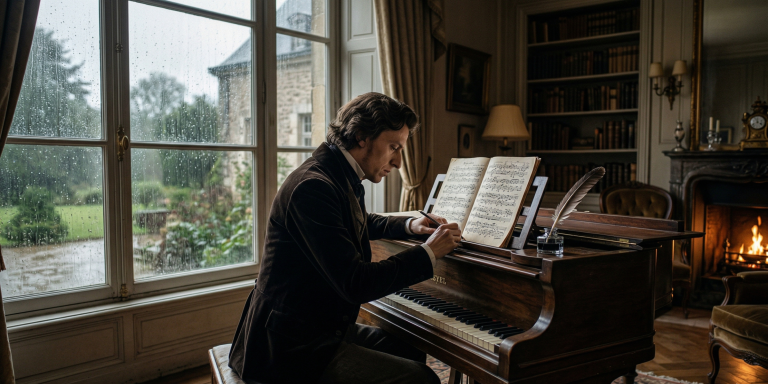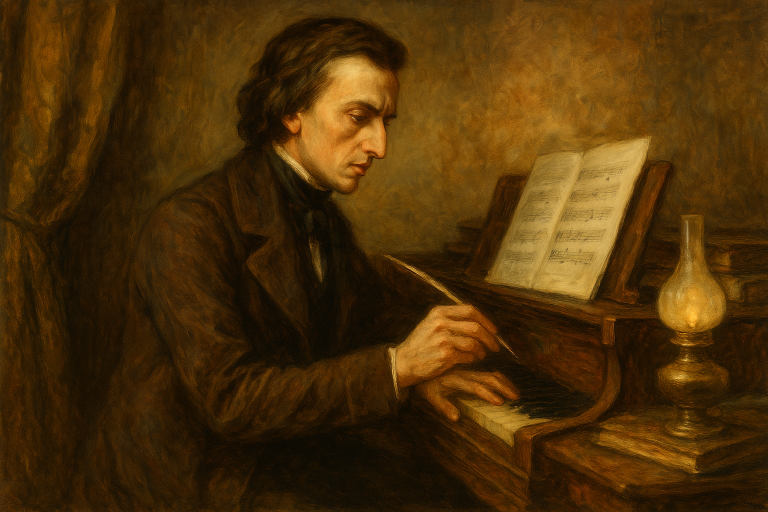
The study of Frédéric Chopin’s Waltz in A Minor, Op. 34 No. 2 represents a significant milestone for the developing pianist. Often described as the most introspective of his waltzes, this piece transcends the dance floor to become a profound musical narrative. Whether preparing for a conservatory examination or seeking to refine Romantic interpretation, understanding the intersection of structural rigor and expressive freedom in this work is essential. This guide provides an exhaustive pedagogical framework to master the technical hurdles and emotional complexities of this Lento masterpiece.
In this article, you will learn the historical context of the “Valse Brillante” set, the formal architecture of the piece (A-B-A-C-A), advanced technical approaches to cantabile playing, and a structured six-week practice plan to bring this work to performance readiness.
Frédéric Chopin’s Waltz in A Minor, Op. 34 No. 2 is a cornerstone of the Intermediate-Advanced Romantic repertoire, notable for its “Lento” tempo and deep emotional gravity. Despite being part of the Trois Valses Brillantes published in 1838, it subverts the traditional “brilliant” style with its melancholic themes and extensive use of rubato. The piece demands high-level control of tone production, syncopated pedaling, and delicate balance between the melody and the characteristic “oom-pah-pah” waltz bass.
1. Historical Context: The Paradox of the “Brilliant” Waltz
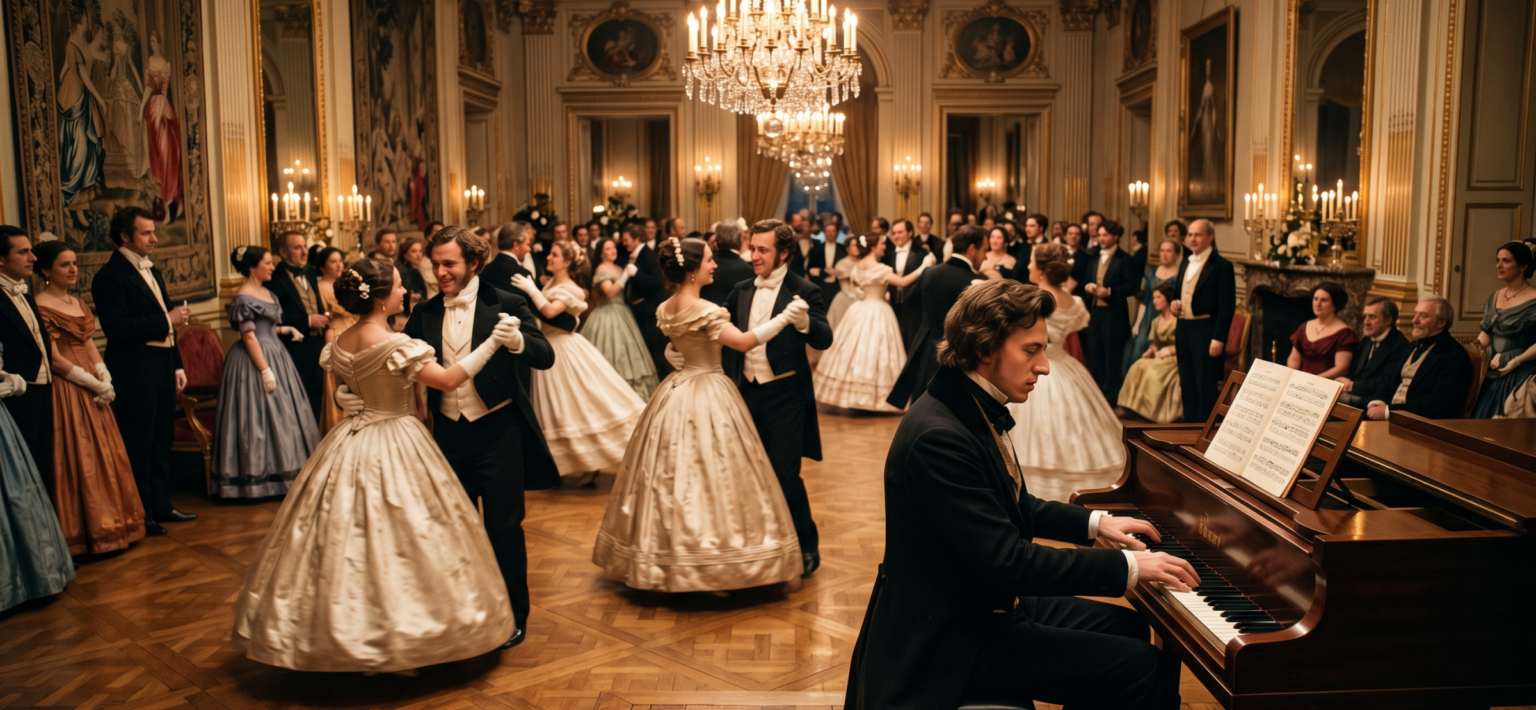
To interpret the Waltz in A Minor, Op. 34 No. 2 accurately, one must understand the environment in which it was conceived. Composed around 1834 and published in 1838, it is the second of three waltzes in the Opus 34 set, titled Trois Valses Brillantes. While the first (A-flat major) and third (F major) embody the “brilliant” virtuosity and sparkling energy typical of the Parisian salon style, the A minor waltz stands in stark contrast.
Frédéric Chopin occupies a distinctive position in Western music history. As a composer working within the Romantic tradition, their output reflects both the aesthetic ideals of their era and a deeply personal artistic vision that transcended contemporary conventions. Their keyboard works in particular demonstrate an intimate understanding of the piano’s capabilities, the singing tone of the upper register, the resonant power of the bass, and the infinite gradations of touch and dynamics that the instrument makes possible.
The compositional output spans multiple genres and forms, but the solo piano works hold a special place in the catalog. They range from technical studies and teaching pieces to large-scale concert works of the highest ambition, all unified by an unwavering commitment to musical expressiveness. The specific work under consideration here represents one facet of this larger creative project, a piece that, within its particular scope, achieves a completeness of expression that rewards repeated study and performance.
Understanding the historical and biographical context enriches any interpretation. The musical language reflects the harmonic and structural conventions of the Romantic period while also incorporating elements that push beyond those conventions. This tension between tradition and innovation is what makes the music enduringly fascinating for performers and listeners alike.
The Paradox of the “Valse Brillante”
The Opus 34 set was composed during a period when Chopin was solidifying his reputation in the high-society salons of Paris. While the first waltz in A-flat major and the third in F major adhere to the expected “brilliant” virtuosity, characterized by sparkling scales and exuberant energy, the A Minor waltz stands in stark, somber contrast. It is a Lento waltz, a tempo marking that immediately signals a departure from the dance floor and an entry into the realm of poetic reflection.
The Irony of Title and Tone: The “Vocal” Piano
Chopin often utilized generic titles as vessels for revolutionary emotional content. In Op. 34 No. 2, the “Waltz” is a shell for what is essentially a Nocturne in triple meter.
- The Bel Canto Influence: During this decade, Chopin was captivated by the Italian Bel Canto opera style, particularly the long, breathless melodies of Vincenzo Bellini.
- Melodic Architecture: This influence is visible in the waltz’s arched melodic lines. The ornaments are not merely decorative; they are “vocal fiorituras” that mimic the sighs and expressive flourishes of a soprano, requiring a piano touch that prioritizes “breath” over percussion.
The Romantic Ideal and the Essence of “Żal”
As a quintessential composer of the Romantic era, Chopin’s work embodies the shift from formal classicism to the exploration of the human psyche. In this period, music was viewed as the most direct link to the soul’s internal landscape.
“Żal” (pronounced “zhal”) is a uniquely Polish concept central to Chopin’s minor-key works, representing a complex blend of melancholy, regret, resentment, and soulful longing. In the Waltz in A Minor, this is manifested through the repetitive, haunting bass motifs and the shifting chromaticism that never quite settles into a sense of peace.
By understanding this cultural baggage, the performer recognizes that the “Waltz” title is almost ironic. It is not music for the feet, but music for the memory—a stylized dance of shadows that established Chopin as the master of the “piano-voice.”
2. Why Learn Waltz in A Minor, Op. 34 No. 2?
Learning Frédéric Chopin’s Waltz in A Minor, Op. 34 No. 2 is a pivotal step for any pianist transitioning from intermediate studies to advanced artistry. Often referred to as the “Valse Mélancolique,” this work provides a masterclass in Romantic phrasing, harmonic sensitivity, and cantabile (singing) touch. Unlike the more virtuosic “Grande Valse Brillante” pieces, Op. 34 No. 2 prioritizes emotional depth over mechanical speed, making it the perfect vehicle for developing a sophisticated musical “voice.”
A Pedagogical Bridge to the High Romantic Style
For many students, this waltz serves as the essential bridge between the technical clarity of the Classical era (Mozart, Haydn) and the complex emotional landscapes of High Romanticism. It introduces the performer to the concept of “Zal”—a Polish term often used to describe the specific brand of soulful melancholy found in Chopin’s music. By mastering this piece, a pianist learns how to manage large-scale structures without losing the intimacy of a salon performance.
Mastering the “Bel Canto” Cantabile Tone
One of the primary reasons to study this waltz is the development of a singing tone. Chopin was deeply inspired by Italian opera, particularly the Bel Canto style of Vincenzo Bellini.
- Melodic Projection: You will learn how to make the right-hand melody float above the accompaniment.
- Tone Gradation: The piece demands subtle shifts in dynamics (from pp to mf) that require extreme control of arm weight and finger velocity.
- Legato Technique: Achieving a true legato in the opening themes requires a sophisticated “transfer of weight” between fingers, a skill applicable to Chopin’s Nocturnes and Ballades.
Developing Sophisticated Rubato
This waltz is a laboratory for learning Rubato—the art of “stealing” time for expressive effect. Because the piece is marked Lento, the performer cannot rely on momentum to carry the musical line. You must learn to:
- Stretch the Pulse: Delay certain beats for dramatic emphasis without breaking the underlying waltz rhythm.
- Balance the Hands: Keep the left-hand accompaniment steady (the “conductor”) while the right hand moves with vocal freedom (the “singer”).
- Harmonic Awareness: Use tempo fluctuations to highlight unexpected chromatic shifts or modulations to A Major.
Technical Precision in the Left Hand
While the right hand sings, the left hand must perform the characteristic “Waltz Jump.” This develops:
- Spatial Awareness: Navigating the distance between a deep bass note on Beat 1 and the higher chords on Beats 2 and 3.
- Touch Contrast: Playing the bass notes with resonance and the chords with a light, “brushed” staccato to keep the texture transparent.
Versatility for Recitals and Exams
From a practical standpoint, the Waltz in A Minor, Op. 34 No. 2 is a strategic addition to any repertoire list.
Duration: At 5–6 minutes, it is long enough to be a standalone “serious” piece in a recital but short enough to be polished in a few months of dedicated practice.
Exam Syllabi: It is a frequent staple in ABRSM, RCM, and Trinity advanced-level exams (typically Grade 7 or 8), making it a high-value asset for students seeking certification.
Strategic Performance Value
Finally, this waltz is uniquely “forgiving” yet “rewarding.” While a mistake in a fast Valse Brillante can derail an entire performance, the slower tempo of Op. 34 No. 2 allows the pianist more mental “breathing room” to recover and refocus. This makes it an excellent choice for a first competition piece or a high-stakes recital where nerves might be a factor. By learning this work, you are not just learning a waltz; you are learning the very DNA of Frédéric Chopin’s piano writing.
3. Structural and Harmonic Analysis
Understanding the form of a piece is the first step toward a convincing interpretation. The Waltz in A Minor, Op. 34 No. 2 follows a complex structure that can be viewed as an expanded ternary form or a rondo-like sequence (A-B-A-C-A with a coda).
The Architecture of the A Minor Key
The choice of A minor is significant. In basic music theory, the A minor scale is the “relative minor” of C major, containing no sharps or flats in its natural form. This “clean” key allows for a wide range of chromatic alterations without losing the fundamental tonal center. Chopin utilizes the harmonic minor scale—raising the seventh degree (G#), to create tension and pull toward the tonic.
| Section | Key Area | Character |
| Section A | A Minor | Melancholic, reflective “Lento” |
| Section B | C Major | Brighter, more dance-like, yet still gentle |
| Section C | A Major | Luminous, “più mosso” quality, hopeful |
| Coda | A Minor | A fading whisper, returning to the opening gloom |
Harmonic Nuance and Voice Leading
The harmonic language is rooted in tonal conventions but enriched with chromatic passing tones. Chopin uses “secondary dominants” to temporarily tonicize related keys, adding layers of color. The voice leading is exceptionally smooth; every inner voice is treated with the care of a polyphonic texture, meaning multiple melodic strands can be followed simultaneously.
The technical difficulty of Chopin’s Waltz in A Minor, Op. 34 No. 2 is deceptively subtle. Unlike the “Minute Waltz” which requires rapid-fire digital dexterity, this work demands an elite level of touch, tone control, and voicing. To perform this piece at a professional level, one must move beyond the mechanical pressing of keys into the realm of “sculpting” sound.
Cantabile Production and Key Velocity
The primary aesthetic goal of this waltz is the Cantabile (singing) style. In Romantic pedagogy, the piano is treated not as a percussion instrument, but as a surrogate for the human voice.
- Arm Weight vs. Finger Force: As noted in advanced pedagogical studies, tone quality is determined by the transfer of weight. Rather than hitting the keys with isolated finger strength, the pianist must allow the natural weight of the arm to flow through a flexible wrist.
- The Physics of Tone: The speed of key descent (velocity) is the primary variable of sound color. A slower descent dampens the initial hammer strike, resulting in a warmer, rounder tone. A faster descent creates a brighter, more percussive attack. For the A Minor theme, a “deep-into-the-key” slow velocity is required to capture the melancholic “Zal.”
The Anatomy of the Waltz Bass (The “Oom-Pah-Pah”)
The left hand provides the harmonic “heartbeat” of the work. According to rhythmic fundamentals, a waltz must maintain a clear triple meter while avoiding a mechanical “clock-like” feel.
- Beat 1 (The Root): This fundamental bass note must be deep and resonant. It acts as the “anchor” for the entire measure’s harmony.
- Beats 2 & 3 (The Chords): These should be played with a “brushed” staccato. They must be significantly softer than the first beat to prevent the texture from becoming “muddy.”
- The Wrist as Shock Absorber: The technical challenge lies in the “jump” from the low bass to the mid-range chords. The wrist must move in a graceful, lateral arc—acting as a shock absorber to ensure a soft landing on the chords and maintaining the rhythmic flow.
Syncopated Pedaling and Harmonic Clarity
The sustain pedal is the “soul” of the piano, but in Chopin’s music, it requires surgical precision.
Syncopated Pedaling (or Legato Pedaling) is the technique where the pedal is depressed immediately AFTER the new harmony is struck. This “catches” the new sound while the previous harmony is cleared, ensuring a seamless connection without blurring.
In Op. 34 No. 2, the pedal is typically depressed on Beat 1 and lifted slightly before or during Beat 3. This allows the bass note to resonate throughout the measure while ensuring the staccato nature of the final beat remains audible.
Ornaments as Vocal Expressions
Ornaments in this waltz—such as grace notes and turns—should never be treated as purely technical exercises.
- Bel Canto Influence: Reflecting the Italian opera influence, these ornaments are “vocal fiorituras.” They should sound spontaneous, like a singer’s sigh.
- Agogic Accents: Use slight rhythmic delays (agogic accents) on the start of a turn to add emotional weight. Phrasing must follow a “natural breathing” pattern; a phrase should “inhale” (crescendo/accelerando) and “exhale” (diminuendo/ritardando).
4. Interpretative Analysis: A Bar-by-Bar Walkthrough
Navigating the emotional landscape of this piece requires a balance between strict structural awareness and poetic freedom.
The Atmospheric Introduction (Bars 1–16)
The waltz begins with a repetitive, cello-like bass motif that establishes the somber mood.
- The “Sticky” Staccato: Use Portato (sticky staccato) for the opening notes. This is achieved by holding the key for nearly its full value but releasing it with a gentle lift of the wrist.
- Minimalist Pedaling: Keep the sustain pedal to a minimum here. The clarity of the minor-second intervals is crucial to creating the “haunting” quality of the introduction.
The A Major Luminous Center (Section C)
The transition from A Minor to A Major represents a shift from darkness to light.
- Voicing and Balance: In this section, the left-hand waltz pattern becomes more persistent. The pianist must prioritize the balance between hands, ensuring the right-hand melody remains at a Mezzo-Forte level while the left hand stays at a supportive Piano.
- The Law of Compensation (Rubato): This section demands more flexibility. As a rule of thumb for Romantic rubato: if you “steal” time to emphasize a high melodic peak, you must “give it back” by slightly moving forward in the subsequent measures to maintain the overall pulse.
The Coda: The Art of the Fade
The piece concludes by returning to the original A Minor gloom, eventually fading into silence.
- Dynamic Trajectory: The final 16 measures require a controlled Diminuendo. This is achieved by gradually reducing the arm weight and using a more “surface-level” finger touch.
- The Performance Silence: The silence after the final chord is an integral part of the composition. A professional performer maintains their posture for 3–5 seconds after the sound dies, holding the audience in the “spell” of the music before releasing the tension.
5. The 6-Week Implementation Roadmap
Weeks 1-2: Structural Discovery and Digital Mapping
The goal of the first two weeks is to build a “tactile map” of the piece and understand its theoretical foundation.
- Harmonic Analysis: Identify the relationship between the A minor tonic and its Relative Major (C Major) used in Section B. Mark all key signatures and accidental shifts.
- Hands Separate Mastery: Practice the left-hand “waltz jumps” slowly. The focus is on the “arc” of the wrist moving from the deep bass note on Beat 1 to the lighter chords on Beats 2 and 3.
- Fingering Consistency: Decide on a definitive fingering for the right-hand melodic flourishes and write it into the score. Consistency at this stage is the only way to ensure long-term security.
- Isolating the “Zal”: Work specifically on the opening 16 measures. Practice producing a warm tone by using arm weight rather than finger pressure.
Week 3: Harmonic Construction and Pedaling Mechanics
With the notes under the fingers, Week 3 focuses on the “glue” that holds the piece together: the harmony and the pedal.
- Hands Together (HT) Integration: Combine the hands at 60-70% of the final tempo. Use a metronome to ensure the “heartbeat” of the waltz remains steady.
- Syncopated Pedaling Drill: Apply legato pedaling. Practice changing the sustain pedal immediately after the chord on Beat 1 is struck to ensure a clean harmonic connection without “blurring” the previous measure.
- Vertical Alignment: Ensure that the right-hand melody notes align perfectly with the left-hand bass notes. Record yourself to check for “flamming” (unintentional staggering of hands).
Week 4: Textural Refinement and Voicing
Week 4 is about “sculpting” the sound and establishing the correct balance between the melodic line and the accompaniment.
- The Balance Challenge: Practice the right hand Forte and the left hand Pianissimo. This exaggerates the voicing required for a professional Cantabile sound.
- Phrase Shaping: Identify the peak of each melodic phrase (usually the highest note). Practice a gradual Crescendo toward the peak and a “tapered” Diminuendo at the phrase ending.
- Ornamental Integration: Incorporate the grace notes and turns. These must sound like vocal sighs, never rushed or mechanical. They should start slightly before or on the beat depending on your stylistic choice.
Week 5: Expressive Integration and Rubato
Now that the technical structure is solid, you must breathe life into the music through the use of Tempo Rubato.
- The Law of Compensation: Practice “borrowing” time during a melodic ascent and “returning” it during the resolution. The left hand should remain the steady “conductor” while the right hand acts as the “soloist.”
- Agogic Accents: Experiment with slight rhythmic delays on particularly poignant harmonic changes (like the shift to A Major) to highlight the emotional narrative.
- Dynamic Architecture: Map out the long-term dynamic plan. Ensure the climax of the piece (the middle section) is significantly more intense than the introspective opening and closing.
Week 6: Performance Readiness and Psychological Flow
The final week is about “performing” the piece rather than “practicing” it.
- The “Three Run-Through” Rule: Perform the piece three times daily. The first for technical accuracy, the second for emotional expression, and the third for “mental stamina” (no stopping).
- The Spell of the Opening: Devote time to practicing the first 4 bars in silence. The mood you establish in the first 10 seconds dictates the audience’s (and your own) focus.
- The Final Fade: Master the Morendo (dying away) in the coda. Practice the release of the final chord and the “performance silence” that follows.
Advanced Practice Tip: The “Stop-Motion” Technique
During Weeks 3 and 4, use “stop-motion” practice for the left-hand jumps. Play the bass note on Beat 1, then “freeze” your hand over the position of the Beat 2 chord without playing it. This builds the spatial muscle memory required to hit the jumps perfectly during the pressure of a live performance.
By following this pedagogical structure, the pianist ensures that their interpretation of Chopin’s Waltz in A Minor, Op. 34 No. 2 is not only technically accurate but deeply rooted in the historical and aesthetic traditions of the Romantic era.
7. Advanced Pedagogical Strategies for Retention
To ensure the Waltz in A Minor remains in your permanent repertoire, apply these “High-Yield” techniques during your study.
The “Skeletal” Practice Method
Play only the Beat 1 bass notes in the left hand and the primary melody notes in the right hand. This strips away the “decoration” and allows you to hear the core voice leading and harmonic skeleton of the work. Understanding this structure makes memorization significantly faster.
Micro-Looping Technical Hurdles
If a specific jump or ornament is inconsistent, isolate that single measure. Repeat it 10 times perfectly at a slow tempo. If you make a mistake on the 9th time, you must restart the count at 1. This builds the high-level digital accuracy required for competitive performance.
Mental Rehearsal (Score Study)
Spend 10 minutes a day away from the piano, simply reading the score. Visualize your fingers moving and hear the ideal tone in your mind. This “cognitive mapping” strengthens the neural pathways between your musical intent and your physical execution.
Advanced Practice Tip: The “Stop-Motion” Technique
During Weeks 3 and 4, use “stop-motion” practice for the left-hand jumps. Play the bass note on Beat 1, then “freeze” your hand over the position of the Beat 2 chord without playing it. This builds the spatial muscle memory required to hit the jumps perfectly during the pressure of a live performance.
By following this pedagogical structure, the pianist ensures that their interpretation of Chopin’s Waltz in A Minor, Op. 34 No. 2 is not only technically accurate but deeply rooted in the historical and aesthetic traditions of the Romantic era.
Conclusion
Mastering Chopin’s Waltz in A Minor, Op. 34 No. 2 is not merely a technical challenge; it is a lesson in musical maturity. The piece requires the pianist to look beyond the “brilliant” surface of the dance to find a deeper, more personal language. By focusing on cantabile tone, expressive rubato, and a clear understanding of the ternary structure, you can transform this work from a simple waltz into a profound artistic statement.
Recommended Approach: Start by perfecting the left-hand jumps in isolation until the “oom-pah-pah” rhythm is second nature. This will free your mind to focus on the right hand’s operatic “Bel Canto” melody. Trust your preparation and allow the “Zal” of the music to guide your performance.
What is the main difference between Op. 34 No. 2 and the posthumous A Minor Waltz (B. 150)?
The Waltz Op. 34 No. 2 is a much longer, more complex work (5-6 minutes) and is categorized as “Intermediate-Advanced.” The posthumous Waltz in A Minor (B. 150) is shorter, simpler, and usually taught at the “Intermediate” level. Op. 34 No. 2 has a much deeper emotional range and more elaborate formal structure.
How do I use rubato without losing the waltz rhythm?
Rubato is a “stretching” of the beat, not a total abandonment of it. Keep the left-hand waltz beat relatively stable while the right-hand melody “flexes” for expression. The rule of thumb is: “what you borrow, you must return.”
Which edition should I use?
For the highest scholarly accuracy, choose a “Urtext” edition (such as Henle or Bärenreiter). For free study, the Peters or Breitkopf & Härtel editions available on IMSLP are reliable as they are in the public domain.
Is the pedal needed throughout the entire piece?
No. While the pedal is essential for the “Romantic” sound, over-pedaling leads to harmonic blur. Passages with rapid chromatic shifts or staccato bass notes should have “clearer” pedaling or no pedal at all to maintain transparency.