The Prelude in D-flat Major, Op. 28 No. 15, stands as a definitive milestone in Romantic piano literature. Known universally by the nickname “Raindrop,” this composition represents the longest and most emotionally complex entry within Frédéric Chopin’s cycle of 24 Preludes. Composed during a turbulent winter in Majorca between 1838 and 1839, the work serves as a sophisticated study in ternary form, pedal point technique, and dynamic architecture. Mastering this piece provides a technical foundation for sustaining long melodic lines while navigating intense harmonic shifts from the serene D-flat major to the ominous C-sharp minor.
Core Learning Objectives:
- Execution of the persistent A-flat/G-sharp pedal point without mechanical monotony.
- Management of the enharmonic transition between the A and B sections.
- Development of chordal voicing and arm-weight distribution in the dramatic climax.
- Understanding the historical context involving George Sand and the Valldemossa monastery.
The “Raindrop” Prelude is characterized by a relentless, repeating eighth-note pulse that acts as the structural spine of the music. It follows an A–B–A’ structure, moving from a lyrical, bel canto melody into a dark, funeral-like chorale before returning to a fragile restatement of the opening theme. For the intermediate-advanced pianist, the piece offers a primary lesson in tonal balance, requiring the ability to project a singing right-hand melody over a constant, subdued accompaniment.
Why the “Raindrop” Prelude Belongs in Every Pianist’s Repertoire
There are pieces that define an era, and Chopin’s Prelude in D-flat Major, Op. 28 No. 15, is one of them. Nicknamed the “Raindrop” Prelude — a title Chopin himself reportedly rejected, this work is the longest and most emotionally expansive of the 24 Preludes. Written during the winter of 1838–1839 on the Spanish island of Majorca, it carries within its notes the sound of rain on monastery rooftops, the anxiety of isolation, and the serene acceptance that follows a storm. For the intermediate-advanced pianist, it offers a masterclass in sustaining a mood, controlling dynamics over long phrases, and navigating between tenderness and terror.
The Composer: Frédéric Chopin (1810–1849)
Frédéric Chopin was born on March 1, 1810, in Żelazowa Wola, a small village west of Warsaw. His father, Nicolas, was a French émigré who taught French language; his mother, Justyna, was from Polish minor nobility. Chopin showed extraordinary musical talent from the age of six and gave his first public concert at eight. He studied at the Warsaw Conservatory under Józef Elsner and left Poland in 1830 — just before the November Uprising — never to return.
In Paris, Chopin became the most sought-after piano teacher among the aristocracy and established himself as both a composer and a performer of the most intimate and refined sort. Unlike Liszt, who commanded vast concert halls, Chopin preferred salons, where his subtle dynamic shadings and rubato could be fully appreciated. His output consists almost entirely of works for solo piano: nocturnes, etudes, ballades, polonaises, mazurkas, waltzes, impromptus, scherzos, sonatas, and the 24 Preludes.
By 1838, Chopin’s health was already fragile. Tuberculosis would eventually claim his life at 39. His relationship with the writer George Sand (Amantine Lucile Aurore Dupin) began that year, and it was Sand who organized their ill-fated winter trip to Majorca. The damp conditions of the Valldemossa monastery exacerbated Chopin’s illness, but he used the isolation productively, completing or revising many of the Op. 28 Preludes during their stay.
The Story Behind the “Raindrop”
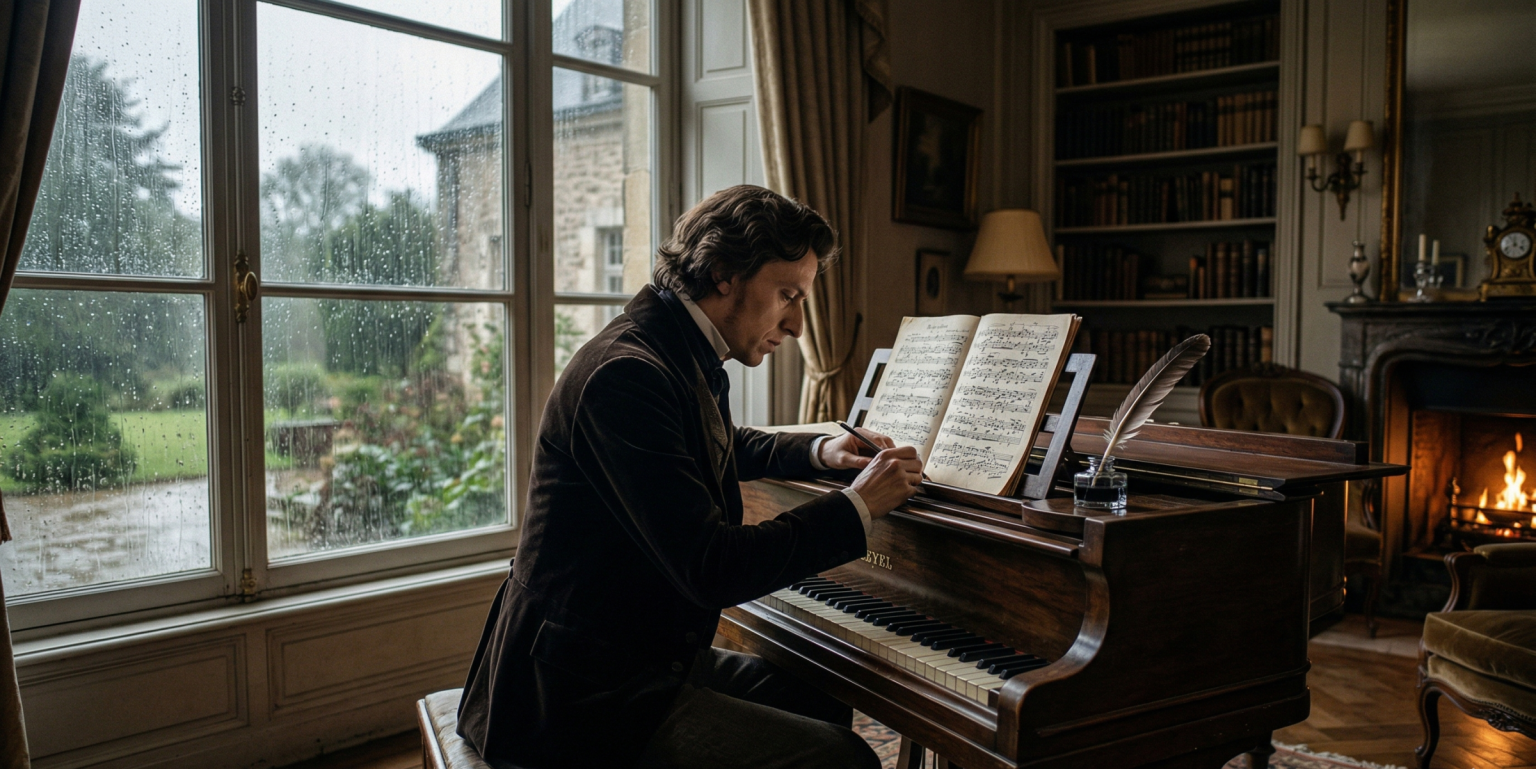
George Sand described an evening when she and her son returned to the monastery after being caught in a rainstorm. They found Chopin at the piano in a state of agitation, having imagined they had drowned. He was playing a piece — likely this one — that Sand said contained “the sounds of drops of rain falling on the roof.” Chopin denied any programmatic intent, insisting that music should never be reduced to literal imitation. Yet the nickname stuck, largely because of a single recurring note, an A-flat (or its enharmonic G-sharp), that pulses through virtually every measure of the piece, mimicking the hypnotic repetition of rainfall.
The Op. 28 Preludes were published in 1839 and dedicated to the German publisher and pianist Camille Pleyel (who had financed the Majorca trip) and, in the German edition, to Joseph Christoph Kessler. They were conceived as a set covering all 24 major and minor keys, following the model of Bach’s Well-Tempered Clavier but in a far more compact and improvisatory form. No. 15 is by far the longest, lasting 5–7 minutes depending on tempo, compared to under a minute for some of the shorter preludes.
Musical Structure and Analysis
Overall Form: A – B – A’
The Raindrop Prelude uses a clear ternary form, but the emotional journey between sections is anything but simple:
A Section (mm. 1–27): D-flat Major. The opening presents a serene, song-like melody in the right hand over a gently rocking left-hand accompaniment. The repeated A-flat in the accompaniment (the “raindrop” note) appears in the middle register and creates a meditative, hypnotic pulse. The melody floats above in long, arching phrases that rise and fall with the natural inflection of vocal music. The harmonic language is relatively simple — I, IV, V progressions enriched with passing tones and suspensions — but the effect is of extraordinary beauty. The dynamic range is piano to mezzo-piano throughout.
B Section (mm. 28–75): C-sharp Minor. The enharmonic reinterpretation of A-flat as G-sharp signals a dramatic shift. The key changes to C-sharp minor (the parallel minor of D-flat), and the texture becomes darker and more ominous. The “raindrop” note now thunders in the bass register as a relentless G-sharp, while the right hand introduces a chorale-like theme in thick chords. The dynamics build gradually from piano to fortissimo over the course of this section, creating an enormous arc of tension. The climax arrives around measure 60–65 with powerful octave passages and full chords that suggest a violent thunderstorm. This is one of the most dramatic passages in all of Chopin’s works.
A’ Section (mm. 76–89): D-flat Major. The return of the opening theme, now fragile and tentative, as though emerging from the aftermath of the storm. The “raindrop” note returns to A-flat in the middle register. Chopin introduces a subtle variation: the melody is slightly decorated, and the accompaniment becomes even more delicate. The final measures feature a descending bass line that fades to a whisper, ending with a single, low D-flat — the quietest possible resolution.
The “Raindrop” Note: A Masterclass in Pedal Tones
The repeated A-flat/G-sharp is the structural spine of the entire piece. In the A section, it sits unobtrusively in the tenor register. In the B section, it migrates to the bass and becomes aggressive, almost threatening. In the A’ section, it returns to its original position but sounds fragile, like the last drops of rain after a storm has passed. This single compositional device unifies the piece while allowing for maximum emotional contrast.
Bar-by-Bar Technical Walkthrough
Measures 1–4: Establishing the Mood
The right hand enters with a melody that spans a major sixth (D-flat to B-flat). Play this with full legato, using finger 5 on the D-flat and transferring weight smoothly through each note. The left hand’s repeated A-flat should be played with the thumb or second finger, absolutely even, at a dynamic level lower than the melody. Think of it as the “background”, constant, reassuring, almost subliminal. Depress the keys slowly to avoid any percussive attack.
Measures 5–8: First Melodic Arc
The melody rises to F, the highest note so far, creating a gentle emotional peak. Shape this rise with a subtle crescendo that reaches its apex on the F, then diminish through the descending phrase. The left-hand “raindrop” continues unchanged. Pedal should be changed with each beat to keep the harmonies clear while sustaining the bass.
Measures 9–20: Development of the A Theme
Chopin repeats and varies the opening phrase with increasingly ornate figuration. Pay attention to the grace notes in measures 13–14 — these should be played quickly, on the beat, and with a light, singing quality. The melody becomes more elaborate, reaching up to a high A-flat in measure 20, which is the emotional climax of the A section. Shape the entire passage as one continuous phrase, with the dynamic arc peaking at measure 20 and then subsiding.
Measures 28–35: Transition to the Storm (B Section)
The shift from D-flat major to C-sharp minor is achieved through enharmonic reinterpretation. The A-flat in the left hand is now spelled as G-sharp and moves to the bass register. This seemingly small change transforms the character entirely. The right hand introduces a solemn, chorale-like theme in close-position chords. Play these chords with a deep, organ-like sonority, using arm weight rather than finger force. The dynamic should begin at piano and very gradually increase.
Measures 36–55: Building the Storm
The intensity builds through a series of sequential phrases, each slightly louder and more agitated than the last. The left hand’s G-sharp becomes increasingly prominent — almost menacing. The right-hand chords thicken, adding octave doublings. Maintain absolute rhythmic steadiness in the left hand while allowing the right hand to push forward slightly. This tension between the rigid bass pulse and the surging upper voices creates enormous dramatic energy.
Measures 56–67: The Climax
This is the emotional and dynamic peak of the entire piece. The fortissimo chords in the right hand should ring with full resonance while the bass G-sharp thunders below. Use full arm weight, engaging the shoulder and back muscles for the most powerful passages. Despite the volume, maintain clarity — each note in the chords should be audible. The pedal should be used generously here to create a wash of sound, but changed frequently enough to prevent mudding.
Measures 68–75: The Storm Recedes
Chopin marks a gradual diminuendo as the B section winds down. The chords become thinner, the dynamic drops from forte to piano, and the G-sharp begins to soften. This transition must feel organic — like a storm naturally exhausting itself. Do not make any sudden dynamic changes.
Measures 76–89: Return and Resolution
The return of the A theme should sound transformed — not simply a repeat, but a memory of something precious that was almost lost. Play with even more delicacy than the opening. The final descending bass line (measures 85–89) should be shaped as a single, long exhale. The last D-flat should barely be audible — the softest note you can produce while still sounding the string.
Expert Playing Tips
1. The Art of the Repeated Note
The A-flat/G-sharp pedal tone appears in almost every measure. It must never become mechanical or monotonous. Vary the touch slightly with the changing harmonies — slightly louder when a new chord arrives, slightly softer between changes. Think of it as “breathing” with the music. Use a consistent finger (usually thumb or index) and practice the repeated note alone for several minutes to find the ideal weight and speed of key descent.
2. Pedaling Strategy
The A sections require a “syncopated” pedal that changes with each harmony while sustaining the repeated note. The technique is: play the new harmony, then change the pedal a fraction of a second later, catching the new harmony while releasing the old one. In the B section, use a fuller pedal to create the organ-like sonority, but still change at least every beat to prevent the bass from becoming a blur. In the final measures, hold the pedal through the last four notes for a lingering, atmospheric ending.
3. Voicing the B Section Chords
The chorale-like theme in the B section has multiple voices within each chord. The top note is generally the melody and should be slightly louder than the inner voices. Practice the right hand alone, playing only the top notes of each chord as a melody line. Then add the inner voices, keeping them softer. This layered approach produces a rich, three-dimensional sound.
4. Dynamic Architecture
Map out the dynamic arc of the entire piece before you begin detailed practice. The overall shape is: quiet (A) — building (early B) — towering climax (late B) — quiet again (A’). Within this macro-structure, each phrase has its own micro-dynamics. The most common mistake is playing the A sections too loudly, leaving no room for the B section to grow. Start the A section at a true piano — softer than you think necessary.
5. Rubato and Tempo
The A sections invite gentle rubato — slightly stretching the peaks of phrases and relaxing into the cadences. The B section should be more metrically strict, with the steady left-hand pulse driving the music forward relentlessly. The transition back to the A section can include a brief ritenuto as the storm fades. Avoid exaggerated rubato that disrupts the hypnotic quality of the repeated note.
Practice Strategy: A 6-Week Plan
Week 1–2: Learning the Notes. Hands separately, at half tempo. Focus on correct notes, fingering, and basic dynamics. Memorize the chord progressions of the B section.
Week 2–3: Hands Together. Very slow tempo (half performance speed). Prioritize the independence between the repeated note and the melody. Use a metronome for the B section to ensure rhythmic accuracy.
Week 3–4: Voicing and Dynamics. Work on the balance between melody and accompaniment. Practice the B section climax in short segments, building physical stamina. Record yourself and listen for any notes that stick out or get lost.
Week 4–5: Pedaling and Interpretation. Add detailed pedaling. Experiment with rubato in the A sections. Practice the transitions between sections until they feel seamless.
Week 5–6: Performance Polish. Play through the entire piece daily without stopping. Work on the opening and closing — these are what audiences remember most. Practice performing for friends or recording yourself to build confidence.
Comparative Analysis Table
| Feature | A Section (D-flat Major) | B Section (C-sharp Minor) |
| Mood | Serene, Lyrical, Meditative | Ominous, Powerful, Choral |
| Dynamic Range | p to mp | p to fff |
| “Raindrop” Role | Gentle tenor pulse | Thundering bass pedal point |
| Technique | Legato melody, singing tone | Heavy chords, arm weight |
| Key Device | Lyrical Rubato | Rhythmic Inevitability |
Is the “Raindrop” nickname authentic?
No. Chopin rejected all programmatic interpretations of his music. The name comes from George Sand’s account and was popularized by subsequent editors and commentators. The German musicologist Wilhelm von Lenz also attributed the name to the piece.
What is the ideal tempo?
Chopin marked the piece “Sostenuto” (sustained), which suggests a flowing but unhurried tempo. Most professional recordings range from around dotted quarter = 56–72. The A sections tend to be slightly faster, the B section slightly slower. Avoid the common error of playing the A section too fast — the “sostenuto” marking is a character instruction, not just a tempo indication.
Which edition should I use?
The Paderewski edition (PWM) and the Henle Urtext edition are the most reliable. For a free PDF, the Breitkopf & Härtel edition from IMSLP (edited by Ignaz Friedman or Carl Mikuli) is excellent and fully public domain.
Can intermediate players attempt this piece?
Yes, though the B section’s climactic passage requires considerable hand span and arm endurance. Pianists with smaller hands may need to redistribute some notes between the hands in measures 56–67. The A sections are well within reach of a solid intermediate player.
How does this compare to the other Preludes?
No. 15 is the longest (89 measures, 5–7 minutes) and the most emotionally varied. It pairs well with the E Minor Prelude (No. 4) for a recital grouping. Chopin intended the 24 Preludes to be performed as a complete set, but individual performances are now standard practice.