The transition from beginner finger exercises to expressive repertoire is a critical phase in a pianist’s development. J.L. Streabbog’s 12 Études Mélodiques et Très Faciles, Op. 63 serves as a cornerstone in this journey, offering a bridge between purely mechanical agility and artistic interpretation. These pieces are celebrated not only for their pedagogical value but for their ability to provide immediate musical satisfaction through lyrical melodies and evocative characters.
In this comprehensive guide, readers will explore the historical context of Jean Louis Gobbaerts, a detailed technical analysis of the most influential studies in the set, and professional strategies for mastering the nuances of touch, dynamics, and phrasing required for early-intermediate performance.
J.L. Streabbog’s Op. 63 is a collection of twelve pedagogical piano studies designed for early-intermediate players to develop melodic independence, rhythmic precision, and dynamic control. Unlike standard technical exercises, these études are composed as miniature “character pieces,” allowing students to master technical hurdles within a highly musical and rewarding context.
The History of Op. 63 and the Composer Behind the Name
Who Was J.L. Streabbog?
J.L. Streabbog was the primary pseudonym used by the Belgian pianist and composer Jean Louis Gobbaerts (1835–1886). The name “Streabbog” is a clever retrograde of his last name, “Gobbaerts.” Born in Antwerp, Gobbaerts became one of the most prolific and successful pedagogical composers of the 19th century, publishing over 1,200 works during his lifetime.
While his larger concert works were popular during the Romantic era, his legacy rests firmly on his educational sets. During the mid-to-late 1800s, the rise of the middle class created an unprecedented demand for piano music that was accessible yet sophisticated. Gobbaerts filled this niche perfectly, creating music that sounded more difficult than it actually was, a trait that endears his work to students and teachers alike.
The Pedagogical Legacy of Op. 63
In the 19th-century piano landscape, instructional music was often synonymous with mechanical repetition. The dominant pedagogical force of the time was Carl Czerny, whose exercises prioritized finger independence, velocity, and technical endurance above all else. While technically sound, these methods often neglected the development of a student’s artistic sensitivity.
1. Expressive Phrasing: Mimicking the Human Voice
At the core of the Streabbog method is the concept of Cantabile playing, or making the piano “sing.” Unlike a woodwind instrument or a vocalist, the piano is a percussive instrument—sound begins to decay the moment a key is struck. Streabbog used Op. 63 to teach students how to overcome this mechanical limitation.
- Breath-Like Articulation: In these studies, a slur is not merely a technical instruction to play legato; it represents a musical “breath.” Students learn to “drop” their arm weight into the start of a phrase and “lift” at the end, precisely as a singer would inhale between lines.
- Melodic Contour: By following the rising and falling pitches of the melody, students learn to apply a natural dynamic swell. This prevents the robotic, flat delivery often found in students trained exclusively on mechanical drills.
2. Atmospheric Textures: The Physics of Sound and Space
Streabbog was a pioneer in introducing Acoustic Painting to early-intermediate students. While his contemporaries focused on the “how” of playing, Streabbog introduced the “where”—creating a sense of physical space through sound.
- Dynamic Layering and Echoes: Studies such as Distant Bells (No. 6) are masterclasses in Dynamic Stratification. Students must learn to execute a sudden shift from Piano (p) to Pianissimo (pp). This teaches the finger control necessary to manipulate the hammers with extreme precision, creating a “hollow” or “distant” timbre.
- The Pedal as a Resonance Chamber: Streabbog introduced the sustain pedal not just to connect notes, but to alter the instrument’s texture. By using the pedal to capture overtones, the student learns how to turn the piano into an atmospheric resonance chamber, preparing them for the complex soundscapes of Romantic composers like Chopin or Liszt.
3. Structural Understanding: Foundations of Form
Before a student can tackle the massive Sonatas of Beethoven or the Sonatinas of Clementi, they must understand the “grammar” of music. Op. 63 uses the miniature format to teach Structural Literacy.
- Ternary and Binary Forms: Most pieces in Op. 63 follow a strict Ternary (A-B-A) form. This teaches the student to recognize a musical “Home” (Section A), a “Departure” or “Contrast” (Section B), and a “Return.” Recognizing these patterns is the first step toward advanced Sight-Reading and memorization.
- Harmonic Trajectory: These studies often introduce basic Harmonic Progressions, moving from the Tonic (I) to the Dominant (V) and back. By feeling these harmonic “pulls,” students develop an intuitive sense of tension and release, which is the foundation of all Western Classical music.
Technical Analysis: Masterpieces of Pedagogy
Each study in Op. 63 targets a specific technical or musical challenge. Below is a deep dive into three of the most pedagogically significant pieces in the collection.
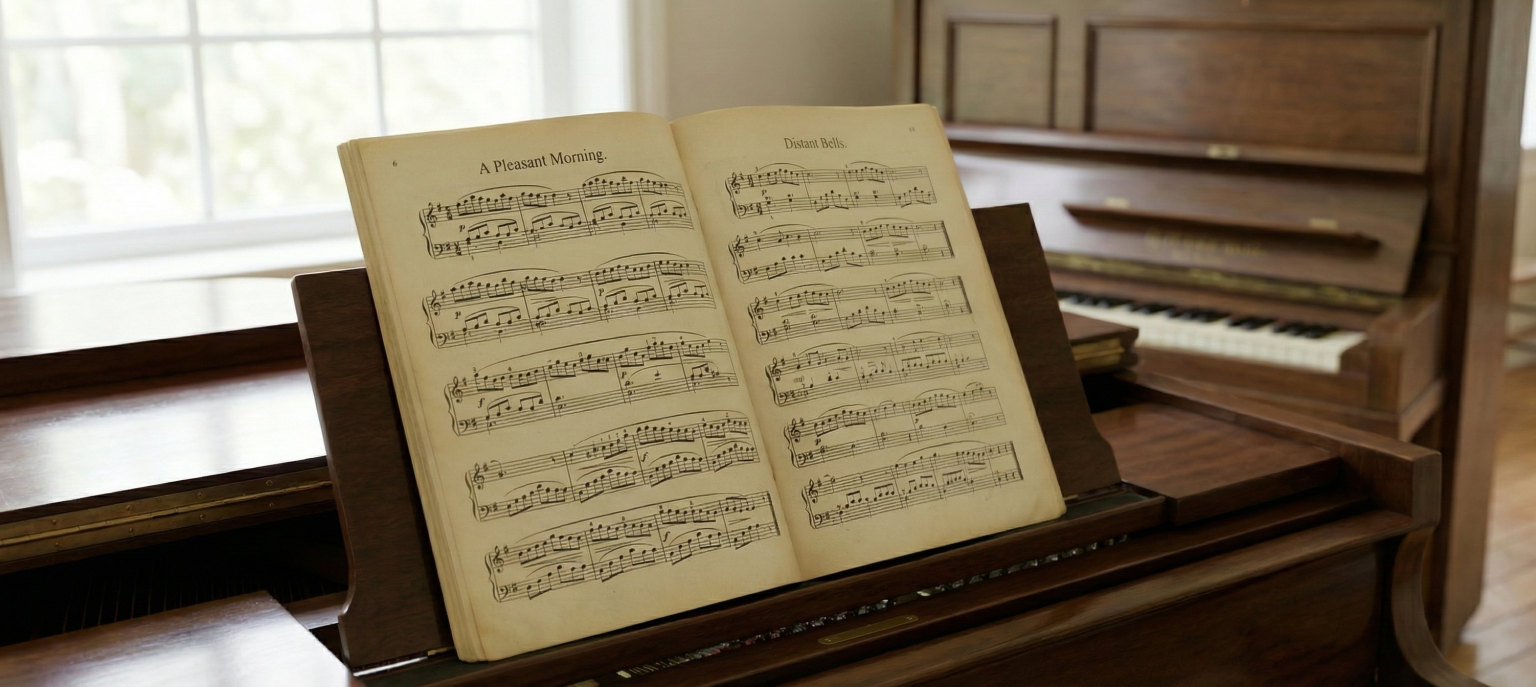
1. A Pleasant Morning
- Key: C Major
- Technical Focus: Legato phrasing and melodic voicing.
- Playing Tip: The right hand carries a lyrical melody that must “float” over the left-hand eighth notes. Practice the right hand alone, emphasizing the peaks of each phrase. Ensure the left hand is played piano to allow the melody to project.
2. Soldier’s March
- Key: C Major
- Technical Focus: Rhythmic precision and staccato chords.
- Playing Tip: The “march” character requires a crisp, vertical touch. The dotted rhythms must be mathematically precise; avoid “swinging” them. Keep the wrist flexible but the fingertips firm when striking the chords.
3. On the Green
- Key: C Major
- Technical Focus: Two-note slurs and grace.
- Playing Tip: Pay close attention to the phrasing marks. The “lift” at the end of each slur should be delicate. Imagine the light steps of someone walking through a meadow.
4. In the Swing
- Key: C Major
- Technical Focus: 6/8 meter and rhythmic lilt.
- Playing Tip: The “swinging” feel comes from the emphasis on the first beat of each triplet group. Do not rush the eighth notes; keep a steady, pendular motion.
5. In a Hurry
- Key: G Major
- Technical Focus: Finger dexterity and velocity.
- Playing Tip: This is a speed study. Keep your fingers close to the keys. Use a “light” staccato in sections where indicated to build agility without tension.
6. Distant Bells
- Key: G Major
- Technical Focus: Dynamics, echo effects, and pedaling.
- Playing Tip: This is the most atmospheric piece in the set. The contrast between p and pp is vital. Use the sustain pedal to create a “halo” of sound, but clear it exactly at the chord changes to maintain clarity.
7. By the Seaside
- Key: C Major
- Technical Focus: Broken chords and flowing triplets.
- Playing Tip: The left hand’s broken chords should mimic waves. Avoid an overly heavy thumb on the left hand; the “top” of the accompaniment should be the most prominent part of the left hand.
8. Hop Scotch Polka
- Key: G Major
- Technical Focus: Syncopation and light articulation.
- Playing Tip: The polka is a dance. Keep the articulation short and witty. The second beat often has a slight “lift” that gives the piece its characteristic bounce.
9. The Stubborn Rocking Horse
- Key: C Major
- Technical Focus: Accents and repetitive rhythms.
- Playing Tip: The “stubbornness” is expressed through sudden accents (sf or >) on the beat. Don’t be afraid to make these sharp—they provide the humor and character of the piece.
10. A Sad Story
- Key: A Minor
- Technical Focus: Minor key expression and cantabile playing.
- Playing Tip: Focus on the “singing” quality. This piece requires a deeper touch in the keys to produce a rich, melancholic tone. Listen for the balance between the hands—the left hand should never overpower the “story” in the right.
11. Chasing Butterflies
- Key: F Major
- Technical Focus: Hand crossings and light staccato.
- Playing Tip: Precision in hand movement is key here. Practice the jumps slowly to build muscle memory. The touch should be “leggiero” (light and fast), like a butterfly moving from flower to flower.
12. Vacation Time
Playing Tip: The final piece should be played with energy. The chords in both hands must be struck perfectly together. Focus on the dynamic buildup (Crescendo) toward the end to provide a triumphant finish to the collection.
Key: C Major
Technical Focus: Chordal attacks and joyful rhythmic drive.
Professional Playing Tips for Op. 63
To achieve a “PianoMode” quality performance of Streabbog, you must refine three core pillars of piano technique: tonal stratification, pedal coordination, and rhythmic vitality.
1. Developing the “Singing” Cantabile Tone
Primary Application: Study No. 1 & No. 10
The word “Melodious” in the title is your primary stylistic directive. To achieve a professional “singing” sound, you must practice the melody in complete isolation. Avoid using isolated finger strength, which can result in a thin, percussive sound. Instead, utilize gravity by allowing your arm weight to sink deeply into the keybed. Think of “caressing” the key rather than “hitting” it.
Once the melody is fluid and warm, introduce the accompaniment. The secret to a professional performance is dynamic layering: the right hand acts as a lead vocalist with a rich, projecting volume, while the left hand remains a soft, supportive background.
2. Mastering Syncopated Pedal Coordination
Primary Application: Study No. 6
In Distant Bells, the sustain pedal is an artistic tool used to create an atmospheric “halo” of sound, simulating the resonance of bells across a valley. A common mistake is using the pedal to mask gaps in finger technique. You must first master the piece with a perfect “finger-legato” (connecting the notes with your fingers only).
Once the fingers are secure, introduce syncopated pedaling. This involves a “down-up” motion: strike the key first, then depress the pedal immediately after. When moving to a new harmony, lift the pedal exactly as the new keys are struck and then quickly depress it again. This “refreshes” the sound, preventing harmonic blurring while maintaining the ringing resonance required for the bell effects.
3. Achieving Rhythmic Precision and Vitality
Primary Application: Study No. 12 & No. 2
For energetic pieces like the celebratory Vacation Time, the objective is to maintain momentum without letting the sound become heavy or “muddy.” To achieve this, use a wrist-rebound technique. Instead of pushing into the keys with a stiff arm, imagine your wrist as a flexible spring that bounces off the keybed. This “staccato wrist” action provides the chords with clarity and a bright, festive character.
Furthermore, to maintain the forward-driving pulse, focus on the “subdivision” of the beat. The short sixteenth notes must be played with mathematical precision, acting as a springboard that pushes the music toward the next strong beat. This prevents the performance from sounding lethargic and ensures the listener feels the triumphant spirit of the composition.
Conclusion & Recommendations
The Twelve Melodious and Very Easy Studies, Op. 63 remains a masterpiece of pedagogical literature. J.L. Streabbog succeeded in creating a curriculum that respects the technical needs of the student while nourishing their musical soul. By mastering the clear phrasing of A Pleasant Morning, the atmospheric depths of Distant Bells, and the rhythmic joy of Vacation Time, the pianist builds a technical foundation that will support their transition into more advanced Romantic masterworks.
Recommendations:
- For Teachers: Use No. 1 to teach voicing and No. 6 to introduce the concept of “orchestration” on the piano.
- For Students: Record yourself playing No. 6. Listen back specifically for the “Distant” quality of the bells, if the volume doesn’t change, your touch is too uniform.
Don’t rush through the set. Master one piece every two weeks, focusing specifically on the dynamic markings (p, f, cresc.). Perfection in these “easy” pieces is the secret to future virtuosity.
What is the correct tempo for Streabbog Op. 63?
The tempo varies by the character of the piece. Lyrical studies like No. 1 are usually around $\text{quarter note} = 92-104, while faster studies like No. 12 can reach quarter note = 120+. Always prioritize clarity over speed.
Are these studies appropriate for adult learners?
Yes. While the titles are imaginative, the technical value is universal. Adults find these pieces highly effective for building hand independence and learning “Romantic” expression in a manageable format.
Is it necessary to learn all twelve studies in order?
Not necessarily. While they progress slightly in difficulty, a teacher may select specific studies to address a student’s particular technical weakness (e.g., No. 6 for pedaling or No. 11 for hand crossings).
What is the meaning of J.L. Streabbog’s name?
It is a pseudonym for the Belgian composer Jean Louis Gobbaerts. He reversed his last name (Gobbaerts → Streabbog) to publish his pedagogical works separately from his concert music.
What level of piano is Streabbog Op. 63?
It is classified as Early Intermediate. In the North American system (RCM), it falls between Grade 2 and Grade 3. In the UK (ABRSM), it is approximately Grade 3.
How does Op. 63 differ from Op. 64?
Op. 63 (12 Melodious and Very Easy Studies) is the introductory set. Op. 64 (12 Melodious and Progressive Studies) is slightly more difficult, introducing faster scales, more complex arpeggios, and larger hand spans.