As an Amazon Associate, PianoMode earns from qualifying purchases. Recommendations are made on their merits; the price you pay is the same.
There is a very specific moment most pianists remember: you play a simple C major triad, then you add one extra note, and suddenly the harmony feels bigger than your hands. It feels like you stepped into a new room. That is the real hook of complex chords. They are not “fancy shapes” reserved for jazz players or conservatory students. They are a practical way to make your playing sound fuller, more modern, and more expressive with only a few carefully chosen notes.
This guide is designed to be educational, thorough, and usable at the keyboard. You will learn how complex chords are built, how chord symbols really work, which notes matter most, how to avoid muddy voicings, and how to apply these sounds to real progressions and real music.
Building complex chords on the piano involves starting from basic triads and adding sevenths, extensions (9th, 11th, 13th), and even altered tones (like ♯9, ♭9, ♯11, ♯5) to create richer harmonies. You construct these chords by stacking notes from scales (usually in thirds), learning different voicings to arrange the notes, and sometimes omitting certain tones to avoid muddiness. Practice with scale theory and functional harmony helps you reharmonize simple progressions with complex chords. Additionally, training your ear to recognize these tensions and practicing improvisation over them will solidify your mastery. Below, we’ll explore each of these steps in detail – from the ground up – and provide diagrams, examples, and tips for every stage.
1. Chord Construction Basics: From Triads to Seventh Chords
Before diving into exotic chords, we must master the basics of chord construction. A chord, in its simplest form, is a combination of two or more notes played together. Most chords in Western music are built by stacking third intervals (every other note of a scale). The most fundamental chords are triads, three-note chords consisting of a root, third, and fifth. For example, a C major triad contains the notes C (root), E (major third above C), and G (perfect fifth above C). These three notes form the basic major chord quality, and you can see them highlighted on the keyboard below.
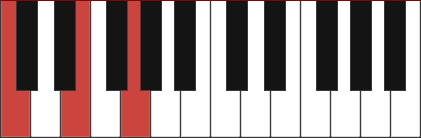
As shown above, the C major chord is built by starting on C and adding the third and fifth scale degrees above it. To summarize common triad types and their interval formulas:
- Major triad: root + major 3rd + perfect 5th (e.g. C–E–G).
- Minor triad: root + minor 3rd + perfect 5th (e.g. C–E♭–G).
- Diminished triad: root + minor 3rd + diminished 5th (e.g. C–E♭–G♭).
- Augmented triad: root + major 3rd + augmented 5th (e.g. C–E–G♯).
Each triad has its own sound or quality – major chords sound stable or happy, minor chords sound sad or tense, diminished chords sound suspenseful, and augmented chords sound uneasy or mysterious. These qualities come from the intervals between the notes (major 3rd vs minor 3rd, etc.), but fundamentally they are all constructed by stacking third intervals.
How to form chords from scales: One helpful way to build any chord is to use the scale of the root note. Take the notes of the scale and skip every other note. For example, if you have the C major scale (C–D–E–F–G–A–B), start on C, skip D, take E, skip F, take G – and you get the C major triad (C–E–G). If you start on the second note of the scale (D) and do the same (D–F–A), you get D minor (in the key of C). Every scale degree can yield a chord this way, giving us the diatonic chords of the key. In a major key, the pattern of diatonic triads is: I major, ii minor, iii minor, IV major, V major, vi minor, vii° (diminished). For instance, in G major: G (I) is major, A (ii) is minor, B (iii) is minor, C (IV) major, D (V) major, E (vi) minor, F♯ (vii°) diminished. This understanding will be useful later when we talk about reharmonization, since complex chords often replace simpler diatonic chords.
Seventh chords: Once you understand triads, the next layer of complexity is adding a fourth note – the seventh. A seventh chord is simply a triad plus one more third stacked on top (the 7th scale degree from the root). Seventh chords are extremely common in all genres (especially jazz and blues) and already start to sound “complex” compared to basic triads. There are a few main types of seventh chords:
- Major 7th chord (maj7): major triad + major 7th. (Formula: 1–3–5–7 from the major scale). Example: Cmaj7 = C–E–G–B.
- Dominant 7th chord (7): major triad + minor 7th. (Formula: 1–3–5–♭7). Example: C7 = C–E–G–B♭. This is the “classic” 7th chord that appears as V7 in classical theory and as a staple chord in jazz/blues.
- Minor 7th chord (m7): minor triad + minor 7th. (Formula: 1–♭3–5–♭7). Example: Cm7 = C–E♭–G–B♭.
- Half-diminished 7th (m7♭5 or ø7): diminished triad + minor 7th. Example: Cø7 (also written Cm7♭5) = C–E♭–G♭–B♭.
- Diminished 7th (dim7): diminished triad + diminished 7th (which is enharmonic to a major 6th). Example: C°7 = C–E♭–G♭–B𝄫 (B double-flat, which sounds as A).
Each of these adds a new flavor: Major 7th chords sound smooth or jazzy (often used as I or IV in jazz), Dominant 7th chords sound tense and want to resolve (V7 in classical harmony), Minor 7th chords are warm and mellow, Half-diminished chords have a suspenseful, unstable quality (viiø7 in major keys, or iiø7 in minor keys), and Diminished 7th chords are very tense and used as leading or passing chords.
To construct a seventh chord yourself, just take the triad and add the seventh note of the corresponding scale. For example, to build C7 (dominant seventh), start with C–E–G (C major triad) and add the minor 7th (B♭). To build Cmaj7, add the major 7th (B natural) to the C major triad. To build Cm7, take C minor (C–E♭–G) and add B♭ (minor 7th).
Why sevenths? Because adding the 7th often “completes” the sound of the chord’s functional harmony. For example, in a G7 chord (G–B–D–F), the 3rd (B) and 7th (F) are a tritone apart and create tension that strongly resolves to C in a C major context; those two notes (B and F) are called guide tones in jazz, as they guide the resolution. Even outside classical resolution, seventh chords simply sound richer and more coloristic than triads – they’re the gateway to complex chords.
2. Adding Extensions: 9th, 11th, and 13th Chords
Once comfortable with 7th chords, we can extend chords further by stacking more thirds. If you keep stacking beyond the 7th, you get extensions: the 9th, 11th, and 13th. These are what people often mean by “complex chords”, those big, lush jazz chords that use notes beyond the basic four.
An extended chord includes the 7th and then one or more notes beyond: the 9th (which is essentially the 2nd scale degree an octave higher), the 11th (the 4th scale degree an octave higher), or the 13th (the 6th scale degree an octave higher). By the time you add up to the 13th, you have spanned all seven notes of the scale! For example, a C13 chord theoretically contains C–E–G–B♭ (that’s C7) plus D (9th), F (11th), and A (13th). That’s seven distinct notes, a big handful on the piano.
Let’s break down the common extensions:
- 9th (add the 2nd scale tone): e.g. C9 = C–E–G–B♭–D. This is often a dominant 9th (based on a dominant 7th chord). C9 contains a minor 7th (B♭) plus a major 9th (D). There are also Maj9 (major 7th + 9th) and m9 (minor 7th + 9th) chords depending on context.
- 11th (add the 4th scale tone): e.g. C11 = C–E–G–B♭–D–F. Usually built on a dominant 7th or sometimes a minor 7th chord. Notice the 11th (F) is the same as the 4th scale degree. In major-key contexts, the 11th often sounds dissonant against the major 3rd (because C–E–F creates a clashing minor 2nd interval between E and F). Often C11 is played with the 3rd (E) omitted, effectively making it a C9sus4 chord.
- 13th (add the 6th scale tone): e.g. C13 = C–E–G–B♭–D–F–A. This chord stacks everything up to the 13th (A). A full 13th chord is very dense, so, as we’ll see, typically some notes are left out.
You might be wondering: do pianists really play all those notes at once? On solo piano, it can be hard (or sound muddy) to play all 6 or 7 notes of an extended chord. The good news is you don’t have to! Musicians usually omit one or more chord tones in extended chords to make them playable and clean-sounding. Here are common practices for extended chords on piano:
- Omitting the fifth: The fifth of the chord (e.g. G in C13) is the least critical tone (it’s a filler that adds stability but little color). Many 9th or 13th chords drop the 5th. Standard rule: In 9th chords, omit the 5th; in 13th chords, often omit the 5th, 9th, and/or 11th.
- Omitting the root: If you have a bass player (or your left hand is playing the bass note separately), you can omit the root in your right-hand voicing. The root is usually implied by context or covered by the bass. This is common in jazz piano comping.
- Omitting the 3rd (for 11ths): In a dominant 11th, the 3rd and the 11th clash, so typically you omit the 3rd. That effectively makes the chord a suspended chord (no 3rd).
- Prioritize color tones: Typically the most important notes in an extended chord are the 3rd and 7th (for defining quality and function), and the highest extension you are using (9th, 11th, or 13th). You ensure those are present, and you can leave some intermediate extensions out if needed. For example, to voice a C13, you might play C–B♭ (root and 7th) in the left hand, and E–A (3rd and 13th) in the right hand, omitting the 5th, 9th, and 11th – yet it still sounds like a C13 chord.
In summary, an extended chord symbol (like C13) does not always mean you play every note from 1 through 13. Instead it tells you which extension is on top. The chord symbol C13 implies the presence of 7th, 9th, 11th, 13th – but in practice, a pianist will choose a good voicing that captures the chord’s sound without necessarily playing all notes.
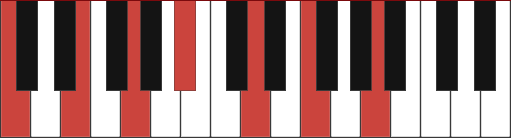
Relationship to simpler chords: It can help to see extensions as built upon simpler chords:
- A 9th chord is like a 7th chord with an added 2nd (9th = 2nd an octave up). For instance, C9 has the same notes as C7 plus a D (the 2nd/9th).
- An 11th chord is like a 7th chord with an added 4th (11th = 4th an octave up) – often notated as a 9sus4 if the 3rd is omitted.
- A 13th chord is like a 7th chord with an added 6th (13th = 6th an octave up). In fact, C13 contains the notes of C7 plus what would be an A minor 7th chord on top (A–C–E–G is Am7, which are the 6th, root, 3rd, 5th of C13). This way of splitting the chord is called a polychord voicing – for example, one could think of C13 as a combination of C and G♭ major triads in some contexts or other structures, but that’s an advanced perspective.
Playing extended chords on piano: To actually play these on the keyboard, use both hands. Typically:
- The left hand might play the root (if needed) and some low chord tones (often root + 7th, or root + 3rd, depending on context).
- The right hand plays the rest of the chord, especially the extension and any important color notes.
- If a chord spans a large range, you can voice it as two chords: e.g., for a C11, you might play a B♭ major triad (B♭–D–F) in the right hand over a C in the bass, that actually gives C–(B♭–D–F) which is a C9sus4, a good voicing for C11. Likewise, for C13, you could play an E–A–D (which is like an A minor chord with an added D) in the right hand over a C7 shell in the left.
- Use inversions and voicings to make these chords comfortable (we’ll discuss voicing in a later section). For instance, you might invert the chord so the extension is on top for clarity.
Sound and usage: Extended chords add color. In jazz and R&B, 9ths, 11ths, and 13ths are used extensively to enrich harmony. For example, the famous opening chord of The Beatles’ “A Hard Day’s Night” has been analyzed as a dominant 9th chord (an Fadd9 over a G7, effectively G7♭9 or a G9sus4) – that bright, complex clang comes from the extra notes. In Wayne Shorter’s jazz tune “Footprints,” the harmony features dominant 11th chords, giving it a modal, suspended quality. John Coltrane’s “Giant Steps” uses lush thirteenth chords in its fast-moving progression, providing depth and sophistication to the sound. In more contemporary gospel and neo-soul, musicians love adding 9ths and 13ths to even simple I–IV–V progressions to create a rich, emotional atmosphere.
Tips for practicing extended chords: If these big chords feel overwhelming at first, here are some practical tips:
- Start simple: Don’t jump right into 13ths in all keys. Begin with adding just one extension at a time. Try practicing ninth chords first (get comfortable with the sound of 9ths). Once you’re comfortable, move to 11ths, then 13ths.
- Break it down: You don’t always need to play all notes. Practice playing just the root, 7th, and the extension (omit the 5th, maybe omit the 3rd if it’s an 11th). This gives the essence of the extended chord without too much clutter.
- Use common progressions: Insert extended chords into ii–V–I progressions. For example, in C major try Dm7 – G9 – Cmaj7, then Dm9 – G13 – Cmaj9, etc. Classic progressions like ii–V–I in jazz or I–IV–V in blues are great testing grounds for extensions.
- Experiment with voicings: Try different inversions and open voicings (spread notes out). For instance, play the 9th on top versus in the middle and hear the difference. Spread tones between hands to avoid clumping notes too closely. We’ll delve more into voicings next.
3. Altered Chords: Adding Sharps and Flats for Color (♯9, ♭9, ♯11, ♭5, etc.)
Moving into even jazzier territory, we encounter altered chords. An altered chord is one where one or more of the chord’s pitches is raised or lowered by a half-step (not counting the root, of course – we typically alter the 5th or the 9th, sometimes the 11th or 13th). These often occur on dominant 7th chords to create heightened tension that begs for resolution.
Common alterations on dominant chords include:
- ♭5 or ♯11: Lowering the fifth gives a flat 5 (e.g. G♭ in a C7 chord), and raising the fourth (which is enharmonically the same as a sharp 11th) gives a similar effect. C7♭5 (also written C7–5 or C7♭5) contains C–E–G♭–B♭. C7♯11 would include the ♯11 (F♯) along with the regular fifth (G) – but usually if you have a ♯11, you might omit the natural 11 or avoid having a natural 5th that conflicts.
- ♯5: Raising the fifth (e.g. G to G♯ in C7) gives an augmented seventh chord (sometimes notated C7+5 or Caug7). For instance, C7♯5 = C–E–G♯–B♭ (note G♯ is enharmonic to A♭, so this could also be called C7♭13 in theory).
- ♭9: Adding a flat ninth is very common in jazz and classical. C7♭9 = C–E–G–B♭–D♭. This chord has a very tense, dark sound (used famously in classical music on V chords, and in jazz as well). The ♭9 wants to resolve downward typically (D♭ resolves to C or to C♯ if moving to, say, a vi chord).
- ♯9: The famous “Hendrix chord” (as in the intro chord of “Purple Haze”) – a dominant 7th with a sharp nine. C7♯9 = C–E–G–B♭–D♯. The ♯9 (D♯) is the enharmonic equivalent of E♭ – so C7♯9 contains both E (the major 3rd) and E♭ (the ♯9), which is an unusual dissonance. This gives a really bluesy, edgy bite. Jazz players use ♭9 and ♯9 a lot on V7 chords leading to minor chords (e.g. G7♯9 resolving to C minor).
- ♯11 (without natural 11): This is basically adding a raised 4th. C7♯11 = C–E–G–B♭–F♯. The ♯11 creates a tritone above the 7th (B♭ to F♯ in C7♯11), adding a brilliant Lydian dominant color. Notably, C7♯11 is often associated with the lydian dominant scale (from melodic minor).
- ♭13: Lowering the 13th (which is same as ♭6). This is less common to see in notation (more often one thinks of it as ♯5). C7♭13 would have A♭ (the ♭13). Indeed, C7♭13 contains the same G♯ (A♭) as C7♯5 – so usually we use ♯5 or ♭13 interchangeably depending on context.
We label a chord “altered” if it has any of these: ♭5/♯5, ♭9/♯9, ♯11 (and sometimes ♭13). In jazz, there’s even the term “the altered scale” (7th mode of melodic minor) which contains all the alterations (♭9, ♯9, ♯11, ♭13) – for example, C7 altered scale: C–D♭(♭9)–D♯(♯9)–E(F♭, 3rd)–F♯(♯11)–G♯(♯5/♭13)–B♭(♭7). Chords labeled just “C7alt” imply you can use any altered tensions on that dominant chord.
Building an altered chord: Technically, start with a dominant 7th and alter the specified note. For example, C7♭9: start with C7 (C–E–G–B♭), and add a D♭ (♭9). C7♯5♯9: start with C7, make G into G♯ (♯5) and add D♯ (♯9). The notation can vary: C7(#5 #9) might be written, or C7alt if unspecified.
On the piano, altered chords often sound best with judicious omission as well. If you have a C7♭9♯5, you have C–E–G♯–B♭–D♭. That’s five notes. You might voice this as E–B♭–D♭ (3,7,♭9) in left hand and G♯ (♯5) in the right, while the bass plays C. That would convey the sound strongly. Less is more with altered tensions; you want the altered note to shine through without too many cluttering voices.
Here’s an example of an altered dominant in context: G7♭9 resolving to C minor. G7♭9 (G–B–D–F + A♭) has a strong pull to C minor (where A♭ resolves to G, B resolves to C, etc.). In fact, the dissonance created by the ♭9 in a dominant chord creates a feeling of tension that needs to resolve – which is why composers love it for V→I resolutions in minor keys.
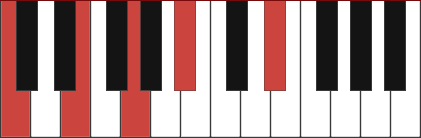
Using altered chords in music: Altered dominants are a hallmark of jazz and gospel harmony. They typically appear as the V chord going to either I or some target chord. For instance, in a jazz blues in C, you might play G7♯9 (or G7♭9) on the V to voice leading into C7 (the I7 in a blues). In a jazz ii–V–I progression in C major, you might play Dm7 – G7♭13♯9 – Cmaj7 to add extra color on the V. The altered notes create a lot of bite, which resolves when you land on the consonant I chord. A classic example in jazz is to use a fully altered V chord to resolve to a I chord or a ii chord (as a secondary dominant).
Tritone substitutions: Altered chords are closely related to the concept of tritone substitution. For instance, G7♭5♭9 shares core notes with its substitute D♭7♭5♭9 (since G7 and D♭7 share the tritone B–F or F–C♭). Both can be voiced with similar altered tensions. So understanding altered chords also helps in reharmonization techniques like tritone sub (more on this later).
Alterations on other chords: While most common on dominants, you can alter tones on other chords too (like a major chord with a ♯11 is a beautiful Lydian sound, e.g. Cmaj7♯11). Or a minor chord with an added major 7 (minor/major 7th chord, like Cm(maj7)) – that’s not usually called “altered” but it’s another color. In film music or late-Romantic classical, you’ll see major chords with added ♯5 (augmented chords) or added ♯4. These are colors you can experiment with once you understand the basic extended/altered framework.
5. Mastering Chord Voicings: Arranging Notes on the Keyboard
Building a complex chord theoretically is one thing; playing it on the piano in a musically pleasing way is another. This is where chord voicings come in. Voicing refers to how you distribute the notes of a chord across the two hands and across the keyboard. The same chord can be played in many different ways (different inversions, spacings, omissions) and can sound surprisingly different depending on the voicing. Learning good voicings is key to making complex chords sound clean and expressive rather than muddy.
When you first learned chords, you probably learned them in closed voicing – meaning all the chord tones are as close together as possible (within one octave). For example, a C7 in closed voicing in root position might have C–E–G–B♭ all within one octave. Closed voicings are dense. As you add extensions, closed voicing often becomes impractical (too many notes bunched up). So we introduce other voicing techniques:
- Open Voicing: Spread the notes out, often over more than an octave. For example, instead of C–E–G–B♭ all tight, you might play C in bass, then G–B♭–E spread out. The chord is the same C7, but “open.” Open voicings generally sound fuller and more balanced because the notes aren’t crowding each other.
- Inversions: This is basic but important – you don’t have to have the root at the bottom. Invert the chord to find the smoothest transition between chords. For instance, if you’re going from G7 to Cmaj9, you might voice G7 as B–F (3rd and 7th) in left hand, and E–A (13th and 9th) in right, then move to Cmaj9 voiced as B–E (7th and 3rd) in left, D–E–G in right (9th, 3rd, 5th) – notice how notes move minimally. This is using voice leading: moving each voice (note) as little as possible to the next chord.
- Shell Voicings: A shell voicing strips the chord to its shell – often just the root and the 7th (and maybe 3rd). For example, playing just C and B♭ for a C7 left hand is a shell (root + 7th). Shells are great in the left hand for comping, especially in jazz, because they outline the harmony without muddiness. In fact, a common jazz left-hand style is to play shell voicings (root and 7th, or root and 3rd) while the right hand plays extensions or melody.
- Drop-2 (and Drop-3, etc.) Voicings: Drop-2 is a technique often used in arranging for piano or ensemble. It means if you have a chord in closed position (stacked 1-3-5-7 from top down, say), you “drop” the second-highest note down an octave. This creates a more spread voicing. For example, take G7 in closed position (G–B–D–F, with G on bottom, F on top). The second-highest note is D; drop it an octave, the voicing becomes D (below) – G – B – F (with D now at the bottom). This is a drop-2 voicing of G7, which is more open. Pianists use drop-2 a lot, especially for four-note chords, because it makes for good spacing without extreme jumps. There are also drop-3 (drop the third-highest note) or drop-2&4 voicings for more complex spreads.
- Rootless Voicings: Especially in jazz, when a bass player is present (or your left hand is busy), you can omit the root and play a chord voicing that gives the flavor without the root. For instance, for C9 or C13, a common rootless voicing is to play E–B♭–D–A (which is 3–7–9–13 of C13) in the right hand. No C, but if the bassist plays C, it sounds like a full C13. This was popularized by pianists like Bill Evans. In a ii–V–I, you might play: Dm9 as F–C–E (which is 3–7–9 of Dm7) then G13 as F–B–E (7–3–13 of G7) then Cmaj9 as E–B–D (3–7–9 of Cmaj7). Notice each moved very little – that’s efficient rootless voice leading.
- Density and Register: As a rule of thumb, avoid clustering too many notes in the lower registers – it will sound muddy. Complex chords often have a lot of their information in the mid and upper register. For example, a voicing might put the 3rd and 7th in the lower-mid range (around middle C or a bit lower) and the extensions in the upper range (treble clef). The bass (below, say, E2 or C2) typically should just have roots or fifths, not full chords (unless you want a murky sound).
The bottom line is that how you play the notes of a complex chord is as important as which notes you play. A well-voiced 11th or 13th chord can sound clear and gorgeous; a poorly voiced one might sound like random dissonance. So spend time practicing different voicings.
Here’s a quick exercise: Take a simple progression like I–vi–IV–V (e.g., C–Am–F–G). First play it in basic triads, root position. Then try adding sevenths to each chord (Cmaj7–Am7–Fmaj7–G7). Next, experiment with making the G7 a G9 or G13. Now, voice each chord for smoothness: maybe Cmaj7 in second inversion, Am7 in first inversion, Fmaj7 in second inversion, and G13 as (B–E in left, F–A in right) which is G13♯11 without root. Notice how the voice leading improves. This kind of hands-on experimentation with voicings will train your ear and fingers to find pleasing sounds.
Pro Tip: A great resource to learn voicings systematically in 2026 is Mark Levine’s The Jazz Piano Book. It dedicates a lot of discussion to voicing techniques and provides examples of drop-2, rootless voicings, upper structure triads, etc., which are invaluable for mastering complex chords in context. Also consider practicing technical exercises like those in Hanon (The Virtuoso Pianist) to build finger strength and independence, being able to reach and articulate wide voicings is easier with strong hands.
The Jazz Piano Book by Mark Levine on Amazon !𝄞As an Amazon Associate I earn from qualifying purchases.
Hanon: The Virtuoso Pianist 60 exercices𝄞As an Amazon Associate I earn from qualifying purchases.
6. Building Chords from Scales and Modes
We touched on deriving chords from the major scale in the basics, but complex chords often come from altering or extending beyond the basic scale. Thus, understanding scale sources for chords can help demystify them.
Diatonic extensions: If you’re in a given key (say, C major) and you extend diatonically, the extensions you get are also from that key. For example, a II chord in jazz (which is typically a Dm7 in C major) – if you extend it to 9th, 11th, 13th diatonically, you’d get Dm13 (D–F–A–C–E–G–B). That basically yields every note of the C major scale starting from D. In practice, Dm13 would usually be voiced as Dm9 or Dm11 omitting some notes, but the point is the extensions are in the C major scale. In classical theory, they might call some of these added tones “non-chord tones” or suspensions, but in modern harmony we just see them as chord extensions if they are stable.
Modes and chord construction: Sometimes complex chords imply a specific mode of a scale. For instance, a chord like G9sus4 (which could be seen as G11 without the 3rd) implies the mixolydian mode (dominant scale) but with a suspended 4th. A chord like Cmaj9♯11 implies the Lydian mode (because C Lydian scale has F♯ which is the ♯11). If you see Fm13 in a jazz chart, that likely implies F Dorian mode (from E♭ major scale) providing the natural 13 (D) and 9 (G) on an Fm chord. So, knowing your modes (Dorian, Mixolydian, Lydian, etc.) and their characteristic notes can guide what extensions sound “inside” (diatonic) versus “altered.”
For example:
- Major scale (Ionian mode) yields maj7,9,13 chords with natural 11 potentially clashing (usually avoid 11 on a major chord or treat as add4).
- Lydian mode (major with ♯4) yields maj7♯11 chords nicely.
- Mixolydian mode (dominant scale) yields 7,9,13 chords (dominant 13th has natural 13, natural 9).
- Dorian mode (minor with natural 6) yields m7,9,11,13 chords where the 13 is major 6 of the minor – gives a nice sound on minor 6/9 chords.
- Natural minor (Aeolian) yields m7,9,11 (the 13 would be ♭13 which is minor 6, often not used as extension on minor chord except in phrygian context).
- Half-diminished chords come from the Locrian mode (7th mode of major scale) – e.g., Bm7♭5 in C major – extensions on half-diminished often include a ♭13 (which is the flat 6 of the scale).
Understanding which scale or mode a chord comes from will help you determine which extensions are available or typical. For instance, an altered dominant chord, as mentioned, comes from the altered scale (Super Locrian mode of melodic minor). If someone says “play a C7alt chord,” you know you can use the notes of C♯/D♭ melodic minor (which is the C altered scale) to find altered extensions.
Scale-tone chords vs. chromatic chords: In reharmonization, you often borrow chords from parallel modes or scales. For instance, borrowing from the parallel minor key is common: in C major, using an E♭7 chord (which comes from C minor’s harmonic domain) as a surprise dominant. These borrowed chords often have alterations relative to the original key.
To practice building chords from scales:
- Pick a scale (major, minor, or any mode).
- Stack thirds to list all triads and seventh chords in that scale (as we did with diatonic chords).
- Then extend further to see the 9th, 11th, 13th for each (some will sound better than others).
- Notice which extensions are major vs minor vs augmented/diminished. For example, in A harmonic minor scale, if you build a chord on E (the V), you get E–G♯–B–D (E7) and extending gives F (♭9) and A (11) – so E7♭9 is naturally in A harmonic minor, which is why V7♭9 is so common in minor keys.
By doing this exercise, you’ll see that complex chords are not random: they emerge from scales. Even altered chords come from certain scales (melodic minor, harmonic minor, whole-tone, diminished scale, etc.).
Finally, learning chords from scales also connects to improvisation: the scale that built the chord is often a good choice for soloing over that chord (more on this in the improvisation section).
7. Reharmonization Techniques: Replacing Simple Chords with Complex Ones
Now that we have a palette of extended and altered chords, how do we use them in actual songs? This leads us to reharmonization – the art of changing a chord progression to make it more interesting or complex, without losing the essence of the original. Reharmonization often involves chord substitution, adding extensions, and using functional harmony in creative ways.
Chord substitution basics: A simple substitution replaces a given chord with another chord that fulfills a similar harmonic function. In traditional harmony, we talk about chord families: Tonic family (I, vi, iii – chords that sound resolved), Subdominant family (ii, IV – chords that lead moderately forward), Dominant family (V, vii° – chords that strongly push to resolution). One reharmonization strategy is to swap a chord for another in the same family. For example, if a song stays on a C major chord (I) for a while, you could reharmonize part of that with an A minor (vi) or E minor (iii) – they share the tonic function and many common tones, so the melody might still fit, but you added interest. Similarly, instead of going from V to I directly, you could insert a ii before the V (a classic ii–V substitution) or use a secondary dominant (V of V, etc.).
Using extensions and alterations in reharm: The easiest way to reharmonize a plain chord is to make it a 7th chord or add a color tone. For instance, if the chord in the song is G (a plain G major triad), you can play G7 or G9 – instant jazziness with the same basic function. If the song is in C major and has an F chord (IV), try making it Fmaj7 or even Fmaj9(♯11) if melody allows – adding E (the 7th) and G (9th) and B natural (♯11) can turn a bland IV into a lush moment (implying a Lydian sound). These kinds of enhancements don’t change the fundamental harmony (still F-based), but they add complexity.
Another reharm idea is approach chords: approach a target chord by its dominant or by a half-step. For example, if you’re going to G7 (the dominant in C), throw in a D♭7 before it – that’s the tritone sub of G7 (shares 3rd/7th in common) and creates a nice chromatic bass drop (D♭7 to C7 or G7 to C, etc.). Or approach an Am chord by an E7 (since E7 is V/vi in C major). These secondary dominants often sound great with alterations: instead of E7, try E7♯9♯5 resolving to Am7 – it adds drama.
Tritone substitution and altered dominants: As mentioned, you can substitute a V7 with the ♭II7 (the dominant a tritone away). So in a jazz context, Cmaj7 – A7♭9 – Dm7 – G7♭13 – Cmaj7 could be a reharm of a basic C – F – G – C progression: here A7♭9 is a secondary dominant leading to Dm (ii), and G7♭13 is a V with alteration; you could even substitute G7 with D♭7 (tritone sub) leading to C. These moves add chromaticism and complexity.
Diminished passing chords: In many Great American Songbook standards, you’ll find diminished 7th chords connecting chords (they act like dominant chords with ♭9). For example, C – C♯°7 – Dm (here C♯°7 is essentially A7♭9 without root, leading to Dm). Using diminished chords is a form of reharmonization that adds a complex color (diminished 7th = lots of minor third intervals stacked) but is actually quite logical as a voice-leading tool.
Modal interchange (borrowed chords): Borrow chords from the parallel minor or major. For instance, in a major key, you might borrow a iv or ♭VII from the minor. Or in C major, use an A♭maj7 (♭VI maj7 from C minor) for a soulful sound. These borrowed chords often are richer (A♭maj7 has that major 7th color and is a non-diatonic surprise).
Example reharmonization: Let’s say you have a simple song line: | G | C | Am | D7 | (a I–IV–vi–V in G major). A jazzier reharm could be: | Gmaj7 G6 | Cmaj9 A7♭9 | Am7 C♯°7 | D7♭9 G/D D7 |. Here we did:
- Turn G into Gmaj7 (even G6 to recall the tonic sound with a 6th added).
- On the second bar, C becomes Cmaj9, then we approach Am by its V: A7♭9 (which is a secondary dominant leading into Am).
- The Am7 is our vi, then C♯°7 is a passing dim chord leading to D.
- The D7 (V) is altered with a ♭9 for tension, and G/D is a socalled pedal inversion preparing the resolution, then D7 again for a nice turnaround back.
This kind of reharmonization drastically spices up the progression while still supporting the original melody (you’d check that the melody notes are chord tones or tasteful tensions against these new chords).
The key to good reharmonization is maintaining the function. If the original chord was providing tension moving forward, your reharm chord should also provide that forward motion (just in a different flavor). If the original was a point of rest, your reharm should also feel somewhat resolved.
Also, let your ear guide you. A reharmonization should enhance the song’s emotional impact, not distract from it. When experimenting, sing or play the melody while trying new chords underneath – if something sounds too far out for the style, dial it back.
8. Improvisation Over Complex Chords
Playing complex chords is one side of the coin; improvising over them is the other. If you’re a pianist who accompanies or creates chord progressions, you’ll also want to solo or create melodies on top of these lush harmonies. Improvisation over complex chords can seem daunting because you have more notes to consider, and altered tones mean the safe scale choices might shift. But here are strategies to approach it:
- Arpeggiate the chord tones: A solid improvisation approach is targeting the chord tones (1–3–5–7 etc.) themselves in your solo. If you have a progression with, say, Gm9 to C13 to Fmaj9, practice arpeggiating Gm9 (G–B♭–D–F–A), then C13 (C–E–G–B♭–(D)–(F)–A), then Fmaj9 (F–A–C–E–G). Emphasizing chord tones in your lines ensures your solo outlines the harmony clearly.
- Use the underlying scales/modes: For each chord, think of the scale that corresponds. Over Gm9 (which is ii in F major), use the G Dorian mode (F major scale). Over C13 (V in F), use C Mixolydian or even C Bebop scale (Mixolydian plus a passing 7th). If it’s altered like C7♭9♯5, you might use the C altered scale (which is D♭ melodic minor) or the diminished scale (for ♭9♯9♭5♯5 chords often a diminished scale fits). Over Fmaj9, use F major or F Lydian if there’s a ♯11. Basically, match your scale to the chord’s key center or mode.
- Target tensions carefully: If a chord has a special tension (like ♯11 or ♭9), try to incorporate that into your solo but perhaps resolve it. For instance, over a C7♭9 chord, you might play a phrase that hits D♭ (the ♭9) and then resolves down to C or B♭ (chord tones). These tensions are like “spicy” notes – use them for flavor, but often resolve them to a chord tone to satisfy the ear.
- Guide-tone lines: Some improvisers like to build lines around the guide tones (3rd and 7th) moving from chord to chord. For example, in a ii–V–I, the 3rd of the ii often moves to the 7th of the V, and the 7th of the V moves to the 3rd of the I. You can make melodies that follow those lines (perhaps ornamenting them) which naturally outline the complex changes.
- Melodic patterns and sequences: Use motifs that you transpose or sequence through the chord changes. If you have a motif that outlines a Gm chord, when the chord changes to C7, adjust the motif to fit C7. This creates a coherent solo even as chords shift.
- Listening and imitation: A great way to get comfortable is to study solos or improvisations by musicians over complex chord progressions. Notice how a jazz soloist navigates a ♯5 or ♭9 chord – often, they embrace the altered note in their line (rather than avoid it). Listening gives you a sense of which tones to emphasize for the right color.
Remember that improvisation is as much an ear thing as a theory thing. All the scale knowledge helps, but you also want to hear the tensions and resolutions. A helpful exercise is to take a complex chord and just improvise slowly within it, without even progression – e.g., play a C7alt vamp and try to make melodies that convey that altered sound. You will start to hear which notes create tension (the altered ones) and which resolve (the chord tones). Over time, your ear will guide your fingers to those juicy notes naturally.
9. Developing a Harmonic Ear for Complex Chords
One of the most rewarding aspects of learning complex chords is training your ear to recognize and appreciate them. A well-developed harmonic ear allows you to identify chords in songs, hear chord progressions internally as you play, and even anticipate chord changes. Here are ways to sharpen your harmonic ear:
1. Active listening: Whenever you listen to music, especially rich harmony (be it jazz, film scores, gospel, etc.), actively identify the chord qualities. Is that chord a major 7th or a dominant? Can you hear a 9th or 13th in it? Pop songs sometimes have subtle extensions (a sus2 or add9 chord, etc.). Try to pick them out. The more you try to listen into the harmony, the better you get. If you know the chord progression, test yourself: hum the third of the chord when it plays, or hum the 7th, to ensure you can hear those chord tones individually.
2. Sing the chord tones: This is a powerful exercise. When you play a complex chord, try to sing each note of it individually. For example, play a B♭m9 chord (B♭–D♭–F–A♭–C) and arpeggiate it slowly, singing along the pitch names or scale degrees. This connects your ear to the chord’s structure. As an advanced step, sing one of the inner voices while playing the whole chord (e.g., sing the 9th while you play the B♭m9). This is challenging but really solidifies your ear’s awareness of that tone within the chord’s context. Jazz musicians often practice singing guide-tone lines or bass lines while playing chords.
3. Isolate and compare tensions: A specific ear training exercise for altered/extended tones is to add one tension at a time over a simple chord and hear its effect. For instance, play a C7 chord in the left hand. With your right hand, add the 9th (D). Listen to C7/9 sound. Now instead, add a ♭9 (D♭); listen to how C7♭9 feels different – it’s crunchier, more unresolved. Next, try ♯9 (D♯/E♭) – notice the clash with the major 3rd. Do the same for ♯11 (F♯ against C7) and ♭5 (G♭) and ♯5 (G♯). By isolating each, you “teach” your ear the distinct color of each tension. Over time, you’ll start to instantly recognize, “oh, that dominant chord in the song has a ♭9” just by sound.
4. Transcribe and analyze: Take recordings of songs with rich chords and try to figure out the chords by ear. Start with something slow or harmonically not too dense (e.g., a jazz ballad or a Stevie Wonder song). Identify the bass notes first, then determine chord quality (major, minor, seventh, etc.), then listen for extensions (does it sound like there’s a 9th or 13th lingering on top?). Check your guesses with sheet music or a known transcription afterward. Each time you correctly identify a complex chord by ear, it’s a huge confidence boost and further trains you.
5. Use ear training tools: There are many apps and websites (like Teoria, ToneDear, EarMaster) where you can practice identifying chord types by ear. Start with basic chords and progress to 7ths and then extensions. Some programs will quiz you on “what kind of seventh chord was that?” or “was that chord a 9th or an add2 or a sus4?” – these distinctions sharpen your ear. For example, practicing to hear the difference between a dominant 7th and a major 7th, or between a 6th chord and a 7th chord with a different inversion, etc., builds your foundation. Then you move to recognizing a ♯11 vs a natural 11 in a chord, etc.
6. Contextual listening (functional ear training): Understand how chords function in progressions by ear. A good ear can often tell “this chord sounds like a V going to I” or “this is a subdominant sound.” For instance, the presence of certain extensions can hint at function: a chord with a ♭9 likely is a dominant resolving down a half-step (common in minor keys). A chord with a major 7th that feels like home is likely the I or IV in the key (tonic or subdominant family). Practicing common progressions (ii–V–I, I–vi–ii–V, circle of fifths sequences, etc.) and hearing them in multiple keys trains you to identify those patterns in real music.
One excellent piece of advice I received was: If you can sing it, you can play it. So even for chords, if you can audiate (hear in your mind) the sound of a given complex chord, you will find it much easier to play it confidently and to use it correctly in arrangements. Developing your harmonic ear is essentially about committing these sounds to memory – like recognizing a flavor in cooking.
A fun practice is to play a chord and then describe to yourself how it feels emotionally. Does C7♭9 give you a tense, “urgent” feeling? Does Fmaj9 sound “dreamy” or “open”? Associating a feeling or color with chord types also helps you recall them by ear. It’s a bit synesthetic, but many musicians describe chord sounds in terms of mood or color.
Finally, remember that ear training is a lifelong journey. Even advanced musicians keep practicing to maintain and improve their ear. Don’t be discouraged if extended chords sound like mush at first, with repeated exposure and active engagement, you will start to hear the individual components. Each time you identify a complex chord correctly, it’s like decoding a secret ingredient in a recipe, your appreciation for music deepens greatly.
Recommended Ressources
Methods
As an Amazon Associate I earn from qualifying purchases.
 Kindle editionRead on Kindle ›
As an Amazon Associate I earn from qualifying purchases.
 Kindle editionRead on Kindle ›
As an Amazon Associate I earn from qualifying purchases.
Tools
As an Amazon Associate I earn from qualifying purchases.
Conclusion
Learning to build complex chords on the piano is like being given a master painter’s palette after working with just primary colors. At first, all the new shades – the ♭9s, ♯11s, add9s and sus4s, can feel overwhelming. But step by step, they integrate into your musical vocabulary. You start to hear music in “high-definition,” recognizing the nuanced emotions that a simple triad could never quite capture.
Reflecting on my own journey, some of the most rewarding moments have been when a complex chord finally clicked in my ear and under my fingers – like the first time I played a fully voiced 13th chord and loved the rich texture, or when I threw an altered dominant into a blues and smiled at the added grit. These sounds have been inside the music I loved all along, and now they were coming from my hands.
I encourage you to be patient and enjoy the process. Theory and practice go hand in hand here: the theory tells you why a chord works, and practice lets you internalize how it feels and sounds. Spend time both at the keyboard and away from it – sometimes imagine chord sounds in your head or listen actively to recordings as a form of practice. Little by little, the once “foreign” harmonies will become second nature.
Music is a language, and by learning complex chords, you’re adding eloquent new words and phrases to your sentences. Use them to express yourself. Even a simple pop ballad can take on new life with a well-placed chord substitution or a gentle 9th added to a chord. And if you’re into composing, these new colors will open avenues for creativity you might not have imagined before.
Above all, keep playing and exploring. There will always be more to discover – an interesting voicing, a peculiar chord in a jazz standard, a beautiful progression in a film score. Embrace the lifelong journey of learning. Every complex chord you conquer is one more tool to convey what’s in your heart through the piano. Happy playing, and may your ears and fingers continue to grow in harmony!
What exactly makes a chord “complex”?
A chord is often considered “complex” when it goes beyond the basic triads and seventh chords – typically by including extensions (such as 9ths, 11ths, 13ths) or altered tones (like ♯5, ♭5, ♯9, ♭9). Complex chords usually have richer dissonance and color. For example, a simple C major chord (C–E–G) is basic, whereas a Cmaj9♯11 (C–E–G–B–D–F♯) is complex. The more notes (and the further those notes extend into the scale), generally the more complex the chord’s sound. Complexity can also come from chord function – diminished 7ths, augmented chords, and chords with suspensions can sound complex because of their tension or ambiguity. In short, if a chord has added “color” notes beyond the usual three or four, or if it’s borrowed/altered from the expected scale, it falls into the complex category.
How can I practice and memorize all these complex chords?
The key is to break it down and practice methodically. Start with one family at a time. For instance, practice all your seventh chords in one key (major 7, minor 7, dominant 7, etc.), then do the same in other keys. Next, add the 9ths: take a chord progression and try adding a 9th to each chord where it fits. Drill common shapes: for example, memorize the rootless voicings for ii–V–I chords in all keys (these are common grips that repeat, e.g., for ii–V–I in C: Dm9 (F–C–E) → G13 (F–B–E) → Cmaj9 (E–B–D)). Use flashcards or apps: one side with a chord symbol (“G7♭9”) and the other with note names or a keyboard diagram, quizzing yourself. Also, incorporate chords into songs you know – if you learn a song that has an Fmaj7 or a B♭13, you will remember that chord in that musical context, which helps retention. Finally, listen to recordings and follow along with a leadsheet: hearing the chord and seeing the symbol reinforces memory (e.g., hearing a big band hit on a G7♯5 chord – you won’t forget that sound-symbol combo easily).
When should I use extended or altered chords in my playing?
Use them when you want to add color, tension, or sophistication to the harmony. In practice.
- If you’re playing a jazz or contemporary piece, the symbols may explicitly call for them (like Gm9 or E7♯5♭9). In that case, use them as written.
- If you’re interpreting a lead sheet or a chord chart that has simple chords (like pop or folk music), you can tastefully add extensions. For instance, on a final sustained major chord, you might end with a major 6/9 chord to make it sweeter. Or during a repeat of a verse, you could swap a plain chord for a 7th or 9th to keep things interesting.
- Use altered dominants when resolving to a minor chord or when you want a very bluesy or jazzy pull. For example, if you have a V chord that lasts a full measure, that’s a great spot to throw in a ♭9 or ♯9 to build drama into the resolution.
- In arranging, any time you have a long duration on one chord, consider using extensions or changing voicings over time (e.g., hold a C chord for two bars – measure 1 play Cadd2, measure 2 play C7 or Cmaj7 – small movement, big effect).
- However, always consider the style and melody: In a delicate folk song, a sudden 13♭9 chord might be out of character. In a hymn or classical piece, certain extensions might clash with the style. So, use complex chords in genres that welcome chromaticism and color (jazz, R&B, soul, fusion, film music, etc.) or in places where the emotion calls for it.
How do I know which scale to improvise with over a complex chord?
Identify the chord’s function and quality, and choose a scale that contains the important chord tones (and extensions). Here’s a quick guide:
- Major chords (with major 7th or 6th): Use the major scale or Lydian if there’s a ♯11. E.g., Cmaj7 → C Ionian (C major scale). Cmaj7♯11 → C Lydian (G major scale).
- Dominant chords (V7): If unaltered (e.g., G7 or G9), use Mixolydian (G major scale with ♭7). If altered (e.g., G7♭9♯5), use the altered scale (which is Ab melodic minor in this case) or the half-whole diminished scale for ♭9/♯9 chords. A simpler approach: target chord tones and altered notes themselves; e.g., over G7♭9, play G diminished arpeggios because G7♭9 is built from the diminished scale.
- Minor chords (m7, m9): Use Dorian mode for m7 chords in functional contexts (ii chords). E.g., Dm9 in C → D Dorian (C major scale). If it’s a Im(maj7) (like A minor-maj7), that’s from harmonic or melodic minor scale.
- Half-diminished (m7♭5): Use Locrian or Locrian ♮2 (from melodic minor). E.g., Bm7♭5 → B Locrian (C major scale) or B Locrian natural 2 (from A melodic minor) if resolving to E7.
- Diminished 7th chords: Use the symmetric diminished (whole-half or half-whole depending which tone you consider root).
In many cases, the chord symbol itself hints the scale: a chord from a melodic minor mode will typically have a ♯something in it (like ♯11 or ♭13 or something indicating it’s not straight major scale). For instance, G7♭13 likely comes from C harmonic minor or F melodic minor. If you’re ever unsure, a safe bet is outline the chord tones and approach chord tones by half-step – this approach (chord-tone soloing) works through any changes without needing to pick a single scale. As you grow, you internalize which scales go with which sounds by practicing and listening.
Do I need a fancy piano or equipment to learn complex chords?
Not at all, any piano or keyboard where you can play at least five notes at once will do! Complex chords sometimes span a wide range, so having an 88-key keyboard (or a piano) is ideal so you can voice things in low and high registers. If you’re in the market, a good digital piano with weighted keys can be very helpful for developing proper technique and voicing control. For example, the Yamaha P-145 and Roland FP-30X are excellent digital pianos known for their realistic feel and sound; they can faithfully reproduce the depth of complex chord voicings. The Donner DDP-100 is a budget-friendly option that still offers full-size keys and a solid piano tone for practicing these chords at home. In addition to the instrument itself, a few accessories can enhance your learning: a reliable metronome is crucial for timing (complex harmonies still need solid rhythm, you can use a standalone metronome or apps), a sustain pedal (most digital pianos come with one or you can add a pedal to practice sustaining those lush chord washes appropriately), and a good piano lamp or lighting setup so you can read chord charts or theory books comfortably. But in essence, the knowledge of complex chords is independent of gear – you can start learning voicings on a simple keyboard or even a piano app. The fancy gear might make practice more enjoyable, but the core requirement is just an instrument you feel comfortable on.
As an Amazon Associate I earn from qualifying purchases.
As an Amazon Associate I earn from qualifying purchases.
As an Amazon Associate I earn from qualifying purchases.
Any tips for getting my hands comfortable with big chord shapes?
Large chords can be a handful (literally). A few tips:
- Work on hand stretch gradually: Don’t force your hands to cover a 10th interval overnight if you’re not used to it. Practice some stride piano or Alberti bass patterns that involve spreading the hand – this indirectly increases flexibility. Also, play arpeggios of extended chords (like C–G–B♭–E for C9) slowly to get used to those reaches.
- Use rolling and pressing techniques: On piano, you don’t always have to play every note exactly simultaneously. It’s okay to roll a chord (play from bottom to top quickly) – classical guitarists do this all the time to accommodate hand stretch; pianists can too, as an effect or to ease the stress. Also, use the sustain pedal to connect wide voicings if needed (e.g., play bass note, pedal, then the rest of the chord).
- Thumb and pinky placement: Often the span from thumb to pinky is the widest. If you need to play a very large span, see if you can redistribute notes between hands – sometimes we try to play too much in one hand when the other hand could take a note or two. For example, a big jazz chord you see in notation might be intended as a two-hand voicing. Experiment splitting any chord between the hands in different ways. There’s no rule that your left hand can only play one note – in complex chords, both hands work together.
- Strengthen your fingers: This is where those Hanon exercises or other technical drills help. Strong, independent fingers can handle awkward voicings more easily. Also practice blocked chord scales (playing diatonic seventh chords up and down a scale in one hand). It’s challenging but improves hand coordination and familiarity with chord shapes.
- Octave substitutions: If a stretch is truly too large (say a 13th between thumb and pinky), consider playing one note in a different octave (or omitting it as discussed). For instance, if your arrangement calls for a big span that you can’t reach, play the upper note an octave down or vice versa. The chord will still sound, just voiced differently.
- Relaxation: Lastly, any tension in your hands or wrists will make big chords harder. Practice staying relaxed – shake out your hands, stretch gently. When voicing chords, use minimum necessary pressure. With practice, your hands usually adapt and you might be surprised that chords you once found impossible become feasible after a few months of consistent practice and stretching.