As an Amazon Associate, PianoMode earns from qualifying purchases. Recommendations are made on their merits; the price you pay is the same.
The art of creating a piano cover is a complex synthesis of auditory analysis, music theory application, and creative arrangement. It transcends the mere replication of notes, requiring the musician to deconstruct a piece of music to its core elements, melody, harmony, and rhythm, and reconstruct it within the idiomatic constraints and possibilities of the piano. This pedagogical guide provides a comprehensive framework for pianists seeking to master the process of transforming any musical work, regardless of its original genre or instrumentation, into a sophisticated solo piano arrangement.
By following a structured methodology, an arranger can move beyond basic transcriptions toward “re-imaginations” that maintain the integrity of the original while showcasing the unique expressive capabilities of the piano. The following sections detail the technical and artistic steps required to achieve this, from initial harmonic mapping to the final application of professional dynamics and recording techniques.
The Fundamental Framework for Piano Arranging
To create a high-quality piano cover, an arranger must master four primary pillars: Active Transcription (identifying melody and key), Harmonic Analysis (decoding chord progressions), Textural Layering (designing left-hand and right-hand interaction), and Expressive Articulation (applying dynamics and rubato). The process begins with identifying the song’s tonal center and its functional harmonic structure (I, IV, V, vi), followed by mapping the vocal melody to the right hand and establishing a rhythmic foundation in the left hand. This structured approach ensures a cohesive and professional-sounding arrangement that resonates with listeners across all musical proficiency levels.
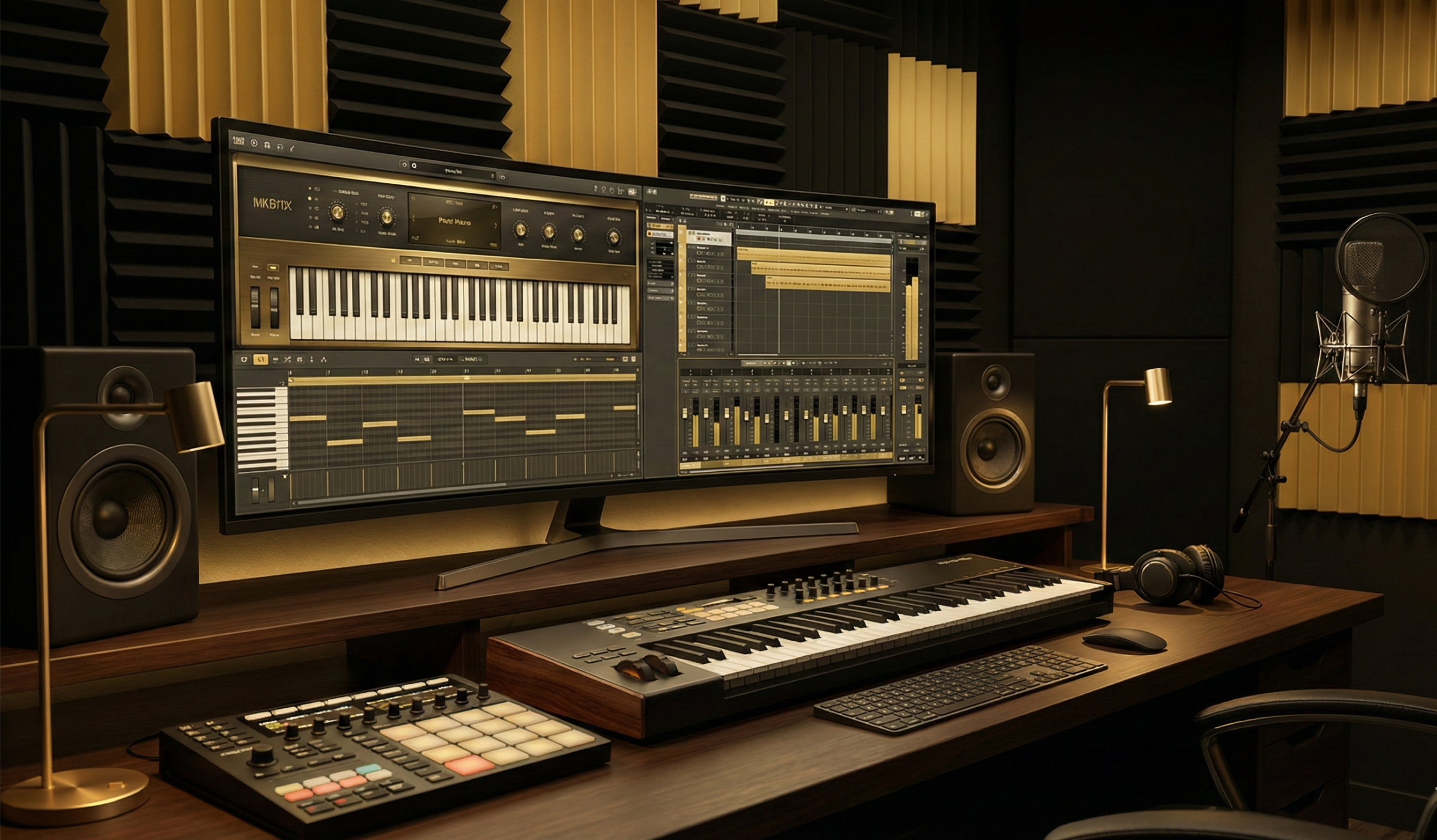
Try Our Mini Studio. Record, mix & create — right from your browser.
Piano, drum machine, microphone & multi-track recording. Everything you need to produce music, no download required.
1. Musical Theory Foundation: The Arranger’s Toolkit
Before attempting to cover a song, one must possess a solid understanding of the theoretical building blocks that govern Western tonal music. Without this foundation, the process of “playing by ear” becomes a trial-and-error struggle rather than a calculated academic exercise.
Understanding Intervalic Relationships
Intervals are the distance between two notes and form the basis of both melody and harmony.
- Perfect Intervals (4th, 5th, 8th): These provide stability and a “hollow” or “open” sound often found in rock or minimalist covers.
- Major/Minor Intervals (2nd, 3rd, 6th, 7th): These define the emotional “color” of the song. The major third is the hallmark of happiness or stability, while the minor third introduces melancholy or tension.
- Dissonant Intervals (Tritones, Major 7ths): Essential for jazz or contemporary pop arrangements to add sophistication and “crunch” to the harmony.
A. Pitch Classes and the Piano Interface
Pitch represents the relative highness or lowness of a sound, determined by the speed of physical vibrations. On a standard piano, these pitches are organized linearly, with each key separated from its neighbor by a half step or semi-tone. A professional arranger utilizes the concept of “pitch-class” to describe the relationship between tones that sound identical but are separated by octaves.
The keyboard serves as the primary visual tool for harmonic analysis. It is essential to recognize the repeating pattern of two black keys and three black keys, which allows for the immediate identification of the “C” pitch-class, the white key to the left of any group of two black keys. The distance between any two notes can be quantified through intervals, which are the fundamental building blocks of all scalar and chordal structures.
| Feature | Description | Pedagogical Relevance |
| Staff (Staves) | A system of 5 parallel lines and 4 spaces. | Used to locate and notate specific pitches. |
| Clef | A symbol indicating the pitch name of a specific line. | Treble (G) clef for high registers; Bass (F) clef for low registers. |
| Grand Staff | The combination of treble and bass staves. | Essential for piano music to cover the full register. |
| Ledger Lines | Small horizontal dashes above or below the staff. | Extend the range of the staff for extreme pitches. |
| Octave | The distance between a note and the next with the same name. | Spans 12 half steps on the piano. |
B. Rhythmic Architecture and Metric Organization
While pitch determines the “what” of a song, rhythm determines the “when.” Rhythmic values are symbols representing the relative duration of sound and silence in musical space. A professional cover must maintain a consistent “pulse” or beat, which acts as the heartbeat of the piece.
Note values are defined by their proportional relationship to one another. Each value is half the duration of the next longer value.
| Note Name (US) | Note Name (UK/Commonwealth) | Proportion of Whole Note |
| Whole Note | Semibreve | 1.0 |
| Half Note | Minim | 0.5 |
| Quarter Note | Crotchet | 0.25 |
| Eighth Note | Quaver | 0.125 |
| Sixteenth Note | Semiquaver | 0.0625 |
| Thirty-Second Note | Demisemiquaver | 0.03125 |
Arrangers often modify these base durations using augmentation dots. A “dotted” note adds half the duration of the original value to itself (e.g., a dotted half note equals three quarter notes). Furthermore, “ties” are used to connect notes of the same pitch across bar lines, allowing a sound to sustain beyond the boundaries of a single measure.
The organization of beats into discrete segments, or measures, is governed by the time signature. Time signatures consist of two numbers: the top number indicates how many beats are in a measure, while the bottom number indicates which note value receives one beat.
- Simple Meter: Meters where the beat naturally divides into two equal portions (e.g., 4/4, 3/4, 2/4).
- Compound Meter: Meters where the beat is a dotted value that divides into three equal portions (e.g., 6/8, 9/8, 12/8).
- Asymmetric Meter: Often called “odd meters,” these mix simple and compound divisions within a measure, creating a complex “push and pull” effect common in progressive rock and modern jazz covers (e.g., 5/4, 7/8).
Professional arrangements often utilize syncopation—the deliberate displacement of the standard beat pattern to emphasize “off-beats”. This is a hallmark of pop and jazz music, where the energy of the track is derived from rhythmic tension between the hands.
The Power of the Circle of Fifths
 Kindle editionRead on Kindle ›
As an Amazon Associate I earn from qualifying purchases.
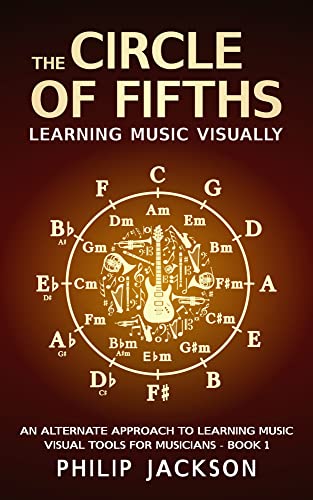
The Circle of Fifths is an indispensable tool for identifying key signatures and predicting chord progressions. Most popular music adheres to the “Law of Proximity” on the circle, where chords adjacent to the tonic (the home key) are the most likely to appear. For instance, in the key of C Major, the most common “neighbor” chords are G Major (the V) and F Major (the IV).
A. Major and Minor Scale Construction
Scales provide the essential pitch material for an arrangement. The two primary scales in Western music are the major and minor.
- Major Scale: Follows the interval pattern W-W-H-W-W-W-H. It is comprised of two identical tetrachords (W-W-H) separated by a whole step.
- Minor Scale: Traditionally has three forms. The “Natural Minor” (Aeolian mode) follows W-H-W-W-H-W-W. The “Harmonic Minor” raises the 7th degree by a half step to create a leading tone, which is the most common form in practical arrangement because it provides a strong resolution to the tonic.
B. The Circle of Fifths as an Arrangement Tool
The Circle of Fifths is a visual representation of the relationship between the 12 keys of the chromatic scale. Moving clockwise around the circle increases the number of sharps by an interval of a fifth (e.g., C major to G major), while moving counter-clockwise increases the number of flats by a fourth.
Arrangers use the Circle of Fifths for several critical tasks:
- Key Identification: Recognizing a key by the number of sharps or flats in the signature.
- Transposition: Shifting a song to a different key to better fit a vocalist’s range or a student’s technical level.
- Modulation: Planning transitions between keys within a complex cover.
| Key Signature | Major Key | Relative Minor | Order of Sharps/Flats |
| 0 Sharps/Flats | C Major | A Minor | – |
| 1 Sharp | G Major | E Minor | F# |
| 1 Flat | F Major | D Minor | Bb |
| 2 Sharps | D Major | B Minor | F#, C# |
| 2 Flats | Bb Major | G Minor | Bb, Eb |
Chord Construction and Voicing
Triads and Their Inversions
Arrangers must be fluent in the three primary triad types found in common keys: Major (4+3 half steps), Minor (3+4 half steps), and Diminished (3+3 half steps). However, playing every chord in “root position” (root at the bottom) results in a “clunky” sound and requires excessive hand movement.
Chord Inversions facilitate:
- Smooth Transitions: Moving the shortest distance between notes of succeeding chords (voice leading).
- Avoiding Register Conflicts: Using inversions in a lower octave to ensure the left hand does not interfere with a right-hand melody below Middle C.
- Variety of Texture: Providing different “shades” of the same harmonic function.
| Inversion Type | Bottom Note | Nomenclature (C Major) |
| Root Position | Root | C |
| 1st Inversion | 3rd | C/E |
| 2nd Inversion | 5th | C/G |
Beyond Triads: Seventh Chords and Extensions
Popular music arrangements frequently utilize seventh chords to add sophistication and jazz-like “color”. A four-note seventh chord follows a 1-3-5-7 pattern.
- Major Seventh (Maj7): Adds a “dreamy” or sophisticated quality.
- Dominant Seventh (7): The most common tool for creating forward momentum in a progression.
- Suspended Chords (sus2/sus4): Created by replacing the 3rd of the chord with a 2nd or 4th. These “money chords” sound good over almost any root and are highly versatile in modern pop piano.
In solo piano arrangements, the “5th” note of a seventh chord is often considered least essential and can be omitted to simplify playing without affecting the chord’s tonality.
2. Phase One: Analytical Listening and Structural Mapping
Successful arranging begins long before the first note is played. It starts with Structural Analysis, where the song is treated as a blueprint to be decoded.
Structure Checklist:
- Identify the overall mood and emotional arc.
- Map the song’s sections (Intro, Verse, Chorus, Bridge, Outro).
- Note the instrumentation and how it can be approximated on piano.
- Locate areas of maximum and minimum tension.
Identifying the Formal Sections
Most contemporary songs follow a standard architecture. Mapping these sections allows the arranger to plan the “energy curve” of the cover:
- Introduction (Intro): Sets the atmospheric tone.
- Verse: The narrative section, usually lower in volume and complexity.
- Chorus: The emotional peak; requires the fullest piano texture.
- Bridge (Middle 8): A departure from the main theme, often involving a key change or rhythmic shift.
- Outro: The resolution and fade.
Determining the Tonal Center (Key)
The “Tonic” is the note where the song feels most at rest. To find the key, one should listen for the final note of the chorus or the note that the bass line repeatedly returns to. Once the tonic is identified, the arranger can determine the scale (Major, Minor, or Mixolydian) used throughout the piece.
Rhythmic Deconstruction
Identifying the Time Signature (usually 4/4, but occasionally 3/4 or 6/8) and the BPM (Beats Per Minute) is crucial. The piano must act as its own percussion section; therefore, understanding the “groove”, whether it is a straight eighth-note feel or a syncopated “swing”, is the first step in designing the left-hand pattern.
3. Phase Two: Transcribing the Melody (The Right Hand)
The right hand typically assumes the role of the lead vocalist or the primary melodic instrument. This requires a high degree of precision and “vocal-like” phrasing.
Establishing the Melodic Skeleton
The initial goal is to find the “anchor notes”, the notes that fall directly on the downbeats. Once the skeleton is mapped, the pianist can fill in the “passing notes” and “neighbor tones.”
Mimicking Vocal Nuances
A piano lacks the ability to sustain a note with the same vibrato or pitch-bending as a human voice. To compensate, arrangers use:
- Grace Notes (Acciaccaturas): Quick “flicker” notes that mimic a singer’s vocal fry or stylistic slides.
- Tremolos: Rapid alternation between notes to simulate a sustained, high-energy vocal belt.
- Trills: For a classical or ornamental feel.
Common Melodic Embellishments:
- Slip-Notes: A modern ornament where a pianist “slips” off a chromatic note onto a chord tone, common in gospel and contemporary pop.
- The “Magic Roll”: A rapidly descending arpeggio that leads into a syncopated cluster chord, creating a professional “flourish”.
- The Echo Effect: During long-held melodic notes (dotted half notes or more), the arranger repeats a portion of the melody an octave higher as an “echo”.
- Runs and Licks: Rapid recall of scale fragments (often from the Blues scale) used to transition between sections.
Octave Doubling and Thickening
In the chorus, a single-note melody often sounds thin. Octave doubling (playing the same note eight steps apart) instantly adds authority and volume. For a more sophisticated sound, the “Inner Voices” can be added, playing the 3rd or 5th of the underlying chord slightly below the melody line.
4. Phase Three: Harmonic Mapping and Bass Lines (The Left Hand)
The left hand is the “engine room” of the piano cover. It provides the harmonic foundation and the rhythmic drive.
Functional Bass Lines
The simplest left-hand approach is to play the Root Note of the chord. However, to create a more melodic and professional bass line:
- The 1-5-8 Pattern: Playing the Root, the Fifth, and the Octave. This is the “gold standard” for pop piano.
- Walking Bass: Moving stepwise between chords, often used in jazz or upbeat blues arrangements.
- Inverted Bass: Using the 3rd or 5th of the chord as the lowest note to create a sense of “rising” or “falling” tension.
Rhythmic Textures (Groove Selection)
The left hand must compensate for the lack of drums.
- Arpeggios: Breaking the chords into individual notes. This creates a flowing, “water-like” texture ideal for ballads.
- Syncopation: Playing off the beat to create a modern, rhythmic feel.
- Block Chords: Striking all notes simultaneously for a powerful, percussive effect (best for rock or anthems).
Comparative Table: Accompaniment Styles for Different Genres
| Genre | Left Hand Technique | Right Hand Technique | Key Theoretical Element |
| Pop Ballad | Wide Arpeggios (1-5-10) | Simple melody + inner chords | Sustained pedal, 4th suspensions |
| Rock/Alternative | Driving Octaves / 5ths | Strong block chords | Syncopation, Power chords |
| Jazz/Neo-Soul | 7th & 9th Shell voicings | Improvisational flourishes | Tritone substitutions, Swing |
| Classical Style | Alberti Bass (1-5-3-5) | Counterpoint melodies | Diatonic harmony, Rubato |
| EDM/Electronic | Staccato rhythmic pulses | Octave-doubled hooks | High BPM, Filter-sweep dynamics |
Originating in the 18th Century, the Alberti bass is an accompaniment pattern made from broken chords. It follows a specific sequence: Bottom – Top – Middle – Top.
- Usage: Ideal for classical sonatinas or pop ballads where continuous movement is needed without the density of blocked chords.
- Technical Tip: Execution relies on “forearm rotation”, the same motion used to turn a doorknob, rather than just finger movement, to avoid tension and loudness.
- Balance: The left hand must remain softer than the right-hand melody to prevent the “clomping elephant” effect.
Modern covers require more driving, rhythmic textures.
- Arpeggios (Broken Chords): hallmark of contemporary ballads (e.g., Adele’s “Someone Like You”). The chords are “rolled” or played sequentially, often spanning more than an octave for a lush sound.
- Octave Hammering: A technique used in rock and roll arrangements where the left hand prepared in an open octave position “bounces” with a loose wrist to provide power and drive.
- Stride Bass: Borrowed from early jazz and ragtime, this pattern involves large leaps between a low bass note and a chord played higher up, creating a playful, rhythmic bounce.
- The “Boogie-Woogie” Line: A bluesy bass pattern that uses the root, 3rd, 5th, 6th, and flatted 7th in a repeating sequence.
5. Phase Four: Professional Arranging Techniques
To elevate an arrangement from a “standard cover” to a “professional performance,” one must apply advanced compositional techniques.
The Concept of “Voice Leading”
Voice leading is the art of moving between chords with the least amount of movement possible. Instead of jumping from a C Major chord to an F Major chord in root position, a professional arranger will use an inversion (e.g., C-E-G to C-F-A). This creates a “smooth” sound that mimics a choir or a string section.
Re-harmonization: Adding Your Signature
Re-harmonization involves changing the underlying chords while keeping the melody the same.
- Tritone Substitution: Replacing a dominant chord with a chord a tritone away (common in jazz).
- Relative Minor Swap: Using an A Minor chord instead of a C Major to add a sudden “dark” or “introspective” shift.
- Pedal Point: Keeping a constant bass note while the chords above it change, creating a dramatic, building tension.
Using “Fill-ins” and Transitions
In vocal music, there are often gaps between phrases. On the piano, these gaps must be filled to maintain momentum.
- Pentatonic Runs: Fast scales using only five notes, which always sound “correct” over the harmony.
- Rhythmic Anticipation: Playing the next chord half a beat early to create a sense of forward motion.
6. Phase Five: Dynamics, Expression, and Articulation
The difference between a MIDI-sounding playback and a soulful performance lies in the Expression Layer.
Mastering the Sustain Pedal (Damper Pedal)
The sustain pedal allows notes to ring out, but over-use leads to “harmonic mud.” The piano’s three pedals (Damper, Sostenuto, and Soft) are essential for modern arranging.
- Damper Pedal (Sustain): Lifts the internal dampers to let the strings ring. It creates a lush, orchestral texture but must be “cleared” frequently to prevent dissonant harmonic overlapping.
- Soft Pedal (Una Corda): Moves the hammers so they strike fewer strings (on a grand) or are closer to the strings (on an upright), resulting in a quieter, more intimate tone.
- Sostenuto Pedal: The middle pedal on most grand pianos, which sustains only the notes held down at the moment it is pressed, allowing a pianist to hold a long bass note while playing staccato chords above.
Dynamics (The Volume Arc)
An arrangement must breathe.
- Crescendo(<): Gradually getting louder during the bridge to build excitement.
- Diminuendo (>): Gradually playing softer for a gentle outro or bridge.
- Decrescendo: Softening the touch for the final outro to provide a sense of closure.
- Staccato vs. Legato: Using “short/sharp” notes for upbeat sections and “long/connected” notes for melodic passages.
- Subito Piano: A sudden drop to a quiet volume to create an element of surprise.
- Marcato: Heavily stressed or emphasized notes, often used for powerful melodic peaks.
Pedagogical Frameworks
Teaching the art of piano covers requires a different approach than traditional classical pedagogy. Adult learners, in particular, benefit from “Quick Wins” and a focus on removing the “mystique” of the instrument.
A. The “FERN” Method for Repertoire Mastery
Piano instructors can ensure a piece is learned thoroughly from the beginning by using the FERN acronym :
- Fingering: Identifying and sticking to the most efficient hand positions immediately.
- Expression: Adding dynamics and articulation from the first day of practice to avoid forming “robotic” habits.
- Rhythm: Mastering the beat and any complex intersections (like 4-against-3 polyrhythms).
- Notes: Ensuring accurate pitch recognition and pattern identification.
B. Strategies for Adult Success
Adult students often have disciplined minds but struggle with self-criticalness.
- Rote Learning: Teaching a “cool” lick or the verse of a famous song (like “Let it Be”) immediately by pattern recognition rather than staff reading helps build confidence.
- Pattern Recognition: Encouraging students to see a measure as a single chord rather than a collection of individual notes.
- Technology Integration: Using software like “Piano Marvel” to provide instant feedback and track progress between weekly lessons.
- Simplification: Instructors should not hesitate to simplify complex seventh chords to basic triads or move syncopated notes back onto the beat for beginner-level players.
Recommended Gears
The Right Instrument
- Digital Pianos: Should feature “Weighted Hammer Action” and “Triple Sensor” technology to capture the nuances of a real piano.
As an Amazon Associate I earn from qualifying purchases.
As an Amazon Associate I earn from qualifying purchases.
As an Amazon Associate I earn from qualifying purchases.
- VSTs (Virtual Studio Technology): Many professional covers use software pianos like Keyscape or Pianoteq to achieve a high-fidelity studio sound from a MIDI controller.
Try Our Mini Studio. Record, mix & create — right from your browser.
Piano, drum machine, microphone & multi-track recording. Everything you need to produce music, no download required.
Post-Production Essentials
- EQ (Equalization): Cutting the low-mids to remove “muddiness” and boosting the highs for “sparkle.”
- Reverb: Adding a “Hall” or “Plate” reverb to give the piano a sense of space and professional depth.
- Compression: Gently leveling out the volume peaks so the recording sounds consistent across all devices (mobile, headphones, car speakers).
Tools for Professional Recording and Performance
Once an arrangement is finalized, capturing a high-quality performance is the next step for sharing with an audience. To ensure a professional result, specific hardware and software tools are required.
Essential Hardware for Piano Recording
For those using an acoustic piano, a “matched pair” of microphones is standard to capture the full stereo image of the instrument.
- Microphones: The Rode NT5 Microphone (Matched Pair) is an industry standard for acoustic piano.
As an Amazon Associate I earn from qualifying purchases.
- Audio Interfaces: To connect microphones to a computer, an interface like the Focusrite Scarlett Solo 4th Gen Audio-interface or the Focusrite Scarlett 2i2 Audio Interface provides high-fidelity conversion.
As an Amazon Associate I earn from qualifying purchases.
As an Amazon Associate I earn from qualifying purchases.
- Mobile Recording: If recording on the go with a tablet or smartphone, the iRig Pro I/O Audio-interface offers a portable solution.
As an Amazon Associate I earn from qualifying purchases.
Studio Monitoring and Mixing
Monitoring your recording requires accurate, “flat” frequency response to hear the nuances of your arrangement.
- Headphones: The Beyerdynamic DT 770 Pro (80 Ohm) is prized for its detail and comfort during long sessions, while the Sennheiser HD 280 Pro Headphone offers excellent isolation.
As an Amazon Associate I earn from qualifying purchases.
As an Amazon Associate I earn from qualifying purchases.
- Mixing Tools: For complex setups involving multiple inputs, the Livetrak L6 Audio-interface allows for real-time control.
As an Amazon Associate I earn from qualifying purchases.
Conclusion: Developing Your Personal Piano Style
Mastering the ability to create a piano cover is a journey of continuous musical discovery. It requires a balance between the analytical mind (understanding the theory) and the creative heart (interpreting the emotion). By deconstructing the song’s architecture, identifying the functional harmony, and applying professional textures like arpeggios and voice leading, you can transform any piece of music into a unique piano masterpiece.
The most successful arrangers are those who aren’t afraid to take risks, slowing down a fast dance track, adding jazz chords to a rock song, or using silence as a tool for tension. As you progress, your “musical vocabulary” will expand, allowing you to intuitively sense which patterns and dynamics will best serve the song.
Start today by selecting a simple 3-chord song. Identify the tonic, map the melody, and experiment with one left-hand pattern. The path to professional arranging is paved with practice, listening, and the courage to make the music your own.
How long does it take to learn how to create your own piano cover of any song?
The timeline varies based on your existing knowledge of scales and chords. A beginner can learn a basic “chord-and-melody” cover in a few days, but mastering professional arranging techniques typically takes 6-12 months of consistent ear training and harmonic study.
Can I cover a song if I don’t know the sheet music?
Yes. Creating a cover is primarily an “ear-based” skill. By identifying the root notes of the bass line and the intervals of the melody, you can transcribe any song without ever looking at a piece of staff paper.
What is the most common chord progression in pop music?
The most prevalent progression is the I – V – vi – IV (e.g., C – G – Am – F). Mastering this progression alone will allow you to play the “skeleton” of thousands of modern hits.
Should I stick to the original key of the song?
Not necessarily. You should transpose the song to a key that feels comfortable for your hand size or suits the “mood” you want to create. Brighter keys like E Major feel more energetic, while keys with many flats like Db Major feel “warmer” and more “velvety.”
How can I accurately transcribe a dense chord by ear?
Utilize the “Play and Stop” technique. Play a very brief snippet of the recording and stop it immediately, allowing your mind to process the ringing tones in silence. If you are unsure if a note is present, “sing” the pitch in your mind while playing the recording; if it is there, it will resonate.
What is the most effective way to practice hand independence for a new cover?
Focus on “Hands Alone” practice, particularly for the left-hand texture. Once the accompaniment pattern is automated in your muscle memory (autopilot), you can then introduce the right-hand melody.
Why does my left-hand accompaniment sound “muddy”?
This usually occurs due to the low register of the piano. To prevent this, avoid playing full blocked chords in the lower octaves. Instead, use “Open Voicings” (root and 5th) or arpeggiate the chord so only one or two notes are sounding at any given moment.
How do I know which notes to add as right-hand “fills”?
Fills should draw from the notes of the current chord or the associated scale. Understanding “Chord Extensions” (adding the 9th, 11th, or 13th) is the most effective way to determine which notes will sound professional over a given harmony.