As an Amazon Associate, PianoMode earns from qualifying purchases. Recommendations are made on their merits; the price you pay is the same.
Music is a living, breathing entity that transcends the static ink on a page. While learning notes and rhythms provides the skeletal structure of a composition, it is the application of dynamics that provides the flesh, blood, and soul. For the pianist, dynamics are not merely about “loud” and “soft”, they are about the strategic manipulation of sound to evoke emotion, define structure, and communicate a narrative. This guide explores the multifaceted world of piano dynamics, offering pedagogical insights into how you can harness the power of volume to transform your performance from a mechanical sequence of tones into a profound artistic experience.
What Are Dynamics in Music?
Dynamics in music refer to the relative volume of sound, ranging from the whisper of a quiet passage to the thunderous roar of a climax. Unlike some instruments where volume is controlled by breath or bow pressure, the piano, originally called the gravicembalo col piano e forte (harpsichord with soft and loud), allows the performer to control volume through the velocity and weight applied to the keys.
Dynamics are the primary tool for creating musical “shape.” By varying the intensity of sound, a pianist can highlight a melody against an accompaniment, signal the climax of a phrase, and create a sense of tension and release. Without dynamics, music lacks direction and fails to engage the listener’s emotional response; with them, even the simplest melody can become a haunting or heroic statement.
1. The Historical Evolution of Dynamic Thought
The concept of dynamics has not remained static throughout musical history. It has transitioned from a performer-led improvisation to a highly precise science of notation, driven by the technological development of keyboard instruments.
Ancient and Non-Western Origins
As early as 7000 B.C., musical instruments like the bone flutes found in China’s Henan Province were capable of dynamic variation through the modulation of air pressure. In ancient Egypt (c. 3500 B.C.) and Greece (c. 2500 B.C.), the development of harps and lyres introduced the concept of touch-sensitive dynamics, where the intensity of the pluck determined the volume. Pythagoras, the first great music theorist, focused on the mathematical ratios of pitch but recognized that the “power” of sound was an essential quality of its communicative force.
The Medieval and Renaissance Texture
In the medieval period, Western music was dominated by monophonic Gregorian chant. Because these chants were designed for liturgical use in resonant cathedrals, dynamics were largely determined by the natural stresses of the Latin text rather than written instructions. As music moved toward polyphony in the Renaissance, dynamics became a function of “texture”. To make a section louder, a composer simply added more voices or instruments, a technique known as “quantitative dynamics”.
The Baroque Era and Terrace Dynamics
The Baroque era (c. 1600–1750) was characterized by a dramatic aesthetic of contrast. However, the keyboard instruments of the time, the harpsichord and the organ, could not produce gradual volume changes through finger pressure. This mechanical constraint led to “terrace dynamics,” where music shifted abruptly between forte and piano levels. This was achieved by switching manuals on the organ or engaging different sets of strings (ranks) on the harpsichord. Composers like J.S. Bach and Handel utilized these sudden shifts to delineate formal structures and create architectural grandeur.
The Invention of the Pianoforte
The most significant event in the history of dynamics was the invention of the piano around 1700 by Bartolomeo Cristofori. By replacing the plucking mechanism of the harpsichord with a hammer action, Cristofori allowed the performer to control volume through the velocity of the key stroke. This instrument, initially called the gravicembalo col piano e forte (harpsichord with soft and loud), revolutionized composition, making the crescendo and diminuendo possible for the first time on a keyboard.
The Classical and Romantic Expansion
In the Classical era (c. 1750–1820), dynamics became integral to the “Sonata Form”. Composers such as Haydn and Mozart used dynamic markings to emphasize the transition between the primary and secondary themes. Ludwig van Beethoven, a pivotal figure, pushed the limits of the instrument, demanding unprecedented extremes of loudness and softness that paved the way for the Romantic era (c. 1820–1900). Romantic composers like Chopin, Liszt, and Tchaikovsky treated dynamics as a direct expression of the human psyche, using expansive swells and sudden, shocking accents to mirror emotional turbulence.
| Musical Era | Primary Keyboard Instrument | Dynamic Characteristic |
| Renaissance | Harpsichord / Clavichord | Subtle, limited range |
| Baroque | Harpsichord / Organ | Terrace dynamics (abrupt shifts) |
| Classical | Fortepiano | Gradual changes, structural clarity |
| Romantic | Modern Grand Piano | Extreme ranges, emotional intensity |
| Modern | Concert Grand / Digital | Absolute control, wide $dB$ range |
2. The Language of Dynamics: Essential Marking
In modern Western notation, dynamics are indicated by a set of standardized Italian terms and symbols. These markings are not absolute values but relative instructions that must be interpreted based on the musical context, instrument, and performance space.
The Standard Dynamic Levels
The hierarchy of volume, from the quietest possible sound to the loudest, follows a logical progression of Italian terms.
- ppp (Pianississimo): Very, very soft. Often used to create a sense of distance or a dream-like state.
- pp (Pianissimo): Very soft. Indicates an intimate, hushed tone.
- p (Piano): Soft. The basic level of quietude.
- mp (Mezzo-piano): Moderately soft. Slightly louder than piano, often used for secondary melodies.
- mf (Mezzo-forte): Moderately loud. The “neutral” or standard speaking volume of the piano.
- f (Forte): Loud. Indicates strength and confidence.
- ff (Fortissimo): Very loud. Used for powerful, triumphant, or dramatic passages.
- fff (Fortississimo): Very, very loud. The extreme of the standard range, signifying a massive climax.
Gradual and Sudden Variations
To guide the performer through transitions of volume, composers utilize several specific markings:
- Crescendo (cresc. or <): A instruction to “grow” the sound gradually louder.
- Decrescendo / Diminuendo (decresc., dim., or >): An instruction to gradually “diminish” the volume.
- Hairpins: The graphic symbols (< and >) are used to indicate the exact span of a gradual volume change. The opening or closing of the “jaw” indicates the direction of the change.
- Sforzando (sfz): Literally “straining,” it indicates a sudden, strong accent on a single note or chord.
- Fortepiano (fp): A specialized marking where a note is struck loudly (forte) and then immediately dropped to a soft (piano) level.
- Subito (sub.): Meaning “suddenly,” this modifier is added to a dynamic marking (e.g., sub. p) to indicate an abrupt shift that bypasses the natural expectation of a transition.
Placement and Consistency
In piano music, these markings are typically placed between the treble and bass staves. If a specific marking appears only under one staff, it may imply that only that hand should change volume, a common requirement in “voicing” a melody against an accompaniment. Clean and consistent spacing of these markings is essential for legibility, as crowded notation can lead to performer confusion regarding the precise onset and termination of a dynamic swell.
3. The Role of Rhythm and Meter
A fundamental principle of music theory is that rhythm and dynamics are inextricably linked. The placement of a note within a measure dictates its “natural” dynamic weight, a concept known as “metrical stress”.
Natural Stress Patterns
In standard Western meters, the first beat of every measure (the “downbeat”) is naturally the strongest. This provides the listener with a rhythmic anchor and a sense of structural stability.
- Duple Meter (2/4, 2/2): Follows a STRONG-weak pattern.
- Triple Meter (3/4, 3/8): Follows a STRONG-weak-weak pattern.
- Quadruple Meter (4/4): Follows a STRONGEST-weak-STRONG-weak pattern, where the third beat receives a secondary stress.
Instructors often use these patterns to teach students how to “feel” the pulse of a piece, encouraging a slight physical leaning or a firmer finger strike on the primary beats.
Syncopation and the Subversion of Stress
Syncopation occurs when the rhythmic stress is shifted from a strong beat to a weak beat or even to the space between beats. This creates a sense of surprise, excitement, and forward momentum. In jazz and modern pop, syncopated notes are often emphasized with a sudden accent or sforzando, effectively using dynamics to highlight the rhythmic “off-beat”.
Pick-up Notes and Dynamic Preparation
An anacrusis (or pick-up note) is a partial measure that begins a piece. Pedagogically, the pick-up note must be played with less weight than the following downbeat to correctly establish the meter. A common mistake among beginner pianists is to accent the pick-up note, which can confuse the listener’s perception of where the measure actually begins.
4. Articulation: The Mechanical Bridge to Tone
While dynamics govern the overall volume, articulation defines the specific “envelope” of each note, how it begins, stays, and ends. Mastering articulation is essential for creating the wide range of timbres available on the modern piano.
The Components of a Musical Tone
Every note played on the piano consists of three phases:
- Attack: The initial sound of the hammer hitting the string. This is the most distinguishing characteristic of an instrument’s sound.
- Timbre (or Harmonic Content): The “body” of the sound, determined by the resonance of the strings and the piano’s soundboard.
- Decay: The gradual fading of the sound as the vibration loses energy.
Technical Articulation Markings
Different articulation types allow the pianist to manipulate these three phases to achieve specific dynamic effects.
| Articulation | Symbol | Description | Dynamic Effect |
| Legato | Slur (curved line) | Notes are smoothly connected. | Softens attack, lyrical feel |
| Staccato | Dot above/below note | Notes are short and detached. | Percussive, bouncy |
| Tenuto | Line above/below note | Notes held to full value. | Adds “weight” or emphasis |
| Accent | Sideways “V” (>) | Note is stressed/emphasized. | Sudden increase in volume |
| Marcato | Vertical Wedge | Extremely stressed. | Heavy, sharp attack |
Pedagogically, these markings are taught by comparison to oratory. For example, a staccato note is like a short, crisp consonant, while a legato passage is like a long, flowing vowel. Students are encouraged to use vocal cues like “Bam!” for accents or “Plink!” for staccato to internalize the required physical energy.
5. The Mechanical Realization of Dynamics on the Piano
The modern grand piano is a marvel of mechanical engineering, designed to amplify the subtlest intentions of the performer. Understanding the internal physics of the instrument allows for a more scientific approach to dynamic mastery.
Hammer Action and Escapement
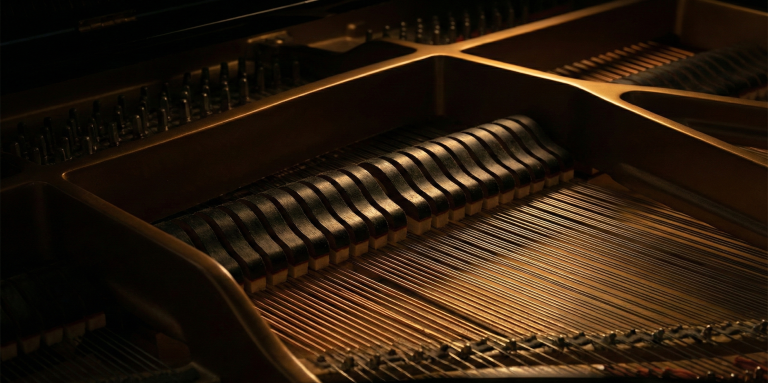
When a pianist strikes a key, a complex series of levers (the “action”) accelerates a hammer toward the strings. Crucially, the hammer is “thrown” at the strings; it is not in direct contact with the key at the moment of impact. This means that once the hammer is in motion, its speed, and thus the resulting volume, is determined entirely by the velocity of the initial key strike.
Sympathetic Resonance and Tone Enrichment
When multiple notes are played together, the piano’s soundboard facilitates “sympathetic resonance”. Strings that are not being struck will vibrate in harmony with the notes being played if their natural frequencies match the harmonics of those notes. This effect is most pronounced when using the sustain pedal, which lifts all dampers and allows the entire instrument to act as a single resonant body. This resonance enriches the tone, making a forte sound “warmer” and “deeper” rather than just louder.
The Three-Pedal System
The pedals are the pianist’s primary tools for manipulating dynamic and timbral range beyond the keyboard itself.
- Sustain (Damper) Pedal (Right): The most commonly used pedal. It lifts all dampers off the strings, allowing notes to continue sounding after the keys are released. This creates the “legato” effect and enriches the sound through resonance.
- Soft (Una Corda) Pedal (Left): On a grand piano, this shifts the entire action to the right, so the hammers strike fewer strings (two instead of three) for each note. This reduces volume and creates a “muted” or “ethereal” timbre. On upright pianos, it simply moves hammers closer to strings, reducing striking force.
- Sostenuto Pedal (Middle): A “selective” sustain pedal. It holds up only the dampers of notes already being played when the pedal is depressed, allowing subsequent notes to remain clean and detached. This is essential for sustaining long bass notes while playing complex, staccato upper-voice figures.
Advanced Pedaling Techniques
- Legato (Delayed) Pedaling: Depressing the pedal a split-second after the note is played and releasing it exactly as the next note is struck. This connects harmonies without a “muddy” overlap.
- Half-Pedaling: Partially depressing the sustain pedal so the dampers only lightly touch the strings. This technique, used in works like Beethoven’s Moonlight Sonata, provides a lingering resonance while maintaining harmonic clarity.
- Flutter Pedaling: Rapid, partial releases of the pedal to “clear” some of the sound without losing the resonant quality.
6. Advanced Pedagogical Strategies for Dynamic Control
Mastering dynamics requires a transition from mechanical playing to “intentional” physical movement. Educators must address the psychological and physiological aspects of performance to help students achieve professional-grade expression.
The Arm Weight Methodology
One of the most significant advancements in modern piano pedagogy is the “Arm Weight” school. This approach emphasizes utilizing the natural weight of the arm and gravity rather than just finger strength.
- The “Heavy Ropes” Visualization: Students are taught to imagine their arms as heavy, wet ropes hanging from their shoulders. This relaxation allows for a deeper, more resonant forte and prevents the “thin,” harsh sound produced by tense finger-only playing.
- Tai Chi Walking: A technique of “transferring” weight from one finger to another, similar to the balance found in Tai Chi movements. This ensures that every note in a phrase is supported by the arm’s mass, leading to a “singing tone” even in soft passages.
Melodic Voicing and Finger Independence
In a complex musical texture, the pianist must often play multiple notes with the same hand at different dynamic levels. This is known as “voicing”.
- Solo Melody Practice: An effective pedagogical method is to have the student play the melody line alone with the right hand, focusing on shaping the phrase with crescendos and decrescendos. Once the expressive shape is established, the left-hand accompaniment is added as a quiet, background “ghost” voice.
- Finger Velocity Variation: Exercises like playing a three-note chord where only one specific finger strikes with force while the others “whisper” help develop the extreme finger independence required for professional voicing.
Mental Visualization and Narrative
Dynamics are often more effectively taught through metaphor than technical measurement.
- Setting the Scene: A teacher might ask a student to imagine a “sleeping baby” for pianissimo or an “outside field day voice” for fortissimo.
- The Narrative Arc: Professional performers often assign a “story” or emotional narrative to a piece, where dynamic peaks represent the climax of the story and decrescendos represent a resolution or peace. This internal visualization ensures that dynamic changes feel “organic” rather than forced.
7. Structural Analysis: Dynamics as an Interpretive Roadmap
In formal music theory, dynamics are not arbitrary; they are deeply tied to the harmonic and structural foundations of the work.
Highlighting Cadences and Climaxes
A “Cadence” is the conclusion of a musical phrase, typically moving from a chord of tension (Dominant, V) to a chord of rest (Tonic, I). A Perfect Authentic Cadence (PAC) is often highlighted by a structural dynamic peak followed by a resolution. Conversely, a Deceptive Cadence, where the Dominant resolves to an unexpected chord like the Submediant (vi), is frequently marked by a sudden, surprising dynamic shift, such as a subito piano, to reflect the harmonic “twist”.
The Leading Tone and Melodic Motion
The “Leading Tone” (the 7th scale degree) has an inherent psychological pull toward the Tonic. Performers use dynamics to emphasize this pull, often applying a slight crescendo as the melody ascends toward the Tonic to increase the tension before the eventual resolution.
| Scale Degree | Theoretical Name | Dynamic Tendency |
| 1st | Tonic | Stable, arrival point |
| 4th | Subdominant | Preparation, beginning of swell |
| 5th | Dominant | High tension, structural peak |
| 7th | Leading Tone | Maximum tension, requires accent |
8. Pedagogical Standards and Assessments
Dynamics are a core component of standardized piano examinations worldwide. Understanding these levels is essential for students in diverse markets.
ABRSM and RCM Frameworks
- Beginner Levels (Grades 1-3): Students are expected to demonstrate basic contrast between piano and forte.
- Intermediate Levels (Grades 4-6): Assessment focuses on the ability to execute smooth crescendos and diminuendos, as well as basic melodic voicing.
- Advanced Levels (Grades 7-8/Diploma): Professional-level control is required, including complex “pedal dynamics,” sophisticated voicing of multi-layered textures, and a high degree of “interpretive authority” where dynamic choices support a deep analytical understanding of the work.
Regional Nuances
While the Italian terminology is universal, regional pedagogical styles vary. The “Russian School,” often influential in Asia and Eastern Europe, focuses heavily on “delayed pedaling” and “arm weight” from the earliest stages of training. In contrast, some North American and UK methodologies place a high priority on early “technical precision” and “metronomic stability” before introducing more subjective expressive elements.
Recommended Equipment
Top-Tier Digital Pianos (Market Leaders)
For students and professionals where an acoustic piano is unavailable, these models provide the most realistic “action” and dynamic response.
- Yamaha Arius YDP-145B: Engineered for technical development, the Graded Hammer Standard (GHS) action provides the essential physical feedback required to translate digital practice to an acoustic stage. Its weighted response allows for a high degree of expressive nuance, giving the pianist total command over hammer velocity to bring out the subtle dynamics and emotional depth of any composition.
As an Amazon Associate I earn from qualifying purchases.
- Alesis Recital Pro: A robust option for intermediate players, featuring fully weighted keys that require significant physical engagement to produce a forte sound, thereby building finger independence.
As an Amazon Associate I earn from qualifying purchases.
Precision Metronomes for Temporal Dynamics
A metronome is not just for keeping time; it is a tool for practicing “temporal dynamics,” such as rubato (stolen time).
- Wittner Taktell Metronome: A classic mechanical metronome that provides a visual pendulum motion, helping students anticipate the beat and time their dynamic swells correctly.
As an Amazon Associate I earn from qualifying purchases.
- Korg TM-60: A reliable, compact digital metronome, highly rated for its accuracy in the global market.
As an Amazon Associate I earn from qualifying purchases.
Ergonomic Seating and Posture Support
Dynamic power comes from the core of the body, making the bench a critical piece of equipment.
- Roland Adjustable Piano Bench: The industry standard. Its mechanism allows for precise height adjustments to ensure the arms are at the perfect 90-degree angle for weight transfer.
As an Amazon Associate I earn from qualifying purchases.
- Roland RPB-500: A high-quality adjustable bench with storage, specifically designed to match the height requirements of modern digital and acoustic uprights.
As an Amazon Associate I earn from qualifying purchases.
Conclusion
Dynamics are the bridge between the technical execution of music and the emotional communication of art. By mastering the physical mechanics of velocity and weight, understanding the historical context of your repertoire, and developing an acute “inner ear,” you can transform your piano playing into a vivid narrative. Remember that dynamics are relative; a forte only sounds powerful if the piano before it was sufficiently quiet.
For the modern pianist, every crescendo is a structural gesture, and every pianissimo is a communicative choice. By integrating advanced techniques like arm weight and melodic voicing, and by utilizing the full mechanical potential of the three-pedal system, the musician transforms a series of static notations into a living, breathing emotional experience. The path to expressive excellence lies in the relentless pursuit of dynamic contrast, the sensitive interpretation of harmonic tension, and the intentional use of the instrument to move the human soul.
I recommend recording your practice sessions frequently. Often, what we feel we are playing dynamically does not translate as clearly to the listener. Listening back will help you realize if your crescendos are too sudden or if your melodies need more “air” to breathe. Embrace the full spectrum of your instrument, and let the volume of your playing tell the story that words cannot.
Why are most dynamic and tempo markings written in Italian?
The piano was invented in Italy by Bartolomeo Cristofori around 1700. Because Italy was the center of musical innovation during the instrument’s early development, the terminology of the Italian language became the international standard for notation, a tradition that continues in the modern global market.
Is there an absolute volume (in decibels) for a forte or piano marking?
No, dynamic markings are strictly relative. A piano marking simply indicates that a passage should be significantly quieter than a forte passage within the same piece. The actual decibel level depends on the room’s acoustics, the size of the piano, and the performer’s interpretation of the work’s emotional scale.
How does the “Soft Pedal” (Una Corda) change more than just the volume?
On a grand piano, the soft pedal shifts the hammer mechanism so that it strikes fewer strings per note. This not only reduces the amplitude but also changes the timbre, creating a more “muted,” “ethereal,” and “veiled” sound quality compared to playing quietly with the fingers alone.
What is the most effective way to improve my dynamic range at home?
Recording yourself is essential. The performer’s perception of volume is often skewed by the physical proximity of the instrument. Listening back to a high-quality recording frequently reveals that your “louds” are not powerful enough and your “softs” are not delicate enough.
Can I use the sustain pedal to hide a lack of dynamic control?
This is a common pedagogical pitfall. Over-pedaling creates a “muddy” sound that masks finger technique. Professional instructors recommend learning a piece without the pedal first to ensure that the fingers are achieving the correct dynamic contrast through pressure and velocity alone.
Why do higher notes on the piano often seem louder than bass notes?
This is due to the “equal-loudness contour” of human hearing. Our ears are naturally more sensitive to the 2,500 Hz to 5,000 Hz range. Consequently, bass frequencies require more physical energy and higher amplitude to be perceived as equal in volume to trebles.