As an Amazon Associate, PianoMode earns from qualifying purchases. Recommendations are made on their merits; the price you pay is the same.
I’ve always believed that musical ability was mostly about rhythm, ear training, and reading notes. But within my first few weeks of practice, I began to notice stiffness, fatigue, and an overall weakness in my hands that I hadn’t expected. It didn’t take long for me to realize that one of the biggest barriers to progress wasn’t a lack of talent : it was a lack of finger strength.
The transition from a casual player to a proficient pianist is often blocked by a physical wall. You have the musical ideas, you understand the rhythm, and you can read the score, but your fingers simply refuse to cooperate. They feel heavy, “stuck” together, or lack the power to produce a consistent tone.
In the world of professional piano pedagogy, Finger Strength is a technical misnomer. It is actually a combination of Finger Independence, Neurological Control, and Muscular Endurance. This guide is designed to deconstruct the physical mechanics of piano playing and provide a comprehensive roadmap to total technical freedom.
What is the fastest way to build piano finger strength?
The most effective way to build finger strength is through slow, high-lift deliberate practice combined with Finger Independence exercises. Rather than focusing on “squeezing” harder, a pianist must train the brain to isolate the individual movement of each tendon while maintaining a relaxed wrist. This is achieved through technical studies like Hanon, the practice of scales in varying rhythms, and maintaining a curved hand position that utilizes arm weight rather than pure muscle force.
1. The Harmony Foundation: Why Classical Matters for Pop
Before we touch the physical exercises, we must address the mental framework. A common question among modern players is whether learning classical theory is relevant to pop music.
Definition: Classical Harmony is the study of how chords are constructed and how they move from one to another based on centuries of Western musical tradition.
The “Rules” as a Creative Launchpad
Pop harmony is essentially a simplified version of tonal harmony. While a pop song might rely on a simple I – V – vi – IV progression, understanding the classical “Rules of Engagement” allows you to:
- Improve Voice Leading: This makes your chord transitions sound smooth and professional rather than jumpy.
- Understand Tension and Release: Knowing how a Dominant Seventh Chord naturally wants to resolve to the Tonic gives you the power to subvert expectations.
- Physical Memory: Classical patterns like the Alberti Bass or complex arpeggios are the DNA of piano music. Learning them builds the very finger strength required for complex pop arrangements.
Expert Authority Note: To break the rules effectively, you must first master them. Pop stars who claim they “don’t know theory” usually have a natural, intuitive grasp of these classical structures. Learning the theory officially speeds up that process by years.
Pop harmony is essentially a high-yield version of tonal harmony. While a modern track might rely on a repetitive four-chord loop, understanding the classical “Rules of Engagement” allows you to break out of the “bedroom producer” sound and into professional arrangement.
The Mechanics of Fluidity: Voice Leading and Tension
Definition: Voice Leading is the linear movement of individual musical lines (voices) as they transition from one chord to the next.
In classical training, we learn that chords aren’t just blocks of sound moving up and down the keyboard. They are a collection of independent voices. By applying classical voice leading to pop:
- Seamless Transitions: You avoid the “choppy” sound of jumping positions. Keeping common tones between chords makes a progression feel inevitable and professional.
- The Power of Resolution: Knowing that a Leading Tone (the 7th degree of a scale) desperately wants to resolve to the Tonic allows you to create emotional “payoffs” in a chorus that a purely intuitive player might miss.
The Architecture of “Earworms”: Motifs and Sequences
Definition: A Sequence is a melodic or harmonic pattern that is repeated at a higher or lower pitch, a technique pioneered by Baroque and Classical masters to create structural unity.
If you analyze the most successful pop hooks, you’ll find they are rarely random. They rely on classical development techniques:
- Motivic Development: Classical theory teaches you how to take a tiny three-note idea (a motif) and expand it. This is exactly how “hooks” are built.
- Harmonic Sequences: Using a “Circle of Fifths” sequence (a staple of Vivaldi and Bach) provides a sense of journey and return. When you hear a sophisticated bridge in a Taylor Swift or Ariana Grande song, you are often hearing a hidden classical sequence providing the emotional momentum.
- Secondary Dominants: This is the “secret sauce” of 1960s pop (The Beatles, Beach Boys) and modern jazz-pop. By using a “Dominant of the Dominant” (V/V), you introduce temporary chromaticism that adds a “expensive” or “soulful” flavor to a standard progression.
Physical Memory: The DNA of the Keyboard
Classical patterns like the Alberti Bass or complex 16th-note arpeggios are the DNA of piano music. Learning them builds the very finger strength and Polyphonic Independence (the ability to play different rhythms in each hand) required for complex pop arrangements.
Expert Authority Note: To break the rules effectively, you must first master them. Pop stars who claim they “don’t know theory” usually have a natural, intuitive grasp of these classical structures. Learning the theory officially speeds up that process by years, turning “happy accidents” into a repeatable, professional workflow.
2. Anatomy of the Pianist’s Hand: The Mechanics of Power
To build strength, you must understand the machinery you are training. Interestingly, the hand does not have muscles inside the fingers; they are moved by tendons connected to muscles in the forearm.
The Bridge of the Hand
The primary knuckles—where the fingers meet the palm, should be thought of as a “Suspension Bridge.” If this bridge collapses or flattens, the power from your arm cannot reach the key.
- The Extensors: Muscles on the top of your forearm that lift the fingers. These are usually the weakest link.
- The Flexors: Muscles on the bottom of your forearm that pull the fingers down. These are naturally stronger but prone to tension.
The 4th Finger Dilemma
The 4th finger (the ring finger) is anatomically tied to the 3rd and 5th fingers by a shared tendon called the extensor digitorum communis. This is why lifting the 4th finger independently feels physically impossible. Strength training for piano is largely the process of creating “neurological bypasses” to work around this anatomical link.
Build strong hands :
As an Amazon Associate I earn from qualifying purchases.
3. The Technical Trio: Hanon, Czerny, and Cortot
If you are serious about technique, you must look at the masters who defined the standard for the modern pianist.
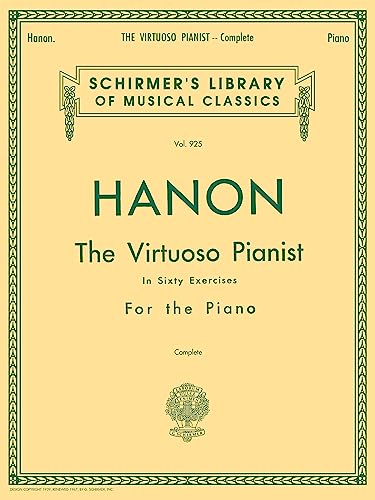
A. Charles-Louis Hanon: The Virtuoso Pianist
Hanon’s exercises focus on five-finger patterns that repeat across the keyboard.
- The Goal: Equality of the fingers and velocity.
- The Method: Start with the first 20 exercises. Play them slowly with a “High Lift”—lifting each finger high before striking the key.
- The Benefit: It builds the endurance needed for long performances and high-speed runs.
 Kindle editionRead on Kindle ›
As an Amazon Associate I earn from qualifying purchases.
B. Carl Czerny: The Bridge to Artistry
Czerny was a student of Beethoven and a teacher of Franz Liszt. His etudes are more musical than Hanon’s mechanical drills.
- The School of Velocity (Op. 299): Focuses on speed and scale passages.
- The Art of Finger Dexterity (Op. 740): Advanced training for the professional level.
 Kindle editionRead on Kindle ›
As an Amazon Associate I earn from qualifying purchases.
C. Alfred Cortot: The Rational Principles
Cortot’s method is for those who want to solve specific technical problems through “Isometrics.” He breaks down piano playing into five categories:
- Equality, independence, and mobility of fingers.
- Passing of the thumb (Scales and Arpeggios).
- Double notes and polyphonic playing.
- Extensions (Chords and wide intervals).
- Wrist technique and execution of octaves.
4. Essential Drills for Finger Independence
The “Glued Fingers” Exercise (Cortot Style)
This is the single most effective exercise for independence:
- Place your right hand on C, D, E, F, G.
- Hold down (depress) all five keys silently.
- While holding 1, 2, 4, and 5 down, lift the 3rd finger and strike the key 10 times with a steady beat.
- Repeat with each finger.
- Important: The 4th finger will barely move. Do not force it to the point of pain; focus on the attempt to lift.
Rhythmic Variation (The “Dotted” Method)
When practicing a scale or a Hanon exercise, change the rhythm to “rewire” your brain’s motor cortex:
- Long-Short: A dotted eighth note followed by a sixteenth note.
- Short-Long: A sixteenth note followed by a dotted eighth note.This forces the fingers to “fire” quickly and then immediately relax, which is the secret to playing fast without fatigue.
5. Off-Piano Recommendations
While the piano bench is your primary training ground, you can supplement your growth away from the keys.
Isometric Table Tapping
Sit at a desk and place your hand in a playing position. Practice lifting one finger at a time while keeping the others absolutely still and relaxed. This isolates the extensor muscles without the resistance of the piano action.
Hand Exercisers: A Word of Caution
You will see “Grip Strengtheners” marketed to musicians. You must be selective. Heavy “crush” grippers used by athletes will make your hands stiff and ruin your sensitivity.
As an Amazon Associate I earn from qualifying purchases.
6. Mastering the “Weak” Fingers (4 & 5)
The 4th and 5th fingers are naturally the weakest. To strengthen them, you must use the “Weight Shift” method:
- Trill Exercises: Practice trilling between fingers 4 and 5 for 30 seconds every day.
- Lateral Support: Ensure that when you play with the 5th finger, your wrist pivots slightly toward it to provide the support of the whole arm.
- Stability: The outer edge of the hand must be strong. Practice playing octaves where the 5th finger stays firm and does not “collapse” at the joint upon impact.
7. Comparison Table: Technical Tools and Their Benefits
| Tool / Method | Best For | Difficulty Level |
| Hanon Exercises | Finger Equality & Endurance | Beginner to Intermediate |
| Scales & Arpeggios | Keyboard Geography & Speed | All Levels |
| Cortot Isometrics | Pure Independence | Advanced |
| Mechanical Metronome | Timing & Structural Strength | Essential (All Levels) |
| Slow Practice | Neurological Accuracy | The Secret to Mastery |
8. Safety, Rest, and Long-Term Health
Building strength is a physiological process. If you push too hard, you will cause inflammation of the tendons.
The Signs of Danger
- Sharp pain in the wrist or top of the hand.
- Numbness or tingling in the fingertips (possible nerve compression).
- Persistent stiffness that doesn’t go away after a 5-minute warm-up.
The Recovery Protocol
- Warm-up: Always start with gentle scales or five-finger patterns at a soft volume.
- Stretching: Gently stretch your forearms by pulling your fingers back toward your elbow.
- Hydration: Tendons require hydration to glide smoothly through their sheaths.
As an Amazon Associate I earn from qualifying purchases.
A high-quality metronome is a pianist’s best friend. It prevents you from rushing through difficult passages where you lack strength, ensuring that every finger develops at the same rate.
Conclusion: The Path to Mastery
Building finger strength for the piano is not about “working out” in the traditional sense. It is about refining the communication between your brain and your fingertips. By combining the rigorous logic of classical harmony with the physical disciplines of Hanon and Cortot, you unlock a level of expression that was previously impossible.
Be patient. Strength and independence are built in millimeters, not miles. Stay consistent, listen to your body, and enjoy the feeling of your fingers finally becoming the obedient servants of your musical imagination.
Next Step: Choose one Hanon exercise today. Play it at 60 BPM, lifting each finger high and clear. Do this for 5 minutes. Your journey to virtuosity has begun.
How do I improve the independence of my 4th finger?
To improve 4th finger independence, you must focus on “neurological bypasses” rather than physical force. Because the 4th finger (ring finger) shares a tendon with the 3rd and 5th, it is anatomically restricted. The most effective way to train it is through isolation exercises, such as holding down surrounding keys while lifting only the 4th finger, and practicing slow trills. This trains the brain to send specific motor signals to that finger, gradually overcoming its natural dependency on the rest of the hand.
Is practicing Hanon exercises really necessary for modern piano players?
Yes, Hanon exercises remain a fundamental tool for building the muscular endurance and finger equality required for both classical and modern piano. While some find them mechanical, their value lies in the repetition of five-finger patterns across all keys. When practiced with a “High Lift” technique, Hanon drills build the “physical vocabulary” needed to execute fast runs and consistent dynamics in pop, jazz, and classical arrangements alike.
How can I build finger strength without causing injury or tendonitis?
The secret to safe strength building is using “arm weight” and maintaining a relaxed wrist at all times. You should never rely solely on the small muscles of the fingers. Instead, ensure your knuckles (the “bridge”) remain firm while your forearm and wrist stay loose. Always start your session with a 5-minute gentle warm-up, stay hydrated to keep tendons gliding smoothly, and stop immediately if you feel sharp pain, numbness, or persistent tingling.
Can hand exercisers or “grip strengtheners” improve my piano playing?
Most generic grip strengtheners should be used with extreme caution, as they can lead to hand stiffness and a loss of sensitivity. Piano playing requires dexterity and independence, not “crushing” power. If you choose to use a gadget, opt for a light-tension adjustable exerciser like the Varigrip, which allows you to isolate individual fingers. However, “off-piano” isometric tapping on a flat surface is often safer and more effective for developing the specific extensor muscles used in playing.
How long does it take to see a noticeable difference in finger strength?
With consistent daily practice of 10–15 minutes of technical drills, most students see significant improvements in control and endurance within 4 to 6 weeks. Real “strength” in piano is a combination of neurological adaptation and muscular development. You will first notice that your fingers feel “lighter” and more obedient during scales, followed by an increased ability to play for longer periods without the forearm feeling heavy or fatigued.