Few pieces sound as much like an improvisation caught on paper as Mozart’s Fantasia in D minor. It opens with a hesitant, rolling sequence of arpeggios that seems to feel its way through the dark, moves into a lamenting slow section and bursts of agitation, and then turns suddenly to a bright D major. Pianists love it because it asks for imagination as much as technique, and listeners love it because its mood changes so quickly and so convincingly.
The piece also has one of the most interesting stories in the piano repertoire. Mozart’s manuscript is lost, and the work reached print only after his death, in 1804, in a version that stops on an unresolved chord. The cheerful ending that most pianists play today appeared in a later Leipzig print in 1806 and is believed to be by another musician, probably August Eberhard Müller. Nobody knows when or why Mozart wrote the music: the usual date of 1782 rests on style, not on documents.
That history shapes how the piece should be studied. Because no autograph survives, the dynamics, articulation and pedalling in any edition come from early prints and editorial decisions, and you face a real interpretive choice about the ending. The notes themselves are within reach of a well-prepared intermediate pianist. The harder task is musical: shaping free, improvisatory writing so that it sounds spontaneous and controlled at the same time.
Mozart’s Fantasia in D minor, K. 397 (385g), is a single-movement fantasia for solo piano of about 107 measures, lasting roughly five to seven minutes. It moves from an arpeggiated Andante through an expressive Adagio and a Presto passage to an Allegretto in D major. The first edition of 1804 breaks off at measure 97, and the last ten measures come from the 1806 print. The composition is in the public domain, and free scans of historical editions are available on IMSLP.
This guide explains the history of the work and its composer, the structure and harmony of its three broad parts, a section-by-section analysis, the technical challenges, the question of tempo, and a realistic four week practice method. It also helps you choose between the available editions and the two possible endings.
About Fantasia in D Minor, K. 397 (385g)
Composer: Wolfgang Amadeus Mozart (1756-1791)
Work: Fantasia in D minor, K. 397 (385g)
Composed: Usually dated 1782, without documentary proof
First published: 1804 (fragment), 1806 (with ending)
Key: D minor, closing in D major
Tempo markings: Andante, Adagio, Presto, Allegretto
Form: Free fantasia in three broad parts
Length: About 107 measures, 5 to 7 minutes
Level: Intermediate
Main challenges: Arpeggios, chromatic lines, cadenza scales, pacing
1. History of the Sheet and the Composer Behind It
Mozart in Vienna
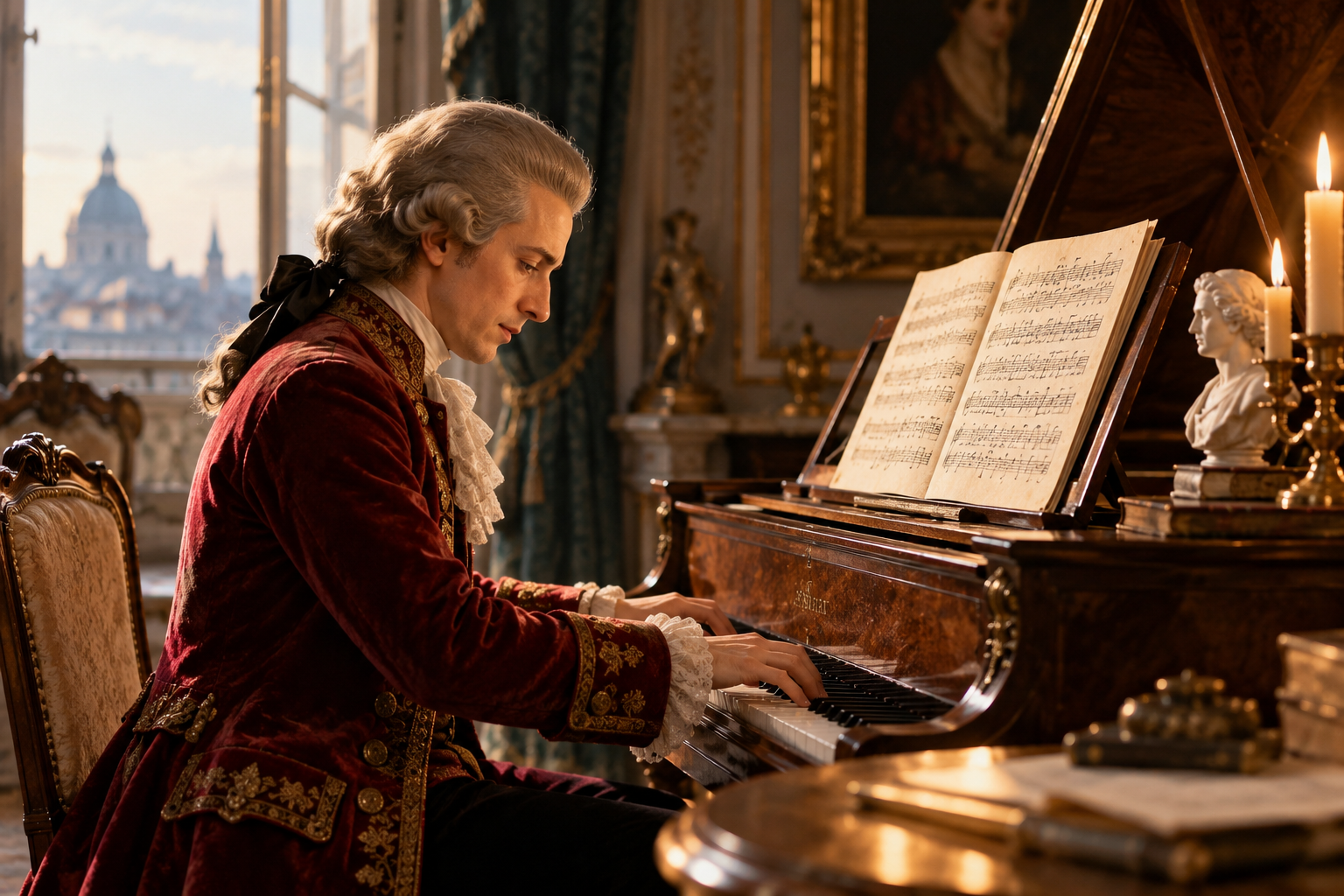
Wolfgang Amadeus Mozart was born in Salzburg on 27 January 1756 and died in Vienna on 5 December 1791, at the age of 35. After years of travelling and a difficult relationship with his employer in Salzburg, he left for Vienna in 1781 and began a career as a freelance musician. He gave piano lessons, played in concerts and composed for a range of clients, and in 1782 he married Constanze Weber. The Fantasia in D minor is traditionally placed in these first Viennese years.
Mozart was a pianist as well as a composer, and the keyboard was central to his public life in Vienna. His piano works include concertos, sonatas, variation sets and a small number of free-standing pieces. Among the latter are three fantasias for solo piano, K. 396, K. 397 and K. 475, and the D minor Fantasia is the one whose origins are most obscure.
A Fantasia Without a Manuscript
The preface to the Henle edition states plainly that nothing is known about when or why the D minor Fantasia was written. Mozart’s autograph is lost, and the work most likely remained a fragment among his papers after his death. Even Mozart’s sister was surprised by it: after receiving the published work in the Breitkopf & Härtel Œuvres Complettes, she wrote to the publisher on 30 April 1807 that the fantasia was completely unknown to her.
The piece appeared in print in two stages. The first edition of 1804 is incomplete, breaking off at measure 97 with a fermata on a dominant seventh chord. According to the PTNA Piano Music Encyclopedia, that edition carried an inscription describing it as a fantasia serving as an introduction, a detached piece. The ending familiar today appeared in a later Leipzig print in 1806.
The date of 1782 is a convention. Henle explains that it rests on the style of the music and on Mozart’s liking for the fantasia or prelude genre at that time, and adds that there is no positive evidence for it. The Wiener Urtext edition describes the piece as a mature work from Mozart’s Vienna years, which is consistent with, but does not prove, the traditional date.
The Ending and Its Probable Author
The last ten measures, in D major, are not believed to be by Mozart. The Bärenreiter preface says it can safely be assumed that another hand added them, most likely August Eberhard Müller (1767-1817), at the time cantor of the Thomaskirche in Leipzig. Henle likewise calls him the probable author. In other words, the ending is a plausible and effective completion, but its authorship is an inference and not a documented fact.
The Wiener Urtext edition goes further and observes that Mozart’s version, as documented in the first edition, ends ten bars earlier on a dominant seventh chord, leaving the way open for continuation. Its editors suggest it is conceivable that the Fantasia was originally written as an introduction to a sonata in D major, and they name the late Sonata K. 576 as a possibility. This is a hypothesis and not an established fact. PTNA makes a related point: the piece may have served as a prelude to another work, such as a sonata or a fugue, in the way that Mozart’s Fantasia in C minor, K. 475, is paired with a sonata.
Some pianists decline Müller’s ending. Mitsuko Uchida, for example, has recorded the piece with an ending of her own that returns to D minor and the arpeggios of the opening. Whichever ending you choose, it helps to know that the choice exists.
2. Musical Structure and Theory
A Free Form in Three Broad Parts
A fantasia is a free, improvisatory piece, so it does not follow a fixed form such as sonata form or rondo. The PTNA encyclopedia describes the D minor Fantasia as consisting of three main parts: an introductory Andante, a central expressive section built from the Adagio and the Presto, and a concluding Allegretto in D major. The Adagio and Presto are heard more than once before the Allegretto begins.
| Part | Character | What it asks of the pianist |
|---|---|---|
| Andante | Arpeggiated chords in both hands, improvisatory and searching | Even arpeggios, resonant bass, a sense of wandering that never loses its pulse |
| Adagio and Presto | A lamenting, chromatic Adagio with rests, answered by a Presto that ends in descending figuration | Voice leading, silence, controlled urgency, a light and even cadenza |
| Allegretto | Bright D major, compared by one analyst to an operatic finale | A lighter touch, clear melody, and a decision about the ending |
Harmony and Chromaticism
The Andante is built mainly on the simple harmonies of the tonic, subdominant and dominant. What gives it colour is the occasional use of borrowed chords at the ends of phrases, which means chords that belong to a neighbouring key. These chords bring brief changes of light and shadow into an otherwise plain harmonic landscape.
The Adagio is more chromatic. Chromaticism means that notes move by semitones and that notes outside the home key colour the harmony, and here it combines with frequent rests to create a growing sense of urgency. The piece’s emotional power comes less from complexity than from the way these chromatic lines are placed and paced.
Unity in a Free Form
Although the piece changes character repeatedly, it is not a collection of unrelated sections. The PTNA analysis points out that the melodic figures of the Allegretto can be heard as a development of figures from the Adagio. This relationship helps explain why the abrupt move from lament to brightness does not sound arbitrary, and it is a useful idea to keep in mind when you shape the transition.
3. Section by Section Analysis
This analysis describes the music by character and position, so that it applies to any good edition. When you have your own score, mark the beginning of each part and note where your edition prints tempo changes.
The Andante: The Arpeggio Opening
The Fantasia begins with arpeggiated chords played by both hands, an opening that PTNA describes as improvisatory, as if wandering in search of something. The task is to make the figures sound free while the underlying pulse remains steady. Evenness and tone matter more than speed, because any unevenness is exposed in such a transparent texture.
Be aware that editions differ in small details of the opening. The Bärenreiter edition, for example, states that its editors have added ties to the bass notes in the first bars. Compare your edition with others before you decide how long to sustain the bass notes.
Practice focus: Play the arpeggios slowly with no pedal, listening for an even sound and a clear bass, then add pedal sparingly to connect the harmonies.
The Adagio: The Lament
The Adagio changes the mood completely. PTNA likens it to a lamenting arietta, a small song, in which chromaticism and rests gradually intensify the feeling of urgency. The rests are as important as the notes: they are moments of suspended breath and should be counted and felt, not skipped.
Think of the Adagio as vocal music. Decide where each phrase begins, where it leans and where it releases, and shape the chromatic lines so that each semitone step is audible.
Practice focus: Sing or hum the melodic line, then play it with the same sense of breath, and practise the rests as deliberately as the notes.
The Presto: The Cadenza Flash
The Presto interrupts the Adagio with fast figuration and culminates in a descending cadenza-like passage, according to PTNA. These passages are scale-like and so are not technically extreme, but they expose any unevenness of finger work and any tendency to rush.
Treat the Presto as a moment of release, not as a race. A light, even tone and a clear sense of direction are more convincing than raw speed.
Practice focus: Practise the descending figures slowly with a metronome, in small groups of notes, and then connect the groups without accelerating.
The Return of the Slow Material
After the first Adagio and Presto, the slow material returns and the Presto is heard again before the Allegretto begins. The repetition is not a copy. The second time, the music has already been through its crisis, and the Adagio can sound more resigned, more intense, or simply more inward, depending on your reading.
Practice focus: Record both statements of the Adagio and listen for differences in tone and tempo. Make a deliberate choice about how the second statement should differ.
The Allegretto: D Major and the Ending
The Allegretto in D major is the largest change of character in the piece. PTNA describes a section reminiscent of an operatic finale and completely different from what came before, although its melodic figures are related to those of the Adagio. A lighter, clearer touch suits it.
This is also where the question of the ending arises. In the first edition of 1804, Mozart’s version stops shortly after the D major section begins, on an unstable chord. In the familiar version, the Allegretto continues with the added ten measures, and the piece closes with a cadenza and a forceful conclusion in D major, as described in Joseph DuBose’s program note.
Practice focus: Learn the Allegretto at a lighter dynamic than the preceding Adagio suggests, then decide on your ending and rehearse the connection into it.
4. Technical Challenges
Evenness in the arpeggios. The Andante depends on arpeggiated chords in both hands. Small differences of speed or weight between the notes are immediately audible, so slow, even practice is essential.
Chromatic voice leading. In the Adagio, semitone steps need to be shaped as lines. A pianist who plays every note with the same weight will flatten the harmony.
Rests and silence. The rests in the Adagio are part of the expression. Rushing through them dissolves the sense of urgency that the piece depends on.
Scale-like cadenzas. The Presto passages are not technically extreme, but they are exposed. An uneven finger or a rushed ending will be audible.
Changes of tempo and character. The piece moves from Andante to Adagio, Presto and Allegretto. Making these transitions convincing, without sounding like separate pieces, is the largest musical challenge.
Pedalling. Too much pedal blurs the arpeggios and the chromatic lines. Pedal markings vary between editions, so check how yours handles them and treat them as suggestions.
Memory and structure. A free form is harder to memorise than a sonata, because it has fewer predictable patterns. Mapping the sections and their transitions helps.
5. Choosing the Right Tempo
The piece has no single tempo. Its markings are Andante, Adagio, Presto and Allegretto: Andante means a flowing, walking pace, Adagio a slow and expressive one, Presto very fast, and Allegretto moderately fast and lighter than Allegro. None of the sources I consulted gives a metronome number, and the correct speed depends on the relationships between the sections more than on any absolute figure.
Performances vary. The PTNA encyclopedia lists a total playing time of 6 minutes 30 seconds, and the recordings it links last from about five and a half to seven minutes. As a guide, a complete performance usually falls between five and seven minutes, depending on tempo and on the ending used.
Choose the Andante first, at a speed where the arpeggios sound free but even. Then set the Adagio, which should feel clearly slower and more inward, and the Presto, which should be fast enough to feel like a release but slow enough to keep the descending passages clean. Finally, judge the Allegretto against the others: it should feel brighter, not rushed. Revisit all four choices after hearing the piece as a whole.
6. How to Practice the Piece
Map the Piece First
Mark the beginning of the Andante, the Adagio, the Presto, the return of the slow material and the Allegretto in your score. Write the tempo markings above them. A clear map makes a free-form piece far easier to learn and to memorise.
Learn Each Part as a Small Piece
Practise each part on its own until it is secure, then connect two parts at a time. The transitions deserve separate attention, because the character changes there and the risk of hesitation or rushing is highest.
Use a Layered Approach for Thicker Textures
Where several voices sound together, play the melody alone first, then the bass, then both together, and finally add the inner notes at a softer level. This approach is especially useful in the Adagio, where the voice leading carries the expression.
Listen to Different Interpretations
Listen to at least three recordings, including one that uses a different ending if you can find it. Notice differences in tempo, rubato, pedalling and in the length of the pauses. Use them to sharpen your own ideas, not to copy.
7. A Four Week Practice Method
This plan is a framework and not a promise. The time needed depends on reading ability, prior experience with Classical style and the amount of focused practice available.
Week 1: Reading and Fingering
Objective: Learn the notes of the Andante and the Adagio, and settle on comfortable fingering and a pedalling plan.
Read the score slowly and mark the sections. Learn the arpeggios of the Andante hands separately and then together at a slow tempo, and learn the Adagio as a line before adding the full texture.
Practical tasks:
- Learn the Andante hands separately, then together.
- Learn the Adagio melody and bass, then the inner voices.
- Mark fingering for the arpeggios and the chromatic passages.
- Check how your edition treats the opening bass notes.
What to listen for: Even arpeggios, a clear bass, and chromatic steps that are audible as lines.
Milestone: Play the Andante and the Adagio slowly with reliable notes.
Week 2: Coordination and Structure
Objective: Learn the Presto passages and connect the Andante, Adagio and Presto.
Practise the Presto figuration in small groups and then in longer phrases, always at a tempo where the notes stay even. Join the Adagio and the Presto and rehearse the return of the slow material.
Practical tasks:
- Practise the descending Presto figures slowly with a metronome.
- Connect the Adagio to the Presto and back.
- Rehearse the transitions separately.
- Rest deliberately where the score has rests.
What to listen for: Even scales, a controlled end to each Presto passage, and a convincing return to the slow tempo.
Milestone: Play from the beginning through the second Presto slowly, without frequent stops.
Week 3: Technique and Interpretation
Objective: Learn the Allegretto, choose an ending, and refine tone and pedalling.
Learn the Allegretto and rehearse the transition into it. Decide whether to play the traditional ending or an alternative, and practise the chosen version until it feels natural.
Practical tasks:
- Learn the Allegretto hands separately and together.
- Rehearse the move from the final Presto into the Allegretto.
- Practise the chosen ending several times.
- Refine pedal changes so that the arpeggios and chromatic lines stay clear.
What to listen for: A lighter touch in the Allegretto, a clean transition, and an ending that feels like a deliberate decision.
Milestone: Play the complete piece slowly with a clear plan for each section.
Week 4: Performance and Refinement
Objective: Consolidate the interpretation and play with continuity.
Review the passages that remain uncertain, then play the piece from beginning to end several times. Record one performance and listen to it away from the keyboard.
Practical tasks:
- Play the complete piece without stopping.
- Record and assess the balance between the sections.
- Refine the tempo relationships between the four parts.
- Prepare the ending and the silence that follows it.
What to listen for: A convincing sense of improvisation inside a steady structure, and clear contrasts between the parts.
Milestone: Perform the piece from beginning to end with reliable notes and a deliberate plan for tempo, tone and ending.
8. Practice Tips
Treat the Rests as Music
In the Adagio, a rest is a pause for breath and not an absence of music. Count it, feel it, and keep your hands relaxed during it.
Make the Arpeggios Sound Free but Stay Steady
An improvisatory effect comes from subtle shaping, not from losing the pulse. Keep a quiet underlying beat and let small variations of weight and timing sit on top of it.
Voice the Chromatic Lines
When notes move by semitones, play the moving voice slightly more clearly than the others. This keeps the harmony alive and prevents a flat, blurred sound.
Keep the Presto Light
A light finger and a relaxed wrist keep fast passages even. If the sound becomes harsh, the tempo is too fast for your current control.
Plan the Relationships Between Tempi
Decide how each tempo relates to the one before it. A convincing performance sounds like one piece with four moods, not four separate pieces.
Use the Pedal to Colour, Not to Hide
Change the pedal with the harmony, and listen for any blurring in the arpeggios and chromatic lines. Practise without pedal regularly to check your finger legato.
Decide on the Ending Early
Choose your ending in the second or third week and rehearse the approach to it often. Last-minute decisions about the ending are risky in performance.
9. Common Mistakes
Rushing the Opening Arpeggios
A hurried opening removes the feeling of searching that makes the Andante work. Let the figures breathe and keep them even.
Over-Pedalling
Too much pedal in the Andante and the Adagio blurs the harmony and the chromatic steps. Use short, clean changes.
Playing the Adagio Sentimentally
The Adagio is expressive, but excess slowing and exaggerated rubato weaken its sense of urgency. Keep a firm underlying pulse.
Skipping the Rests
Rests in the Adagio create tension. Treat them as part of the phrase, not as gaps to be filled.
Racing Through the Presto
The Presto passages are meant to flash, not to crash. An uneven or rushed cadenza is more noticeable than a slightly slower, clean one.
Making the Allegretto Heavy
The D major section should feel bright and clear. A heavy touch undermines the contrast with the preceding music.
Treating the Ending as an Afterthought
The ending has to grow out of the Allegretto. If it is added without preparation, it can sound pasted on.
10. Choosing the Right Sheet Music Edition
Because the autograph is lost, every edition is based on the early prints, and the choice of edition affects what you see on the page. Several good Urtext editions exist, and free historical scans are also available.
Urtext Editions
The Henle edition (HN 52) is edited by Ullrich Scheideler, with fingering by Walther Lampe, and its text is drawn from Henle’s complete volume of Mozart’s piano pieces (HN 22). It reproduces the familiar ending and, in its preface, explains that the ending is probably by Müller. Henle’s collection Mozart: At the Piano lists the Fantasy as medium difficulty, level 5/6 on its nine-point scale. This is a publisher-specific classification, not an examination grade.
The Bärenreiter edition (BA 5764) is the Urtext of the Neue Mozart-Ausgabe, edited by Wolfgang Plath, with fingering by Matthias Kirschnereit. It includes the familiar ending, clearly marked as an addition, and its preface notes that the editors have added ties to the bass notes of the opening bars. The Wiener Urtext edition (UT 50245) also prints the traditional ending and discusses the evidence that Mozart’s own version ended ten bars earlier. Its publisher lists the level as intermediate.
Free Scans on IMSLP
IMSLP lists several historical editions of the Fantasia, including the Breitkopf & Härtel print of 1806, the first to include the ending, the Breitkopf & Härtel complete edition of Mozart’s works from 1878, and the Neue Mozart-Ausgabe edition edited by Wolfgang Plath. Historical scans are useful for comparison and study. For daily practice, choose a clear, readable score with fingering you trust.
Is K. 397 in the Public Domain?
Mozart died in 1791, so the composition itself is in the public domain in the United States, the United Kingdom, Canada and the European Union. The ending, added in 1806 by a composer who died in 1817, is also old enough to be in the public domain. However, a modern edition may carry its own rights for the editor’s work, fingering, annotations and typesetting, and Urtext editions from Henle, Bärenreiter and Wiener Urtext are protected. Check the licence of the exact file you plan to copy or distribute.
11. Why Learn Mozart’s Fantasia in D Minor?
The Fantasia in D minor is one of Mozart’s best-known piano pieces, and it teaches skills that few other works develop in so compact a form: shaping improvisatory writing within a steady pulse, voicing chromatic lines, using silence, moving convincingly between very different tempi and characters, and making informed decisions about an edition and an ending.
It is also a good introduction to the idea that a score is a document with a history. A pianist who studies this piece learns to ask where a text comes from, what evidence supports it and where editors have had to make choices. That habit improves the way you read every other score.
Finally, the piece rewards repeated listening and repeated playing. Its emotional range, from brooding to radiant, is wide enough to keep changing as your technique and musical understanding develop, and it is short enough to be studied in depth.
Conclusion
Mozart’s Fantasia in D minor, K. 397 (385g), is a compact and dramatic piano fantasia whose history is as intriguing as its music. The autograph is lost, the first edition stops on an unresolved chord at measure 97, and the ending most pianists play today was probably added by August Eberhard Müller. These facts do not diminish the piece. They simply mean that you are an active participant in its interpretation, from the choice of edition to the choice of ending.
To learn the piece well, begin with accurate reading and a clear map of its sections. Work on even arpeggios, voiced chromatic lines and light, controlled cadenzas, and make the transitions between tempi as carefully as the sections themselves. Choose a reliable edition, compare it with others where details differ, and decide on your ending early.
When these elements come together, the Fantasia sounds both free and inevitable, which is what makes it one of the most rewarding pieces of its kind in the repertoire.
Did Mozart finish the Fantasia in D minor, K. 397?
Probably not. The autograph is lost, and the first edition of 1804 breaks off at measure 97 on a dominant seventh chord. Henle’s editor concludes that the work most likely remained a fragment.
Who wrote the ending of Mozart’s Fantasia in D minor?
The ten-measure D major ending first appeared in a Leipzig print of 1806. Bärenreiter and Henle both attribute it, with caution, to August Eberhard Müller, but there is no documentary proof.
Why does the piece have two numbers, K. 397 and K. 385g?
The Köchel catalogue of Mozart’s works was revised several times. The piece is numbered K. 397 in the first two editions and K. 385g in the third and sixth, so you will see both numbers on scores and recordings.
How difficult is Mozart’s Fantasia in D minor?
Henle’s collection Mozart: At the Piano lists it as medium, level 5/6 on its nine-point scale, and the Wiener Urtext edition lists it as intermediate. The notes are manageable for a prepared intermediate pianist, while the free character and changes of tempo demand musical maturity.
How long does Mozart’s Fantasia in D minor take to play?
Most performances last between five and seven minutes, depending on tempo and on whether the traditional ending is used. PTNA lists a total playing time of 6 minutes 30 seconds.
When did Mozart compose the Fantasia in D minor?
It is usually dated to 1782, during Mozart’s first years in Vienna. Henle stresses that this date rests on style and not on documents, and that there is no positive evidence for it.
Is Mozart’s Fantasia in D minor in the public domain?
The composition is in the public domain, since Mozart died in 1791. Individual modern editions, arrangements and files may have their own rights, so always check the licence of the exact score you intend to copy or distribute.
Sources
- Mozart: Fantasy in D minor K. 397 (385g), HN 52, preface by Ullrich Scheideler. G. Henle Verlag. Supports the lost autograph, the 1804 and 1806 prints, the probable role of Müller, Mozart’s sister’s letter and the status of the 1782 date.
- Mozart: Fantasie in d, KV 397 (385g), BA 5764, preface. Bärenreiter, Urtext of the Neue Mozart-Ausgabe. Supports the 1804 edition breaking off at bar 97, the 1806 ending and the editorial ties in the opening.
- Mozart: Fantasy D minor KV 397, Wiener Urtext Edition UT 50245. Wiener Urtext Edition, Universal Edition. Supports the hypothesis of an introduction to a D major sonata and the description of the first-edition ending.
- Fantasie d-moll K.397 (385g), PTNA Piano Music Encyclopedia. PianoTeachers’ National Association of Japan. Supports the three-part structure, the harmonic description and typical performance durations.
- Fantasia in D minor, K.397/385g (Mozart, Wolfgang Amadeus). International Music Score Library Project. Lists the historical editions and scans.
- Wolfgang Amadeus Mozart. Europeana. Supports the biographical dates and the move to Vienna.