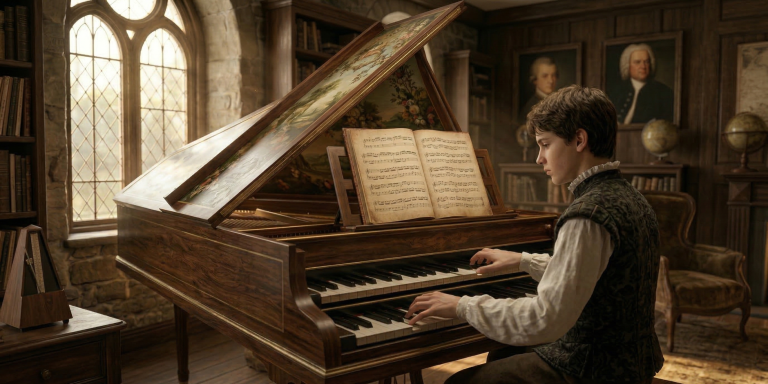
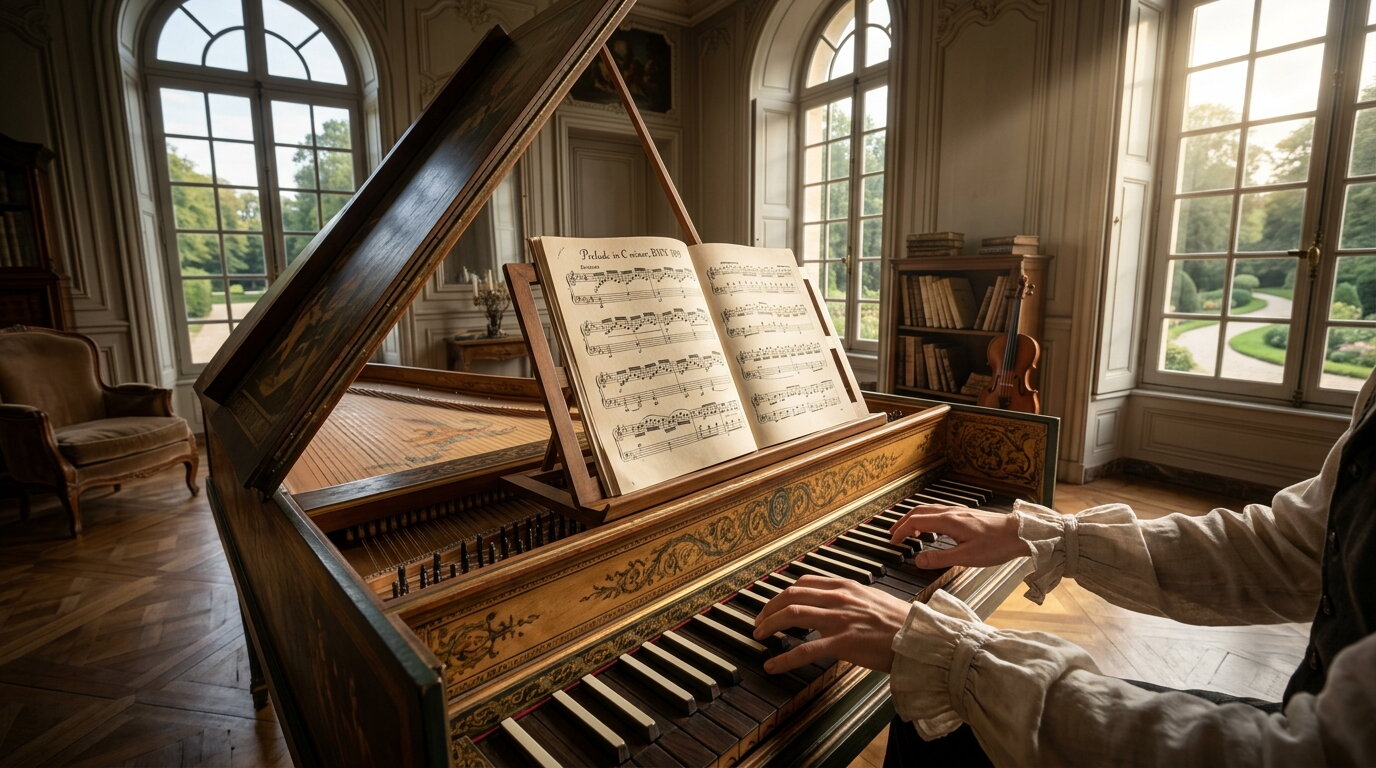
Prelude in C Minor, BWV 999 by J.S. Bach (1685–1750) stands as one of the essential works at the Beginner-Intermediate level in the Baroque piano repertoire. Composed in C Minor, this piece offers a unique combination of musical depth and technical challenge that makes it invaluable for developing both artistry and keyboard proficiency. With a performance duration of approximately 2–3 minutes, it is substantial enough to feature prominently in a recital program while remaining focused enough for concentrated practice sessions. The piece is fully public domain worldwide, meaning you can freely download, print, perform, and distribute it without any copyright concerns.
The Composer: J.S. Bach (1685–1750)
J.S. Bach occupies a distinctive position in Western music history. As a composer working within the Baroque tradition, their output reflects both the aesthetic ideals of their era and a deeply personal artistic vision that transcended contemporary conventions. Their keyboard works in particular demonstrate an intimate understanding of the piano’s capabilities, the singing tone of the upper register, the resonant power of the bass, and the infinite gradations of touch and dynamics that the instrument makes possible.
The compositional output spans multiple genres and forms, but the solo piano works hold a special place in the catalog. They range from technical studies and teaching pieces to large-scale concert works of the highest ambition, all unified by an unwavering commitment to musical expressiveness. The specific work under consideration here represents one facet of this larger creative project, a piece that, within its particular scope, achieves a completeness of expression that rewards repeated study and performance.
Understanding the historical and biographical context enriches any interpretation. The musical language reflects the harmonic and structural conventions of the Baroque period while also incorporating elements that push beyond those conventions. This tension between tradition and innovation is what makes the music enduringly fascinating for performers and listeners alike.
About Prelude in C Minor, BWV 999
This work was composed in the key of C Minor and belongs to the Baroque tradition of piano composition. At the Beginner-Intermediate level, it occupies a pedagogically important position: challenging enough to develop significant technical and musical skills, yet accessible enough for dedicated students who have mastered the fundamentals of piano playing. The estimated performance duration of 2–3 minutes places it comfortably within the range of both practice repertoire and concert programming.
The piece has maintained its place in the standard repertoire for compelling reasons. It addresses fundamental pianistic skills, tone production, dynamic control, rhythmic precision, phrasing, pedaling, within a musically satisfying framework. Unlike purely technical exercises, which can feel mechanical and uninspiring, this work integrates technical challenges into a genuine artistic statement. Every passage serves both a technical and a musical purpose, making practice feel like artistic exploration rather than rote drilling.
Musical Structure and Analysis
The formal structure of the piece reveals careful compositional craft. The music unfolds through clearly delineated sections, each with its own character, texture, and harmonic language. The transitions between sections are handled with particular skill, never abrupt, always organic, leading the listener naturally from one idea to the next.
The harmonic language is rooted in the tonal conventions of C Minor but enriched with chromatic passing tones, secondary dominants, and occasional modal inflections that add color and emotional depth. The voice leading between chords is consistently smooth, with each note connecting logically to the next. This attention to voice leading is one of the features that distinguishes well-composed piano music from amateur attempts: every note has a purpose, and the ear can follow multiple melodic strands simultaneously.
Rhythmically, the piece employs a characteristic pattern that establishes its identity from the opening measures. This rhythmic motif is developed, varied, and transformed throughout the work, providing both structural coherence and musical interest. The interplay between rhythmic regularity and subtle departures from the expected pattern creates a sense of living, breathing music rather than mechanical repetition.
The dynamic architecture spans the full range from pianissimo to fortissimo, with carefully calibrated gradations in between. The loudest moments are not merely about volume, they represent emotional climaxes that have been prepared by the preceding musical narrative. Similarly, the quietest passages are not simply soft but are moments of intimacy, reflection, or mystery that give the louder passages their meaning by contrast.
Bar-by-Bar Technical Walkthrough
Opening Section
The piece begins by establishing its fundamental character within the first few measures. Pay close attention to the articulation markings: legato passages should be genuinely connected, with weight transferring smoothly from finger to finger; staccato notes should be crisp and detached, with the finger or wrist providing a quick, controlled lift. The opening dynamic level sets the stage for everything that follows, start at exactly the marked dynamic, resisting the temptation to begin louder than intended.
The right hand typically carries the primary melodic material in these opening measures. Prioritize a singing tone by using arm weight rather than finger force: allow the weight of the arm to flow through the finger into the key, producing a round, full sound. The wrist should remain flexible, acting as a shock absorber that prevents the arm weight from producing a harsh attack. The left hand provides harmonic and rhythmic support; keep it softer than the right hand to maintain clear melodic projection.
Development and Middle Section
As the piece develops, the texture typically becomes more complex. Additional voices may emerge in the inner parts, the harmonic rhythm may accelerate, and the dynamic level may increase. These changes require the pianist to manage multiple musical elements simultaneously, a skill that develops gradually through attentive practice.
For passages with thicker textures, identify the primary melody and practice it alone first. Then add the bass line, creating a two-voice framework. Finally, fill in the inner voices, ensuring they remain subordinate to the outer voices. This layered approach to learning complex textures is one of the most efficient practice techniques available and applies to virtually all piano repertoire.
The harmonic changes in the development section may include modulations to related keys. Listen carefully for these shifts — they change the emotional color of the music and should be reflected in subtle changes of touch, dynamics, or pedaling. A modulation to a minor key, for example, might call for a slightly darker, more weighted tone; a move to a bright major key might invite a lighter, more sparkling touch.
Recapitulation and Coda
When familiar material returns, it should sound both recognizable and transformed. The second time through, the performer has the opportunity to add subtle interpretive nuances: a slightly different dynamic shading, a touch more rubato at a phrase ending, a richer pedaling that wasn’t present the first time. These small changes give the music a narrative quality, a sense that it has been somewhere and returned with new wisdom.
The ending of the piece requires particular attention. Whether it concludes with a dramatic fortissimo or a whispered pianissimo, the final notes must feel inevitable, the only possible way the music could end. Practice the last 8–16 measures as a separate unit, refining the dynamic trajectory, the timing of the final note, and the quality of the silence that follows. The silence after the last note is part of the music: hold your hands in position for a moment before releasing, maintaining the mood until the spell naturally breaks.
Expert Playing Tips
1. Tone Production
The foundation of all piano playing is tone quality. For cantabile (singing) passages, depress the keys slowly using arm weight, not finger strength. The speed of key descent determines the tone quality: slower descent = warmer, rounder tone; faster descent = brighter, more percussive tone. Experiment with different speeds to find the ideal color for each passage. For the Baroque style specifically, a warm, rounded tone is generally preferred for melodic passages, with a lighter, more articulated touch for faster figurations.
2. Pedaling Technique
The sustain pedal is essential for creating legato connections, sustaining bass notes, and adding harmonic richness. Use syncopated (or “legato”) pedaling as your default: play the new harmony, then change the pedal a fraction of a second later, catching the new sound while releasing the old. This produces a seamless connection between harmonies without the blur that results from holding the pedal too long. For passages requiring special clarity, reduce or eliminate pedal, relying instead on finger legato.
3. Phrasing and Musical Breathing
Every melody needs to breathe. Identify phrase boundaries (often marked by rests, longer notes, or cadences) and create tiny spaces between phrases, as a singer would take a breath. Within each phrase, shape a dynamic arc: gently crescendo toward the peak (usually the highest note) and diminish through the cadence. This natural rise-and-fall pattern gives the music a sense of speech-like communication.
4. Balance Between Hands
In passages where one hand carries the melody and the other provides accompaniment, the melody hand should always be audibly louder. A useful practice technique: play the melody hand forte and the accompaniment hand piano, then gradually bring them closer together until the balance sounds natural. Record yourself frequently, balance issues that are invisible while playing often become obvious on playback.
5. Tempo and Rubato
Begin by establishing a rock-solid tempo with a metronome. Once the notes and rhythms are secure, gradually introduce rubato (tempo flexibility). The key principle: what you steal in time, you must give back. If you slow down for an expressive moment, compensate by moving slightly forward afterward. The overall pulse of the piece should remain stable even when individual moments flex. Rubato should always feel organic and spontaneous, never calculated or mechanical.
Play this exercise
Practice Strategy: A 6-Week Structured Plan
Weeks 1–2: Discovery. Learn the notes hands separately at 50% of performance tempo. Identify the formal structure (sections, key areas, climaxes). Mark fingering, pedaling, and breathing points in the score. Practice difficult passages in isolation.
Weeks 2–3: Construction. Bring hands together at 60–70% tempo. Focus on balance between melody and accompaniment. Add basic pedaling. Work on transitions between sections. Begin memorizing the harmonic progression (chord by chord).
Weeks 3–4: Refinement. Approach performance tempo. Add detailed dynamics, phrasing, and pedaling. Record yourself and compare with 3–4 professional recordings (for inspiration, not imitation). Address any persistent technical difficulties with targeted exercises.
Weeks 4–5: Integration. Play complete run-throughs daily without stopping. Practice performing for others (friends, family, camera). Work on the opening and closing, these are what audiences remember most. Develop confidence through repetition.
Week 6: Performance. Finalize interpretation. Do complete run-throughs in performance conditions (proper attire, seated at the piano for a moment before beginning, bowing after). Address any residual anxiety through slow, confident practice of difficult passages. Trust your preparation.
Conclusion
The Prelude in C Minor, BWV 999 is far more than a simple pedagogical exercise; it is a profound gateway into J.S. Bach’s musical universe. By blending rigorous structural clarity with rich harmonic depth, this masterpiece offers intermediate pianists an ideal platform to master fundamental technique, refine balance and tone production, and cultivate genuine expressive artistry.
Whether you are preparing for an examination, enriching your recital program, or exploring the elegance of the Baroque era for personal fulfillment, mastering BWV 999 yields rewards that extend to every corner of your repertoire. Engage with the structured practice plan, listen with an open ear, and allow yourself to discover the timeless artistic beauty woven into every measure of Bach’s enduring work.
What edition should I use?
For scholarly accuracy, use a Urtext edition (Henle, Bärenreiter, or Wiener Urtext). For a free PDF, you can chose our sheet or download from IMSLP at https://imslp.org/wiki/Prelude_in_C_minor,_BWV_999_(Bach,_Johann_Sebastian), look for editions published before 1929, which are fully public domain worldwide. The Peters, Breitkopf & Härtel, and Schirmer editions are typically available.
How long will it take to learn?
For a pianist at the appropriate level (Beginner-Intermediate), expect 4–8 weeks of dedicated daily practice (30–60 minutes on this piece). The timeline varies based on prior experience with the Baroque style and the specific technical challenges involved.
Is this piece suitable for exams or competitions?
Yes. Prelude in C Minor, BWV 999 is a recognized standard in the Baroque repertoire and appears on numerous examination syllabi worldwide. For competitions, judges will expect not just technical accuracy but also musical sensitivity, appropriate stylistic awareness, and a convincing personal interpretation.
Can I use this for a wedding/event performance?
Depending on the character of the piece, it may be suitable for various events. Consider the mood and tempo when making your selection. This piece in C Minor has a character that would be appropriate for a wide range of performance settings including informal gatherings and student recitals.
What should I listen to for reference?
Search YouTube for “Prelude in C Minor, BWV 999” to find multiple professional recordings. Listen to at least 3-4 different interpretations to understand the range of valid approaches. Pay attention to differences in tempo, dynamics, pedaling, and overall character. Then develop your own interpretation that feels authentic to you.