The journey of learning the piano often begins with a spark of inspiration, perhaps the haunting melody of a Chopin Nocturne or the rhythmic drive of a modern jazz piece. A student sits at the bench for the first time, fingers eager to press the ivory and ebony keys, envisioning a future of fluid performance. However, as the weeks progress, that initial excitement often encounters a common form of friction. The fingers feel sluggish, the rhythm seems slightly “off,” and the once-simple task of reading two staves simultaneously becomes a source of profound frustration. These hurdles are not a lack of talent, but rather the result of foundational missteps that impede progress. By identifying these pitfalls early, a student can transform their practice from a repetitive struggle into a disciplined path toward mastery.
Success in piano performance is built upon a dual foundation of physical ergonomics and theoretical comprehension. To avoid the “beginner plateau,” one must prioritize correct posture and hand shape to ensure technical fluidity, while simultaneously building a “Music Theory” framework that includes an understanding of intervals, scales, and rhythmic structures.
Mistake 1: Neglecting Physical Ergonomics and Hand Technique
The piano is as much a physical discipline as it is an intellectual one. Beginners often view the bench as a simple seat, rather than a tool for leverage and balance.
Defining Proper Piano Posture
Piano Posture refers to the specific alignment of the body, including the back, shoulders, arms, and wrists, designed to minimize tension and maximize the efficiency of force transfer from the torso to the fingertips.
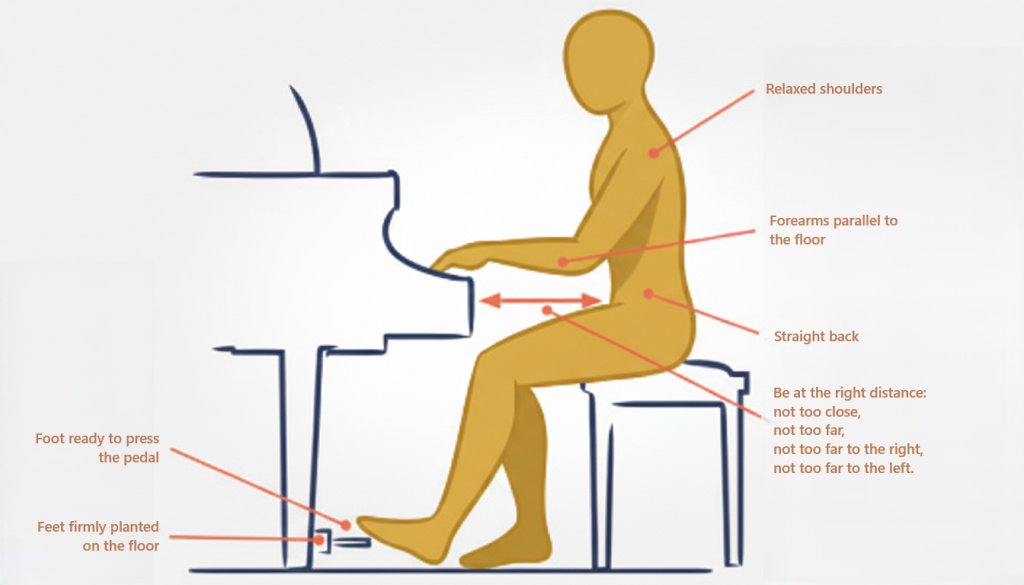
Many novices sit too close to the instrument or too low on the bench. Correct positioning requires:
- Bench Height: The forearms should be roughly parallel to the ground when the fingers are on the keys.
- Distance: The pianist should sit on the front half of the bench, allowing the feet to rest flat on the floor (near the pedals) to provide a stable base of support.
- The “Claw” Hand Shape: Fingers should maintain a natural curve, as if holding a tennis ball. This allows the weight of the arm to fall onto the fingertips rather than “poking” at the keys with flat fingers.
Axial Alignment and Seating Mechanics
The interaction between the pianist and the keyboard begins with the bench. Contemporary pedagogy dictates that the bench must be positioned squarely to the keyboard, centered on the width of the instrument. A common error among novices is utilizing the entire surface of the bench; however, sitting on the front half or third of the seat is required to engage the core muscles and allow for the distribution of weight through the sitting bones (ischial tuberosities). This position facilitates a slight forward lean from the hips, essential for transferring arm weight to the keys.
| Posture Component | Pedagogical Requirement | Clinical Implication of Error |
| Spine | Tall, elongated, maintaining natural lordotic and kyphotic curves | Chronic back pain, reduced lung capacity for phrasing |
| Shoulders | Neutral, dropped naturally away from the cervical spine | “Dinosaur” posture, shoulder impingement, tension-based tone |
| Elbows | Level with or slightly above the keybed, 90-degree angle | Wrist strain, lack of leverage for forte passages |
| Knees/Feet | Knees slightly under the keyboard, feet flat on floor | Loss of stability, inability to operate pedals effectively |
The distance from the keyboard is equally critical. A standard measurement used by instructors is the “knuckle test”: with arms extended, the student’s knuckles should be able to touch the fallboard. If the elbows are positioned behind the torso or flare outward (“wings”), the student loses the ability to channel the mass of the arms into the sound production process.
Hand Archetypes and the “Dome” Position
The “note-typing” trend in modern beginners often results in flat, stiff fingers that strike the keys with the pads rather than the tips. Expert hand technique requires the maintenance of a natural “dome” shape, which can be found by placing the hand on the knee and allowing the fingers to curve around the kneecap. This curvature ensures that the knuckles remain the highest point of the hand, providing a stable bridge for force transmission.
A secondary technical failure is the “flying pinkie” or “Karate Chop” wrist. These occur when the fifth finger extends rigidly or the wrist is angled sharply, creating a bottleneck for neural signals and blood flow. The “Puppet String” imagery, pretending a string pulls the wrist upward, helps maintain buoyancy and prevents the pop of the “hand bubble” beneath the palm.
Clinical Prevention of Repetitive Strain Injuries
Piano playing involves high-frequency repetitive motions that can thicken ligaments, causing the compression of the median nerve in the forearm. Symptoms include tingling, numbness, and burning sensations in the hand. To prevent carpal tunnel syndrome, learners must adopt a neutral wrist position (0° to 10° extension). The “Parachute Touch” and “Cushioning Wrist” techniques are suggested to minimize the impact force on the keys.
Clinical guidelines for long-form practice sessions include:
- Micro-breaks: Standing and stretching every 20-30 minutes.
- Thermal Management: Avoiding practice with cold hands; using fingerless gloves if necessary to maintain flexibility.
- Active Rest: Engaging in low-impact activities like swimming to promote muscle relaxation.
As an Amazon Associate I earn from qualifying purchases.
As an Amazon Associate I earn from qualifying purchases.
Mistake 2: Rushing Past the Fundamentals of Music Theory
There is a common temptation to skip “boring” exercises to play complex repertoire immediately. However, without a grasp of the “building blocks” of music, the student is essentially trying to read a novel without knowing the alphabet.
A common mistake among adult beginners, often fueled by the desire for immediate gratification, is bypassing music theory in favor of rote memorization or “learning by ear”. While aural training is vital, the absence of theoretical literacy creates a technical ceiling and prevents the student from understanding the “roadmap” of a composition.
The Grand Staff and Rhythmic Nomenclature
Western music is notated on a staff of five parallel lines and four spaces. The Grand Staff integrates the treble clef (higher pitch range) and the bass clef (lower pitch range), connected by Middle C on a ledger line. A fundamental misconception is that the clefs represent the left and right hands; in advanced repertoire, clef changes occur frequently within a single hand’s part.
Rhythmic notation serves as the heartbeat of the score. There is a notable divergence in terminology between North American and United Kingdom/Commonwealth markets, which can cause significant confusion for self-taught students accessing global resources.
| Note Type (US/Canada) | Note Type (UK/Aus/IE/India) | Relative Duration (4/4 Time) |
| Double Whole Note | Breve | 8 Beats |
| Whole Note | Semibreve | 4 Beats |
| Half Note | Minim | 2 Beats |
| Quarter Note | Crotchet | 1 Beat |
| Eighth Note | Quaver | 1/2 Beat |
| Sixteenth Note | Semiquaver | 1/4 Beat |
| 32nd Note | Demisemiquaver | 1/8 Beat |
Scale Construction and Key Signatures
Novices often view scales as tedious exercises rather than the structural DNA of music. The Major scale is defined by a specific sequence of whole steps (W) and half steps (H): W-W-H-W-W-W-H. This pattern is universal regardless of the starting pitch.
The Minor scale, conversely, is perceived by beginners as “sad” or “complex,” yet it is a singular entity with three functional forms:
- Natural Minor: The basic sequence found by counting down three half steps from a major tonic.
- Harmonic Minor: Raises the 7th degree to create a “leading tone” for harmonic resolution, though it introduces a “melodic gap”.
- Melodic Minor: Corrects the melodic gap by raising the 6th and 7th degrees during ascent, reverting to natural minor during descent.
The Circle of Fifths serves as a critical mnemonic device for navigating these keys. Clockwise movement adds sharps (G, D, A, E, B, F#, C#), while counter-clockwise movement adds flats (F, Bb, Eb, Ab, Db, Gb, Cb).
Intervallic Reading and Landmark Notes
Fluent sight-reading is achieved not by identifying letter names (C, D, E), but by recognizing intervals, the distance between pitches. Professional musicians follow the “contour” of the line. Landmark notes, Treble G, Bass F, and Middle C, provide the anchor points from which a student can calculate “steps” (seconds) and “skips” (thirds).
| Interval Quality | Characteristics | Example |
| Major Third | 4 Half steps, consonant | C to E |
| Minor Third | 3 Half steps, “softer” consonance | C to Eb |
| Perfect Fifth | 7 Half steps, highly stable | C to G |
| Perfect Octave | 12 Half steps, frequency doubling | C to next C |
As an Amazon Associate I earn from qualifying purchases.
As an Amazon Associate I earn from qualifying purchases.
Mistake 3: Misunderstanding Rhythmic Pulse and Meter
Rhythm is often the most neglected component of beginner practice. Novices frequently pause to find notes, effectively rewriting the meter of the piece and destroying the musical pulse.
Meter and Pulse Architecture
Time signatures regulate the organization of beats into measures. The top number indicates the number of beats per bar, and the bottom number indicates the note value that receiving the beat.
- Simple Time: 4/4 (Common Time), 3/4 (Triple), and 2/4 (Duple) allow for divisible-by-two subdivisions.
- Compound Time: 6/8, 9/8, and 12/8 utilize a “three-based” grouping, where a dotted quarter note typically acts as the primary beat unit.
Pedagogical research suggests that internalizing these stress patterns, such as the strong downbeat in 3/4 time, is essential for phrasing. Syncopation, the act of “skipping” or accenting off-beats, requires a rock-solid internal clock that many beginners lack.
The Metronome as a Strategic Practicing Tool
Practicing at an inconsistent tempo is a “hidden” mistake that prevents the consolidation of motor skills. Expert advice suggests that “if a student cannot play it slowly, they do not know it yet”. The metronome forces the learner to process notes and rhythms simultaneously.
Strategies for Metronome Integration:
Isolating “Hiccups”: Using the metronome to identify specific measures where the student unintentionally slows down.inners tend to speed up during easy sections and slow down during difficult ones, destroying the musical “heartbeat.”
Accuracy Over Tempo: Starting at 50% of the target speed to ensure 100% accuracy.
Small Increments: Increasing speed by 2-4 BPM only after three consecutive perfect play-throughs.
As an Amazon Associate I earn from qualifying purchases.
As an Amazon Associate I earn from qualifying purchases.
Mistake 4: Poor Reading Habits and the “Look-Down” Trap
Reading music involves translating symbols on the Grand Staff into physical movements. The Grand Staff consists of two staves: the Treble Clef (usually for the right hand) and the Bass Clef (usually for the left hand), joined by a bracket.
The “Look-Down” Habit
Beginners often look at the music, find the note, and then look down at their hands to confirm the key. This “visual ping-pong” breaks the flow of information.
- Correction: Develop tactile awareness. Use the groups of two and three black keys to orient the fingers without looking down.
- Ledger Lines: Beginners often struggle with notes that fall above or below the staff. These are indicated by small horizontal lines called ledger lines. Consistent “Sight-Reading” practice is required to recognize these instantly.
Mistake 5: Unstructured Practice and Lack of Goal Setting
Inefficient practice, defined as “noodling” or practicing what is already comfortable, is a pervasive barrier to progress. Cognitive science identifies three stages of skill acquisition: the Cognitive (figuring it out), Associative (refining and correcting), and Autonomous (autopilot). Most beginners fail to move past the cognitive stage because they do not “disrupt their autopilot”.
The SMART Goal Framework
Adult learners benefit from treating piano practice as a project management task. The SMART framework transforms vague intentions into actionable results.
| SMART Criteria | Example Application | Non-Compliant Goal |
| Specific | “Memorize the LH of measures 1-8 of Minuet in G” | “Get better at piano” |
| Measurable | “Play the C major scale at 100 BPM hands together” | “Play scales faster” |
| Achievable | “Learn one new pop chord progression this week” | “Master a Liszt Etude in one month” |
| Relevant | “Master the II-V-I progression for jazz improvisation” | “Practice old-school drills I dislike” |
| Time-bound | “Master the first page of Fur Elise by March 15th” | “Learn this song eventually” |
Structural Practice Routines
Pedagogy favors “little and often” over marathon sessions. Clinical evidence indicates that mental fatigue sets in after 40 minutes for adults and 10-15 minutes for children. A recommended 30-minute session should be subdivided as follows:
- Warm-up (5 min): Finger independence drills (Hanon/Czerny) or scales.
- Specific Goals (15 min): Isolating tricky measures, practicing hands separately.
- Repertoire Review (5 min): Maintaining pieces already learned.
- Creative Exploration (5 min): “Fun music” or improvisation to maintain motivation.
Establishing a dedicated “visible” practice space, avoiding keeping the keyboard in a closet, removes friction from the routine.
Psychological Resilience: Overcoming Plateaus and Attrition
The “Mistake of Discouragement” rules them all. Many beginners expect linear progress, failing to recognize that skill acquisition is a series of ascents and plateaus.
The Science of the Plateau
A learning plateau is not a sign of failure but of “neural consolidation”. During these phases, the brain is strengthening synaptic pathways and muscle memory in the background. To break through a plateau, students are encouraged to use the “Aggregation of Marginal Gains” theory, focusing on tiny improvements in posture, tone, or rhythm rather than milestone moments.
Mindset and Motivation
Adult learners frequently bring excessive self-judgment and “perfectionism” to practice. Strategies for psychological management include:
- Process vs. Outcome: Valuing the act of showing up daily as much as the final performance.
- Recording and Review: Listening to oneself objectively helps identify areas for improvement that are invisible while playing.
- Aural Training: Listening to professional recordings to widen musical knowledge and understand how a “correct note” should actually sound.
Recommended Gear
To avoid these mistakes, having the right equipment is essential. Below are products available on Amazon that support proper piano development:
- Weighted-Key Digital Piano: Ensure your keyboard has “graded hammer action.” This mimics the feel of an acoustic piano, which is vital for developing finger strength and avoiding “flat” technique.
As an Amazon Associate I earn from qualifying purchases.
As an Amazon Associate I earn from qualifying purchases.
- Adjustable Piano Bench: A height-adjustable bench is necessary to achieve the correct ergonomic alignment mentioned in Mistake 1.
As an Amazon Associate I earn from qualifying purchases.
As an Amazon Associate I earn from qualifying purchases.
- Mechanical or Digital Metronome: A dedicated metronome (or a high-quality app) is non-negotiable for mastering pulse and rhythm.
As an Amazon Associate I earn from qualifying purchases.
As an Amazon Associate I earn from qualifying purchases.
- Piano Lamp: Proper lighting on the sheet music prevents eye strain and slouching.
As an Amazon Associate I earn from qualifying purchases.
As an Amazon Associate I earn from qualifying purchases.
- Theory Workbooks: Books like Music Theory: From Beginner to Expert or Music Theory for Dummies provide the necessary homework to reinforce the concepts of scales and intervals.
 Kindle editionRead on Kindle ›
As an Amazon Associate I earn from qualifying purchases.
 Kindle editionRead on Kindle ›
As an Amazon Associate I earn from qualifying purchases.
Conclusion
Mastering the piano is a marathon that requires patience, discipline, and a structured approach. The common mistakes outlined above, ranging from poor ergonomics to neglecting music theory, are not insurmountable barriers; they are simply signs that the student’s foundation needs reinforcement. By embracing the “Slow Practice” method, utilizing a metronome, and developing a deep understanding of scales and intervals, a beginner can bypass years of frustration. The piano is a highly logical instrument; once the underlying patterns are understood, the music begins to speak. We recommend setting small, achievable goals each week and celebrating the incremental progress that leads to artistic expression.
How long should a beginner practice each day?
Consistency is more important than duration. Twenty to thirty minutes of focused, daily practice is significantly more effective than a single four-hour session once a week. Frequent repetition aids “muscle memory” and cognitive retention.
How long does it take for a beginner to move to an “Intermediate” level?
There is no universal timeline; however, the Associated Board of the Royal Schools of Music (ABRSM) suggests that each grade generally takes 6-12 months of consistent study. For adults, reaching an “Early Intermediate” level (Grade 2-3) typically requires 18-24 months of focused daily practice.
Why is the metronome often frustrating for new students?
The metronome highlights every microscopic rhythmic error, which can be ego-bruising. However, this “restricted” feeling is necessary to develop “relative pulse”. Students should start at a tempo so slow that they feel “bored,” which allows the brain to process the rhythmic subdivisions without panic.
Is it acceptable to use a dining chair instead of a piano bench?
No. Standard chairs are typically too low, forcing the wrists to bend upward and the shoulders to hunch. A proper piano bench, preferably an adjustable one, allows the pianist to align their forearms parallel to the floor, which is the foundational position for tension-free play.
Is it necessary to learn the Bass Clef immediately?
Yes. Many beginners focus only on the Treble Clef, but the piano is a polyphonic instrument. Learning the Bass Clef from day one prevents a “weak” left hand and is essential for reading the Grand Staff.
What is the difference between “weighted” and “semi-weighted” keys?
Fully weighted keys (hammer action) use a mechanical mechanism to replicate the weight of acoustic piano hammers. This is essential for building finger strength and controlling dynamics. Semi-weighted keys use springs to provide resistance and are found in budget keyboards; they are insufficient for serious long-term study.
Should I learn scales or songs first?
Both should happen simultaneously. Scales provide the technical and theoretical framework, while repertoire (songs) provides the musical application and motivation.
Should beginners focus exclusively on classical music?
While classical repertoire (e.g., Bach, Clementi) provides the best technical foundation, research shows that mixing in styles the student enjoys, such as pop or jazz, skyrockets motivation and prevents burnout. The SMART framework should include both technical and “fun” goals.
Why do my wrists hurt after practicing?
Wrist pain is usually a sign of tension or incorrect height. Ensure your wrists are flexible and not “locked,” and verify that your bench is high enough so your arms are not reaching “up” to the keys.
How can a beginner distinguish between “practice soreness” and “injury pain”?
Muscle soreness similar to that experienced after a gym workout may occur as finger muscles strengthen. However, sharp pain, burning sensations, or numbness in the wrist or forearm are clinical indicators of Repetitive Strain Injury (RSI). In these cases, practice should stop immediately until the ergonomic cause is identified and corrected.