As an Amazon Associate, PianoMode earns from qualifying purchases. Recommendations are made on their merits; the price you pay is the same.
Mastering the interaction between the left and right hands is the definitive challenge for any pianist, whether they are navigating their first C major scale or performing a complex Bach fugue. This cognitive and physical dissociation, often referred to as hand independence, is the ability to execute different rhythms, dynamics, and articulations in each hand simultaneously. Coordination is not an innate talent but a developed skill that requires systematic training, patience, and a deep understanding of musical structure.
This guide provides a framework for developing superior hand coordination, exploring the unique roles of each hand, the methodology of isolation, and the most effective technical exercises for bridging the gap between separate and combined practice.
Effective practice of both hands on the piano involves a phased approach beginning with strict unilateral isolation (Hands Separate practice) followed by extremely slow integration (Hands Together practice) using synchronization points. This process facilitates the structural adaptation of the corpus callosum and the motor cortex, transitioning the practitioner from conscious spatial attention to automated motor execution.
1. Understanding the Anatomy of Piano Coordination
Piano coordination is a form of neuroplasticity. The brain must learn to manage two distinct streams of information, processing the treble clef (typically melody) and the bass clef (typically harmony or bass) through separate motor pathways.
The challenge of bimanual coordination is fundamentally a struggle against the brain’s natural inclination toward “mirroring.” The primary motor cortex and the supplementary motor area (SMA) are naturally wired to swing limbs in-phase or in-mirror patterns. When a pianist attempts to play a scale where the hands move in the same direction (parallel motion), the fingers utilize different muscle groups (e.g., the thumb of the right hand moves as the pinky of the left hand moves), which creates a high cognitive load. Overcoming this requires the development of “keyboard sense”, a combination of proprioception and haptic perception that allows the player to navigate the keys without visual reliance.
Defining Hand Independence (Dissociation)
In music theory, hand independence is the capacity of the performer to treat each hand as a distinct voice. This is particularly evident in polyphonic texture, where two or more independent melodic lines are played at once.
The Cognitive Challenge
The primary difficulty in “Left Hand vs Right Hand” practice lies in the brain’s natural tendency to synchronize movement. Without specific training, the weaker hand (usually the left) will attempt to mimic the rhythm or dynamic of the dominant hand. Breaking this “mirroring” effect is the first step toward advanced musicality.
2. The Distinct Roles: Treble vs. Bass Clef
To practice effectively, one must understand the functional division of labor on the piano. Standard piano notation utilizes the grand staff, connecting the treble and bass clefs with a brace.
The grand staff is the visual representation of the keyboard. The right hand typically reads the treble clef, where the lines represent E-G-B-D-F and the spaces F-A-C-E. The left hand reads the bass clef, where the lines represent G-B-D-F-A and the spaces A-C-E-G.
The Right Hand: Melodic Authority
While the RH part is usually more intuitive for right-handed players, isolation is used here to refine fingering and articulation.
- Fingering Consistency: A major cause of coordination breakdown is inconsistent fingering. If the student uses a different finger for the same passage every time they practice, the brain can never automate the movement. HS practice allows the student to commit to a specific “fingering map.”
- Focus: Precision, phrasing, and rapid finger dexterity.
- Practice Goal: Developing the “singing” quality of the melody (Cantabile) through careful articulation.
The Left Hand: The Harmonic and Rhythmic Foundation
For the majority of right-handed pianists, the left hand is the limiting factor in coordination. It is often weaker, less accurate, and slower to react. Pedagogues recommend that the left hand should receive significantly more isolated practice than the right.
- Chord Blocking: If the LH has a series of broken chords (arpeggios), practice them as “blocked” chords first. This helps the hand internalize the shape and position of the notes before adding the complexity of sequential movement.
- Bass Pattern Continuity: Practice LH accompaniment patterns (like the Alberti bass or walking jazz lines) until they can be maintained metronomically without looking at the hand.
- Common Patterns: Alberti bass, walking basslines, or broken chord arpeggios that fill out the harmony.
3. The Mastery of Isolation: Hands Separate (HS) Practice
It is a fundamental rule of piano pedagogy that one cannot play together what one cannot play perfectly apart. Hands Separate (HS) practice is the phase where 90% of the learning occurs.
Why Isolation is Mandatory
Practicing “Hands Separate” (HS) allows the brain to dedicate 100% of its processing power to a single motor stream. By repeating a passage with the left hand alone, the motor cortex builds a secure “script” for that movement. Once this script is so well-learned that the student can play it while holding a conversation, it has been moved into the subconscious. Only when both hands have achieved this level of automation can they be combined effectively.
Key Steps for Effective HS Practice:
- Analyze the Rhythm: Before touching the keys, clap out the rhythm for each hand to internalize the beat.
- Strict Fingering: Use the exact fingerings marked in the score. Inconsistency here is the number one cause of coordination failure.
- Dynamic Intent: Practice the left hand more softly if it is an accompaniment, and the right hand more firmly if it carries the melody.
- The “Safety” Tempo: Play at a speed where you can execute 100% of the notes correctly three times in a row.
4. Bridging the Gap: Transitioning to Hands Together (HT)
Moving from isolation to integration is the most cognitively demanding part of piano practice. It requires the brain to merge two established scripts into a singular performance.
The “Slow is Smooth” Methodology
The most frequent mistake in integration is practicing too fast too soon. Speed is a byproduct of precision; it cannot be forced. If a student makes a mistake while playing hands together, the tempo is too fast. The brain needs time to process the “firing order” of the fingers. Extremely slow practice, where each note is given several seconds of thought, allows the neural connections to form without the interference of error-correction.
Ghosting and Muted Practice
Ghosting is a sophisticated technique used to bridge the gap between HS and HT practice. It is particularly effective for balancing the “voicing” of the hands (making the melody louder than the accompaniment).
- The Technique: The student plays the RH (melody) normally, but the LH (accompaniment) only “ghosts” the keys, touching the tops of the keys with the correct rhythm and fingering but not actually depressing them to produce sound.
- The Benefit: This trains the brain to manage the movements of both hands simultaneously while allowing the ear to focus on the melody. It breaks the habit of “bilateral weight parity,” where the hands naturally want to hit the keys with the same amount of force.
The “Synchronization Point” Strategy
Rather than trying to feel the entire measure as a blur, students should identify “anchors” where both hands strike at the exact same time. By focusing on these vertical alignment points, the player can use them as a scaffold to hang the remaining notes. This is often practiced by playing only the notes that fall on the beat in both hands, omitting the subdivisions until the pulse is secure.
5. Essential Exercises for Superior Coordination
Technical drills are the “gymnastics” of the piano. They build the muscle memory required so that your mind can focus on the music rather than the mechanics.
The Hanon Finger Drills
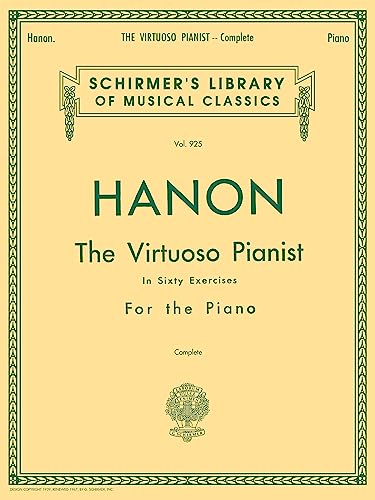
C.L. Hanon’s “The Virtuoso Pianist” contains exercises designed to equalize the strength of all fingers, particularly the weaker 4th and 5th fingers of both hands.
- Coordination Benefit: Because both hands play the same pattern an octave apart, it helps the brain recognize parallel motion.
 Kindle editionRead on Kindle ›
As an Amazon Associate I earn from qualifying purchases.
Carl Czerny: School of Velocity, Op. 299
Czerny, a student of Beethoven and teacher of Liszt, created hundreds of études. The School of Velocity focuses on rapid, independent finger work. Unlike Hanon, Czerny’s exercises are musical pieces that require the student to maintain a steady LH rhythm while the RH performs virtuosic scales and arpeggios.
 Kindle editionRead on Kindle ›
As an Amazon Associate I earn from qualifying purchases.
Scales and Arpeggios in Contrary Motion
While playing scales in parallel motion is standard, contrary motion (hands moving in opposite directions) is far superior for developing independence.
- Procedure: Starting on a central C, the right hand moves up while the left hand moves down. This forces the brain to process mirrored physical movements, which is a high-level coordination skill.
Polyphonic Studies: Bach and Counterpoint
Johann Sebastian Bach is the master of hand independence. His Inventions and French Suites feature counterpoint, where the left hand’s melody is just as complex as the right.
- The Benefit: Practicing these pieces ensures the left hand is never “lazy.” It must act as its own soloist.
- Invention No. 1 in C Major: Teaches “imitation”, where the RH starts a theme and the LH follows a bar later.
- Invention No. 8 in F Major: Teaches rapid, independent runs in both hands simultaneously.
- Invention No. 13 in A Minor: Focuses on independent arpeggios and rhythmic precision.
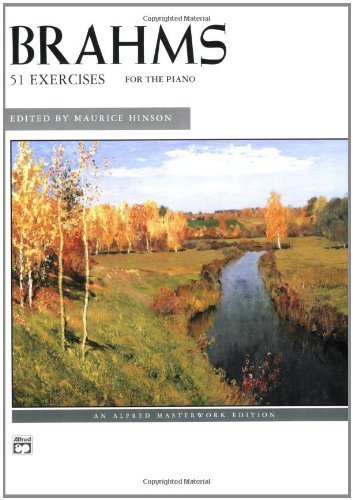
Johannes Brahms: 51 Exercises (1893)
Brahms’ exercises are notorious for their difficulty. They focus on “held-note” exercises (where some fingers hold down keys while others play a melody) and extreme polyrhythms. These are designed to break the “webbing” of the hand’s tendons and build true, high-level independence for advanced Romantic literature.
 Kindle editionRead on Kindle ›
As an Amazon Associate I earn from qualifying purchases.
Polyrhythms: The 2-against-3 Challenge
True hand independence is achieved when the hands can operate under different rhythmic “clocks.” This is common in jazz, Romantic, and modern classical music.
A polyrhythm occurs when two different subdivisions of a beat are played simultaneously. The most common is the “triplet against duplet” (2:3).
- The Math: If the measure is divided into 6 equal parts, the “2” rhythm hits on 1 and 4, while the “3” rhythm hits on 1, 3, and 5.
- The Mnemonic: Students are taught to say the phrase “Nice Cup of Tea” or “Cold Cup of Tea.”
- Nice (Both hands together)
- Cup (Right hand alone)
- of (Left hand alone)
- Tea (Right hand alone)
Rhythmic Dissociation Exercises
To train the brain for these complex patterns, the piano is not always necessary.
- Knee Tapping: Tapping 16th notes with the RH while tapping 8th notes with the LH on the knees. This isolates the rhythmic challenge from the mechanical difficulty of the keyboard.
- Conducting Drills: A highly advanced exercise involves conducting 2/4 time with one hand and 3/4 time with the other. This requires the brain to manage two different “meters” simultaneously, a skill used by high-level conductors and organists.
6. Common Mistakes and How to Avoid Them
| Mistake | Consequence | Solution |
| Ignoring the Left Hand | The music sounds “thin” and the tempo becomes unstable. | Devote 60% of HS practice time to the left hand. |
| Rushing through HS | Errors in fingering are memorized, causing “stuttering” during HT. | Do not merge hands until each can play its part perfectly at double the target tempo. |
| Failing to use a Metronome | Uneven rhythm and “rushing” the easy parts while “dragging” the hard parts. | Set the metronome for every practice session to build an internal clock. |
| Visual Dependency | Staring at one hand while the other makes mistakes. | Practice looking at the sheet music, or alternate which hand you watch while playing. |
7. Adult Learners and Late-Onset Neuroplasticity
A common myth is that hand coordination can only be mastered if one begins as a child. While early childhood offers a “sensitive period” for white matter development, the adult brain is highly capable of developing coordination.
The Adult Brain’s Advantages
Adult learners (aged 20-80) possess advanced executive functions compared to children. They are better at planning, setting goals, and understanding the “why” behind an exercise. While a child might mindlessly repeat a drill, an adult can use “deliberate practice”, analyzing where a coordination break happens and applying a specific corrective strategy like ghosting or blocked chords.
Motivation and the “Inner Critic”
Adults are often more intrinsically motivated; they play because they love the music, not because of parental pressure. However, adults are more prone to frustration. Because their “cognitive” understanding of the music often exceeds their “physical” ability to play it, they may feel discouraged. Understanding that coordination is a neurological process that takes time to “wire” (often happening overnight during sleep) can help adults stay patient with the process.
Cognitive Health Benefits
Learning the piano is one of the most effective ways to maintain brain health in older age. A study in The Journals of Gerontology found that piano training in adults aged 60–80 significantly improved processing speed and working memory. The intense bilateral coordination required by the piano acts as a “full-body workout” for the brain, strengthening the corpus callosum and delaying cognitive decline.
Different cultures of piano playing have developed unique philosophical and mechanical approaches to solving the problem of hand coordination.
The Russian School of Technique
The Russian School (e.g., Rachmaninoff, Richter) focuses on “orchestral” sound and technical power. Coordination is built through a holistic use of the body, where the arms, shoulders, and back are integrated into the movement of the hands. This school utilizes a “deep key engagement,” which provides a massive amount of tactile feedback to the brain, aiding in the stabilization of coordinated movements.
The French School of Articulation
The French School (e.g., Debussy, Ravel) prioritizes “jeu perlé”, a light, elegant, and exceptionally clear articulation. The focus here is on finger agility rather than arm weight. Hand independence is achieved through “fine-motor” isolation, often practiced through the works of Francois Couperin. The French approach teaches that coordination is about the “economy of motion”, doing the absolute minimum required to produce a clear tone, which reduces systemic tension.
The Taubman Approach to Ergonomics
A modern alternative to the traditional schools, the Taubman Method emphasizes “rotational” movements of the wrist and forearm. Dorothy Taubman argued that up-and-down finger movements are inherently limited by human anatomy. By using rotational mechanics (similar to turning a doorknob), the pianist can coordinate hands at high speeds while keeping the fingers in their most comfortable, neutral position. This method is highly successful in rehabilitating pianists with repetitive strain injuries.
Recommended Gear for Coordination Mastery
To maximize your practice efficiency, consider these essential tools available on Amazon:
- Mechanical or Digital Metronome: A non-negotiable tool for building rhythmic stability. (KORG MA-2 or Wittner Taktell).
As an Amazon Associate I earn from qualifying purchases.
As an Amazon Associate I earn from qualifying purchases.
- Hanon: The Virtuoso Pianist in 60 Exercises: The gold standard for finger independence. (Look for: Schirmer’s Library of Musical Classics).
As an Amazon Associate I earn from qualifying purchases.
- Finger Exerciser & Hand Strengthener: Useful for building the grip strength needed for the left hand’s bass octaves. (Varigrip).
As an Amazon Associate I earn from qualifying purchases.
- Adjustable Piano Bench: Proper posture is crucial for the range of motion required in independent hand movement.
As an Amazon Associate I earn from qualifying purchases.
Conclusion
Mastering the relationship between the left and right hand is the definitive challenge of the piano, requiring a harmonious blend of neurological adaptation, anatomical awareness, and disciplined practice. The journey from the frustration of hands “clashing” to the fluidity of independent coordination is not a matter of raw strength, but of educating the brain and nervous system. By utilizing the isolation of the hands, embracing the “slow is smooth” philosophy, and applying sophisticated techniques like ghosting and proprioceptive training, any student can overcome the brain’s natural impulse toward symmetry.
Remember, the goal is not to force the hands together, but to allow them to coexist. Patience is the ultimate technical skill. Trust the slow practice, and soon the puzzle of the piano will become a second-nature language.
Why does my left hand always want to copy my right hand?
This is a natural neurological reflex called “mirroring.” To break it, practice rhythmic variations: play the right hand in eighth notes while the left hand holds whole notes, then swap. This teaches the brain to send different signals to each arm.
Why is my left hand so much slower than my right?
For right-handed individuals, the left hand has fewer established neural connections in the motor cortex for fine motor skills. This results in “asymmetrical interlimb transfer.” The solution is to prioritize left-hand isolation and engage in more LH-dominant repertoire to build those neurological pathways.
How long should I practice hands separately?
There is no set time, but a good rule of thumb is to remain in the HS phase for at least the first 2-3 days of learning a new section. If you stumble when playing HT, it is a sign you need more HS isolation.
Should I look at my hands when playing them together?
While looking at the hands is common for beginners, it can become a crutch. If you look at your right hand, you lose focus on the left. The goal is to develop “proprioception”—knowing the location of the keys through touch and spatial awareness. Try practicing with your eyes closed to strengthen this skill.
Is it normal to get worse when I first put hands together?
Yes. This is due to “cognitive overload.” When you play hands together, your brain’s processing requirements quadruple. This is why you must slow down the tempo to a crawl, sometimes one note every few seconds, to give the brain time to process the dual motor streams.
Does learning the piano help with general coordination?
Yes. Studies in music theory and performance show that developing hand independence strengthens the corpus callosum, the bridge between the two hemispheres of the brain—improving overall cognitive processing and motor skills.
Is it better to learn the melody (RH) first?
While the melody is more recognizable, many experts suggest learning the bass/harmony (LH) first. Because the left hand provides the “anchor” for the rhythm, having it on “autopilot” makes adding the melody much easier.