I still remember the first time I sat down with a complex piece of sheet music. The notes looked manageable, but the concept of time signatures felt like a mysterious code I had to crack before I could truly connect with the music. To the untrained eye, music is a language of pitch. We see notes moving up and down the staff, and we obsess over melodies and harmonies. We spend hours practicing scales to perfect our finger velocity. But to the master musician, music is primarily a language of time.
Whether you are studying for your ABRSM exams in London, taking Trinity College lessons in Mumbai, or learning jazz in New York, the fundamental architecture of music remains the same. However, the way we describe it often changes. To the master pianist, the Time Signature is not just a fraction at the start of the staff. It is the heartbeat of the composition. It is the gravitational force that dictates whether a piece walks, runs, dances, or floats.
If pitch is the “what” of music, then rhythm is the “when,” and the time signature is the “how.”
I remember the exact moment my relationship with the piano changed. I was eighteen, struggling with a Chopin Nocturne. I was hitting every note correctly, yet my professor stopped me. “You are typing,” he said. “You are not speaking.” He explained that I was treating the time signature as a mathematical constraint, a rigid grid to be obeyed, rather than an architectural blueprint for emotion.
The two numbers at the beginning of the staff are not just fractions. They represent the gravitational laws of the piece. They dictate where the music breathes, where it lands, and how it propels itself forward. Understanding time signatures is the difference between a robotic performance and one that makes an audience hold its breath.
In this definitive guide, we will go beyond the elementary “how to count to four.” We will dissect the anatomy of meter, explore the historical evolution of rhythmic notation, and provide you with the advanced cognitive tools to internalize any rhythm, from the simplest march to the most complex asymmetrical jazz fusion.
What You Will Master in This Guide:
- The Foundation: The physics of Pulse vs. Rhythm vs. Meter.
- The Syntax: Decoding the numbers with professional accuracy.
- The Great Divide: The definitive explanation of Simple vs. Compound Time.
- Advanced Metrics: Mastering 5/4, 7/8, and Mixed Meters.
- The “Hidden” Signatures: Cut Time, Common Time, and Free Time.
- Technique: Conducting, Subdivision, and Metronome Mastery.
- Musicality: How to use time signatures for emotional expression (Agogics, Hemiola).
1. The Global Glossary: Bridging the US/UK Divide
Before we dive into the theory, we must align our vocabulary. The world of music theory is divided into two main naming conventions.
- North American System: Based on fractions (Whole, Half, Quarter). Used in USA, Canada.
- Commonwealth System: Based on Latin/historical roots (Semibreve, Minim, Crotchet). Used in UK, Australia, New Zealand, India, and widely in Europe.
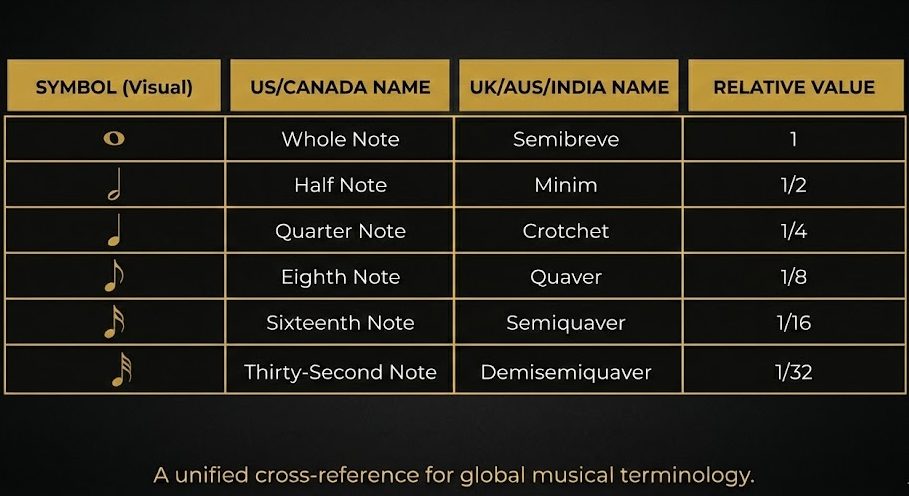
2. The Physics and Philosophy of Time
Before we can decode the symbols, we must understand what they represent. Most students confuse “beat,” “rhythm,” and “meter.” Let’s separate these distinct forces.
The Pulse (The Tactus)
The pulse is the primal throb of the music. It is the steady, recurring beat that you tap your foot to. It is isochronous (occurring at equal time intervals).
- Neuroscience context: The human brain naturally seeks patterns. When we hear a series of identical clicks, our brain anxiously waits to group them. We cannot stand chaos; we crave order. The pulse is the raw data of time.
The Meter (The Organization)
Meter is the cognitive grouping of pulses. It is not on the page; it is in your mind.
If you hear “click, click, click, click,” your brain will inevitably start to hear “STRONG, weak, STRONG, weak” or “STRONG, weak, weak.”
- Time Signatures are the notation of Meter. They tell the performer: “Organize these pulses into groups of X.”
The Rhythm (The Duration)
Rhythm is the actual sequence of long and short sounds that overlay the meter.
- Analogy: If the Pulse is the pillars of a bridge, and the Meter is the spacing between them, the Rhythm is the traffic flowing over the bridge.
3. Anatomical Decoding of the Time Signature
Located after the clef and the key signature, the time signature is the third crucial instruction for the performer. It consists of two superposed integers.
A Time Signature is a symbol placed at the beginning of a musical staff (after the clef and key signature) that defines the metric structure of the music. It consists of two numbers stacked vertically: the top number represents the quantity of beats per measure, and the bottom number represents the quality (duration) of the note that constitutes one beat.
The Top Number: The Quantitative Value
This number represents the magnitude of the measure. It answers: How many pulses exist before the primary accent returns?
A measure (or bar) is simply a container of time. The bar line is the visual reset button.
- 2: Duple Meter (Binary). Two pulses per bar. The most fundamental rhythm (Heartbeat, Walking).
- 3: Triple Meter (Ternary). Three pulses per bar. The rhythm of rotation and circularity.
- 4: Quadruple Meter. Four pulses per bar. The standard structure of Western music.
- 5, 7, 11: Asymmetrical Meters. These create tension because they do not resolve evenly.
- 6, 9, 12: These imply Compound Meter (discussed after).
The Bottom Number: The Qualitative Value
This number represents the unit of measurement. It answers: What note value equals one pulse?
This system relies on the fractional division of the Whole Note (Semibreve).
- 4: Represents the Quarter Note (Crotchet). This is the most common beat unit.
- 8: Represents the Eighth Note (Quaver).
- 2: Represents the Half Note (Minim).
- 16: Represents the Sixteenth Note (Semiquaver).
Example: 3/4 Time
- Top: We count to 3.
- Bottom: We are counting Quarter Notes (Crotchets).
- Result: Three Crotchet beats per bar.

Historical Deep Dive: Why “4/4”?
Why don’t we just call it “1”? In the Medieval period (Ars Nova, 14th Century), music was measured in “Perfect” (Triple, representing the Holy Trinity) or “Imperfect” (Duple) time. The full circle represented perfect time. The broken circle—which looks like a C—represented imperfect time. This “C” persisted and evolved into our 4/4 symbol. It is a direct relic of medieval theology embedded in your sheet music.
4. The Great Divide: Simple vs. Compound Meter
This is the single most important chapter of this guide. If you do not grasp the difference between Simple and Compound time, you will never be able to sight-read effectively. And if you are preparing for Grade 5 Theory (ABRSM) or AP Music Theory, this is the core requirement.
The difference is not about the number of beats. It is about how the beat subdivides.
Simple Meter: The Binary Subdivision
In Simple meters, the main pulse is naturally divisible by two.
- Rule: The Top Number is usually 2, 3, or 4.
- The Beat: Is a standard (undotted) note (e.g., a Quarter note / crotchet).
- The Breakdown:
- One Beat = 2 Eighth Notes.
- Count: “One-and, Two-and.”
The Feeling of Simple Time:
Simple time feels square, architectural, and stable. Even in a 3/4 waltz, the subdivision (1-and, 2-and, 3-and) provides a rigid scaffolding.
Compound Meter: The Ternary Subdivision
In Compound meters, the main pulse is naturally divisible by three.
- Rule: The Top Number is usually 6, 9, or 12.
- The Beat: Is a Dotted Note (e.g., a Dotted Quarter note / Crotchet).
- The Breakdown:
- One Beat = 3 Eighth Notes.
- Count: “One-and-a, Two-and-a” OR “One-la-li, Two-la-li.”
The Feeling of Compound Time:
Compound time feels circular, fluid, and rolling. It is the sound of water (Barcarolles), of skipping (Jigs), and of swinging.
A. The “6/8” Paradox
The most common confusion in piano students is 6/8 time.
- The Amateur View: “It has 6 beats per measure. I will count 1-2-3-4-5-6.”
- The Expert View: “It has 2 beats per measure. Each beat is a dotted quarter note (or crotchet).”
Why counting to 6 is dangerous:
If you count “1, 2, 3, 4, 5, 6” at a slow tempo, you lose the metric accent. You treat every eighth note as equal. But they are NOT equal.
- Beat 1 is Strong.
- Beat 4 is Medium.
- Beats 2, 3, 5, 6 are Weak.If you play them all equally, the music sounds like a sewing machine. You must feel the “Two Big Swings.”
Why not call it 3/4? Both 3/4 and 6/8 contain six quavers mathematically. But the grouping is different.
- 3/4: [2+2+2] = 3 Beats. (ONE-and, TWO-and, THREE-and).
- 6/8: [3+3] = 2 Beats. (ONE-la-li, TWO-la-li).
Expert Insight: Try singing “Happy Birthday.” “Hap-py Birth-day to…” That swinging feeling? That is the triplet subdivision of Compound Time.
B. The “Big Three” Compound Meters:
- 6/8 (Compound Duple):
- Visual Illusion: Looks like 6 beats.
- Musical Reality: 2 Beats. Each beat is a dotted quarter note (crotchet).
- Pulse: ONE-two-three, FOUR-five-six. (Felt as TWO big swings).
- 9/8 (Compound Triple):
- Musical Reality: 3 Beats.
- Pulse: ONE-2-3, TWO-2-3, THREE-2-3. often found in flowing Romantic era pieces (Debussy, Chopin).
- 12/8 (Compound Quadruple):
- Musical Reality: 4 Beats.
- Pulse: This is essentially 4/4 time but with a triplet feel built-in. It is the foundation of Slow Blues and Doo-Wop.
Crucial Distinction: 3/4 vs. 6/8 Mathematically, they both contain the value of 6 eighth notes. But the grouping is different.
- 3/4: [1-2] [3-4] [5-6] (3 groups of 2) -> ONE-and TWO-and THREE-and
- 6/8: [1-2-3] [4-5-6] (2 groups of 3) -> ONE-la-li TWO-la-li
Try this on the piano: Play six notes evenly. Accent every 2nd note (3/4). Now accent every 3rd note (6/8). The character changes entirely from a waltz to a lullaby/march.
5. Visual Recognition – The Law of Beaming
How do you know if a piece is Simple or Compound without looking at the numbers? The answer is in the Beaming (the horizontal lines connecting eighth notes).
Composers use beaming to show you where the beat lies.
Scenario: You have 6 eighth notes in a measure.
- Case A (3/4 Time): You will see three groups of two.
- [♫] [♫] [♫]
- Count: ONE-and, TWO-and, THREE-and.
- Accent: STRONG – weak – weak.
- Case B (6/8 Time): You will see two groups of three.
- [♫♫♫] [♫♫♫] (Connected by a single beam).
- Count: ONE-la-li, TWO-la-li.
- Accent: STRONG – Medium.
This visual grouping is critical for Sight Reading. You don’t read individual notes; you read “beat shapes.” In 6/8, you read triangles (groups of 3). In 3/4, you read rectangles (groups of 2).
6. The “Hidden” Symbols: History of Notation
You will often see symbols instead of numbers.
Common Time (C)
- Meaning: 4/4 Time.
- Origin: In medieval “Mensural Notation,” a full circle represented “Perfect Time” (The Holy Trinity, number 3). A broken semicircle (C) represented “Imperfect Time” (number 2 or 4). It is a relic of the 14th century.
Alla Breve / Cut Time (¢)
Usage: Used for fast marches or orchestral music to make reading easier. Instead of counting “1-2-3-4” frantically, you count “1… 2…” on the half notes.
7. Advanced Metrics and Asymmetrical Time
Meaning: 2/2 Time.
The Difference: It has the same math as 4/4 (four crotchets), but it is felt in TWO Minim beats.
Once you master the binary/ternary divide, you are ready for the fascinating world of asymmetrical (or “Odd”) meters. These are common in Eastern European folk music, Jazz, and Progressive Rock.
The Quintuple Meter (5/4)
Five is an uncomfortable number for the body. It limps.
To make it musical, we must break it down into smaller, manageable cells.
- The 3+2 Division: (Waltz + March). ONE-two-three, FOUR-five. This feels like a resolution that comes too early.
- The 2+3 Division: (March + Waltz). ONE-two, THREE-four-five. This feels like a delayed resolution.
- Famous Example: Holst’s The Planets (“Mars”) uses a relentless 5/4 rhythm (3+2+3+2? No, it’s 5 beats driven by triplets). Take Five by Dave Brubeck is the classic 3+2.
The Septuple Meter (7/8)
Seven eighth notes per bar. This is pure kinetic energy. It usually moves too fast to count “1-2-3-4-5-6-7”.
We group it:
- 2+2+3: Short-Short-LONG.
- 3+2+2: LONG-Short-Short.
- Application: When playing 7/8, do not count numbers. Use a rhythmic mantra.
- For 2+2+3: “Ta-co, Ta-co, Bur-ri-to.”
- For 3+2+2: “Bur-ri-to, Ta-co, Ta-co.”
Mixed Meters (Changing Time Signatures)
In modern classical music (Stravinsky, Bartók, Copland), the time signature may change every bar.
- Bar 1: 4/4
- Bar 2: 3/8
- Bar 3: 5/8
- The Secret Technique: “L’istesso Tempo” (The Same Speed)To navigate this, you must find the Lowest Common Denominator, usually the Eighth Note.Keep the eighth note pulse constant like a machine gun in your mind. The measures simply become “containers” of different sizes that catch varying amounts of these eighth notes.
8. Rhythmic Nuances: Beyond the Numbers
To play like a master, you must understand how time signatures affect accentuation and phrasing.
The Hierarchy of Beats
Not all beats are created equal. To avoid the “typewriter effect” (where every note sounds the same volume), you must respect the hierarchy.
In 4/4 Time:
- Beat 1 (Downbeat): The strongest accent. Grounding.
- Beat 3: Medium accent. Keeps the momentum.
- Beat 2 & 4 (Upbeats): Weak. In Classical music, these are light. In Jazz/Rock, these are accented (Backbeat).
Metric Modulation & Hemiola
- Hemiola: A rhythmic device (common in Brahms and Baroque music) where two measures of 3/4 are articulated as if they were three measures of 2/4. It creates a feeling of the music “slowing down” or changing gears without changing the tempo.
- Syncopation: Stressing the weak beat or the “and” (off-beat). This creates drive and excitement. You can only truly syncopate if you have established a steady internal Time Signature pulse to fight against.
9. Technical Mastery – How to Practice
Knowing the theory is useless if your hands cannot execute it. Here is a professional regimen for rhythmic precision.
The Conducting Method
Pianists often have terrible rhythm because they never take their hands off the keys. Orchestral conductors have perfect rhythm because their physical movement is the time.
The Exercise:
Before learning a piece, sit away from the piano. Put the score on your lap.
- Right Hand: Conduct the pattern (Down-In-Out-Up).
- Left Hand: Tap the rhythm of the melody on your knee.
- Voice: Sing the subdivision (“1-e-and-a”).This dissociates the rhythm from the technical difficulty of finding notes.
The Subdivision Strategy
When you play a slow piece (Adagio), do not count the beats. Count the subdivisions.
Why? Because the longer the gap between notes, the more likely you are to speed up (rush).
- If the time signature is 4/4, but the tempo is Largo (very slow), imagine it is 8/8 or 16/16. Fill the empty space with counting syllables.
Metric Modulation with the Metronome
Most students use the metronome passively. Use it actively.
- Level 1: Click on the beat (Quarter notes / Crotchet).
- Level 2: Click on the subdivision (Eighth notes).
- Level 3 (Pro): Displaced clicking.Set the metronome to click only on the “AND” of the beat.
- Metronome: [Silence] CLICK [Silence] CLICK
- You Play: ONE [click] TWO [click]. This forces you to internalize the downbeat perfectly, or you will fall out of sync immediately.
The “Takadimi” or “Konnakol” System (Indian Influence)
Indian Classical music has the most advanced rhythmic system in the world. Many Western conservatories now use adapted syllables.
- Simple Beat: Ta-Ka (1-2).
- Compound Beat: Ta-Ki-Da (1-2-3). Using percussive syllables (“Ta-Ki-Da”) is often faster and more precise for the tongue than counting numbers (“One-and-a”).
10. Expressive Timing – Agogics and Rubato
Finally, we arrive at the art. Once you have a perfect grid, you must learn to bend it.
The Agogic Accent
On the piano, you can accent a note by playing it louder (Dynamic Accent). But you can also accent a note by playing it longer (Agogic Accent).
By delaying the arrival of a beat by a millisecond, or holding a structural downbeat slightly longer than its mathematical value, you create emotional weight.
- Rule: You can only break the grid if the grid is established. You cannot play Rubato (stolen time) if the listener doesn’t know what the original tempo was.
The Hemiola
A favorite device of Brahms and Schumann.
In a 3/4 piece, the rhythm temporarily shifts to imply a 2/4 feel across two bars.
- Standard 3/4: | 1 2 3 | 1 2 3 | (Two downbeats)
- Hemiola: | 1 2 3 | 1 2 3 | (Three “false” downbeats spaced by 2 quarter notes – crotchet).It creates a feeling of broadening or braking, often used before a final cadence.
Syncopation
Accenting the weak part of the beat (the “and”). This creates drive (common in Jazz/Pop).
- Rule: Syncopation only works if the listener knows where the “real” beat is. You must keep your Left Hand (the band) steady while the Right Hand (the singer) syncopates.
Recommended Gear for Rhythmic Mastery
Is Your Internal Clock Drifting? Anchor It.
Phone apps are convenient, but they are passive. To truly feel the time signature, you need a mechanical reference that engages your eyes and ears without the distraction of notifications.
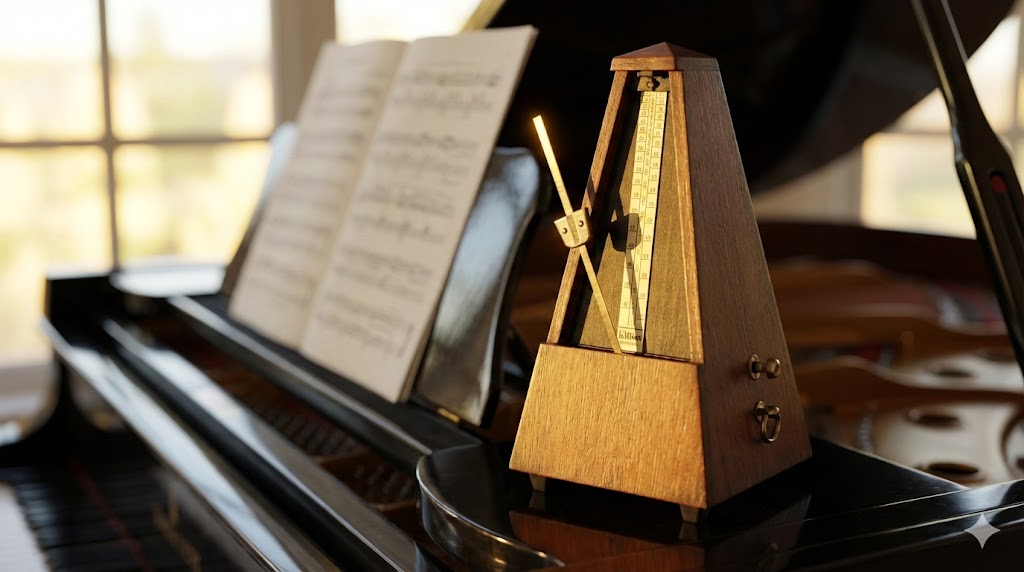
The Professional Standard: Wittner Taktell 830 or 836 (Wood Case)
- Why it works: The visual swing of the pendulum allows you to anticipate the beat, rather than reacting to it. This is crucial for navigating complex meters like 6/8 or 7/8. Plus, the wooden “tock” is percussive and organic, reducing ear fatigue during long practice sessions.
- Verdict: The absolute best investment for serious pianists.
As an Amazon Associate I earn from qualifying purchases.
Some other, mechanical or digital
As an Amazon Associate I earn from qualifying purchases.
Do Your Fingers Struggle to Keep Up?
You might understand the rhythm intellectually, but if your 4th and 5th fingers are weak, your timing will sound uneven. Precision requires physical independence.
The Solution: VariGrip Hand Exerciser (Adjustable Tension)
- Why it works: Unlike a stress ball, this tool has individual buttons for each finger. It allows you to isolate and strengthen the weak fingers (ring and pinky) that often cause rhythmic dragging in fast passages.
- Verdict: Essential for developing the “snappy” articulation needed for crisp rhythmic playing.
As an Amazon Associate I earn from qualifying purchases.
Expand Your Rhythmic Vocabulary (To Go Further)
If you want to move beyond basic 4/4 and truly master sight-reading and odd meters, you need dedicated training material.
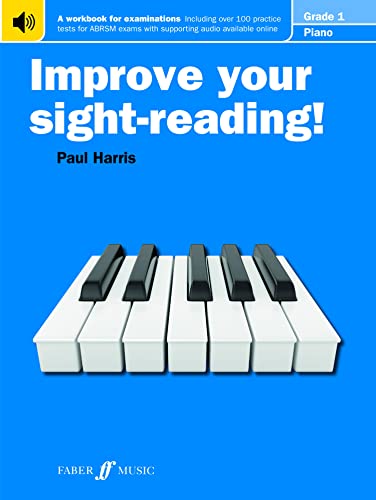
1. The Sight-Reading Bible: “Improve Your Sight-Reading!” by Paul Harris
- Target: All Levels (Grades 1-8).
- Benefit: Harris doesn’t just give you notes; he forces you to spot rhythmic patterns before you play. It changes how your brain processes sheet music.
 Kindle editionRead on Kindle ›
As an Amazon Associate I earn from qualifying purchases.
2. The Rhythmic Gym: “Rhythmic Training” by Robert Starer
- Target: Intermediate to Advanced.
- Benefit: This book strips away the melody and harmony, leaving only the rhythm. It forces you to tap complex polyrhythms and changing meters until they become second nature.
As an Amazon Associate I earn from qualifying purchases.
Conclusion
Time signatures are not merely administrative data at the start of a score. They are the DNA of the music’s movement. A 3/4 is not just “three counts”; it is the spirit of the dance. A 4/4 is the spirit of the march. A 12/8 is the rolling spirit of the blues.
To master the piano, you must move beyond typing notes. You must become an architect of time.
Start today. Look at the piece you are currently practicing. Ignore the melody for a moment. Look at the numbers. tap the rhythm. Conduct the meter. Feel the structure. When you finally put your hands back on the keys, you will find that the music flows with a new, undeniable authority.
What is the primary purpose of a time signature in music?
A time signature is a symbol placed at the beginning of a musical staff that defines the metric structure of a composition. It functions as a roadmap for the performer, indicating how many beats are contained within each measure and which specific note value serves as the fundamental unit of the pulse. By establishing this grid, the time signature dictates the “heartbeat” and gravitational flow of the music.
How do I interpret the top and bottom numbers of a time signature?
The numbers represent two distinct sets of information:
- The Top Number (Quantitative): Specifies the number of beats or pulses in each measure (e.g., 2, 3, or 4).
- The Bottom Number (Qualitative): Specifies the note value that constitutes one beat. For example, a “4” represents a quarter note (crotchet), while an “8” represents an eighth note (quaver).
What is the difference between Simple and Compound meter?
The distinction lies in how the main beat is subdivided:
- Simple Meter: Each beat is naturally divisible into two equal parts (e.g., a quarter note divides into two eighth notes). Common simple meters include 2/4, 3/4, and 4/4.
- Compound Meter: Each beat is a dotted note value naturally divisible into three equal parts (e.g., a dotted quarter note divides into three eighth notes). Common compound meters include 6/8, 9/8, and 12/8.
Why are 3/4 and 6/8 time signatures considered different if they both contain six eighth notes?
While they are mathematically identical (six eighth notes total), their metric grouping and “feel” are entirely different:
- 3/4 Time (Simple Triple): Contains three beats per measure, each being a quarter note. It is felt as “ONE-and, TWO-and, THREE-and”.
- 6/8 Time (Compound Duple): Contains two beats per measure, each being a dotted quarter note. It is felt as “ONE-two-three, FOUR-five-six,” creating a swinging, two-pulse motion.
What does the “C” symbol represent at the start of a staff?
The “C” stands for Common Time, which is simply another way of notating 4/4 time. This is the most prevalent meter in Western music, characterized by four quarter-note beats per measure. The symbol is a historical relic from medieval “imperfect” time notation.
What is Cut Time (Alla Breve) and when is it used?
Cut Time, or Alla Breve, is symbolized by a “C” with a vertical line through it ($\phi$) and represents 2/2 time. In this meter, the pulse is felt in two half-note beats rather than four quarter-note beats. It is typically used for fast marches or orchestral movements to simplify the reading of rapid passages by reducing the frequency of the conductor’s pulse.
How can I visually identify the meter without looking at the numbers?
The key is in the beaming (the horizontal lines connecting notes):
- Simple Time: Eighth notes are typically beamed in groups of two or four to reflect the binary subdivision.
- Compound Time: Notes are beamed in groups of three to signify the ternary subdivision of the pulse.
What are Asymmetrical or “Odd” Meters?
Asymmetrical meters (also known as irregular meters) have top numbers that do not divide evenly into duple or triple patterns, such as 5/4, 7/8, or 11/8. These meters often feel like they “limp” or have an uneven gait because they combine simple and compound pulses within a single measure (e.g., a 5/4 bar might be felt as a group of 3 + 2).
What is a Hemiola?
A Hemiola is a rhythmic device where the perceived meter temporarily shifts without changing the written time signature. Most commonly, it occurs in 3/4 time when two measures are articulated as if they were three measures of 2/4. This creates a sensation of the music “broadening” or slowing down, and was a favorite technique of Baroque and Romantic composers like Brahms.
How does an “Anacrusis” or Pick-up Measure affect the counting?
An Anacrusis is an incomplete measure found at the very beginning of a piece. It typically consists of one or more “upbeats” that lead into the first full measure (the downbeat). To maintain mathematical balance, the final measure of the piece is often shortened by the exact duration of the pick-up notes.
Sources & References
Mark Feezell, Music Theory Fundamentals: High-Yield Music Theory, vol. 1 (LearnMusicTheory.net).
Lawrence Martin, Basic Music Theory for Adult Beginner-Level Piano Players (Lakeside Press).
Michael Pilhofer & Holly Day, Music Theory For Dummies (Wiley Publishing).
Andy Schmitz (Ed.), Music Theory v. 1.0.
Paul Harris, Improve Your Sight-Reading! (Faber Music).
Robert Starer, Rhythmic Training (Hal Leonard).
Dave Brubeck, “Take Five” (Exemple de mesure à 5/4).
Gustav Holst, The Planets – “Mars, the Bringer of War” (Exemple de mesure asymétrique).