
A handful of melodies are known by people who have never studied music, and Brahms’ Lullaby is one of them. Its rocking left hand and gently rising tune have helped children fall asleep for generations, and for a pianist it offers a rare pleasure: a piece that everyone recognises and that a patient beginner can actually play well.
Behind the familiar tune is a song, not a piano piece. Johannes Brahms wrote the Wiegenlied for voice and piano in 1868 as a gift for Bertha Faber, a friend from his Hamburg years, on the birth of her second son, and the publisher Simrock issued it that November as the fourth of the five songs of Opus 49. Brahms is also said to have hidden a song she used to sing to him inside the melody, which makes the lullaby a private message as well as a public favourite.
This guide teaches the piano version supplied on this page. It is a simple arrangement of 16 measures in 3/4, and, as its key signature of one flat shows, it is in F major, a whole tone above the original E-flat major of Brahms’s song. The score prints very few markings, so much of the musical work, which means balancing the melody over the accompaniment, shaping the phrases and choosing when to pedal, is left to you.
Brahms’ Lullaby (Wiegenlied), Op. 49 No. 4, is a song for voice and piano in E-flat major, first published in November 1868. The PianoMode edition is a 16-measure piano arrangement in F major in 3/4 time, with a two-eighth-note pickup. It suits a beginner who can already play hands together, because the melody moves mostly by step and the left hand repeats one broken-chord pattern. The real challenge is a warm, balanced sound, not speed. The composition is in the public domain.
Below you will find the story of the song and its composer, a measure-by-measure analysis, the technical challenges, advice on tempo, a realistic four week practice method, and notes on editions and public domain status. Measure numbers follow the PianoMode edition, which treats the pickup as an unnumbered bar and numbers the first full measure 1.
About Brahms’ Lullaby (Wiegenlied), Op. 49 No. 4
Composer: Johannes Brahms (1833-1897)
Work: Wiegenlied, 5 Lieder, Op. 49 No. 4
Composed: 1868
First published: November 1868 (Simrock, Berlin)
Key: F major here (original E-flat major)
Time signature: 3/4
Form: Song melody over rocking accompaniment
Length: 16 measures plus a pickup (PianoMode edition)
Level: Beginner to early intermediate
Main challenges: Legato melody, even left hand, balance, soft pedalling
1. History of the Sheet and the Composer Behind It
Johannes Brahms
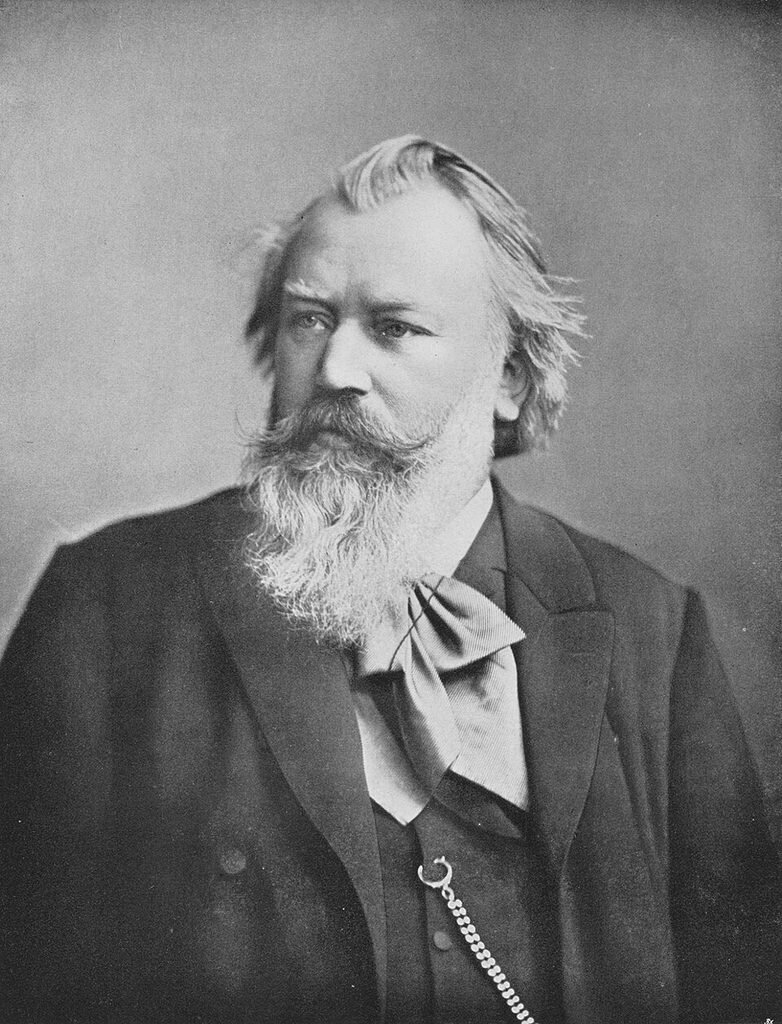
Johannes Brahms was born in Hamburg on 7 May 1833 and died in Vienna on 3 April 1897. A gifted pianist from childhood, he moved to Vienna in 1863, and the city remained his principal home for the rest of his life. He is remembered for symphonies, chamber music, piano works and a large body of songs, and the Wiegenlied shows how those skills meet: a tune simple enough for a child, supported by an accompaniment built with real craft.
A Lullaby for Bertha Faber
As a young man in Hamburg, Brahms set up a women’s choir, and Bertha, later Bertha Faber, was one of its singers. According to the accounts that survive, the two grew close, but the relationship ended, and Bertha later married Artur Faber and lived in Vienna. Brahms stayed on friendly terms with the couple, and when their second son was born in 1868 he wrote the lullaby for the occasion.
Brahms sent the music to Artur Faber with a letter, and the sense of it is well known. Bertha, he wrote, would see at once that the Wiegenlied was meant for her little one, and he thought it entirely fitting that while she sang her son Hans to sleep, a love song was being sung to her. Biographical accounts, including the one by Jan Swafford, add that the melody was shaped to suggest, as a hidden counter-melody, a song Bertha used to sing to him in their youth. Scholars have also noted that the tune partly rests on “S’Is Anderscht”, a duet by Alexander Baumann published in the 1840s.
From Song to Piano Solo
The Wiegenlied is the fourth of the five songs of Opus 49, for voice and piano, and Simrock published the set in Berlin in November 1868. Its first public performance took place in Vienna on 22 December 1869, with the singer Luise Dustmann and Clara Schumann at the piano. The text of the first verse comes from Des Knaben Wunderhorn, the collection of German folk poems edited by Achim von Arnim and Clemens Brentano, and it begins “Guten Abend, gut’ Nacht” (“Good evening, good night”).
The song was first printed with a single verse. A second verse, adapted from a poem by Georg Scherer of 1849, appears in later Simrock printings, such as a copy digitised by the Bavarian State Library, and library catalogues record the dedication on that print as “An B. F. in Wien”, meaning “To B. F. in Vienna”. Brahms also reused the tune: according to program notes, it returns in the first movement of his Second Symphony.
Because the melody is so memorable, it has been arranged for almost every instrument, including many versions for piano solo. The one on this page is a simple arrangement that keeps the melody and a rocking left-hand accompaniment, which is why it works so well as a first famous piece.
2. Musical Structure and Theory
Four Phrases of Four Measures
The PianoMode arrangement presents the melody once, in four phrases of four measures each. Each phrase ends with a two-eighth-note pickup into the next one, which gives the music its gentle, continuous motion.
| Phrase | Measures | Melody | Left hand | Printed markings |
|---|---|---|---|---|
| 1 | Pickup to 4 | Starts on A, rises to C and then F, and falls through E and D | F major, with B flat major in measure 3 | Pedal in every measure, partial fingering |
| 2 | 5 to 8 | Answers lower down, around B flat and G, then rises and settles on F | G in the bass (5 and 6), a C chord (7), F major (8) | Pedal in every measure |
| 3 | 9 to 12 | Two-note chords, then a rising line of three quarter notes and a tied C | B flat major, F major, a C chord, F major | mf in measure 9, decrescendo hairpin in measure 12 |
| 4 | 13 to 16 | Repeats the chords of phrase 3, then a short embellished fall to the final F | B flat major, F major, a C chord, F major | Pedal in every measure |
The Rocking Accompaniment
The left hand plays six eighth notes in every measure except the last, outlining a broken chord that rises and falls like the sway of a cradle. In measures 1, 2, 4, 8, 10, 12 and 14 the pattern outlines F major (F, A, C), and in measures 3, 9 and 13 it moves to B flat major (F, B flat, D). Measure 7 and measure 15 use C, G and B flat, a dominant seventh sound that pulls back toward F, and measure 11 uses C and G alone. Measures 5 and 6 begin the pattern on G, which gives a brief change of colour before the dominant returns.
This is an example of three of the most basic harmonies in tonal music: the tonic (F), the subdominant (B flat) and the dominant (C). Hearing them as a simple journey from home to away and back again makes it much easier to shape the phrases.
The Melody
The melody moves mostly by step and uses a small number of rhythms: a dotted quarter followed by an eighth in measures 1 and 3, long half notes at the ends of measures 2, 6 and 8, and pairs of eighth notes that lead into each new measure. It reaches its highest note, F, in measure 3. In phrase 3 the right hand plays two-note chords in measures 9, 10, 13 and 14, with the melody on top, and the line then rises in quarter notes in measure 11. The single embellishment of the piece is the sixteenth-note pair in measure 15.
3. Section by Section Analysis
Phrase 1: Pickup to Measure 4
The two pickup eighth notes on A set the mood, and the first line of the poem, “Guten Abend, gut’ Nacht”, fits the pickup and the first two measures. The melody then rises to the C of measure 2, reaches its peak in measure 3, and falls back through measure 4. The left hand begins with a quarter rest and starts its pattern in measure 1.
Play the opening softly. There is no dynamic printed at the start, so choose a gentle level and keep the left hand quieter than the melody.
Practice focus: Play the left-hand pattern of measures 1 to 4 until it is even and automatic, then add the melody, singing the words quietly in your head.
Phrase 2: Measures 5 to 8
The second phrase answers the first in a lower register. The melody rests on B flat and G in measures 5 and 6, and the left hand starts its pattern on G. Measure 7 introduces the dominant chord, and the long F of measure 8 settles the phrase, with an F-F pickup into measure 9.
This phrase should sound like a calm reply. Let the long notes in measures 6 and 8 last their full value without pressing.
Practice focus: Practise measures 5 to 8 hands together, taking care that the left-hand change in measure 5 does not disturb the evenness of the pattern.
Phrase 3: Measures 9 to 12
Measure 9 carries the only printed dynamic of the piece, mf, and the right hand changes to two-note chords with the melody on top. Measure 10 repeats the idea one step lower, measure 11 rises by quarter notes, and measure 12 settles with a tied C and a decrescendo hairpin.
This is the expressive centre of the arrangement. The mf is not loud, only a little fuller than the opening, so play the top note of each chord slightly more firmly than the lower note.
Practice focus: Practise the chords of measures 9 and 10 alone until the top note sings, then practise the rise of measure 11 and the diminuendo of measure 12 as one gesture.
Phrase 4: Measures 13 to 16
Measures 13 and 14 repeat the chords of measures 9 and 10. Measure 15 brings the dominant chord in the left hand and a small embellishment in the right, an eighth note followed by a sixteenth-note pair on B flat, C and B flat. The final measure holds an F for a dotted half note over the last left-hand pattern.
The ending should relax, not slow dramatically. Let the last note decay and keep your hands on the keys for a moment after it.
Practice focus: Practise measures 15 and 16 on their own, and rehearse the final release of the pedal until the last sound fades naturally.
4. Technical Challenges
An even left hand. The left hand repeats a six-note pattern in every measure. Small differences in weight or timing become obvious in such a transparent texture, so the pattern should be practised until it is perfectly steady.
Balance between the hands. The melody must sound clearly above the accompaniment. This is easier said than done when the left hand plays more notes than the right.
Two-note chords in the right hand. In measures 9, 10, 13 and 14 the right hand plays thirds. The top note carries the melody, so the chord must be played with a slightly firmer upper finger.
Long notes and silences. The half notes of measures 2, 6, 8 and 10 and the final dotted half note need to be held for their full value while the left hand continues.
Soft playing. The piece should be played quietly, but soft playing still needs a clear tone. Avoid tightening the fingers to reduce the volume.
Pedalling. The PianoMode edition marks the pedal in every measure, with a press at the start and a release near the end. This helps to connect the broken chords but also demands a clean change at each bar line.
5. Choosing the Right Tempo
The PianoMode edition prints no tempo marking, so the speed is yours to choose. The music comes from a lullaby, and the best guide is a quiet, singing pace that a person could comfortably hum while rocking a child. In 3/4, feel the three quarter-note beats of each measure, with the six eighth notes of the left hand rocking gently across them.
A practical starting point is a slow, comfortable pulse of roughly 60 quarter-note beats per minute, adjusted to what your hands can do evenly. If the left hand starts to sound hurried, slow down. If the melody loses its sense of line, you may be too slow. Recordings of the song vary, with performances running from a little under one and a half minutes to more than two minutes depending on tempo, ritardandos and whether both verses are sung. Played once through at a gentle pace, the 16 measures of this arrangement last under a minute.
A metronome helps while you are learning, but the finished performance should breathe. Allow a little more time at the ends of phrases, particularly measure 8, measure 12 and the final measure, without letting the pulse disappear.
6. How to Practice the Piece
Start with the Left Hand
The left hand is the foundation. Play measures 1 to 16 with the left hand alone, using the fingering printed in measures 1 and 3, and listen for evenness.
Learn the Melody as a Song
Sing or hum the right-hand line before you play it. Notice where the phrases begin and end, and where a singer would take a breath. Then play it with a connected touch.
Combine in Phrases
Put the hands together one phrase at a time, at a slow tempo, and stop at the end of each phrase to check the balance. Join two phrases only when each one is secure.
Add Pedal Last
Learn the notes without pedal first, so that you can hear every note clearly. Then add the pedal changes printed at each measure, and listen for blurring.
Listen to the Song
Listen to a sung version and a piano version. Notice how the singer shapes the long notes and how the accompaniment stays in the background. Use these observations to guide your own phrasing.
7. A Four Week Practice Method
This plan is a framework and not a promise. How quickly you progress depends on your reading, your experience and the amount of focused practice you can fit in.
Week 1: Reading and Fingering
Objective: Learn the notes and fingering of phrases 1 and 2 (pickup to measure 8).
Read slowly, check the key signature of one flat, and learn each hand separately. Use the printed fingering as a starting point and add your own where it is missing.
Practical tasks:
- Learn the left-hand pattern of measures 1 to 8.
- Learn the right-hand melody of the pickup to measure 8 in short groups.
- Mark the phrase endings and pickups in the score.
- Hum the melody while following the notes.
What to listen for: An even left hand, correct notes and a connected melody.
Milestone: Play phrases 1 and 2 with each hand separately and reliably.
Week 2: Coordination and Structure
Objective: Learn phrases 3 and 4 (measures 9 to 16) and join the hands.
Practise the right-hand chords of measures 9, 10, 13 and 14 alone, then combine the hands in short groups.
Practical tasks:
- Learn the left-hand pattern of measures 9 to 16.
- Practise the chords of measures 9 and 10 until the top note sings.
- Learn the embellishment of measure 15 slowly.
- Combine the hands phrase by phrase.
What to listen for: A stable pulse across the bar lines and a melody that stays above the accompaniment.
Milestone: Play the whole piece hands together slowly, with only occasional stops.
Week 3: Technique and Interpretation
Objective: Shape the dynamics and add the pedal.
Plan a gentle opening, a slightly fuller phrase 3 at the mf in measure 9, a diminuendo in measure 12, and a quiet ending. Add the pedal changes marked in every measure.
Practical tasks:
- Practise the dynamic plan at slow tempo.
- Add pedal changes measure by measure.
- Record yourself and listen for balance.
- Work on the long notes of measures 2, 6, 8 and 10.
What to listen for: A singing tone, clean pedal changes and a convincing shape across the four phrases.
Milestone: Play the complete piece with a clear dynamic plan and clean pedalling.
Week 4: Performance and Refinement
Objective: Consolidate the interpretation and play with calm confidence.
Review any passage that still feels uncertain, then play the whole piece several times without stopping. Play it for someone, or record it, to practise staying calm.
Practical tasks:
- Play the complete piece without stopping.
- Refine the ending, from measure 13 to the last note.
- Practise the final release and the silence after it.
- Focus on continuity and not on correcting every small slip.
What to listen for: An even left hand, a clear melody and a quiet, settled ending.
Milestone: Perform the piece from beginning to end with a steady pulse and a deliberate plan for each phrase.
8. Practice Tips
Sing the Melody First
Singing the line, even silently, shows you where the phrases breathe. It is the quickest way to make a simple tune sound musical.
Keep Every Left-Hand Measure Identical
The left hand repeats the same shape with small changes of notes. Aim for the same weight and timing in every measure so that the rocking never falters.
Voice the Top Note
In the chords of measures 9, 10, 13 and 14, make the upper note slightly stronger than the lower one. This keeps the melody in front without needing more volume.
Use the Printed Fingering as a Guide
The score prints fingering for some measures, including the left-hand pattern of measures 1 and 3 and the figure of measure 15. Keep it where it is comfortable, and write in your own wherever the score is silent.
Change the Pedal Cleanly
The pedal is marked in every measure. Press at the start of the bar and release near the end, and listen carefully to the moment of change.
Shape the Rise in Measure 11
The three quarter notes of measure 11 lead toward the tied C of measure 12. Let them grow slightly, then ease away in the diminuendo.
Let the Ending Decay
Do not lift your hands as soon as the last note sounds. Let it fade and hold the silence for a moment.
9. Common Mistakes
Rushing the Tempo
A lullaby should be unhurried. Speeding up makes the left hand uneven and removes the sense of calm.
Letting the Left Hand Dominate
The accompaniment has more notes, so it is easy to make it too loud. Keep it light and let the melody lead.
Playing Everything at One Volume
Only two dynamic markings are printed, so the shaping is up to you. A flat volume makes the piece sound mechanical.
Cutting the Long Notes Short
The half notes and the final dotted half note should last their full value. Lifting early breaks the line.
Blurring the Pedal
If you change the pedal late, the chords of neighbouring measures run together. Practise the changes slowly and listen.
Ignoring the Tie in Measure 12
The C in measure 12 is tied across the beat. Hold it and do not repeat it.
Slowing Down Too Much at the End
A small ritardando is natural, but a very large one breaks the pulse. Keep the ending gentle and proportionate.
10. Choosing the Right Sheet Music Edition
The PianoMode Edition
The score on this page is a one-page piano arrangement titled “Lullaby – Brahms”. It is in F major, in 3/4, with a two-eighth-note pickup and 16 measures. It prints a mf in measure 9, a decrescendo hairpin in measure 12, pedal marks in every measure, a partial fingering, and no tempo marking, slurs or phrase marks other than a tie. The PDF was created with MuseScore 2.0.2, and it carries no credit for an arranger and no copyright or licence text.
Because Brahms’s song is in E-flat major, this arrangement is a transposition a whole tone higher. For a solo pianist the difference is small, but if you plan to play along with a singer or a recording of the original, you will need to transpose or choose a score in E-flat.
Other Editions
IMSLP lists the first edition of Opus 49, published by Simrock in Berlin around 1868 (plate 323), together with later album editions. These are scores for voice and piano and show how Brahms wrote the piano part, which is a useful comparison if you want to hear the original texture. Many piano solo arrangements are also available, and the best one for you is the one with clear notation, reliable fingering and a difficulty that matches your level.
Is Brahms’ Lullaby in the Public Domain?
Brahms died in 1897, so the composition itself is in the public domain in the United States, the United Kingdom, Canada and the European Union. An arrangement is a separate work, however. Because the PDF on this page prints no arranger and no licence, you should not assume that you may redistribute it commercially, and you should check its status before sharing or reproducing it.
11. Why Learn Brahms’ Lullaby?
Brahms’ Lullaby is a very good first famous piece because it asks for the skills that matter most in the early years: a connected, singing melody, an even accompaniment, soft playing with a clear tone, phrasing that follows the breath, and a balance between the hands. None of these is flashy, but all of them make later repertoire easier.
The piece also connects you to the song tradition. A student who sings the tune before playing it learns to hear a melody as a line of words and breaths, and this habit improves every other piece. It also links to the history of Brahms himself, since the same tune returns in the first movement of his Second Symphony, according to program notes.
Finally, it is a piece you can share. Almost everyone knows the tune, and playing it quietly and well for a friend or a child is one of the most direct pleasures a beginner pianist can have.
Conclusion
Brahms’ Lullaby began as a gift for Bertha Faber and her newborn son, and it has become one of the most loved melodies in the world. The PianoMode arrangement presents it in just 16 measures, in F major, with a rocking left hand and a melody that moves mostly by step. That simplicity is what makes it a good first famous piece, and also what makes it demanding: with so little music on the page, every difference in tone, balance and timing is audible.
To learn it well, start with the left hand, sing the melody, join the hands phrase by phrase, and add the pedal last. Plan your own dynamics, because the score prints only an mf in measure 9 and a decrescendo in measure 12. Choose a gentle tempo, keep the long notes long, and let the ending fade.
When these elements come together, a simple arrangement becomes a convincing performance, and the lullaby does what it was written to do.
Who composed Brahms’ Lullaby?
Johannes Brahms (1833-1897) composed it. It is the Wiegenlied, the fourth song of his Opus 49, for voice and piano, published by Simrock in November 1868.
What is the real title of Brahms’ Lullaby?
Its title is Wiegenlied, which means “cradle song”, and it is also known by its first line, “Guten Abend, gut’ Nacht”. It is catalogued as Op. 49 No. 4.
What key is Brahms’ Lullaby in?
The original song is in E-flat major. The PianoMode arrangement is in F major, a whole tone higher, as the single flat in the key signature shows.
Why did Brahms write the lullaby?
He wrote it for his friend Bertha Faber on the birth of her second son. In a letter to her husband he explained that, as she sang her child to sleep, a love song was being sung to her.
Is Brahms’ Lullaby suitable for beginners?
It suits a beginner who can already play hands together. The melody moves mostly by step and the left hand repeats one pattern, but the quiet dynamics, the balance between the hands and the pedal changes need careful attention.
How long does it take to learn Brahms’ Lullaby?
It depends on your reading, your experience and how much you practise. The four week method above gives a realistic framework for a beginner, but progress varies from person to person.
Is Brahms’ Lullaby in the public domain?
The composition is in the public domain because Brahms died in 1897. An arrangement is a separate work, so check the rights and licence of the exact score you plan to copy or share.
Sources
- 5 Lieder, Op.49 (Brahms, Johannes). International Music Score Library Project. Lists the Simrock first edition of Opus 49 (ca. 1868, plate 323) and later album editions.
- Wiegenlied: aus Simrock’s Kinderbuch, Op. 49, No. 4 (digitised score). Bayerische Staatsbibliothek via Deutsche Digitale Bibliothek. Supports the dedication line “An B. F. in Wien” and the later printing with a second verse.
- Fünf Lieder: Op. 49. The Morgan Library & Museum. Records an early Simrock edition of Opus 49 (1868) and the contents of the set.
- Johannes Brahms. Encyclopaedia Britannica. Supports the composer’s dates, his birthplace and his move to Vienna in 1863.
- Brahms’ Lullaby: history and lyrics. Classic FM. Supports the dedication to Bertha Faber, the content of Brahms’s letter and the origin of the two verses.