A multidimensional analysis of failure factors in musical learning.
The seemingly simple question “Why can’t I do it?”, asked in the context of piano learning, masks a profound diagnostic complexity. Whether you are an adult amateur or an aspiring virtuoso, hitting an insurmountable plateau is rarely due to a simple lack of “talent” or “discipline.” These terms obscure the true mechanical, cognitive, and methodological dysfunctions at work. Piano failure is the result of a convergence of misunderstood physiological limitations, fundamental theoretical confusion, and the application of contradictory historical methodologies.
In This Article, You Will Learn :
- Direct Definitions: Understanding the core terms behind musical progress.
- The Theoretical Gap: How “musical illiteracy” creates physical tension.
- Biomechanical Barriers: Why the 4th finger (ring finger) is anatomically restricted.
- Historical Methods: The war between the “Finger School” and the “Weight School.”
- Adult Psychology: Why the “Intellectual-Physical Gap” leads to frustration.
- Diagnostic Table: A quick guide to identifying and fixing your technical pain.
Pianistic stagnation occurs when the musical demands of a piece exceed the adaptive capacities of the student’s neuromuscular or cognitive systems. This failure is rarely due to a lack of “discipline” but is rather the result of an interference between three pillars: inefficient biomechanics (relying on extrinsic muscles instead of arm weight), theoretical gaps (reading note-by-note instead of recognizing patterns), and psychological barriers (perfectionism causing physical locking). To break through a plateau, a student must transition from “fighting” the instrument to aligning their anatomy with the physics of the piano.
Introduction: The Polyfactorial Nature of Musical Impasse
The seemingly simple question, “Why can’t you do it?”, asked in the context of piano learning, masks a profound diagnostic complexity. When a student, whether an adult amateur or an aspiring virtuoso, reaches an insurmountable plateau, the answer rarely lies in a singular lack of “talent” or “discipline.” These terms, often used as catch-all explanations, obscure the true mechanical, cognitive, and methodological dysfunctions at play. A rigorous analysis of pedagogical and scientific literature reveals that piano failure is the result of a convergence of misunderstood physiological limitations, fundamental theoretical confusions, age-specific psychological barriers, and the application of contradictory historical methodologies.
This report proposes to deconstruct the mechanisms of musical failure. It is not merely about cataloging errors but examining the dynamic interaction between the human organism and the instrument. The piano, as a machine, demands biomechanical efficiency comparable to elite sports, while the score requires cognitive processing of extreme density. Stagnation occurs when the demands of the music exceed the student’s neuromuscular or cognitive system’s ability to adapt. By dissecting hand anatomy, the physics of piano action, fundamental music theory, and the psychology of skill acquisition, we can build a complete taxonomy of the obstacles that prevent mastery.
1. The Lack of Music Theory
A major cause of technical failure, often underestimated, is insufficient theoretical understanding. The student who “cannot do it” physically is often a student who does not intellectually understand what they are reading. The brain, overloaded by note-by-note decoding, cannot send fluid motor signals to the hands, creating physical tension that is, in reality, a manifestation of mental confusion.
The Critical Importance of Intervals and Scales
Fluency at the piano depends on the ability to recognize patterns rather than individual notes. Fundamental music theory, particularly the understanding of whole steps and half steps (tones and semitones), is often under-taught, depriving the student of essential tools for reading and execution.
The inability to instantly identify intervals (intervals), the distance between two notes, forces the pianist to spatially recalculate every movement, slowing down execution and breaking the musical flow. Mastery of major, minor, perfect, augmented, and diminished intervals is the foundation of chord construction and harmonic understanding. Without this, a sequence of chords is just a series of arbitrary finger positions, difficult to memorize and execute, rather than a logical progression like I-IV-V or ii-V-I that can be cognitively anticipated.
Furthermore, a lack of knowledge regarding scale structure (major and minor) prevents the student from understanding the “topography” of the key in which they are playing. Knowing that a major scale follows the whole step-whole step-half step-whole step-whole step-whole step-half step (tone-tone-semitone-tone-tone-tone-semitone) pattern allows the hand to anticipate black and white keys, reducing cognitive load and favoring fluid execution.
Rhythmic Confusion: Simple and Compound Meters
Another frequent source of failure is the misunderstanding of rhythmic structures, particularly the distinction between simple and compound meters.
- Simple Meter (Simple Time): The beat (pulse) naturally divides into two equal parts (e.g., 2/4, 3/4, 4/4). The upper number indicates the number of beats, and the lower number indicates the beat unit.
- Compound Meter (Compound Time): The beat divides into three parts (e.g., 6/8, 9/8, 12/8). Here, the upper number indicates the number of subdivisions, not main beats, which often creates major confusion for beginners who try to count six beats in a 6/8 measure instead of two ternary beats.
The inability to internalize this difference leads to mechanical, arrhythmic, or unstable executions. The student fails not because their fingers are slow, but because their internal clock is poorly calibrated relative to the piece’s metric structure.
The Absence of Harmonic Analysis
Failure in memorization and interpretation often stems from purely melodic reading. Pianists who do not perceive the vertical (harmonic) structure, major, minor, diminished triads, and seventh chords—lack structural landmarks. Understanding that a chord is a triad in first inversion (e.g., E-G-C for a C Major chord) allows the hand to form in anticipation of the chord rather than searching for each note individually. Harmonic analysis, using Roman numerals to describe the progression, transforms a page of complex notes into a coherent and manageable story.
Master Your Pulse & Rhythmic Precision
As an Amazon Associate I earn from qualifying purchases.
2. The Biomechanical Barrier: Hard Hands Independence
If the theoretical deficit paralyzes intention, biomechanical reality paralyzes action. The fundamental tragedy of piano technique lies in the divergence between the linear and uniform design of the keyboard and the unequal, interdependent anatomy of the human hand. Technical failure occurs when pedagogy attempts to force the hand to behave like an abstract machine rather than a biological organism.
The Anatomical Reality of the Hand
The human hand is not made of five independent pistons of equal strength. It is a complex system of levers operated by extrinsic muscles (in the forearm) and intrinsic muscles (in the hand).
Extrinsic vs. Intrinsic Musculature
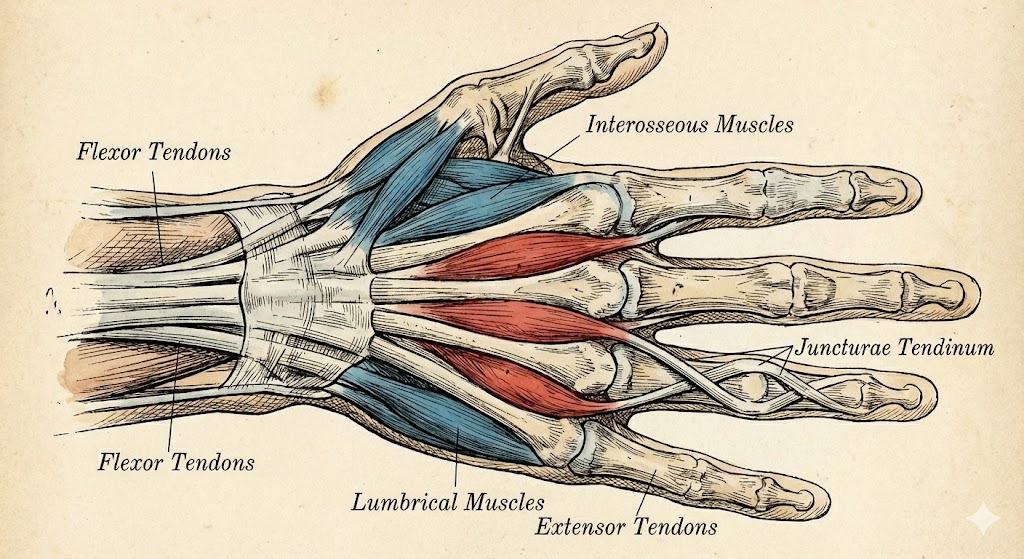
Primary finger flexion (curving) and extension (straightening) strength comes from extrinsic muscles in the forearm: the flexor digitorum profundus and flexor digitorum superficialis for flexion, and the extensor digitorum for extension. These muscles are connected to the fingers by long tendons passing through the carpal tunnel. Excessive reliance on these muscles to generate force is a primary source of tension and tendonitis (tendinitis), as they are far from the point of action and, when over-solicited, stiffen the wrist.
Conversely, the intrinsic muscles, the lumbricals and interossei, are located in the palm. These muscles are crucial for fine motor control, speed, and stabilizing the finger joints. The interossei allow for abduction and adduction (lateral movement) of the fingers, while the lumbricals assist in flexing the metacarpophalangeal joints (knuckles) while extending the phalanges. Research indicates that expert pianists use these intrinsic muscles more effectively than novices, allowing for fast, precise movements without the metabolic cost and tension associated with extrinsic muscle overuse. Failure to activate these muscles leads to a technique where the hand arch collapses, forcing forearm muscles to compensate, leading inevitably to fatigue and injury.
The Fourth Finger Paradox
The most persistent source of technical failure is the anatomical interdependence of the fingers, specifically the fourth finger (ring finger). The tendons of the extensor digitorum are connected by fibrous bands called juncturae tendinum. These connections physically bind the fourth finger to the third and fifth fingers, making independent extension (lifting the finger) biomechanically impossible beyond a certain range.
Historical pedagogies that demanded “lifting fingers high” (the Finger School) ignored this constraint, instructing students to force the fourth finger to lift as high as the others. This practice is not only futile but dangerous, creating excessive tension as the extensor muscles fight against their own connective tissues. The inability to play an even trill with the 3rd and 4th fingers is not a failure of will; it is a failure of the method to recognize anatomy.
Hand Exerciser / Varigrip (to target intrinsic muscles specifically).
As an Amazon Associate I earn from qualifying purchases.
2. The Physics of Sound Production
The piano is a percussion instrument. Sound is produced by a hammer striking a string. Once the key is depressed and the hammer is in flight, the pianist no longer has any control over the sound. This physical reality dictates that any pressure exerted at the bottom of the key after the sound is produced is wasted energy, contributing to tension without altering the musical result.
Force, Velocity, and Mass
Sound volume is determined solely by the velocity of the hammer at the moment of impact. According to the law $F=ma$, to generate a loud sound (forte), high key acceleration is required. This can be achieved in two ways:
- Muscular Force: Using the small muscles of the fingers and forearm to strike the key.
- Gravitational Weight: Using the mass of the arm (which constitutes about 5-6% of body weight) to accelerate the key.
Novices often fail because they rely exclusively on muscular force (Method 1). To play louder, they tense the forearm, which creates a harsh sound and leads to rapid fatigue. Expert technique relies on the effective transfer of arm weight (arm weight) (Method 2). By releasing the arm’s weight into the keyboard, the pianist can generate massive power with minimal muscular effort. The finger does not serve as a hammer but as a conduit—a firm pillar (bridge) that supports the arm’s weight. Failure to master this “arm weight” concept results in a thin sound and a physical ceiling on dynamic range and endurance.
3. Conflicting Piano Methods
The history of piano technique is marked by a conflict between two opposing philosophies: the Finger School and the Weight School. The confusion resulting from these contradictory instructions is a major contributor to student failure. A student instructed to “lift fingers high” by one teacher and to “relax the arm” by another risks developing a dysfunctional hybrid technique accumulating tension and lack of control.
The Finger School: Isolation and Articulation
Dominant in the 18th and early 19th centuries (associated with the harpsichord and light fortepiano), this school emphasizes developing fingers as independent mechanical levers. The arm and forearm remain relatively still, and the fingers perform the work from the knuckles.
- Methodology: High finger lift, isolation exercises (holding some keys down while playing with others), and mechanical repetition of patterns (Hanon, Czerny).
- Purpose: To build “strength” and independence.
- Failure Mode: On modern pianos, which have heavier actions and greater key depth than 18th-century instruments, this technique is insufficient. Relying solely on finger musculature leads to tension accumulation in the forearm (co-contraction of flexors and extensors), resulting in tendonitis and carpal tunnel syndrome. The instruction to “lift high” is particularly damaging, as it needlessly engages weaker extensor muscles, creating tension before the note is even played.
The Weight School (Arm Weight): Relaxation and Gravity
Emerging in the late 19th and 20th centuries (associated with Chopin, Liszt, and the Russian School), this approach views the playing mechanism as a holistic unit involving the shoulder, arm, wrist, and hand.
- Methodology: Using gravity to “drop” arm weight into the keys, supple wrists, and forearm rotation.
- Purpose: To produce a resonant, singing tone and prevent injury by using larger muscle groups.
- Failure Mode: A misunderstanding of “relaxation” leads to “floppiness.” If the wrist and fingers are too relaxed, they collapse under the arm’s weight, leading to a dull, indistinct sound and a lack of articulation. The Weight School requires a firm (but not tense) bridge in the hand to support the weight; without intrinsic muscle activation, arm weight is useless. Furthermore, total “relaxation” is a myth; effective playing requires controlled muscle tone, not total flaccidity.
The Synthesis: The Modern Biomechanical Approach
Contemporary pedagogy, informed by sports science and performing arts medicine, seeks to reconcile these schools. The consensus is that finger activity must be supported by arm mobility. The fingers articulate, but the arm carries the hand to the optimal position for each strike. Forearm rotation (as taught by the Taubman approach) is essential for relieving the fingers, particularly the weak 4th and 5th fingers. Failure often occurs when a student adheres dogmatically to one school while ignoring the biomechanical necessity of the other.
4. Practice Pathologies and Technical Exercise
The prescription of technical exercises is a contentious area. The blind application of traditional exercises without understanding their physiological purpose is a primary cause of injury and stagnation.
Hanon: The Virtuoso Pianist
The exercises of Charles-Louis Hanon are ubiquitous but highly controversial.
- The Utility: They provide predictable and symmetrical patterns excellent for warming up, learning keyboard geography, and practicing transposition. They can be useful for developing basic hand coordination.
- The Risk: Hanon’s original instructions—”lift fingers high”—are physiologically unsound and dangerous on a modern piano. Following them to the letter promotes tension and dissociates the finger from the arm.
- The “Jailbreak” (Hacking): Modern pedagogy suggests “hacking” Hanon: use the note patterns but ignore the instructions. Instead of lifting fingers high, students should apply rotation, arm weight, and rhythmic variations to the patterns. Used this way, Hanon becomes a canvas for teaching ergonomic movement rather than a finger-strengthening exercise.
 Kindle editionRead on Kindle ›
As an Amazon Associate I earn from qualifying purchases.
Czerny: The School of Velocity
Carl Czerny’s etudes (studies) are often contrasted with Hanon.
- The Utility: Unlike Hanon’s sterile patterns, Czerny’s etudes are musical compositions with harmonic progressions and melodic contours. They present specific technical challenges (arpeggios, scales, repeated notes) in a musical context, bridging the gap between pure exercise and repertoire.
- The Risk: Like Hanon, they can be played mechanically. However, because they require phrasing and musicality (even dynamic nuances), they generally encourage a more musical and therefore more relaxed approach than Hanon.
 Kindle editionRead on Kindle ›
As an Amazon Associate I earn from qualifying purchases.
Advanced Studies: Pischna, Brahms, and Dohnányi
Premature or incorrect use of these collections is a frequent cause of tendonitis in ambitious intermediate students.
- Pischna: Known for “holding” exercises where certain fingers hold keys down while others play. These are extremely dangerous for the unguided student. They force fingers to work against anatomical connections (juncturae tendinum), creating maximum tension. They should only be attempted by advanced students under expert supervision to develop independence through relaxation, not force.
- Brahms (51 Exercises) & Dohnányi: These exercises are intended for advanced pianists to maintain technique. They focus on polyrhythms, large extensions, and independence. They serve as “vitamins” for the virtuoso but can be “poison” for the beginner with fundamental tension issues.
- Cortot (Rational Principles): Alfred Cortot proposes an analytical approach, transforming technical difficulties into musical logic exercises. Highly effective for developing finger independence and keyboard awareness, they require intellectual and physical maturity. The common error is practicing them too fast or too hard, ignoring Cortot’s instructions on touch quality and suppleness.
The Myth of Digital “Strength”
A pernicious belief is that exercises build finger “strength” like weightlifting builds biceps. Fingers do not contain muscles; they are moved by tendons. “Strength” at the piano is actually coordination and efficiency. It is the ability to recruit the right muscle fibers at the right time and release them immediately after. Mindless repetition builds endurance for tension, not true technique. Repertoire-based technical work (e.g., isolating passages from Bach or Chopin) is often more effective because it resolves specific musical problems rather than mechanical abstractions.
5. The Psychology of Stagnation: Why Adults Fail
While biomechanics explain how a student fails physically, psychology explains why they fail to correct their errors. The adult learner faces cognitive and emotional barriers distinct from those of a child.
The Intellectual-Physical Gap
Adults possess fully developed cognitive faculties. They can quickly grasp complex theoretical concepts, harmonies, structures, patterns. However, their motor adaptation rate is slower than that of children. This creates a painful divergence: “The mind learns faster than the hands.” An adult can visually read a passage and intellectually understand it in seconds, but the neuromotor pattern required to execute it can take weeks to consolidate.
- The Result: Impatience and frustration. The adult interprets this delay not as a natural phase of motor learning, but as a personal failure or a lack of “gift.” This leads to “rushing” practice, skipping the slow, deliberate repetition necessary for myelination, thereby encoding carelessness and insecurity into muscle memory.
The “Drill Sergeant” and Perfectionism
Adult learners are often tormented by a severe inner critic—the “Drill Sergeant”—who demands immediate competence. Unlike children, who are used to the role of a novice, adults are often experts in their professional lives and find the vulnerability of a beginner psychologically intolerable.
- Perfectionism as Paralysis: The desire to play without error leads to tension. Fear of wrong notes causes the performer to “lock” their movements, stiffening muscles and reducing fluidity. This anxiety creates a feedback loop: fear leads to tension, tension leads to technical failure, and failure reinforces fear.
- Unrealistic Expectations: Many adults underestimate the complexity of the instrument, expecting to play advanced repertoire (e.g., La Campanella or Bach Fugues) within months. When reality fails to meet these expectations, motivation collapses.
Neuroplasticity and Unlearning
Although the adult brain retains plasticity, the process of overwriting established motor patterns is difficult. A self-taught student who has spent years playing with a collapsed wrist or tensed shoulders has myelinated those neural pathways. “Unlearning” these bad habits is often harder than learning from scratch. The feeling of “regressing” to correct technique is a major psychological hurdle that causes many to abandon formal study.
6. Terminological and Cultural Confusion
A less obvious but significant source of friction for international or self-taught students is the terminological divergence between the American and British/Commonwealth systems. A student using a British method while watching American YouTube tutorials may encounter major cognitive dissonance regarding rhythm and theory, slowing down the understanding of core concepts.
Rhythmic Terminology Conversion
The American system uses fractional names based on the German system (Whole, Half, Quarter), which are mathematically intuitive. The British system uses archaic terms derived from medieval mensural notation.
| American Term (US/Canada) | British Term (UK/Commonwealth/IN) | Relative Value |
| Double Whole Note | Breve | 2 |
| Whole Note | Semibreve | 1 |
| Half Note | Minim | 1/2 |
| Quarter Note | Crotchet | 1/4 |
| Eighth Note | Quaver | 1/8 |
| Sixteenth Note | Semiquaver | 1/16 |
| Thirty-Second Note | Demisemiquaver | 1/32 |
| Sixty-Fourth Note | Hemidemisemiquaver | 1/64 |
Cadence Confusion
Confusion also reigns in harmony, essential for understanding musical phrase structures.
- Authentic Cadence (US) = Perfect Cadence (UK) (V-I progression).
- Half Cadence (US) = Imperfect Cadence (UK) (Ending on V).
- Deceptive Cadence (US) = Interrupted Cadence (UK) (V-vi progression).
Failing to understand these terms can lead to theoretical confusion during structural analysis, which is essential for memorization and interpretation.
7. Technical Diagnosis and Advices
When a student says “I can’t do it,” the obstacle usually manifests through specific technical pathologies. Here is a summary of symptoms and corrections based on the preceding analysis.
Diagnostic Table of Common Failures
| Symptom | Probable Cause (Mechanism) | Recommended Correction |
| Pain on the pinky (ulnar) side of the wrist | Ulnar Deviation: Lateral twisting of the wrist to reach notes instead of moving the arm. | Neutral wrist alignment; lateral movement of the entire arm. |
| Rapid fatigue, harsh sound | Co-Contraction: Simultaneous contraction of flexors and extensors; static hand without rotation. | “Active relaxation”; incorporate forearm rotation; use gravity/arm weight. |
| Weak sound, lack of precision | Collapsed Arches: Weakness of intrinsic muscles; knuckles (MCP joints) inverting. | Intrinsic strengthening exercises; maintain a firm hand structure to transmit weight. |
| “Bump” or “Lump” in scales | Thumb Under: Excessive twisting to pass the thumb under the hand. | Adopt “Thumb Over” or lateral shifting; the thumb acts as a pivot, the arm carries the hand. |
| Reading blocks / Hesitation | Theoretical Deficit: Note-by-note reading; misunderstanding of key signatures or chords. | Harmonic analysis (Roman numerals); recognition of intervals and chord shapes (triads, 7ths). |
Recommended Toolbox
To break your stagnation and align your technique with the biomechanical principles discussed above, we recommend the following professional-grade tools:
Professional Metronome: For mastering complex Time Signatures (Time Signatures) and steady pulse.
As an Amazon Associate I earn from qualifying purchases.
Adjustable Piano Bench: The foundation of Arm Weight (Arm Weight) and healthy posture.
As an Amazon Associate I earn from qualifying purchases.
Hanon & Czerny Editions: The essential “hacker” canvas for technical development.
Kindle editionRead on Kindle ›As an Amazon Associate I earn from qualifying purchases.
Kindle editionRead on Kindle ›As an Amazon Associate I earn from qualifying purchases.
Intrinsic Hand Exerciser: To strengthen the palm, hands, and prevent Tendonitis (Tendinitis).
As an Amazon Associate I earn from qualifying purchases.
LED Piano Lamp: High-quality lighting to prevent eye strain during Sight-Reading (Lecture à vue).
As an Amazon Associate I earn from qualifying purchases.
Conclusion
The answer to “Why can’t you do it?” is rarely an absence of innate capacity. It is almost always the presence of interference.
- Physical Interference: The student fights their own anatomy by using extrinsic muscles for tasks requiring intrinsic support, or by stabilizing joints through co-contraction rather than skeletal alignment.
- Psychological Interference: The adult learner inhibits their own motor learning through perfectionism, creating a stress response that physically locks the playing mechanism.
- Pedagogical Interference: Applying 19th-century mandates (“absolute finger independence,” mechanical Hanon) to a task that requires 21st-century physics (arm weight, rotation, ergonomics).
- Theoretical Interference: Harmonic and rhythmic illiteracy turns music reading into a laborious decoding process, overloading the brain and preventing fluidity.
Success in piano study is not the conquest of the instrument through force; it is the alignment of the body’s natural mechanics with the physics of the instrument and the logic of music theory. When the student stops fighting the mechanism and begins collaborating with gravity, anatomy, and theory, the question changes from “Why can’t I?” to “How does it work?” and that is the beginning of mastery.
Why am I stuck at a plateau despite practicing every day?
Piano stagnation occurs when your musical goals exceed the current efficiency of your biomechanical or cognitive systems. Daily practice is only effective if it targets the root cause of the impasse. Most plateaus are not caused by a lack of “discipline” but by inefficient biomechanics (using forearm tension instead of arm weight), theoretical gaps (reading note-by-note instead of recognizing harmonic patterns), or psychological locking (perfectionism causing physical tension). To break through, you must shift from mechanical repetition to diagnostic practice.
Is my fourth finger (ring finger) naturally weak, or am I doing something wrong?
The perceived weakness of the fourth finger is a biological reality caused by the juncturae tendinum, which are fibrous bands connecting the extensor tendons of the third, fourth, and fifth fingers. This anatomical link makes independent vertical lifting of the fourth finger physically impossible beyond a limited range. Traditional methods that demand “lifting fingers high” often lead to injury. Instead of forcing independence through strength, modern technique uses forearm rotation and lateral arm movement to support the fourth finger, bypassing its anatomical limitations.
What is the “Theoretical Gap,” and how does it cause physical tension?
The “Theoretical Gap” is a state of musical illiteracy where the pianist lacks the harmonic and structural understanding to anticipate the music. When your brain is overloaded by decoding individual notes (rather than seeing a “C Major triad” or a “ii-V-I progression”), it cannot send fluid motor signals to the hands. This cognitive overload manifests as physical tension, the body’s natural response to mental confusion. Mastering intervals, scales, and harmonic analysis reduces the cognitive load, allowing the body to remain relaxed.
Should I use Hanon or Czerny exercises to fix my technique?
Hanon and Czerny are effective tools only when “hacked” with modern biomechanical principles. – Hanon: Useful for keyboard geography and symmetry, but the original instructions to “lift fingers high” are dangerous on modern heavy-action pianos. You should apply arm weight and rotation to these patterns.
- Czerny: Superior for bridging the gap between exercises and repertoire because they involve harmonic progressions and musical phrasing, which naturally encourage better muscle tone. Mindless repetition of either will only build “endurance for tension” rather than true technical facility.
What is the difference between the “Finger School” and the “Weight School”?
The Finger School and Weight School represent two opposing philosophies of sound production and piano technique.
- Finger School: Emphasizes isolated finger movement and high articulation (knuckle-based). While precise, it often leads to co-contraction (tension) and injury on modern instruments.
- Weight School: Focuses on using gravity and the mass of the arm to accelerate the keys. It produces a deeper, “singing” tone. The modern expert approach is a synthesis: the fingers provide the precision and firm “bridge,” while the arm provides the power and mobility.
Why do adults find piano learning more frustrating than children?
The primary hurdle for adults is the “Intellectual-Physical Gap,” where cognitive understanding outpaces motor development. Adults can quickly analyze complex music but their neuromotor patterns (myelination) take longer to consolidate. This leads to impatience and a “Drill Sergeant” inner critic that causes physical locking. Adult learners must accept the biological pace of motor learning and focus on slow, deliberate practice to overwrite old habits or encode new ones correctly.
Why do my hands feel “heavy” when I try to play fast?
Hand heaviness is usually caused by “Extrinsic Muscle Overload,” a condition where the muscles in your forearm stay contracted, acting like a brake on your movement. This happens when you attempt to play with finger “strength” instead of using Arm Weight and Rotation. To fix this, you must practice Active Relaxation, consciously releasing muscle tension the micro-second after a key is played. Speed is a result of efficiency, not effort.