As an Amazon Associate, PianoMode earns from qualifying purchases. Recommendations are made on their merits; the price you pay is the same.
The initial encounter with a piano often triggers a profound sense of overwhelming complexity. To the novice, the vast expanse of 88 alternating black and white keys presents a labyrinth of indistinguishable pitches and mysterious patterns. This sensory inundation is a common milestone in the developmental journey of any musician. However, as the structural logic of the instrument reveals itself, the intimidating facade of the keyboard transforms into a highly organized, linear map of Western musical thought. The journey from visual confusion to cognitive mastery involves breaking down the keyboard into its fundamental architectural units, understanding the relationship between physical keys and abstract notation, and recognizing the underlying mathematical and physical principles that govern every sound produced. This report provides a comprehensive analysis of the piano keyboard layout, the nomenclature of notes, the physics of pitch, and the pedagogical strategies used to achieve fluency.
What you will learn in this guide:
- The architectural logic of the 88-key layout.
- How to use the black key groups as a primary navigational system.
- The relationship between the musical alphabet and the white keys.
- A deep dive into accidentals (sharps and flats) and enharmonic equivalents.
- The physical connection between the keyboard and the musical staff.
Understanding the piano keyboard requires recognizing a repeating 12-note pattern consisting of seven white keys (naturals) and five black keys (sharps and flats). This layout is visually anchored by groups of two and three black keys, which serve as geographic landmarks for identifying notes. A standard piano features 88 keys, spanning over seven octaves, anchored by Middle C (C4). This physical interface mirrors the grand staff of musical notation, where the treble and bass clefs categorize notes by register. Mastery is achieved through a combination of landmark identification, understanding the physics of intervals, and the cognitive mapping of scales and chords.
1. The Evolutionary Architecture of the Keyboard
The modern piano keyboard is the culmination of over two millennia of technological and musical refinement. Its origins can be traced back to the monochord of ancient Greece, a single-stringed device used to investigate the mathematical ratios of intervals. By the 11th century, primitive keys were applied to monochords and early organs to provide a standardized method for striking strings at specific points to produce intended pitches.
The 14th century marked the arrival of the clavichord, an instrument that utilized metal blades called tangents to strike strings, offering a range of four to five octaves. While the clavichord allowed for subtle dynamic variations through finger pressure, its volume was insufficient for public performance. The subsequent emergence of the harpsichord around 1500 resolved the volume issue by using a plectrum to pluck strings. However, the harpsichord lacked dynamic expression; the strings were plucked with uniform force regardless of how the keys were depressed.
The pivotal breakthrough occurred in 1700 when Bartolomeo Cristofori of Italy, a harpsichord maker, sought to combine the dynamics of the clavichord with the volume of the harpsichord. By replacing the plucking mechanism with a sophisticated hammer-and-lever system, Cristofori created the gravicembalo col piano e forte, the harpsichord with soft and loud. This mechanism, which used hammers to strike strings and allowed them to ring or be dampened by releasing the key, formed the basis of the modern piano.
The Expansion to 88 Keys
Early pianos by Cristofori and his contemporaries typically possessed 49 to 54 keys, covering a range of approximately four octaves. As musical composition evolved, particularly through the works of Mozart and Haydn, composers began to exhaust the available range of their instruments. By the early 19th century, Beethoven’s “Hammerklavier” Sonata pushed piano makers to extend the keyboard to accommodate notes that did not yet exist on standard models.
The 88-key standard was finalized in the 1880s, largely through the efforts of manufacturers like Steinway & Sons. This standard range, comprising 52 white keys and 36 black keys, spans 7.25 octaves from A0 to C8. This range is optimized for the human auditory system; frequencies below the 27.5 Hz of A0 are perceived more as vibrations than tones, while frequencies above the 4186 Hz of C8 lose their tonal character and sound as dissonant noise.
2. Cognitive Mapping and Keyboard Geography
The most critical skill for a beginning pianist is the development of a mental map of the keyboard’s geography. This process is not a matter of memorizing 88 individual keys but rather recognizing the repeating 12-note sequence that defines Western music.
Visual Anchors: The Black Key Groupings
The arrangement of black keys into alternating sets of twos and threes is the primary visual reference point for all keyboard navigation. Without these groupings, the white keys would be indistinguishable from one another.
- The Two-Black-Key Group: The white key situated immediately to the left of any pair of black keys is C. The white key nestled between the two black keys is D, and the key to the immediate right is E.
- The Three-Black-Key Group: The white key immediately to the left of a group of three black keys is F. The two white keys found within the three-black-key group are G and A, respectively. The white key to the immediate right of the third black key is B.
This sequence (C-D-E-F-G-A-B) constitutes one octave. Once a student can identify these landmarks, they can locate any of the natural notes across the entire 88-key range by simply scanning for the black key clusters.
The Landmark System and Middle C
In pedagogical practice, the “Landmark System” is often preferred over the rote memorization of individual keys. This system identifies specific keys as anchors from which other notes are measured. The most significant of these is Middle C (C4), which is generally located near the center of the keyboard and serves as the bridge between the treble and bass clefs in notation.
Other common landmark keys include Treble G (G4) and Bass F (F3). By memorizing these locations, a student can quickly calculate the positions of neighboring notes, fostering a more intuitive understanding of keyboard layout than traditional mnemonic devices like “Every Good Boy Does Fine”.
3. The Mathematical Physics of Pitch and Octave Designations
Musical pitch is a sensation produced by the frequency of sound waves, measured in Hertz (Hz). The piano layout is a physical manifestation of specific mathematical ratios that define the relationships between these frequencies.
The Ratio of the Octave
The most fundamental relationship in music is the octave, which occurs when a frequency is either doubled or halved. For instance, A4 is standardized at 440 Hz. The pitch exactly one octave higher, A5, vibrates at 880 Hz. When these two notes are played simultaneously, the brain perceives them as the “same” note because their wave peaks align perfectly, a phenomenon known as octave equivalence.
Scientific Pitch Notation (SPN) vs. Helmholtz
To provide clarity across the various octaves of an 88-key piano, musicians utilize specific labeling systems. Scientific Pitch Notation (also known as American Standard Pitch Notation) combines a letter name with an integer identifying the octave, with each new octave beginning at the note C. In contrast, the Helmholtz system uses upper and lower case letters combined with primes (‘) or subscripts.
| Pitch Class | Scientific Pitch Notation (SPN) | Helmholtz Notation | Frequency (Hz) |
| Sub-Contra A | A0 | A,, | 27.50 Hz |
| Contra C | C1 | C, | 32.70 Hz |
| Great C | C2 | C | 65.41 Hz |
| Small C | C3 | c | 130.81 Hz |
| Middle C | C4 | c’ | 261.63 Hz |
| Tuning Reference A | A4 | a’ | 440.00 Hz |
| Two-Line C | C5 | c” | 523.25 Hz |
| Three-Line C | C6 | c”’ | 1046.50 Hz |
| Four-Line C | C7 | c”” | 2093.00 Hz |
| Five-Line C | C8 | c””’ | 4186.01 Hz |
Mathematics of Equal Temperament
Modern pianos are tuned using Equal Temperament, a system that divides an octave into twelve semitones with an identical frequency ratio between each adjacent key. This ratio is precisely the twelfth root of two, or approximately 1.059463. This constant ratio allows a pianist to play in any of the 12 musical keys with consistent relative intervals, facilitating transposition.
To raise a note by n semitones, the frequency is multiplied by 1.059463n. Consequently, moving up 12 semitones (one octave) results in a frequency multiplication of 2, while moving up 7 semitones (a perfect fifth) results in a multiplication of approximately 1.5 (a 3:2 ratio).
4. The Language of Accidentals and Enharmonics
While the white keys represent the natural notes (A, B, C, D, E, F, G), the black keys represent “accidentals”, notes that are chromatically altered. The naming of these keys depends entirely on the musical context or the direction of movement.
- Sharp (#): Indicates a note raised by one half step. For example, C# is the black key immediately to the right of C.
- Flat (b): Indicates a note lowered by one half step. For example, Db is the black key immediately to the left of D.
- Natural (natural): A symbol used to cancel a previously applied sharp or flat, returning the key to its natural white-key state.
Enharmonic Equivalence
The piano keyboard is the ultimate visualizer for Enharmonic Equivalence, the principle where two different names refer to the same physical key. Because a black key can be approached from the left (raising a note) or the right (lowering a note), it possesses two names that sound identical. C# and Db are enharmonically equivalent, as are F# and Gb. This concept also applies to white keys; because there is no black key between E and F, E# is the enharmonic equivalent of F natural, and Fb is the enharmonic equivalent of E natural.
5. Theoretical Structures: Scales and Modes
The layout of the piano mirrors the sequence of whole and half steps that define Western scales. This visual organization allows the keyboard to act as a map for complex musical concepts.
Heptatonic Scale Patterns
The most common scales are heptatonic (seven-tone) scales. The pattern of whole steps (W) and half steps (h) determines the character of the scale.
- Major Scale Pattern: W-W-h-W-W-W-h. This pattern is naturally occurring on the white keys starting from C to C (C Major).
- Natural Minor Scale Pattern: W-h-W-W-h-W-W. This pattern is naturally occurring on the white keys starting from A to A (A Natural Minor).
The Three Forms of the Minor Scale
Music theory recognizes three distinct forms of the minor scale, each used to satisfy different melodic or harmonic requirements.
| Scale Form | Characteristic Feature | Purpose |
| Natural Minor | Standard sequence: W-h-W-W-h-W-W. | The diatonic foundation. |
| Harmonic Minor | Raises the 7th note by one half step. | Creates a “leading tone” for stronger harmonic resolution. |
| Melodic Minor | Raises both 6th and 7th notes when ascending; reverts to natural minor when descending. | Avoids the large gap between 6 and 7 in the harmonic minor for smoother melodies. |
Introduction to Modes
Beyond major and minor scales, the keyboard layout illustrates the Church Modes, which are also heptatonic scales built using only the white keys but starting on different notes.
- Ionian: C to C (identical to the Major scale).
- Dorian: D to D. Used frequently in jazz and folk music.
- Phrygian: E to E. Characterized by its dark, Spanish-flavored sound.
- Lydian: F to F. Features an augmented fourth, creating a bright, ethereal sound.
- Mixolydian: G to G. Common in rock and blues.
- Aeolian: A to A (identical to the Natural Minor scale).
- Locrian: B to B. The most unstable mode due to its diminished fifth.
6. Architectural Harmony: Intervals and Chords
A deeper understanding of the keyboard allows for the visualization of harmony. Chords are formed by combinations of intervals, which measure the distance between any two pitches.
The Hierarchy of Intervals
Intervals are identified by their quantity (the number of staff lines and spaces) and their quality (Major, minor, Perfect, Augmented, or Diminished).
| Interval Size | Semitones | Quality Type |
| Unison | 0 | Perfect |
| Second | 1 or 2 | minor or Major |
| Third | 3 or 4 | minor or Major |
| Fourth | 5 | Perfect |
| Tritone | 6 | Augmented 4th / Diminished 5th |
| Fifth | 7 | Perfect |
| Sixth | 8 or 9 | minor or Major |
| Seventh | 10 or 11 | minor or Major |
| Octave | 12 | Perfect |
Chords and Triads
The most basic harmonic unit is the triad, a three-note chord built by stacking intervals of a third (skipping a key in the scale).
- Major Triad: Consists of a root, a major third (4 semitones), and a perfect fifth (7 semitones). The structure is a Major third stacked with a minor third.
- minor Triad: Consists of a root, a minor third (3 semitones), and a perfect fifth (7 semitones). The structure is a minor third stacked with a Major third.
- Diminished Triad: Consists of two minor thirds stacked together (Root, minor 3rd, diminished 5th).
The Mechanics of Inversion
Chord Inversion is the process of rearranging the notes of a triad so that a note other than the root is the lowest sounding pitch. This technique is essential for smooth voice leading and finger economy.
- Root Position: The root of the chord is at the bottom (e.g., C-E-G for C Major).
- First Inversion (6): The third is at the bottom (e.g., E-G-C).
- Second Inversion (6_4): The fifth is at the bottom (e.g., G-C-E).
7. Cognitive Impact of Piano Study
The process of learning piano notes and the keyboard layout has been a subject of extensive research in cognitive psychology and neuroscience. Piano training is considered a unique “brain workout” because it requires the simultaneous processing of auditory, visual, and motor information.
Spatial-Temporal Reasoning
Longitudinal studies, such as those conducted by Rauscher et al., have demonstrated a robust correlation between piano instruction and the development of spatial-temporal reasoning. This refers to the ability to transform mental images and recognize patterns without a physical model. Preschool children who received weekly keyboard instruction for nine months showed a 47% improvement in spatial-temporal scores compared to national norms.
This cognitive advantage occurs because reading musical notation is a spatial task; notes are positioned vertically to represent frequency and horizontally to represent time. Translating this vertical-horizontal staff into a horizontal keyboard requires a high level of mental mapping and executive function.
Brain Plasticity and Cognitive Reserve
Neuroimaging has revealed significant structural differences between the brains of musicians and non-musicians. Musicians often possess greater gray matter volume in motor, auditory, and visuospatial areas. Furthermore, piano training increases the size of the corpus callosum, the bridge of fibers connecting the two hemispheres of the brain, facilitating better communication between analytical and creative regions.
For adult beginners and the elderly, piano study serves as an effective intervention to promote Cognitive Reserve (CR). Regular practice has been shown to reduce depression, improve subjective well-being, and potentially delay the onset of memory decline in neurodegenerative diseases like Alzheimer’s.
8. Ergonomics and Biomechanics for the Keyboardist
Mastering the keyboard is as much a physical endeavor as it is an intellectual one. Proper biomechanics and ergonomics are essential to prevent playing-related musculoskeletal disorders (PRMDs), such as carpal tunnel syndrome and tendinitis.
Posture and Bench Alignment
The foundation of a good technique is the relationship between the body and the instrument. The pianist should sit on the front half of the bench with their feet grounded near the pedals for stability. Bench height should be adjusted so that the elbows are slightly higher than the keyboard, providing gravity-assisted leverage for striking the keys.
Hand Anatomy and the Dome Shape
The hand should maintain a natural “dome” shape with rounded knuckles and curved fingers. This position maximizes the mechanical advantage of the tendons in the arm and prevents unnecessary tension. A critical pedagogical strategy for beginners is to focus on “arm weight”, using the weight of the entire arm to produce sound rather than just the strength of the fingers.
Challenges for Small-Handed Pianists
The standard 88-key piano keyboard was designed for the average adult male hand span. Female pianists and those with smaller hands are at a statistically higher risk of injury due to the excessive wrist abduction required to reach large octaves and chords.
- Omission Strategies: In complex pieces, omitting non-essential notes (such as the perfect fifth in a chord) can maintain musical integrity while protecting the hand.
- Ergonomically Scaled Piano Keyboards (ESPK): Some modern manufacturers offer keyboards with narrower keys (7/8 or 15/16 size). Research suggests that practicing on an ESPK allows pianists with smaller hands to develop a more relaxed technique that can eventually be transferred back to standard keyboards.
9. Advanced Sight-Reading and Fluency Techniques
Achieving fluency in piano playing requires a transition from “spelling out” individual notes to “reading” musical patterns.
The Strategy of Looking Ahead
One of the most effective sight-reading habits is the ability to look ahead. Expert sight-readers keep their eyes several notes or even a full measure ahead of where their hands are playing. This creates a “buffer” in the brain, allowing the hands to process the current notes while the eyes prepare for upcoming shifts in position.
Trusting Tactile Awareness
To read music efficiently, a pianist must learn to play without looking at their hands. This requires high-level tactile awareness of keyboard geography. Beginners can develop this skill by practicing simple scales or pieces in a darkened room, forcing the brain to rely on physical memory and auditory feedback rather than visual confirmation.
Reading by Intervals and Patterns
Fluent reading involves recognizing intervals (the distance between notes) and shapes (chord structures) rather than identifying individual letter names. For example, when a pianist sees two notes on adjacent lines of the staff, they instinctively recognize a third and position their fingers accordingly, regardless of the specific notes involved.
Common Note Memorization Pitfalls for Beginners
- The “B-C” and “E-F” Trap: Beginners often assume there is always a black key between white keys. There is no black key between E and F, nor between B and C. These are “natural” half steps.
- Over-reliance on Stickers: Using letter stickers on keys can hinder your brain’s ability to recognize the internal pattern of the black keys. It is better to struggle for three days without stickers than to rely on them for three months.
- Ignoring the Register: Not all “G” notes are created equal. Be mindful of whether you are playing G3, G4 (Middle G), or G5.
Recommended Gear and Resources
Top Digital Piano Recommendations
Selecting an appropriate instrument is paramount for any aspiring pianist. For serious study, an instrument with 88 weighted keys and hammer action is essential to develop the finger strength and dynamic control required for traditional piano literature.
1. Alesis Recital Pro: Best Overall Beginner Experience
- Key Info: 88 full-sized hammer-action keys with adjustable touch response. Includes a 20W speaker system and 12 premium built-in voices.
- Price: $370+
- Pros:
- Educational Features: The “Lesson Mode” splits the keyboard into two identical zones, allowing teacher and student to play simultaneously in the same octave.
- Portability: Can be powered by 6 D-cell batteries, a rarity for full-sized hammer-action pianos.
- Simple Interface: Very intuitive for those who want to avoid complex menus.
- Cons:
- Non-Graded Action: The keys have the same weight from top to bottom, unlike an acoustic piano where the bass is heavier.
- Mechanical Noise: The keybed can be slightly “clunky” or loud when playing at lower volumes.
As an Amazon Associate I earn from qualifying purchases.
2. Yamaha P-143 / P-145: Best Value & Reliability
- Key Info: Features the Graded Hammer Compact (GHC) action. This model focuses on a slim design and high-quality sampling of the Yamaha CFIIIS concert grand.
- Price: $340+
- Pros:
- Authentic Feel: The GHC action provides a significantly better tactile response than most entry-level competitors.
- App Integration: Fully compatible with Yamaha’s “Smart Pianist” app, making sound selection and configuration visual and easy.
- Compact Footprint: One of the slimmest 88-key pianos on the market, ideal for tight spaces.
- Cons:
- Minimalist Controls: Most settings require holding the “Function” button while pressing a piano key, which can be difficult to memorize without the app.
- Basic Sound Count: Offers fewer instrument voices (10-12) compared to arranger-style keyboards.
As an Amazon Associate I earn from qualifying purchases.
3. Roland FP-10: Best Realism in Touch
- Key Info: Equipped with the PHA-4 Standard keyboard featuring “Escapement” (the click feel of an acoustic grand) and ivory-feel keys. Powered by the SuperNATURAL sound engine.
- Price: $490+
- Pros:
- Professional Action: The PHA-4 keybed is widely considered the best in its price bracket, offering a weight and texture that mimics a real grand piano.
- Rich Resonance: Includes sympathetic string resonance and damper resonance for a more immersive acoustic experience.
- Bluetooth MIDI: Connects wirelessly to MIDI apps like GarageBand or Roland’s Piano Partner 2.
- Cons:
- Speaker Placement: The 6W speakers are downward-firing, which can result in a “muffled” sound if placed on a flat desk instead of a proper stand.
- Polyphony: 96-note polyphony is lower than the 128 or 192 found in some competitors, which may limit complex classical pieces.
As an Amazon Associate I earn from qualifying purchases.
4. Casio Privia PX-S1100: Most Portable & Stylish
- Key Info: The world’s slimmest 88-key digital piano. Features touch-sensitive controls and integrated Bluetooth Audio/MIDI via a bundled WU-BT10 adapter.
- Price: $590+
- Pros:
- Sleek Aesthetic: Modern, glossy design with a completely flat control panel that illuminates only when powered on.
- Bluetooth Audio: Unlike most others, you can stream music from your phone through the piano’s speakers to play along.
- Battery Power: Extremely portable; runs on AA batteries for performances anywhere.
- Cons:
- Short Pivot Length: Due to its slimness, the keys are shorter internally, making it harder to play deep into the keys (close to the fallboard).
- Fingerprint Magnet: The glossy finish requires frequent cleaning to maintain its premium look.
As an Amazon Associate I earn from qualifying purchases.
5. Roland FP-90X: Best Premium Performance & Action
- Key Info: 88-key PHA-50 Hybrid Keyboard (Wood and Plastic) with Escapement. Features the PureAcoustic Piano Modeling engine and a powerful four-speaker internal sound system.
- Price: ~$2,190+
- Pros:
- Elite Key Action: The PHA-50 action is a masterclass in engineering, combining wooden sides for traditional feel with a durable inner core. It offers the most authentic grand piano touch available in a portable frame.
- Unlimited Expression: Using PureAcoustic Modeling instead of traditional samples, it provides “unlimited” polyphony for piano sounds, allowing for complex sustain and tonal resonance that feels truly organic.
- Professional Features: Includes a dedicated Microphone input with built-in vocal effects, advanced Bluetooth Audio/MIDI connectivity, and a robust physical slider system for EQ and layering.
- Cons:
- Considerable Weight: Weighing approximately 52 lbs (23.6 kg), it is “portable” only in name. It requires a high-quality, heavy-duty stand and is difficult to move frequently alone.
- Price Point: It is a significant financial investment, designed for professional performers, recording studios, or advanced students who require a no-compromise practice tool.
As an Amazon Associate I earn from qualifying purchases.
6. Donner DDP-80: Best Home Aesthetic / Furniture Design
- Key Info: 88 weighted hammer-action keys housed in a minimalist, modern wood cabinet. Designed to look like a piece of high-end furniture.
- Price: ~$500+
- Pros:
- Stunning Design: The wood finish and metal legs make it a beautiful addition to any room, avoiding the “plastic” look of portable keyboards.
- Simple “Sit & Play”: No complex screens or buttons; it functions just like an acoustic piano with one high-quality grand piano sound.
- Included Stand & Pedals: Comes with a matching wooden stand and a professional 3-pedal unit (Sustain, Soft, Sostenuto).
- Cons:
- Lack of Versatility: It only has one sound. There are no metronomes, recording functions, or alternative voices.
- Stationary: Once assembled, it is a furniture piece and is not meant for gigging or constant moving.
As an Amazon Associate I earn from qualifying purchases.
Essential Accessories for Practice
- Adjustable Bench: The On-Stage KT7800 is highly recommended to ensure proper ergonomic alignment and posture.
As an Amazon Associate I earn from qualifying purchases.
- Sustain Pedal: A high-quality pedal like the M-Audio SP-2 is necessary for legato playing and shaping dynamics.
As an Amazon Associate I earn from qualifying purchases.
- Metronome: Consistent use of a metronome, such as the Wittner Taktell, is critical for developing a steady internal pulse.
As an Amazon Associate I earn from qualifying purchases.
Top-Rated Educational Resources
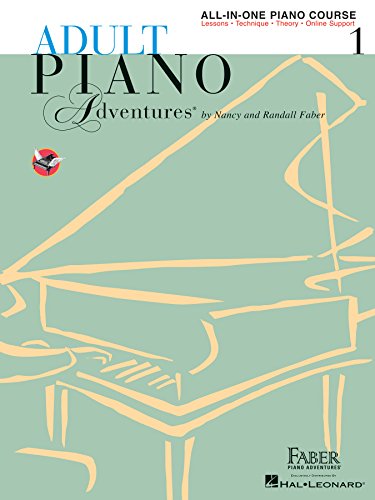
- Faber Adult Piano Adventures All-In-One Course: A comprehensive method that integrates theory, technique, and repertoire.
 Kindle editionRead on Kindle ›
As an Amazon Associate I earn from qualifying purchases.
- Alfred’s Basic Adult All-in-One Course: Known for its thorough foundation in chord theory and blues/jazz introductions.
As an Amazon Associate I earn from qualifying purchases.
Conclusion
The piano keyboard is a masterfully designed bridge between the physical laws of acoustics and the human capacity for artistic expression. Its layout, anchored by the repeating patterns of black and white keys, provides a visual and tactile map of the Western 12-tone system. Understanding this geography, from the landmark identification of Middle C to the complex mathematics of equal temperament and the twelve root of two, is the fundamental requirement for musical literacy.
While the initial encounter with 88 keys can be intimidating, modern pedagogical techniques and high-quality digital interfaces have made mastery more accessible than ever. Beyond the performance skills, the study of piano offers profound cognitive benefits, enhancing spatial reasoning, executive function, and brain plasticity throughout the lifespan. By mastering the fundamental notes and layout, a musician unlocks a limitless world of creative possibility, transforming a complex machine into a vessel for infinite musical thought.
What is the purpose of the black keys on a piano?
The black keys represent the sharps and flats, the notes that lie between the natural white keys. They allow the piano to play all twelve pitches of the chromatic scale and serve as visual landmarks for navigating the keyboard.
Why does the piano start on an A?
While “C” is the center of the music theory universe for beginners, the standard 88-key piano starts on A0. This historical standard was established to accommodate the range of orchestral instruments and the physics of string tension.
Why is Middle C so important?
Middle C (C4) is the primary reference point in both keyboard geography and musical notation. It is located near the center of the keyboard and sits on the ledger line between the treble and bass clefs on the grand staff.
How do I find “Middle C” on a 61-key keyboard?
On a smaller keyboard, Middle C is still the “C” closest to the center of the instrument. It is usually the third “C” from the left.
What is the difference between weighted and non-weighted keys?
Weighted keys utilize a hammer mechanism to replicate the resistance of an acoustic piano, allowing for dynamic expression through touch. Non-weighted keys, typical of budget synths, offer no resistance and are generally not recommended for serious piano study.
Can I learn piano on a 61-key keyboard?
While a 61-key keyboard can introduce basics, it is insufficient for most classical and intermediate repertoire. A standard piano has 88 keys, and students are encouraged to learn on a full-size instrument to avoid outgrowing their gear quickly.
Is it better to learn using mnemonics or landmarks?
While mnemonics are common, the “Landmark System” (memorizing anchor notes and reading by intervals) is considered superior for developing long-term sight-reading fluency and spatial awareness of the keyboard.