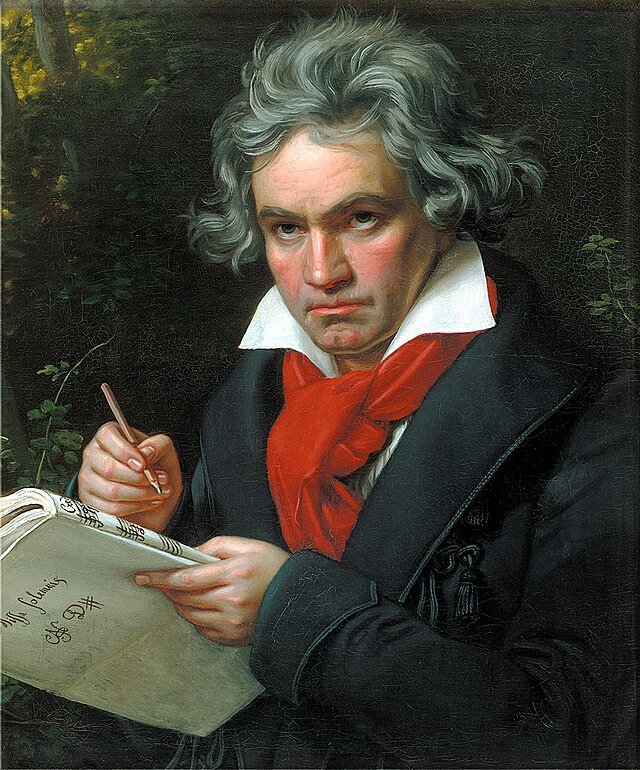
Among the pantheon of composers, Ludwig van Beethoven stands in a category of his own. He is not simply remembered as a genius of the classical era but as the musician who carried Western music into the romantic world. His relationship with the piano was so profound that it became both his voice and battlefield, the medium through which he expressed triumph, despair, rebellion, and transcendence. From his early prodigious beginnings in Bonn to his heroic struggle against deafness in Vienna, Beethoven’s life reads like a novel filled with brilliance and tragedy, glory and isolation.
I’ll guide you through the complete story of Beethoven with a strong focus on his connection to the piano. We will look at the milestones of his career, dive into his private life, uncover some of the most fascinating anecdotes, and explore hard numbers that show the staggering scope of his work. By the end, you’ll not only know the man and his music but also feel the depth of what it meant for Beethoven to revolutionize the instrument that dominated his creative life: the piano.
Ludwig van Beethoven revolutionized the piano by demanding an instrument with greater range, power, and expressive potential than the early fortepianos of his time. By pushing the limits of dynamics (from pianissimo to fortissimo) and introducing complex rhythmic structures and orchestral textures, he forced instrument makers to innovate, leading to the development of the modern iron-frame piano. His 32 Piano Sonatas remain the fundamental “New Testament” of the repertoire, essential for every serious student of the instrument.
1. The Origins: The Bonn Prodigy and the Shadow of Mozart
Born in December 1770 in Bonn, Germany, Ludwig van Beethoven was the product of a musical lineage that carried both prestige and pain. His grandfather, Ludwig, was a respected Kapellmeister, but his father, Johann, was an abusive singer whose obsession with creating a “second Mozart” led to a childhood of strict, often cruel, musical training.
Early Education and Discipline
Beethoven’s early education was characterized by grueling practice sessions. It is reported that his father would pull him from bed at night to practice scales and arpeggios, instilling a level of technical discipline that would later allow him to dominate the Viennese salons. Despite this rough start, Beethoven showed extraordinary musical gifts. He studied organ, violin, and composition, and by his teenage years, he was already assisting as a court musician. By age 12, he was already publishing his first compositions and serving as an assistant court organist.
The Move to Vienna
In 1792, Beethoven moved to Vienna to study with Joseph Haydn. Vienna was the epicenter of European music, a city of aristocrats and high-stakes musical duels. It was here that Beethoven’s identity shifted from a gifted student to a ferocious piano virtuoso. He studied counterpoint and form, but his spirit was already beginning to rebel against the strict “Galant” style of his predecessors.
A New Kind of Composer
What made Beethoven unique was that he was not satisfied with the traditions of the late 18th century. The piano itself was evolving, becoming stronger, louder, and more capable than the harpsichord or early fortepianos. Beethoven saw in this instrument a universe of expressive potential. He expanded the size of sonatas, gave them unprecedented emotional depth, and transformed piano concertos into dialogues between individual and collective voices.
2. The Piano Revolution: From Fortepiano to Hammerklavier
To understand Beethoven, one must understand the evolution of the instrument itself. When Beethoven arrived in Vienna, the piano (or fortepiano) was a delicate, wooden-framed instrument with a limited range and light action.
Pushing the Physical Limits
Beethoven was never satisfied with the sound available to him. He was known for “punishing” his pianos, often breaking strings and hammers in his pursuit of a more powerful, orchestral sound. He sought a timbre (tone color) that could mimic the gravity of a full symphony.
| Feature | 18th Century Fortepiano | Beethoven’s Evolution (Hammerklavier) | Modern Grand Piano |
| Frame | Wooden | Reinforced Wood/Metal | Cast Iron |
| Range | 5 Octaves | Expanded to 6+ Octaves | 7 1/4 Octaves |
| Dynamics | Narrow (p to f) | Extreme (pp to ff) | Highly Responsive |
| Action | Very Light | Heavier/Responsive | Balanced/Weighted |
Innovation in Technique
Beethoven introduced the extensive use of the damper pedal (often called the sustain pedal) to create a “wash” of sound, a technique that was revolutionary at the time. He also utilized extreme dynamics, such as the sforzando (sfz), a sudden, sharp accent, to inject drama and unpredictability into his music.
Beethoven’s music required a new kind of pianist. His scores called for wide leaps, crushing chords, rapid repeated notes, and extreme dynamics from whisper-soft pianissimo to thunderous fortissimo. Many pianists of his time complained his works were unplayable, but today they form the core of every serious pianist’s repertoire.
Improvisation Mastery
Beethoven’s contemporaries marveled at his ability to improvise for hours at the piano, weaving complex fugues and variations out of simple themes. At musical duels, a common event in Vienna where two pianists would compete, Beethoven was virtually unbeatable. Rival pianists admitted defeat after hearing the sheer force of his imagination.
3. The 32 Piano Sonatas: The “New Testament” of Piano Literature
Hans von Bülow, the 19th-century conductor, famously referred to J.S. Bach’s Well-Tempered Clavier as the “Old Testament” of piano music and Beethoven’s 32 Sonatas as the “New Testament.” These works represent a diary of Beethoven’s creative life, divided into three distinct periods.
The Early Period (Classical Mastery)
In works like the Sonata Pathétique (Op. 13), Beethoven shows respect for the Sonata Form (Exposition, Development, Recapitulation) while infusing it with a new, dark emotionality. Notably, the Pathétique introduction features rare 128th notes (semi-demi-semi-quavers), showcasing his demand for extreme technical precision.
The Middle Period (The Heroic Style)
During this phase, Beethoven composed his most famous works, including the Waldstein and Appassionata. These sonatas are large-scale, virtuosic, and “heroic” in nature. They feature wide leaps, thick chords, and a sense of relentless struggle.
The Late Period (Spiritual Transcendence)
Beethoven’s final sonatas (Op. 101 to Op. 111) are philosophical and experimental. He began to explore polyphony and complex fugues, moving away from standard structures toward a more spiritual, nearly atonal soundscape. Op. 111, his final sonata, famously consists of only two movements, ending in a transcendent C major that many believe represents a release from earthly suffering.
He also composed five piano concertos, culminating in the magnificent Emperor Concerto, which embodies his heroic style.
4. The Silent Symphony: Triumph Over Deafness
The most tragic and inspiring aspect of Beethoven’s life was his progressive hearing loss, which began in his late 20s. By 1802, the struggle had reached a breaking point, leading to the Heiligenstadt Testament, a letter to his brothers where he expressed his despair and his decision to continue living for the sake of his art.
Composing in Silence
As his hearing faded, Beethoven’s connection to the piano changed. He could no longer hear the high frequencies, which led him to use the lower, more resonant registers of the instrument. He relied on his absolute “inner ear”, the ability to hear the music perfectly in his mind without physical sound. This isolation allowed him to create sounds that were completely original, as he was no longer influenced by the musical trends of the day.
The Conversation Books
In his final years, Beethoven carried “conversation books” in which visitors would write their side of a dialogue. These books provide a rare, intimate look into his daily struggles, his humor, and his unwavering dedication to his nephew, Karl.
Beethoven’s Private Life
Beethoven never married, though he fell in love several times, often with aristocratic women above his social rank. His passion for love and companionship was as intense as his music, but his blunt character, financial instability, and growing deafness kept him from lasting relationships.
His final years were marked by poor health, loneliness, and battles with his nephew Karl. He died in Vienna on March 26, 1827, at age 56. Over 20,000 people attended his funeral, a testament to the reverence he inspired.
5. Beethoven in Numbers and Anecdotes
To appreciate the sheer volume of his output, one must look at the numbers. Beethoven was a meticulous worker, often sketching out ideas for years before finalizing a score.
- 32 Piano Sonatas.
- 5 Piano Concertos (including the “Emperor”).
- 9 Symphonies (redefining the genre).
- 16 String Quartets.
- 1 Opera (Fidelio).
- 722 Total works cataloged.
- 60 Coffee beans (the exact number he counted for every cup – read below).
Beethoven’s music fills thousands of pages, covering nearly every genre. His piano music alone is enough to define him as a giant, but his orchestral works cement his reputation as the bridge between Classical balance and Romantic passion.
- The ear-trumpet incident: As his deafness worsened, Beethoven used ear trumpets. Once, frustrated, he threw one out of the window after failing to hear a conversation.
- Coffee obsession: Beethoven was meticulous about his morning coffee. He insisted on exactly 60 beans per cup, counting them by hand.
- Bad temper: He was known to argue with aristocrats who were his patrons. Once he shouted at Prince Lichnowsky, “There are thousands of princes, but only one Beethoven.”
- Messy lifestyle: His apartments were famously chaotic, filled with scattered manuscripts, unwashed plates, and broken furniture.
- Mysterious love letters: The “Immortal Beloved” letter, never delivered, was addressed to a woman historians still debate about. It remains one of music’s great romantic mysteries.
6. Pedagogical Advice: How to Play Beethoven
Approaching Beethoven at the piano requires more than finger dexterity; it requires a psychological understanding of the “Beethovenian” spirit.
Respect the Dynamics
Beethoven was the master of the sudden change. Never ignore a subito piano (sudden soft) after a fortissimo passage. These markings are the “musical punctuation” that tells the story.
Orchestral Thinking
When playing a Beethoven sonata, imagine you are a conductor. The bass notes are the cellos and double basses; the trills are the flutes. This orchestral texture helps the pianist achieve the proper weight and resonance.
Rhythmic Integrity
Beethoven’s music is driven by pulse. While Romantic music later allowed for extensive rubato (flexibility of tempo), Beethoven requires a grounded, strong rhythmic foundation. The tension in his music often comes from the conflict between a steady pulse and “off-beat” accents, or syncopation.
Balance strength and poetry
Beethoven’s power is legendary, but his soft passages are equally vital. Learn to whisper as well as roar. Beethoven is about truth and intensity. Don’t play timidly, take risks, as he did.
Recommended Gear for Beethoven Enthusiasts
To truly master the works of Beethoven, you need the right tools. Here are our top recommendations:
Henle Urtext: Beethoven Piano Sonatas (Volumes 1 & 2): The industry standard for accuracy. These editions provide the most faithful representation of Beethoven’s original manuscripts.
As an Amazon Associate I earn from qualifying purchases.
Yamaha P-225 Digital Piano: For students needing a weighted, responsive action to practice Beethoven’s demanding dynamics at home.
As an Amazon Associate I earn from qualifying purchases.
Wittner Metronome (Taktell Piccolo): Essential for maintaining the rigorous rhythmic integrity required for Beethoven’s Allegro con brio passages.
As an Amazon Associate I earn from qualifying purchases.
Sony WH-1000XM5 Noise Canceling Headphones: Perfect for listening to the nuances of legendary recordings by masters like Alfred Brendel or Daniel Barenboim.
As an Amazon Associate I earn from qualifying purchases.
Conclusion
Studying Beethoven is more than learning notes on a page. It is entering the mind of a man who battled fate itself and still produced art that speaks to eternity. His piano music is a diary of his life, fiery, tender, defiant, and sublime.
For anyone who sits at the piano, Beethoven is not just a composer; he is a guide. He shows us how to be fearless, how to confront darkness, and how to transform suffering into beauty. His legacy is not only measured in the number of works or the crowds at his funeral but in the millions of pianists who, two centuries later, still feel their souls ignite when they play the opening chords of the Appassionata or the delicate trills of Für Elise.
Beethoven’s story is not only about genius but about resilience. He reminds us that even in silence, music can roar.
Was Beethoven completely deaf when he wrote the 9th Symphony?
Yes. By the time of the 9th Symphony’s premiere in 1824, Beethoven was profoundly deaf. Legend has it that he had to be turned around at the end of the performance to see the audience’s thunderous applause.
What is the “Moonlight Sonata” actually about?
Beethoven titled it “Sonata quasi una Fantasia” (Sonata in the manner of a fantasy). The name “Moonlight” was given by a critic after Beethoven’s death, who compared the first movement to moonlight on Lake Lucerne. It was dedicated to his student and love interest, Countess Giulietta Guicciardi.
Why is the piano so central to Beethoven’s music?
The piano was Beethoven’s primary tool for improvisation and composition. Most of his symphonic ideas were first tested at the keyboard. The ease of building chords and exploring intervals on the piano made it the ideal “interface” for his creative process.
Sources & References
High-Yield Music Theory, Vol. 1, Mark Feezell.
Basic Music Theory for Adult Beginner-Level Piano Players, Lawrence Martin.
Music Theory For Dummies, Michael Pilhofer and Holly Day.
Music Theory (v. 1.0), Mark Andrew Cook.