Learning to play the piano has traditionally been a journey reserved for those with the time and budget for private conservatory lessons. However, the digital revolution has democratized music education, moving the “classroom” from a formal studio to our living rooms. When I first sat down at my keyboard, the silence was intimidating; I knew the music was in there, but I didn’t have the map to find it. Turning to YouTube felt like opening a door to a massive, global library, but it also came with the risk of information overload. Through trial, error, and hundreds of hours of practice, I discovered that the right digital mentors can be just as effective as an in-person tutor.
In this guide, you will learn which YouTube channels offer the best structured paths for beginners, how to use them to master complex music theory, and how to build a practice routine that actually sticks.
The definitive list of YouTube channels for piano mastery in 2026 includes Pianote for its institutional-level structure, Piano Lessons On The Web for core theoretical basics, Creative Piano Academy for unlocking musical intuition, and Jazer Lee for psychological practice techniques. Hoffman Academy and Dylan Laine serve as the primary gateways for all-ages foundations, while the Mangold Project provides critical classical simplification. For repertoire-focused learners, HDpiano leads in visual hybrid guides. Advanced students find unparalleled depth through Nahre Sol’s artistic compositions, Charles Cornell’s harmonic analysis, Bill Hilton’s improvisation tools, and David Bennett Piano’s engaging musicology.
1. Top YouTube Channels for Learning Piano
1. Pianote – The Standard for Comprehensive Instruction
With 2.39 million subscribers as of early 2026, Pianote remains the dominant force in digital piano education. Operating as a full-featured online school, it bridges the gap between casual video watching and formal conservatory training.
- Core Methodology: They utilize a structured “Learning Path” that takes students from absolute zero to “musical freedom”.
- Key Strengths: High-quality production, energetic teachers like Lisa Witt, and a massive archive of lessons covering hand independence, rhythm, and ear training.
- Best For: All skill levels seeking a traditional classroom feel with modern flexibility.
2. HDpiano – The Master of Song-Based Learning
Boasting 1.83 million subscribers, HDpiano is the premier resource for learners who want “quick wins” by playing recognizable hits without necessarily reading sheet music.
- Core Methodology: They invented the “Hybrid Piano Lesson” format, utilizing high-definition visual keyboard guides to walk students through songs section by section.
- Key Strengths: A library of over 1,600 songs, including pop, movie themes (Zimmer, Einaudi), and video game scores.
- Best For: Visual learners and beginners who want to sound impressive immediately.
3. Charles Cornell – The Theory Enthusiast’s Cheerleader
With 1.4 million subscribers, Charles Cornell has revolutionized how music theory is taught by integrating it with humor and pop culture analysis.
- Core Methodology: Breaking down the musical concepts behind viral songs, soundtracks, and jazz standards.
- Key Strengths: Making complex harmonic concepts like reharmonization and chord substitutions approachable and entertaining.
- Best For: Intermediate students who are “theory-curious” and want to understand the “why” behind the music.
4. Jazer Lee – The Habit Specialist
Based in Australia but with a massive North American following of 755,000 subscribers, Jazer Lee focuses on the psychology of practice.
- Key Content: “7 Piano Practice HACKS for Busy Adults” and “5 Skills Piano Beginners Skip”.
- Niche: Correcting bad habits and streamlining technique for adult learners who lack the time for 4-hour daily practice sessions.
5. Nahre Sol – The Artistic Virtuoso
A Juilliard-trained pianist with 826,000 subscribers, Nahre Sol explores the intersection of classical technique, modern composition, and genre exploration.
- Key Content: “13 Levels of Piano Technique” and “How to Sound Like…” series.
- Niche: Advanced students looking for creative inspiration and a deep dive into the “creative process”.
6. Hoffman Academy – The Foundation for All Ages
Joseph Hoffman’s channel is the “Mr. Rogers” of the piano world, providing a polished, step-by-step curriculum.
- Core Methodology: A meticulously organized series ranging from beginning technique to advanced topics.
- Best For: Young learners and absolute beginners who require a gentle, thorough introduction to the instrument.
7. London Contemporary School of Piano
A rising star with 136,000 subscribers, this channel serves “curious pianists” looking for clarity and style.
- Niche: Focuses on contemporary gospel sounds, 4-part harmonization, and improvisation tools.
8. Bill Hilton
A British musician with 429,000 subscribers, Bill Hilton provides some of the best tutorials on harmony and improvisation.
- Key Content: A 21-part beginner series and in-depth tutorials on cocktail piano and jazz improvisation.
- Pedagogy: He encourages students to figure things out for themselves, building long-term musical intuition.
9. Mangold Project
Run by Assaf, this channel reaches 790,000 subscribers and is a goldmine for understanding “Interesting Chords” and “Classical Practice”.
- Key Content: Hands-separated classical breakdowns and “bite-sized” piano lessons.
- Unique Feature: On-screen scores combined with clear keyboard labeling for complex harmonic concepts like tritone substitutions.
10. Creative Piano Academy (Josef Sykora): Unlocking Creativity
Josef Sykora focuses on the “creative” side of the brain. His channel, Creative Piano Academy, is built on the philosophy that everyone can improvise.
Unique Selling Points:
- Pattern-Based Learning: Instead of memorizing notes, you learn patterns that can be moved across different keys.
- Emotional Playing: Lessons on how to use the Sustain Pedal and Dynamics to evoke specific feelings.
- The 12-Day Blueprint: A famous introductory series that gets people playing “beautifully” in less than two weeks.
Comparative Evaluation of Top YouTube Educators (2026)
| YouTube Channel | Feb 2026 Subscribers | Core Methodology | Primary Focus |
| Pianote | 2.39 Million | Structured “Learning Paths” | Comprehensive/Full School |
| HDpiano | 1.83 Million | Visual hybrid keyboard guides | Song-Based/Pop Hits |
| Charles Cornell | 1.4 Million | Humor-integrated pop analysis | Theory/Harmonic Insights |
| Nahre Sol | 826,000 | Classical/Modern synthesis | Technique/Artistry |
| Mangold Project | 790,000 | Classical simplification | Harmony/Technical Drills |
| Jazer Lee | 755,000 | Habit correction/Psychology | Adult Beginner/Efficiency |
| Bill Hilton | 430,000 | Figuring things out intuitively | Improvisation/Harmony |
| Creative Piano Academy | 315,000 | Pattern-based brain focus | Creativity/Improvisation |
| Hoffman Academy | 271,000 | Step-by-step gentle curriculum | Foundations/All Ages |
| London Contemporary | 136,000 | Clarity, style, and confidence | Contemporary/Gospel |
2. Technical Foundations: The Science of Piano Mastery
To truly benefit from these YouTube mentors, a student must master the “Grammar of Music”, Music Theory. This section utilizes expert frameworks from recognized pedagogical texts.
1. Notation and the Musical Staff
The Staff (or staves) is a system of five parallel lines used to locate specific pitches.
- Treble Clef (G-clef): Locates the pitch “G” on the second line up. It is primarily for the right hand.
- Bass Clef (F-clef): Locates the pitch “F” on the fourth line up. It is primarily for the left hand.
- The Grand Staff: A combination of both staves connected by a brace. Middle C (C4) acts as the anchor point between them.
2. The Physics of the Keyboard
- Half Steps (Semitones): The smallest distance between any two adjacent keys (white or black).
- Whole Steps (Tones): The distance of two half steps.
- Middle C (C4): Vibrates at approximately 261.6 Hz, while A4 (the universal tuning standard) is 440 Hz.
3. Scales: The Major and Minor Systems
A Scale is a sequential collection of five or more pitches.
- Major Scale Pattern: W-W-H-W-W-W-H (where W=Whole step, H=Half step).
- Natural Minor Scale Pattern: W-H-W-W-H-W-W.
- Relative Keys: Major and Minor scales that share the same pitch content (e.g., C Major and A Minor).
4. Harmonic Architecture: Intervals and Chords
- Intervals: The distance between two notes, defined by Quantity (lines/spaces) and Quality (Major, Minor, Perfect, Augmented, Diminished).
- Triads: Three-note chords built from a root, third, and fifth.
- Major Triad: 4 half steps + 3 half steps.
- Minor Triad: 3 half steps + 4 half steps.
- Diminished Triad: 3 half steps + 3 half steps.
- Seventh Chords: Adding a fourth note to the triad. The Dominant Seventh (V7) is the most common, creating the tension required to resolve to the tonic (I).
3. Global Skill Benchmarking: ABRSM vs. RCM
For students who want formal validation of their progress, two organizations provide the international gold standard.
| Level | ABRSM (UK/Global) | RCM (Canada/USA) |
| Beginner | Grades 1–2 | Preparatory – Grade 2 |
| Intermediate | Grades 3–5 | Grades 3–7 |
| Advanced | Grades 6–8 | Grade 8 – ARCT (Professional) |
- ABRSM: Tests for 8 distinct grades. Their manual provides extensive lists of musical pieces for each level.
- RCM: Uses 10 grades plus an ARCT level. It is known for a very comprehensive 112-page syllabus.
4. How to Build Your Self-Taught Routine
The biggest risk of learning from YouTube is “aimless scrolling.” To see real progress, you must treat YouTube as a supplement to a dedicated practice routine.
- Define Your Goal: Are you looking to read classical scores, or do you want to play by ear in a band?
- The 20/20/20 Rule:
- 20 Minutes of Technique: Focus on scales and finger exercises (Mangold Project is great for this).
- 20 Minutes of Theory: Watch a video on intervals or triads (Piano Lessons On The Web).
- 20 Minutes of Repertoire: Work on a specific song (HDpiano).
- Record Your Progress: Use your phone to record your playing once a week. It allows you to hear rhythmic inconsistencies that you might miss while playing.
Conclusion
The “Best YouTube Channel” is ultimately the one that keeps you sitting at the bench. The piano landscape of 2026 is one of unprecedented democratization. By combining the institutional structure of Pianote with the creative intuition of Josef Sykora and the technical depth of Nahre Sol, you can build a multifaceted musical identity. Success is predicated on consistency. As you sit at your keyboard, remember that every master started with the same 88 keys and the same 12 notes. Your digital mentors are ready; your journey begins with the first note.
Now, go sit at your keyboard, open a tab, and start your first lesson. The music is waiting.
Is it better to use an app (like flowkey) or YouTube in 2026?
YouTube offers a human element and “pedagogical authority” that apps often lack. While apps are great for “note-matching,” YouTube teachers explain the emotion and technique behind the notes. In 2026, the best students use a hybrid approach: YouTube for the “Lesson” and an AI app for the “Practice.”
Can I really learn piano only using YouTube?
Yes, you can build a strong foundation using YouTube, but it requires extreme discipline. Unlike an in-person teacher, YouTube won’t correct your posture or hand position in real-time, so you must be very observant of your own technique.
Is it better to learn sheet music or play by ear?
Ideally, both. Learning to read music (sight-reading) opens up centuries of classical repertoire, while playing by ear helps you understand the “soul” of music and improvisation. Most top channels like Pianote advocate for a balanced approach.
How much should I practice every day?
Consistency is more important than duration. Practicing for 30 minutes every day is far more effective than a four-hour session once a week.
Can I learn Classical piano exclusively on YouTube?
Yes, but you must be careful. Classical piano requires strict hand posture to avoid injury. Channels like The Mangold Project and Nahre Sol are excellent, but you should occasionally film yourself and compare your hand shape to theirs to ensure you aren’t developing bad habits.
Do I need a MIDI keyboard to follow these channels?
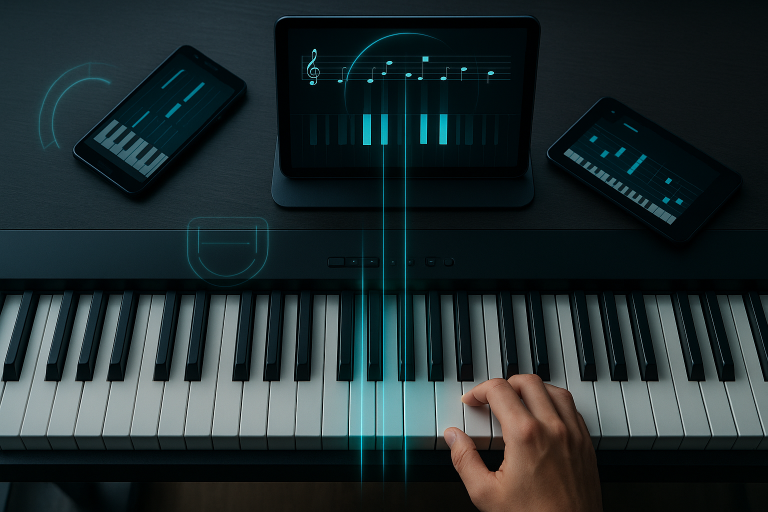
Not strictly, but it helps. Many channels offer interactive files that you can plug into your piano to see the notes light up. However, a standard acoustic piano works perfectly with the “Visual Hybrid” style of modern tutorials.
How long does it take to see results with YouTube?
If you follow a structured channel like Pianote or Jazer Lee for 30 minutes a day, you can expect to play basic two-handed songs within 30 days. To reach an intermediate level (playing Chopin Preludes or Jazz standards), expect a 2-year journey of consistent practice.
Which channel is best for a complete beginner?
For structure, Pianote. For a gentler, child-friendly approach, Hoffman Academy.