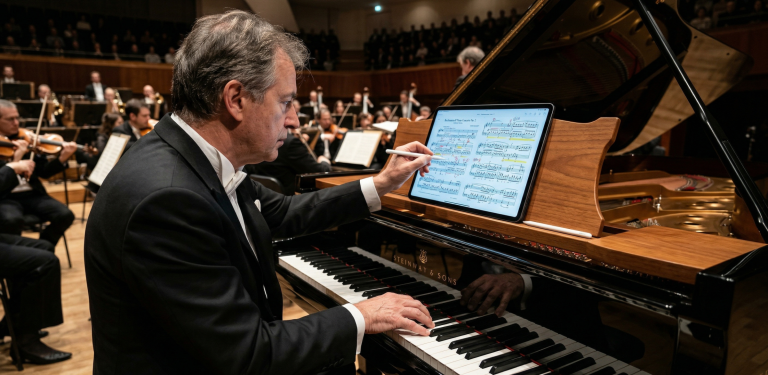
Sight reading, the ability to play music at first sight, without prior preparation – is a vital skill for pianists of every level. Strong sight reading helps students learn new pieces quickly, play confidently in ensembles or accompaniment situations, and maintain musical independence. It often feels like learning a new language: the more exposure and practice you get, the more fluent you become. Modern practice apps make regular sight reading more engaging and effective. They offer instant feedback, customizable difficulty, and game-like challenges that keep practice varied and fun. In this article we’ll explore why sight reading matters and how apps can supercharge practice. Then we’ll review the top sight-reading apps of 2026 (and beyond), comparing features, strengths, weaknesses, and pricing. Finally, we’ll discuss integrating these tools into daily practice, how they compare to traditional methods, and share expert tips plus common pitfalls to avoid.
Why Sight Reading Matters
Sight reading isn’t just a handy party trick – it builds foundational musicianship. Musicians who can sight read well have more confidence and flexibility. They learn new repertoire faster and can accompany singers or ensembles even on short notice. In education and exams, good sight reading saves rehearsal time for expression and technique rather than note work. Moreover, the mental skills used in sight reading – scanning ahead, pattern recognition, rhythmic subdivision, benefit all musical tasks. Good sight readers often develop better rhythm and pitch skills, and they feel the structure of music as they play. In short, strong sight reading means less stress and more enjoyment when tackling new music. Like reading a novel, fluency comes with practice. By building sight-reading into daily routine, pianists reinforce their reading vocabulary (scales, intervals, chords, common patterns) and train their ears to anticipate notes before playing.
Apps can make this process easier and more fun. Instead of flipping randomly through sheet music, apps deliver endless new exercises and instant scoring. They let pianists practice from home, on any device, with guidance and interactive challenges. As a result, students spend more time sight reading each day in a structured way. By using apps alongside traditional materials, pianists can rapidly improve their reading speed, accuracy, and musicality.
1. How Apps Enhance Sight Reading Practice
Modern sight reading apps offer features that traditional practice often lacks. Key advantages include:
- Instant Feedback: Many apps listen to your playing (via microphone or MIDI) and show which notes or rhythms were correct. This immediate assessment helps you identify patterns of errors and adjust in real time. For example, apps like Piano Marvel and Note Rush score your performance on the spot.
- Customizable Difficulty: Apps let you tailor exercises to your level. You can select the key signature, time signature, note range, tempo and even note values. This focused customization – often found in Sight Reading Factory and Music Tutor – ensures practice material is neither too easy nor too hard.
- Endless New Material: Unlike a finite book of exercises, many apps can generate infinite new pieces. Sight Reading Factory’s algorithm composes fresh sight-reading exercises on demand, so you’ll never run out of practice pieces. This “never-seen-before” approach is crucial, since practicing the same tune twice defeats the purpose of sight reading.
- Gamification and Engagement: Apps turn drills into games with levels, themes, and rewards. Titles like Note Rush and Melodics use arcade-style gameplay (racing horses, falling notes like Guitar Hero, vibrant animations) to make practice addictive. Leaderboards, achievements, and daily streaks add motivation.
- Structured Progress Tracking: Many apps track your progress over time. You can see scores, accuracy percentages, and unlock levels as you improve. For instance, Piano Marvel assigns a standardized sight-reading score (SASR) and shows a chart of your growth. Seeing improvement in numbers encourages regular practice.
- Integration with Other Skills: Good apps don’t isolate sight reading alone. They often incorporate rhythm training, ear training, and theory drills. For example, some apps alternate between reading notes and clapping rhythms or recognizing intervals. This reinforces overall musicality alongside reading.
- Accessibility and Convenience: Smartphone and tablet apps mean you can practice sight reading anywhere – in a few minutes on the go or as part of a daily routine. Many work offline once downloaded, so you’re not tied to the internet. Portable practice is a boon for busy learners.
By combining these benefits, sight-reading apps transform practice from a chore to an interactive learning session. Instead of mindlessly thumbing through old music books, students get targeted, adaptive exercises with feedback that teachers alone can’t always provide.
2. Top Sight-Reading Apps of 2026
Here we review the most effective and credible sight-reading tools available in 2026, including both free and paid options. We focus on piano-oriented apps, but note when others apply broadly to musicians. For each app, we cover its main features, strengths, weaknesses, pricing, and best use cases.
Sight Reading Factory
Platform: Web (any browser on PC/Mac/Tablet), iOS app version.
Cost: Free to try; Personal plan $45/year. (Educator/student pricing also available.)
Overview: Sight Reading Factory (SRF) is a leading app for generating custom sight-reading exercises. It’s essentially an infinite, algorithm-driven music generator. Users can specify difficulty levels or manually set parameters like key signatures, time signatures, pitch ranges, clefs, rhythms and articulations. SRF then instantaneously creates brand-new sheet music that looks like a real composition. No two exercises are ever the same.
Key Features:
- Unlimited New Exercises: Every time you refresh, SRF composes fresh music. This is ideal for daily practice since you’ll never memorize repeated material.
- Fully Customizable: Select exactly what you want to practice – from simple quarter notes in C major to complex polyrhythms in mixed meter. You can include or exclude accidentals, choose scales, set speed, etc. This level of control suits students gradually mastering key signatures or extending their range.
- Multiple Difficulty Levels: SRF has preset levels, from beginner through advanced, adding more rhythms, leaps, and accidentals at higher levels. Beginners can start with very simple melodies, while advanced players can generate challenging piano etudes.
- Auto Assessment: The app offers an optional auto-assessment mode. It listens to your playing via microphone, then reports note accuracy, rhythm timing and intonation. This immediate feedback helps you pinpoint mistakes.
- Practice Logs and Printing: It logs your practice sessions and lets you print sheet music if you prefer paper.
- Ensemble/Choir Use: Unique to SRF is its support for many instruments and voices. You can generate group sight-reading for choir, band or orchestra, projecting parts for all students. Teachers can create assignments and track classroom practice.
Strengths:
- Infinite Variety: You’ll never run out of sight-reading material. This keeps practice fresh and mimics the unpredictability of real music.
- High Customization: Tailoring exercises to exactly what you need (e.g. only treble clef in D minor) is a big plus for targeted learning.
- Realistic Music: SRF’s algorithm ensures exercises use standard musical patterns, making them sound like actual compositions rather than random notes.
- Educational Tools: Features like practice logs, assignments and standard repertoire (for auditions) make it valuable in schools.
Weaknesses:
- Not Gamified: SRF is a tool, not a game. There are no cartoon characters or races. It focuses on content generation rather than flashy design. Users must self-motivate to play each exercise.
- Requires Discipline: Because you can customize so much, beginners might be overwhelmed by options. Teachers often need to guide students in using it.
- Online Connection: Primarily web-based; limited offline functionality.
- Annual Subscription: After a short trial, you need to subscribe. ($45/year is moderate but not free.)
Best For: Pianists who want serious, consistent sight-reading practice and teachers needing fresh material. Beginners to advanced can all benefit by adjusting difficulty. It’s especially great for students preparing for exams or recitals, and for classroom settings. The app’s versatility makes it useful beyond piano – violinists, singers and more can use it, though piano is included.
Piano Marvel
Platform: Windows, Mac, iPad, Android. (Chrome/Chromebook supported.) Requires connection to keyboard via USB/MIDI or on-board sounds.
Cost: Free tier; Premium $17.99/month (annual ~$129.99/year).
Overview: Piano Marvel is a comprehensive piano learning program with a strong emphasis on sight reading. It stands out for its proprietary Standard Assessment of Sight-Reading (SASR) tool. SASR gives a numerical score (up to ~1900) that quantifies your sight-reading level. Through regular SASR tests, students can see measurable improvement. Piano Marvel also includes a huge library of songs, exercises, and video lessons, plus a game-like “Sight-Reading Samurai” mode for graded practice.
Key Features:
- SASR (Standard Assessment of Sight Reading): A benchmarked sight-reading test with 90 levels. As you play, pieces get harder until you fail three times, then you receive your SASR score. This objective score tells you where you stand (e.g. “Intermediate” vs “Advanced”).
- Sight-Reading Samurai: A gamified training mode. You progress through thousands of arranged pieces in order, unlocking new levels by achieving high accuracy on the previous one. It’s like having an endless graded book of sight-reading duets, but within the app.
- Immediate Feedback: As you play through pieces or exercises, the software highlights mistakes in real time. It provides accuracy percentages and tracks your progress.
- Massive Content Library: Premium unlocks 25,000+ songs and 1,200+ exercises. These range from simple etudes to complex classical repertoire. You can also upload your own MIDI songs to sight-read.
- Video Tutorials and Lessons: Over 200 lesson videos cover technique, theory and repertoire.
- Progress Tracking: Charts and practice logs show improvement over time, and you earn medals and awards. Teachers or parents can link to student accounts to monitor progress.
Strengths:
- Highly Structured: The combination of SASR and Sight-Reading Samurai provides a clear progression path. You know exactly when you’ve reached a new level.
- Real-Time Assessment: The app listens via MIDI (preferred) or microphone, giving instant grade/performance feedback. This helps students stay accountable in practice.
- Versatile Content: It’s not just sight-reading – you also get finger exercises, scales, and a vast song library (classical to pop).
- Teacher Support: Many piano teachers trust Piano Marvel, as it mirrors exam criteria (it was co-developed by educators). It gives students goals and measurable targets.
Weaknesses:
- Requires MIDI/USB Connection: You need an electronic piano or adapter. An acoustic piano won’t work reliably (no microphone mode).
- Subscription Cost: The free plan is limited. Premium is a significant investment, though school licenses reduce cost per student.
- Overwhelming for Beginners: With so much content, new users may feel lost. It has a steep learning curve if you jump into complex pieces.
- Less Game-Like: Compared to apps with flashy interfaces, Piano Marvel feels more like a digital workbook.
Best For: Intermediate to advanced players who are serious about measurable progress. It suits students prepping for conservatory or exams who need objective benchmarks. Also good for dedicated hobbyists or teachers assigning sight-reading challenges. Beginners can use it, but should start with basics; the free tier still offers 150+ songs and exercises to try before committing.
Flowkey
Platform: Windows, Mac (via app or browser); iOS and Android apps. Connects via microphone or MIDI.
Cost: Free trial with a few lessons/songs; subscription ~$19.99/month or ~$129.99/year.
Overview: Flowkey is a popular piano learning app that combines song lessons with interactive score reading. While its primary focus is learning songs, it includes clear note-by-note highlighting and practice tools that aid sight-reading. Users can choose from a diverse library of 1,000+ songs (classical, pop, jazz, film scores, etc.) and learn at their own pace. Flowkey emphasizes intuitive learning: as a piece plays, the sheet music scrolls and notes light up in sync.
Key Features:
- Wide Song Library: Hundreds of songs in many genres. Newbies will find familiar melodies to keep them engaged.
- Interactive Lesson Mode: You can play along to the song with the app listening. Correct notes are confirmed in real time (via mic or MIDI) and the app can slow down difficult passages or loop sections for practice.
- Courses and Tutorials: Several guided courses cover fundamentals like posture, hand positions, basic theory and even sight-reading exercises. These are more video/tutorial style than drills.
- Easy-to-Use Interface: The app has a sleek design. You can practice hands separately, change tempo, and see visual feedback (on-screen keyboard highlighting, video of hand placement, etc.).
- Multi-Device Sync: Keep track of progress across tablet, phone or computer.
Strengths:
- Highly Engaging: Flowkey is geared toward fun learning. The variety of song material and the friendly UI motivate users to keep practicing.
- Beginner-Friendly: The app introduces note reading gradually. Even complete novices can play something quickly with the on-screen keyboard mode.
- Flexible Detection: You can connect via USB/MIDI or just use your device’s microphone (though mic is less reliable if the piano has sustain pedal noise or ambient sound).
- Feedback and Progress: It shows progress bars and achievements as you play through songs, which is rewarding.
Weaknesses:
- Not Focused on Depth: Unlike Sight Reading Factory or Piano Marvel, Flowkey is more about learning songs than exhaustive sight-reading practice. Its built-in theory/sight-reading content is limited.
- Arrangements Can Be Tricky: Some songs are arranged with expressive timing. Beginners may struggle if the tutorial piece uses rubato instead of a steady beat. The lack of a built-in metronome means it’s easy to get used to playing “in the groove” of the recording rather than a strict rhythm.
- Subscription Model: The free tier is very limited (few songs/courses). Full access requires an ongoing subscription.
- No Sheet Export: You can’t download sheet music from Flowkey, so it’s tied to the app interface.
Best For: Beginners and intermediate players who enjoy learning with real music. It’s excellent for those who want to see quick progress by playing recognizable tunes. Flowkey is also suitable for casual learners and as a supplement to lessons, but it should be paired with other practice for rigorous sight-reading training. Its intuitive style and gentle learning curve make it a great introduction for children and adults alike.
Simply Piano
Platform: iOS and Android only (mobile/tablet). No desktop version.
Cost: 7-day free trial; then ~$59.99 (3 mo), $89.99 (6 mo), or $149.99/year.
Overview: Simply Piano (by JoyTunes) is a guided, gamified piano course in app form. It’s structured into lessons and popular-song tutorials. Though focused on teaching piano basics, each exercise includes sight-reading practice of notes on the staff. Users advance through levels (called “courses”) and the app listens via the device mic or MIDI to judge accuracy. It uses bright colors and video instructions to appeal to users of all ages, especially younger ones.
Key Features:
- Two Learning Paths: “Soloist” (melody) track for playing songs, and “Chords” track for accompaniment. You can follow both.
- Video Tutorial Segments: Each lesson begins with short videos demonstrating new concepts (notes, rhythms, chords).
- Interactive Play-Along: As the staff scrolls by, you play the keys. Correct notes light up, incorrect notes flash red and cause practice modes.
- Progressive Structure: New theory (notes, clefs, chords) is introduced gradually. Each lesson reviews past material.
- Built-in Support: The app forces you to repeat sections until correct – a bit like having an instructor who won’t let you move on with mistakes.
- Song Library: Hundreds of songs (mostly pop/folk standards) segmented by difficulty. Songs are taught in pieces (intro, chorus, etc.).
Strengths:
- Works with Any Piano/Keyboard: Because it listens via microphone, any acoustic or digital piano can be used (though MIDI hookup is recommended for accuracy).
- User-Friendly for All Ages: Colorful graphics and straightforward tasks make it inviting for kids and beginners. Up to five family members can share one account with separate progress profiles.
- Instant Correction: Wrong notes trigger hints, slows down the music, or activates practice mode. This insistence on accuracy cements good habits early.
- Offline Use: Once lessons are downloaded, you can practice offline – great for areas with spotty internet.
Weaknesses:
- Slow Progression: Simply Piano is designed as a 2-year course. It intentionally moves slowly through basics. While good for total novices, more advanced learners might get bored or feel held back. Key signatures and 16th notes, for example, appear very late in the program.
- Lack of Customization: You can’t jump around or adjust tempo freely. The app has fixed lesson content and moderate tempo options. If you want to practice in a different key or at a faster pace, you’re limited.
- Limited Advanced Material: The program covers basic sight reading, but not much beyond elementary. Advanced notation (ledger lines, complex syncopations) and deeper theory are not taught. Users often outgrow it after a year or two.
- Cost and Subscription: As with other apps, full access is subscription-based.
Best For: True beginners with no reading background – both children and adults. It’s ideal for those who want a gentle guided introduction to reading music and playing piano. For a parent wanting their child to learn at home, or an adult wanting to dabble in piano casually, Simply Piano works very well. It is less suited for experienced players seeking advanced sight-reading drills.
Tenuto (MusicTheory.net)
Platform: iOS (iPhone, iPad).
Cost: One-time purchase (~$4.99).
Overview: Tenuto is not a sight-reading “app” per se, but a collection of music theory and ear training exercises optimized for mobile devices. Created by the team behind Musictheory.net, Tenuto essentially brings the website’s drills to the app world. It does include note-reading tasks that support sight-reading, among other theory tools.
Key Features:
- 24 Interactive Exercises: These cover note identification, key signatures, intervals, chord quality, scales, and more. For example, you might be asked to tap on the note on the staff that matches a given pitch name, or to identify an interval by ear.
- 6 Calculators: Handy tools that let you build chords, intervals or scales by inputting notes. (Good for quickly understanding theory.)
- Fully Customizable Drills: You can target your weak spots. For instance, if ledger lines confuse you, configure the note-reading exercise to include those. A “Challenge Mode” adds time limits or question limits for extra push.
- Offline Capability: Tenuto works entirely offline; you can practice on the beach with no internet required.
- Score Tracking: At the end of a drill, it shows your score and you can email reports to a teacher or friend.
Strengths:
- Depth of Material: Tenuto is extremely thorough for music theory and ear training. If sight-reading mistakes are linked to poor interval recognition or unclear key signatures, Tenuto drills fix those gaps.
- Polished Interface: It’s elegantly designed for phones and tablets – buttons, music staff and interactive elements all scale nicely.
- One-Time Payment: No subscriptions – buy it and use forever.
Weaknesses:
- iOS Only: No Android or desktop version (though the musictheory.net website itself covers theory drills on any device).
- Not Gamified: It’s a straightforward training tool. It doesn’t feel like a game, so it may not motivate by itself.
- Steep for Absolute Beginners: The content assumes some music knowledge. If you have trouble identifying notes already, some exercises will be tricky until you climb the levels.
Best For: Those who want to shore up theory and aural skills behind the scenes. A piano student who struggles with reading quickly might use Tenuto’s interval ear-training or note-naming drills. It’s especially useful for intermediate players and music majors who need theory reinforcement, and also as a supplement for advanced beginners who want to see theory in a clean interface.
Note Rush
Platform: iOS (iPad/iPhone) and Android.
Cost: Free download with optional in-app purchases/subscriptions.
Overview: Note Rush is a fast-paced game that drills note recognition and sight-reading speed. Designed like an arcade game, it displays notes on the staff and you must play them on your piano or instrument as quickly as they appear. There are different levels and themed backgrounds (space, underwater, etc.), making practice playful and colorful.
Key Features:
- Game Mechanics: Notes roll or appear on the screen, and you “hit” them by playing the correct pitch on your instrument. The app uses your device microphone to listen for the note.
- Variety of Modes: Practice treble clef, bass clef, or combined. There are timed games, speed runs, and challenges.
- MIDI/Headphone Support: The latest version adds MIDI input capability, so you can connect a digital piano via USB or use headphones for quiet practice (no mic needed).
- Progress Tracking: Scores, streaks, and levels are tracked. You can compete against your own high scores.
- Customization: You can create custom levels or set which notes to practice (e.g. only middle C to G).
Strengths:
- Engaging for Kids and Adults: The arcade-style gameplay makes boring note drills fun. Seasonal themes and unlockable levels keep users returning.
- Immediate Recognition Practice: It forces you to map notes to keys instantly. Over time this builds the “flashcard” memory of note positions.
- Builds Speed and Fluency: By setting increasing note speeds, you train your eyes and fingers to go faster.
- Free Access: Basic content is free; more modes come with a subscription.
Weaknesses:
- Single-Note Focus: It mostly deals with single notes, not chords or multi-voice parts. So it’s very targeted (good for note drills, but doesn’t cover sight-reading whole pieces).
- Noise/Environment: Microphone mode requires a fairly quiet room and clear piano sound. Sometimes stray sounds can cause missed notes.
- Level Ceiling: Advanced pianists may outgrow it quickly (once you can instantly recognize all notes, there’s not much more to do).
- Subscription Needed for Full Content: Many game levels are locked behind a monthly fee.
Best For: Anyone wanting to sharpen note identification speed. It’s especially popular with beginners and children because of the game element. Music teachers often recommend Note Rush to supplement theory lessons. For an adult, it’s also a good short daily drill (5-10 minutes a day) to keep note-reading reflexes sharp. The MIDI option makes it practical for silent practice on digital pianos.
Melodics
Platform: Windows, Mac (desktop app). Requires MIDI/USB keyboard or pad. (No mobile version.)
Cost: Free 20 lessons; subscription ~$14.99/month (or $179.99/year for “Keys” subscription).
Overview: Melodics is a gamified practice app originally targeted at electronic musicians (keyboardists and finger drummers). It’s somewhat different from traditional sight-reading apps: it focuses on timing, hand coordination, and playing patterns/riffs in rhythm. Lessons look like falling blocks (similar to Guitar Hero or Synthesia). While not aimed at reading standard notation, it does reinforce reading simple scores and rhythmic accuracy.
Key Features:
- Lesson Library: Over 800 lessons in 50+ courses, covering genres like funk, hip-hop, jazz, and EDM.
- Interactive Feedback: The app listens via MIDI, scoring timing and accuracy (immediate, with no latency).
- Progression and Gamification: You earn scores, “trophies”, and complete “streaks” (practicing multiple days in a row). Lessons get harder as you improve.
- Practice Modes: Scales, chords, and theory exercises are integrated (though theory is taught more by playing than lecturing).
- Frequent Updates: New lessons are added weekly from the Melodics community.
Strengths:
- Fun and Engaging: Its game-like design makes practicing feel like a video game. For many users, this encourages much more practice time.
- Improves Rhythm and Timing: Since many lessons emphasize rhythm patterns and syncopation, users often see big gains in timing and coordination.
- Beginners Can Jump In: No prior reading is needed. The app teaches note names and fingerings on the fly, so you can start playing melodies immediately.
- Cross-Instrument: There are versions for drum kits and pad controllers too, which is great for multi-instrumentalists.
Weaknesses:
- Requires Specific Gear: It only works with a MIDI keyboard or controller; you cannot use your acoustic piano or phone microphone.
- Less Emphasis on Traditional Reading: Melodics shows notes, but it’s more like a lead sheet. It doesn’t drill reading large classical scores or multiple voices.
- Subscription Cost: The price is relatively high for just one user (though it includes all content).
- Not a Structured Curriculum: Lessons are abundant but not organized by strict levels. You may find it a bit random what lesson comes next.
Best For: Musicians who already have a MIDI keyboard and want a fun way to practice. It’s excellent for improving technical skill (speed, dexterity, groove) rather than raw sight-reading. Drummers and electronic producers also benefit. For pianists, it’s a great supplement to focus on timing, hand independence and learning by doing. It’s especially appealing to teens and adults who enjoy a game-like approach.
Other Noteworthy Apps
Beyond the above, several additional apps deserve mention:
- Staff Wars & Flashnote Derby: These are note-naming games for young learners. Staff Wars has a space theme (shoot notes before they reach Earth), and Flashnote Derby is a horse race where answering note names moves the horse forward. Both let you choose clefs and note ranges, and use microphone input. Great for children to drill treble/bass clef note recognition in a fun way.
- Treble Cat & Bass Cat: Similar concept by MelodyCats, but on a music-staff background. You pick out requested notes from a stream. They have backgrounds and music tracks for motivation.
- Music Tutor (by ZeroBrain): A very popular free app (iOS/Android) offering flashcard-style drills. You see notes on a staff (or letter names) for a set time and must identify them. Tracks speed and accuracy.
- ABRSM Sight-Reading Trainer: An official app from the Associated Board (UK exams). It contains short, grade-appropriate sight-reading pieces (Grades 1–5) with preparation games. Before each piece, mini-games quiz you on rhythms and key features of the piece (rhythm match, pitch patterns, quick-fire quizzes). This simulates the exam habit of analyzing music for 30 seconds before playing. It costs a few dollars and is best for classical students preparing for ABRSM-style exams.
- SoundGym / EarMaster: While not piano apps, these ear-training tools (often browser-based) sharpen rhythmic and interval recognition. Using them alongside reading exercises can build musicianship that supports sight reading (e.g. hearing rhythms internally).
- Playground Sessions: An older piano app (by Quincy Jones) that combines popular songs with video lessons. It includes some sight-reading exercises and a falling-note mode. It’s more like Flowkey/Simply Piano in concept.
- Yousician (Piano): Known for guitars, Yousician’s piano track teaches songs with on-screen falling notes and light gamification. It isn’t heavy on sight reading, but it does introduce note reading and has a massive song library. (Works with mic or MIDI.)
These apps each have their niche – whether it’s kids’ games, exam prep, ear training or general piano learning. The list above covers the main players, but new tools can emerge, so keep an eye on music education tech news for 2026.
3. Integrating Apps into Daily Practice
How do you make the most of these apps? The key is consistency and balance. Here are strategies for different skill levels:
- Beginners: Start with guided courses (Simply Piano, Flowkey, or Piano Maestro) to learn note names and basic pieces. Spend 5–10 minutes a day on a note-naming game (Note Rush or Staff Wars) to reinforce recognition. Use a theory app (Tenuto) for 5 minutes to quiz yourself on intervals or keys. As soon as you can read a few notes, try simple exercises on Sight Reading Factory (e.g. C major quarter notes) or Piano Marvel’s starter repertoire. Keep practice sessions short and regular – even 15 minutes daily will add up.
- Intermediate Students: Mix things up. Warm up with scales or chords, then spend 10 minutes on a sight-reading app exercise at your current level. For example, take a 30-day challenge with Piano Marvel’s SASR test or Sight Reading Samurai – do one random piece per day. Use Simply Piano or Flowkey to learn a new song once a week (this counts as sight reading, too). Allocate time for theory/ear (Tenuto drills, clapping rhythms). Keep a log of your scores to track improvement. Teachers can assign tailored SRF exercises after lessons to reinforce new concepts.
- Advanced Players: Challenge yourself with the hardest levels on Sight Reading Factory and Piano Marvel. For daily training, alternate between genres (classical, jazz, pop) so you don’t get stuck in one style. Use apps like Sight Reading Samurai or Sight Reading Factory on demanding clefs (try alto or tenor clef if unfamiliar). Record yourself with the app’s feedback to identify persistent errors. Consider using an ensemble app (SRF’s Live Practice) or partner with a friend to sight read duet parts together. Incorporate metronome practice into your reading apps (some have built-in click) to push your tempo steadily. Finally, never reuse the same exercise twice – always pick fresh random pieces to simulate real sight reading.
In all cases, apps should supplement traditional study, not replace it entirely. For example, if your teacher gives you a new piece to learn, sight-read it first on your own. Use apps for “filler” practice when a teacher isn’t available. They’re excellent for those minutes when you’re sitting at the piano unsure of what to play – an app can give instant structure.
4. App-Based Learning vs. Traditional Methods
App-based sight reading and traditional methods each have strengths. Here’s how they compare:
- Feedback & Motivation: Apps provide instant visual/audio feedback and can gamify practice, which traditional sheet music and metronome lack. This makes solo practice more engaging. In contrast, a live teacher can give nuanced feedback on tone and musicality that an app cannot.
- Variety of Material: Apps offer endless custom content and styles at a click. Traditional methods rely on books and the teacher’s library, which may have less variety. However, playing real repertoire (even unfamiliar pieces) exposes the player to more musical context (e.g. phrasing) than algorithmic exercises.
- Structure vs. Flexibility: Some apps (Simply Piano, Flowkey) have a set curriculum – you unlock levels in order. This is similar to following a graded method book. Other apps (SRF, Piano Marvel) allow you to jump around. Traditional study under a teacher is most flexible and personalized, but apps can’t fully replicate a teacher’s guidance in real time.
- Cost and Accessibility: A subscription app can be cheaper and more accessible than weekly lessons. You can practice anytime, anywhere. But apps require self-discipline; there’s no external accountability unless you set goals.
- Rhythm and Ensemble: Traditional methods (playing with a metronome, practicing with a band or using classroom drills) develop group skills that most apps only approximate. Some apps (like SRF’s Live Practice) project to a class, but solo app practice can’t fully mimic an ensemble sight-reading session.
Bottom Line: The ideal approach is to blend both. Use apps to drill reading consistently and in varied ways. Then apply that fluency to real music: practice sight-reading new pieces from actual songbooks or exam books occasionally. Work with a teacher or ensemble to ensure musical expression isn’t lost. Think of apps as a modern supplement that makes your practice smarter and more fun, not as a complete replacement for instruments, teachers, or sheet music.
5. Apps Supporting Rhythm, Ear Training, and Theory
Good sight-reading involves more than just recognizing notes; it requires solid rhythm, aural, and theoretical skills. Many apps integrate these areas:
- Rhythm Training: Apps like Melodics, Rhythm Lab and Rhythm Swing focus on clapping or tapping rhythms in various meters. Taking 5 minutes on a rhythm app before sight reading helps you internalize beat subdivision, so you stay steady when notes get tricky. Even sight-reading apps often have modes to practice rhythm only (e.g. disabling pitch input).
- Ear Training: Sight reading fluency is tied to a good ear. Apps such as Tenuto (interval ear trainer), Perfect Ear, or EarMaster develop skills like interval recognition and pitch memory. Also, playing along with backing tracks in Flowkey or Simply Piano can reinforce aural skills. Some advanced sight-reading apps (Piano Marvel) include tone-deafness meters that track when you play out of tune, indirectly training your pitch awareness.
- Music Theory: Understanding key signatures, scales, and harmonic patterns accelerates reading. Tenuto’s key signature drills, or apps that quiz you on major/minor scales, give you that quick recall. AutoChords and similar tools even show chord progressions, which helps anticipate harmonic structures when sight-reading chordal scores. Within sight-reading apps, you’ll often see drills that explicitly test theory knowledge (for example, ABRSM’s games ask about keys and rhythms of the upcoming piece).
- Multidimensional Practice: Some advanced apps mix skills. For instance, Sight Reading Samurai challenges you to play pieces in sequence (reading rhythm and pitch together), while Melodics lessons might ask you to learn a melody by ear and sight simultaneously. Mixing in mental practice (reading scores away from the keyboard) and singing/solfège apps (improves ear and inner hearing) will further bolster the skills behind sight-reading.
In summary, use your sight-reading apps to concurrently sharpen related musicianship areas. This holistic approach, reading notes, feeling the rhythm, hearing the music, and understanding theory, will make you a more well-rounded reader.
6. Expert Tips and Common Sight-Reading Mistakes to Avoid
To maximize your app practice, keep these pro tips in mind and avoid common pitfalls:
- Practice Daily, Even If Short: Consistency is key. Just 10–15 minutes of sight reading each day will yield far better results than a long session once in a blue moon. Regular exposure trains pattern recognition gradually.
- Start with Rhythm: Never dive in note-by-note. Before you play, look at the rhythm. Clap or tap the entire exercise first, or speak the beats. This separates rhythm from pitch and ensures you won’t rush or hang on to notes. Many experts recommend reading in rhythm alone before adding notes.
- Analyze Before Playing: Take a moment to note the key signature (so you know which notes are sharp/flat) and time signature (beats per measure) before you start. Scan for tricky things like repeats, accidentals, or jumpy intervals. Apps like ABRSM’s trainer teach you to do exactly this during a fixed prep time, and it makes a big difference.
- Use a Metronome: Work with a steady pulse. Even if an app or song has a backing track, practicing with an external metronome strengthens your internal clock. Start slower than the marked tempo and gradually increase as accuracy improves. Some sight-reading apps include a metronome or subdivision counts to help.
- Keep Going Despite Mistakes: Real sight reading is about flow. If you hit a wrong note, don’t stop or rewind. Continue playing (or the app’s playback) – learning to recover on the fly builds confidence. Only afterward, or in a separate session, go back to fix the trouble spots. Some apps switch to a “practice mode” if you err repeatedly, which mimics this process by slowing you down rather than restarting the piece.
- Look Ahead on the Staff: Don’t read each note only when your finger is on it. Try to keep your eyes at least one beat ahead as you play. This “forward vision” lets your brain anticipate leaps and patterns. Apps that scroll music as you play implicitly train this skill; make a conscious effort to apply it to all reading practice.
- Choose the Right Difficulty: Avoid frustration by picking material at your level. A good rule of thumb is you should get about 80–90% right on the first try at a comfortable tempo. If you’re failing 50% of notes or losing the beat, that piece is too hard for sight reading. Most apps let you dial the level up or down. Gradually increase difficulty only when you’re consistently hitting around 85% accuracy at each stage.
- Never Repeat the Same Piece Twice: True sight reading means reading fresh music every time. Once you’ve seen and played an exercise, your brain remembers it. Always use new material for training. Apps shine here, since they can generate new examples endlessly. Use books or PDFs strategically – play something once then switch to a new piece rather than replaying.
- Mix Clefs and Styles: Even if you’re a pianist focusing on treble clef, occasionally practice reading bass clef alone or tenor clef lines. This broadens your reading ability. Also vary genres – practice classical, jazz, gospel or toy-tunes. Each style has unique rhythms and intervals that will make you a more flexible reader.
- Practice Mentally Away from the Keys: Sometimes improve your sight-singing, where you sing or hum the piece without playing. This develops inner hearing and grammar of music. Some sight-reading apps or tools include a “singing mode” where you tap out rhythms or name intervals, which simulates reading away from the instrument.
By combining technology with sound practice habits, you’ll see real progress. Remember that the most common mistake is jumping into playing without method – treat app drills seriously and follow a structured approach. With consistency, apps can be your secret weapon to reading fluently.
What is the most important skill to focus on when sight-reading?
The most critical element of sight-reading is rhythmic continuity. Even if you play a wrong pitch, you must keep the pulse going. Professional musicians prioritize “the flow” over “the note” because, in an ensemble or accompaniment setting, a missed note is a minor error, but a broken rhythm stops the entire performance.
Should I use a MIDI connection or the device’s microphone?
For serious practice, a MIDI or USB connection is vastly superior. Microphones can be affected by ambient noise, the piano’s internal acoustics, or sustain pedal resonance, leading to “false negatives” where the app thinks you missed a note you actually played. MIDI provides a direct data stream, ensuring the feedback you receive is 100% accurate.
Why is it a mistake to repeat a sight-reading exercise?
True sight-reading only happens during the first attempt. The moment you repeat an exercise, your brain shifts from “reading” to “memorizing” and “recognizing.” To build the neural pathways for fluency, you must constantly expose yourself to “fresh” music. This is why algorithmic generators like Sight Reading Factory are so highly recommended—they ensure you never play the same sequence twice.
Which app is best for ABRSM or RCM exam preparation?
Sight Reading Factory and Piano Marvel are the top choices for formal exam prep. Sight Reading Factory allows you to customize exercises to match the exact requirements of your grade level (clefs, accidentals, rhythms). Additionally, the ABRSM Sight-Reading Trainer app is specifically designed to mimic the “30-second prep time” and the specific rhythmic patterns found in the UK examination syllabus.
Can I learn sight-reading without knowing music theory?
Technically, you can learn to recognize shapes, but your progress will plateau quickly. Understanding key signatures, intervals, and harmonic structures (like knowing what a I-IV-V progression looks like) allows you to “chunk” information. Instead of seeing seven individual notes, a pianist with theory knowledge sees “a G Major scale fragment,” making the reading process significantly faster.
How long does it take to see real progress with these apps?
With a consistent routine of 10–15 minutes daily, most students see a measurable increase in their SASR score or reading speed within 30 days. Sight-reading is a “slow-twitch” skill; it requires daily, short bursts of exposure rather than one long weekly session.