As an Amazon Associate, PianoMode earns from qualifying purchases. Recommendations are made on their merits; the price you pay is the same.
Between the dilemma of touch, price, sound, and design, choosing a digital piano can feel like entering a maze. Should you prioritize the authentic feel of the keys, the richness of sound, or a compact and modern look? Do you go for a budget option that allows you to start quickly, or should you invest in a piano that will grow with you for years?
When I first started looking for a digital piano, I quickly learned that it was not only about comparing specifications. It was about matching the instrument to my own environment, my personality, and the people I lived with. Buying a digital piano is both a practical decision and an emotional one. The right instrument becomes a partner in your musical journey, while the wrong one can become nothing more than furniture collecting dust.
I will take you through the factors that truly matter when selecting a digital piano. We will discuss how your environment shapes your choice, explore the technical essentials, share practical playing tips, and review five excellent instruments that are often available to buy in many parts of the world. My goal is to help you make a confident decision, so your piano inspires you every day.
Choosing the right digital piano requires a balance of keyboard action, sound engine quality, and polyphony. For a true piano experience, one should prioritize 88 fully-weighted keys with graded hammer action, a sound engine that utilizes high-resolution multi-layer sampling or physical modeling, and a minimum of 128-note polyphony. The specific choice ultimately hinges on the player’s goals: portable models for gigging, console models for home aesthetics, or hybrids for the most demanding classical repertoire.
1. Why Your Environment Matters
The first lesson I learned is that choosing a digital piano is never only about the player. It is also about the environment in which the piano will be placed.
Shared living spaces and apartments
If you live in an apartment with thin walls or roommates on the other side, your main concern will likely be volume. Headphone compatibility and volume control become essential. Fortunately, many digital pianos today include high quality headphone outputs and even simulated ambience that creates the illusion of playing in a concert hall. This allows you to practice late at night without disturbing neighbors or family.
Families and children
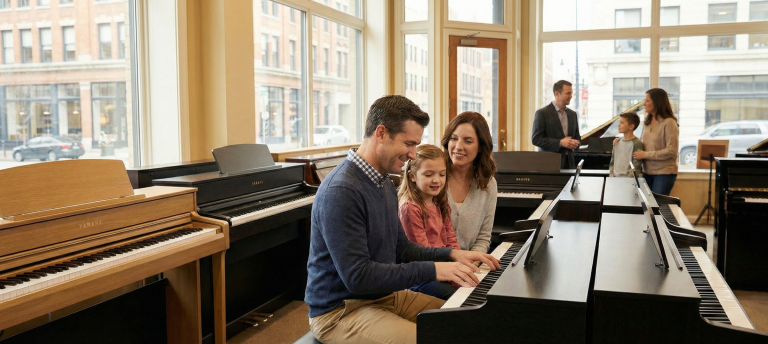
Parents buying a piano for their children face different priorities. Children need instruments that are durable and light enough to move if necessary. They are also more motivated when they can connect the piano to apps or tablets that make learning interactive. A piano that works seamlessly with a learning app can transform practice from a chore into a game.
Small spaces
Space is another crucial factor. Console style digital pianos that resemble acoustic uprights look elegant, but they require space. If you live in a small apartment or a dorm room, a slim portable model makes more sense. I once placed a console style digital piano in a tiny studio apartment. Although it looked beautiful, I eventually admitted it took up too much space and replaced it with a slim model that gave me more freedom.
Motivation and practice habits
Your level of commitment also matters. If you only expect to play casually, you do not need the most advanced model. But if your ambition is to learn classical repertoire or progress to advanced pieces, investing in a piano with authentic touch and sound will support you for years.
2. The Crucial Factor: Touch
Among all variables, touch is the one that can make or break the experience. The weight of the keys, the resistance under your fingers, and the responsiveness to dynamics determine whether a piano feels alive.
When I practiced on lightweight, springy keyboards, I quickly lost motivation. The sound might have been acceptable, but without realistic touch, it felt uninspiring. Graded hammer action, where the lower keys feel heavier and the higher ones lighter, is essential because it mirrors the behavior of an acoustic piano. Some advanced digital pianos even reproduce escapement, the subtle notch you feel when pressing gently, which adds realism.
Realistic touch is not only enjoyable. It also builds correct technique, strengthens your fingers, and allows expressive playing. For beginners, starting with a realistic key action means developing good habits from the start.
Whenever possible, try a piano in person. Close your eyes and pay attention to how the keys respond. Do soft notes sound gentle? Do louder passages respond with power? Can you repeat notes quickly without strain? If you cannot visit a store, online reviews and comparison videos are helpful. Pianists often share their impressions of touch, and while nothing replaces your own hands, their feedback is valuable.
3. Technical Essentials to Consider
Choosing a digital piano is not only about touch. Several technical factors separate average instruments from excellent ones.
Understanding Key Action and Tactile Response
The most critical component of a digital piano is its “action”, the mechanical mechanism that determines how the keys feel and respond to the player’s touch. Unlike a standard keyboard, a digital piano must simulate the physical weight and resistance of an acoustic instrument.
The Three Main Types of Action
- Fully Weighted / Hammer Action: This mechanism uses actual small hammers (rather than springs) to recreate the inertia of an acoustic piano.
- Graded Hammer Action: On an acoustic piano, the hammers in the bass section are heavier than those in the treble. Graded action replicates this variation, providing a more authentic resistance across the keyboard.
- Semi-Weighted Action: Found in mid-range portable models, this uses a combination of springs and weights. While easier to transport, it lacks the resistance necessary for developing proper finger strength and technique.
Advanced Tactile Features
For advanced players, secondary features become essential. Escapement (or Let-off) simulates the slight “click” or resistance felt when a key is pressed halfway down on a grand piano. Additionally, triple-sensor technology allows for faster note repetition without the key needing to return fully to its resting position, which is vital for complex classical pieces.
Sound engine
How a digital piano produces sound is as important as how it feels. There are two primary philosophies in digital sound synthesis:
PCM Sampling
Most digital pianos use Pulse Code Modulation (PCM) sampling. This involves recording each note of a world-class grand piano at multiple volume levels (velocity layers).
- Pros: Highly realistic capture of a specific instrument’s timbre.
- Cons: Can sometimes feel “static” because the samples are pre-recorded loops.
Physical Modeling
High-end instruments, such as those from Roland or Kawai, often use physical modeling. Instead of playing back a recording, a powerful processor calculates the sound in real-time based on the physics of strings, hammers, and the wooden cabinet.
- Cons: Can sometimes sound “clinical” if the algorithm isn’t sophisticated.
- Pros: Infinite variations in tone; captures “sympathetic resonance” (where other strings vibrate when a note is struck).
Polyphony
Polyphony measures how many notes a piano can produce simultaneously. If you use the sustain pedal during complex passages, higher polyphony prevents notes from cutting off. A minimum of 128 notes is recommended, and advanced players may want even more.
Why does this matter for a piano with only 88 keys? When a pianist uses the sustain pedal, notes continue to ring out while new ones are played. If the polyphony limit is reached (e.g., 64 notes), the oldest notes will be abruptly cut off to make room for new ones.
- Beginner Standard: 64-128 notes.
- Intermediate/Professional Standard: 192-256 notes.
- High-End: “Infinite” polyphony for the piano voice.
Connectivity
Modern learners often want to connect their piano to tablets, smartphones, or computers. Bluetooth and USB connectivity allow you to integrate learning apps, record performances, or even stream backing tracks through the piano’s speakers.
USB to Host: To connect the piano to a computer (DAW) or tablet for MIDI control.
Bluetooth Audio/MIDI: Allows for wireless practice with apps like Skoove or Flowkey, or streaming music through the piano’s speakers.
Dual Headphone Jacks: Critical for teacher-student lessons in a quiet environment.
Speaker system
Built in speakers vary widely in quality. Entry level models often have smaller speakers that sound thin, while premium models include powerful multi speaker systems that simulate the resonance of an acoustic piano. If you practice mainly with headphones, speaker power may not matter much, but for home performances it becomes important.
Design and weight
Do you need a slim, portable design that can be moved easily, or a furniture style console that becomes part of your home decor? Portability can be a priority for students and performers, while aesthetics may matter more for families placing the piano in a living room.
Portable Digital Pianos (Slab Pianos)
These are lightweight and designed to be placed on a folding stand. They are ideal for students with limited space or gigging musicians.
- Top Picks: Yamaha P-Series, Roland FP-Series, Kawai ES-Series.
Console Digital Pianos
Housed in a wooden cabinet with built-in pedals and a sliding key cover, these instruments are designed as furniture pieces. They typically feature larger speakers and better resonance.
- Top Picks: Yamaha Clavinova, Roland HP/LX Series, Kawai CA Series.
Hybrid Pianos
A hybrid piano features a complete acoustic wooden action inside a digital body. There are no strings; instead, the hammers strike sensors. This provides the 100% authentic feel of a grand piano without the need for tuning.
- Top Picks: Yamaha AvantGrand, Kawai Novus.
4. Playing Tips Before You Decide
- Experiment with dynamics: Play both soft and loud notes and notice whether the piano translates the difference naturally.
- Test repeated notes: Repetition should feel smooth. If it feels clunky, it may hold back your progress.
- Check headphone quality: Plug in headphones and see if the sound feels immersive.
- Pedal response: Some pianos include pedals with half pedal detection, which is useful for expressive playing.
- Think long term: Ask yourself whether you will outgrow the instrument quickly or if it will support your progress for years.
5. Five Digital Pianos Worth Considering
After reviewing availability, here are five excellent digital pianos you can currently find. Each has its strengths, target audience, and compromises.
Roland F107 – Stylish Compact Upright
The Roland F107 is a stylish entry-level upright digital piano designed for home use. It shares many of the same core technologies as Roland’s higher-end models, including the SuperNATURAL piano sound engine and the PHA-4 Standard key action, but is housed in a slim cabinet that fits easily into modern living spaces. With Bluetooth audio and MIDI support, students can connect directly to apps for lessons, practice, or streaming. Its three-pedal system and elegant finish make it a convincing alternative to an acoustic upright for families and learners.
Ideal for: Families who want an affordable upright-style piano, beginners who want proper weighted keys and connectivity, students practicing at home with headphones.
Pros: Authentic touch and sound, elegant upright design, Bluetooth audio and MIDI, compact and stylish cabinet.
Cons: Speaker system is modest compared to larger uprights, fewer advanced features than higher Roland models.
As an Amazon Associate I earn from qualifying purchases.
Roland FP 30X – Best Intermediate Portable
The Roland FP-30X is a highly regarded portable digital piano that combines professional-level sound with a compact and lightweight design. It offers Roland’s PHA-4 Standard weighted key action, the SuperNATURAL piano sound engine, and 256-note polyphony, making it suitable for both beginners and progressing students. With built-in Bluetooth audio and MIDI, the FP-30X connects easily to learning apps and external devices, making practice more engaging. Its portability also makes it a favorite for players who want a piano that can move with them between rooms or performances.
Ideal for: Beginners and intermediates seeking a portable yet professional-feeling instrument, students who want app connectivity, hobbyists needing strong performance without a console footprint.
Pros: Compact and portable, realistic weighted key action, strong polyphony, Bluetooth connectivity, excellent value under $1000.
Cons: Internal speakers less powerful than console models, limited onboard sound library compared to higher-end stage pianos.
As an Amazon Associate I earn from qualifying purchases.
Casio PX-S3100 – Portable and Versatile Performer
The Casio Privia PX-S3100 is one of the slimmest and most portable 88-key digital pianos available today, and it is widely sold on Amazon across the USA, Canada, UK, and France. It combines a scaled hammer action keyboard with Casio’s AiR sound engine, offering expressive piano tones and over 700 additional instrument sounds. Bluetooth audio and MIDI connectivity make it easy to integrate with apps, record your progress, or play along with your favorite songs. Its sleek and modern design means it fits into almost any space without sacrificing performance.
Ideal for: Intermediate learners, hobbyists, and creative players who want versatility in a portable and stylish design.
Pros: Extremely slim and portable, large library of tones and rhythms, bluetooth audio and MIDI built in and affordable price point for the features offered
Cons: The many features may feel overwhelming for absolute beginner. Speakers are smaller than console models
As an Amazon Associate I earn from qualifying purchases.
Casio Privia PX 870 – Best Budget Console
The Casio Privia PX-870 is one of the most popular console-style digital pianos available today. Designed to deliver an authentic acoustic experience at an affordable price, it comes with a full 88-key weighted keyboard, a powerful four-speaker system, and a sleek upright cabinet with three pedals. Casio created this model as the flagship of the Privia home line, blending elegant design with realistic sound and touch. With its AiR sound engine, 256-note polyphony, and features like Concert Play, the PX-870 is a reliable choice for students, families, and adult learners looking for a serious home instrument.
Ideal for: Families who want a piano that looks and feels like an acoustic upright, beginners starting with weighted keys and proper piano technique, adults returning to piano who want a stylish home instrument without high maintenance
Pros: Affordable, realistic feel, authentic weighted action with textured keys, compact console design.
Cons: Fewer advanced features, no Bluetooth.
As an Amazon Associate I earn from qualifying purchases.
Yamaha P-225 – Modern Successor to the reliable P-125
The Yamaha P-225 is the updated replacement for the extremely popular P-125, designed to offer a slim and portable body with improved sound and feel. It features the Graded Hammer Compact (GHC) keyboard action, which is slightly lighter and more compact while still delivering a natural piano response. Powered by Yamaha’s CFX concert grand piano sampling, the P-225 provides a rich, expressive tone in a design that fits easily into smaller spaces. With USB connectivity and compatibility with Yamaha’s Smart Pianist app, it is ideal for learners who want both authenticity and modern integration.
Ideal for: Beginners and intermediates who want Yamaha’s latest portable piano, students practicing at home with limited space, adults returning to piano who prefer a slim and modern instrument.
Pros: Slim and portable, improved CFX grand piano sound, modern keyboard action, Smart Pianist app compatibility, affordable compared to console models.
Cons: Smaller onboard speaker system than upright-style pianos, fewer premium features than higher-end Yamaha Arius or Clavinova models.
As an Amazon Associate I earn from qualifying purchases.
Summary Comparison
| Model | Best For | Key Action Technology | Primary Strengths | Technical Considerations |
| Roland F107 | Modern homes & dedicated beginners | PHA-4 Standard with Escapement | Authentic ivory feel, sleek upright cabinet, SuperNATURAL sound engine. | Fixed console design; not suitable for transport or gigging. |
| Roland FP-30X | Students, gigging musicians & small studios | PHA-4 Standard with Escapement | Industry-leading key action for price point, Bluetooth MIDI/Audio, portable. | Downward-firing speakers require a hard surface for optimal resonance. |
| Casio PX-S3100 | Creative producers & space-conscious hobbyists | Smart Scaled Hammer Action | World’s slimmest design, 700+ high-quality tones, intuitive touch interface. | Compact keys have a shorter pivot point; less ideal for advanced classical repertoire. |
| Casio PX-870 | Families & intermediate home learners | Tri-Sensor Scaled Hammer II | Powerful 40W 4-speaker sound system, 256-note polyphony, elegant lid projection. | Lacks Bluetooth connectivity; traditional “furniture” footprint is heavy. |
| Yamaha P-225 | Yamaha enthusiasts & mobile learners | GHC (Graded Hammer Compact) | Iconic CFX Grand Piano sampling, ultra-slim profile, Smart Pianist App integration. | 2-way speakers are clear but lack the “thump” of larger console models. |
Conclusion
Choosing the right digital piano is about balance. It is not only about specifications but about how the instrument fits your environment, your lifestyle, and your ambition. For elegant compact design, the Roland F107 is a strong choice. For portability and intermediate growth, the Roland FP 30X excels. For advanced players, the Kawai ES920 offers professional quality in a portable body. For budget households, the Casio PX 870 is a reliable console, and for dependable intermediate value, the Yamaha P 225 is hard to beat.
Above all, remember that touch is the soul of a piano. The right piano is the one that feels good under your fingers, inspires you to practice, and keeps you motivated to grow. Whether you are a beginner learning your first scales or an advanced pianist refining your technique, choosing wisely will ensure that your digital piano becomes a lasting partner in your musical life.
Do digital pianos ever need tuning?
No. Because digital pianos use electronic samples or modeling to produce sound, they do not have strings and are not affected by humidity or temperature changes in terms of pitch.
Is an 88-key keyboard necessary for beginners?
Yes. While smaller keyboards (61 or 76 keys) exist, they often lack weighted action. Starting on 88 weighted keys ensures the student develops the correct finger strength and won’t outgrow the instrument within the first year.
Can I use any headphones with my digital piano?
Most digital pianos use a 1/4 inch (6.35mm) jack. If you have standard headphones with a 3.5mm plug, you will need a simple gold-plated adapter. High-impedance studio headphones may require a piano with a powerful internal amplifier.