Learning how to practice piano effectively is one of the most important, and often misunderstood, aspects of becoming a better pianist. Many players spend hours at the keyboard yet feel stuck, frustrated, or unsure why their progress feels so slow. The truth is simple but powerful: it’s not how long you practice, but how you practice that determines how fast you improve.
Whether you’re a complete beginner learning your first scales, an adult returning to piano after years away, or an advanced player refining a Chopin, Debussy, or jazz standard, the quality of your practice routine makes all the difference. Randomly playing through pieces, repeating the same mistakes, or practicing without clear goals can actually slow your progress, and drain your motivation.
Professional pianists don’t just practice more; they practice smarter. They use structured routines, clear objectives, slow and focused work, and feedback loops that allow steady improvement day after day. The good news? These methods are not reserved for conservatory students. Anyone can apply them, regardless of age, level, or musical style.
In this guide, you’ll discover 10 proven piano practice tips used by professional musicians and experienced teachers. These strategies will help you build an effective practice routine, avoid common mistakes, and make measurable progress in less time. The advice applies to all styles, classical, jazz, pop, film music, and more, and works whether you practice on an acoustic piano or a digital keyboard.
From building daily habits and setting clear goals, to using essential tools like a metronome, headphones, and recording devices, this article will show you how to practice piano with intention, focus, and confidence, so every minute at the keyboard truly counts.
By the end of this article, you will know how to:
- Build a consistent daily piano practice habit, even with a busy schedule
- Structure your practice sessions with clear goals and a logical plan
- Eliminate distractions and practice with deep focus
- Use slow practice, a metronome, and sectional work to master difficult passages faster
- Develop strong technique through warm-ups, scales, and fundamentals
- Practice deliberately and mindfully, instead of mindlessly repeating pieces
- Diversify your repertoire to stay motivated and grow musically
- Use feedback, recordings, and teachers to accelerate your progress
The most effective way to practice piano is to practice consistently every day with clear goals, slow and focused repetition, deliberate problem-solving, and regular feedback, rather than playing mindlessly or rushing through pieces.
1. Make Practice a Daily Habit
Consistency is the secret sauce of effective piano practice. Aim to practice every day, even if it’s only for a short session. A regular daily routine beats sporadic marathon sessions every time. In fact, keeping a consistent schedule (for example, 30 minutes each day) will yield far more progress than a few hours once a week. As one expert puts it, “‘Little and often’ will help you achieve far more than overdoing it one day, and then doing nothing for the next few days”.
Tips to build the habit:
- Schedule it: Treat practice like an appointment. Set aside a specific time each day (morning, after work, etc.) and stick to it. Soon it becomes second nature.
- Create a practice-friendly space: Keep your piano or keyboard easily accessible. Don’t hide it in a closet or seldom-used room, seeing your instrument reminds you to play. For example, setting up your keyboard in a prominent spot (like the living room) encourages frequent practice by making it convenient and inviting.
- Short but focused: You don’t have to practice for hours on end. In fact, professionals often limit any single practice session to about 30–40 minutes before taking a break. Several short, focused sessions (even 10-15 minutes if that’s all you have) can be more effective for learning than one long, tiring session. The goal is to practice while your mind is fresh and attentive, so you retain more.
- “Something is better than nothing”: Even on busy days, try to squeeze in a few minutes at the piano. Run a scale, play a short piece, just keep your fingers in touch with the keys daily. Consistency builds momentum and keeps your progress from stalling.
By making practice a non-negotiable part of your daily routine (like brushing your teeth or eating breakfast), you’ll develop steady improvements in your piano playing. Consistent practice lays the foundation for all the other tips to work their magic.
As an Amazon Associate I earn from qualifying purchases.
As an Amazon Associate I earn from qualifying purchases.
2. Set Clear Goals and Plan Your Practice
Don’t go into a practice session without a game plan. Practicing with specific goals will supercharge your progress. Before you start, decide what you want to accomplish today. Is it mastering the left-hand part of a new song? Improving the accuracy of a tricky passage in Beethoven’s “Moonlight” Sonata? Perhaps increasing the tempo of a scale by a few beats? Define it, and then plan your practice around that goal.
How to set effective practice goals:
- Write down your goals: Keep a practice journal or log book to track what you aim to do each session and your progress. Jot down specific targets (e.g., “today: play measures 20-40 hands together at 60 BPM without mistakes”). This helps you stay focused and gives you a record to review. In fact, many piano teachers recommend keeping a practice diary to organize your practice tasks. There are even dedicated piano practice planners available (for example, the Piano Practice Journal : 12 Month Log for Musicians). Using a planner like this can motivate you to hit your targets and see your improvement over time.
As an Amazon Associate I earn from qualifying purchases.
- Break down long-term goals: If your big goal is to learn an entire piece, break it into smaller milestones (learn one page per week, memorize the first 16 bars by Friday, etc.). This makes large tasks less daunting and more achievable.
- Plan your session structure: Decide how you’ll spend your practice time before you start. For example: 5 minutes warming up, 10 minutes on scales/technique, 15 minutes on Song A, 15 minutes on Song B. Having a clear roadmap prevents aimless noodling. Research backs this up – a study of advanced piano students found that the most effective practicers did a lot more planning and strategizing at the start of their sessions than less effective students. The top pianists would identify difficult parts and set specific objectives for the session, rather than just plunging in randomly. Take a page from their book by planning what you intend to achieve each time you sit down at the keys.
- Set performance deadlines: One clever goal-setting trick is to schedule opportunities to perform what you’re practicing. This could mean telling your teacher or a friend you’ll play the piece for them next week, or even setting a “recording date” for yourself. Knowing you’ll perform or record a piece by a certain date lights a fire under you to practice with purpose. Plus, recording yourself and listening back is incredibly eye-opening, you’ll notice details to fix that you might miss while playing.
Each time you practice, have a goal in mind, something specific you want to improve or accomplish. This turns practice from just “playing through stuff” into a deliberate, focused mission. You’ll walk away from each session with a sense of achievement, and over time those small wins add up to significant progress.
3. Minimize Distractions and Stay Focused
When it’s practice time, make it quality time. This means eliminating interruptions and concentrating fully on the music. Practicing piano effectively isn’t just about quantity of hours, it’s about the quality of focus during those hours. A half-hour of fully engaged practice can yield better results than two hours of distracted playing.
Strategies to create a focus-friendly practice environment:
- Remove electronic distractions: Before you start, silence your phone (or better yet, keep it in another room). Close your laptop (unless you’re using it for sheet music or backing tracks). Our always-connected devices are temptation machines, a quick text or notification can break your concentration instantly. Give yourself the gift of uninterrupted time. As one expert noted, we learn most efficiently when our mind’s full attention is on the task at hand, so free your space of noise and disruption : “switch off your phone”.
- Find a quiet time and place: Try to practice when you can have peace and quiet. Early mornings or later evenings might be times when the household is calmer. If you share space, communicate with family that this is your practice time so you won’t be disturbed.
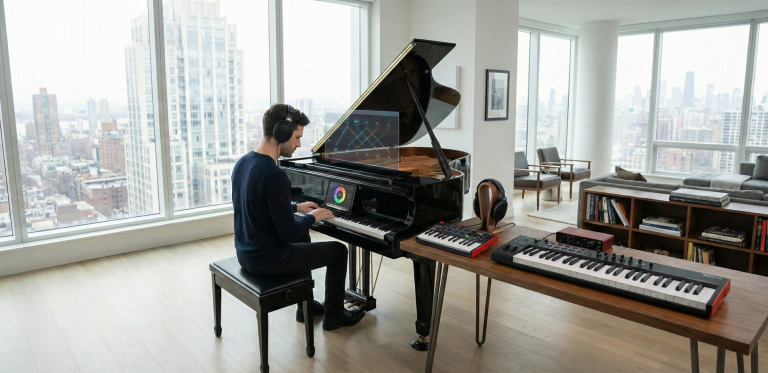
- Use headphones for digital pianos: If you’re practicing on a digital piano or keyboard, a good set of headphones can be your best friend. Not only do headphones let you practice anytime without bothering others, they also help you focus on the details of your playing. You’ll hear your dynamics, articulation, and mistakes more clearly. Look for comfortable, high-quality over-ear headphones that provide clear, balanced sound. For example, the Beyerdynamic DT 770 Pro is a popular choice for pianists due to its excellent sound quality and comfort. With headphones, you can immerse yourself in the music and block out external noise – it’s like having a private practice studio.
As an Amazon Associate I earn from qualifying purchases.
- One thing at a time: While practicing, focus on one small task or section at a time (more on that later) and zero in on it. Avoid letting your mind wander to other parts of the piece or other things you need to do that day. If you catch yourself going on autopilot, stop, refocus, and resume with intention.
- Take short breaks: Ironically, taking breaks can improve focus. After 20-30 minutes of intense practice, stand up, stretch, or walk around for a couple of minutes. This resets your brain. Just be sure the break doesn’t become a distraction in itself (set a timer for 2-5 minutes). Then sit back down refreshed and ready for more concentration.
Remember, mindful practice is far more effective than mindless practice. When you eliminate distractions and put all your attention on the music in front of you, you’ll absorb techniques and correct mistakes much faster. In the end, 30 minutes of focused practice beats hours of distracted playing – it’s a true quality-over-quantity scenario.
4. Warm Up and Practice Your Fundamentals
Ever notice athletes warming up before a game? Pianists are no different – warming up is essential. Begin each practice session with a brief warm-up to get your fingers, hands, and mind ready to play. Warming up prevents injury and improves your technique over time, acting as a foundation for effective practice.
Ideas for warm-up and technical practice:
- Scales and arpeggios: The bread-and-butter of piano technique. Start with a couple of scales (major or minor) each day. Focus on playing evenly and smoothly, with relaxed hands. Gradually increase speed once you’re accurate. Arpeggios (broken chords) are also excellent for finger independence and hand coordination. For variety, cycle through different keys each week. If you’re not sure where to start, consider using a scale reference or chart to guide you in all keys (there’s a great all-in-one piano scale chart available on Amazon).
- Hanon or Czerny exercises: These are classic piano exercises aimed at building finger strength and agility. Spending 5–10 minutes on exercise patterns can really warm up your fingers. Just avoid doing them mechanically – listen for even tone and work on weak fingers.
As an Amazon Associate I earn from qualifying purchases.
- Etudes or technical pieces: If straight scales bore you, use a musical etude (study piece) as a warm-up. For example, a simple Burgmüller or Czerny study can both warm you up and build a specific skill (like trills or leaps) in a musical context.
As an Amazon Associate I earn from qualifying purchases.
- Slow, controlled play: Whatever warm-up you choose, start slowly and with full control. The goal is not speed at first, but to awaken your muscles and focus your mind. Pay attention to your hand posture and relax your shoulders. This mindful warm-up carries over into better playing in your repertoire.
Don’t skip the basics, technical fundamentals are the tools that make the rest of your practicing more effective. Just as a house needs a solid foundation, your fingers need strength, flexibility, and familiarity with the keyboard. A short warm-up routine prepares you physically and mentally for the challenges ahead in your practice session. Over weeks and months, those scale and technique sessions compound, leading to cleaner, faster, and more confident piano playing.
5. Practice Slowly (The Speed Will Come) – and Use a Metronome
It’s a bit of paradox: to learn a piece quickly, you should practice it slowly. Rushing to play at full speed too soon is one of the most common practice mistakes. When you practice piano slowly and deliberately, you give your brain the chance to absorb the music and your fingers the chance to learn the correct movements without stumbling. In short, the slower you go, the quicker you learn!
Why slow practice works (and how to do it):
- Accuracy over speed: By slowing down, you can play the notes, rhythms, and fingerings correctly. You train your muscle memory with the right patterns instead of reinforcing mistakes. As one instructor humorously reminds us: any mistakes you make repeatedly will become ingrained, because practice makes permanent, not necessarily perfect. So go slow enough that you can play the passage without errors – even if that feels very slow.
- Build control and evenness: Slow practice lets you listen to each note and check your timing. Are both hands coordinated? Are those fast runs even? Is your tone clean? You can notice and fix these details at a slow tempo. Think of it like zooming in with a microscope to clean up imperfections.
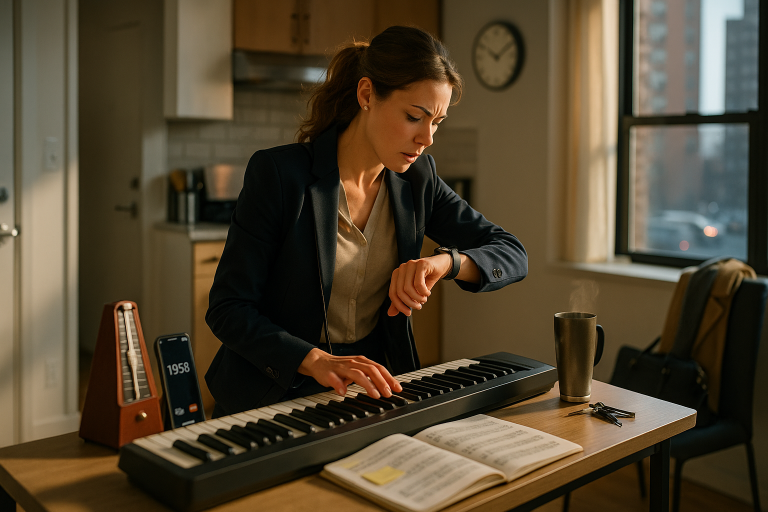
- Use a metronome: A metronome is an indispensable tool for slow practice. Set it to a comfortable slow tempo and play along, ensuring each beat is rock steady. The metronome keeps you honest – no rushing through the easy bars or slowing down for the hard parts. Start, for example, at a very slow 50-60 BPM for a difficult passage. Once you can play it perfectly at that tempo, notch the metronome up by a few beats and repeat. Over multiple days or weeks, you’ll gradually increase the speed until you reach your goal tempo, all the while maintaining precision. This crawl-walk-run approach might test your patience, but it absolutely pays off in clean, confident performances. As a rule of thumb, never increase the tempo until you can play the passage correctly at the current tempo.
- Prevent “unlearning” mistakes: Pushing speed too early often leads to sloppy playing and wrong notes, which then require unlearning later (a frustrating process). It’s much faster in the long run to learn it right the first time at a slow pace, than to bulldoze through fast with errors and have to fix them afterward.
So embrace the motto “Go slow to go fast.” If you feel impatient, remind yourself that every minute of slow practice is an investment in accuracy that will save you tons of time later. And of course, keep that metronome handy – it’s like having a coach alongside you to maintain steady rhythm. (If you don’t have one, consider getting a simple metronome; for instance, the classic Wittner 806K wind-up metronome is a reliable choice available. There are also many metronome apps, but a physical metronome’s visual and auditory click can be especially effective.) By practicing slowly and with a steady beat, you’ll master pieces with precision and speed them up in due course, without the wheels falling off.
As an Amazon Associate I earn from qualifying purchases.
6. Break Music into Sections and Isolate Problem Areas
When faced with a new piece (or a challenging section of a piece), don’t just always play it from start to finish. A pro tip for effective practice is to divide the music into small sections and work on those chunks individually. Likewise, isolate the problem areas, the measures or phrases that give you trouble, and focus on them in depth. This approach makes your practice time much more efficient and targeted.
How to implement sectional practice:
- Chunk the music: Instead of treating the piece as one long sequence, break it down. You might practice one phrase or 4-measure section at a time. For a longer piece, divide it into sections (intro, A section, B section, etc., or even by page). Work on mastering each section separately. This way, you give attention to every part of the piece, not just the beginning that we tend to replay. Many students have the habit of always starting back at bar 1; as a result, the opening of their piece is polished but the rest is weaker. To avoid that, sometimes start practicing from the middle or end sections. “Don’t always start your pieces from the beginning. Divide the music into sections and begin each day’s work from a different section.” Otherwise, you’ll know the start of the piece far better than the ending. Wise advice indeed!
- Target the tough spots: Identify the exact spots that trip you up – a tricky transition, a fast run, an awkward chord change. Isolate those passages. It could be as short as one measure or even just a couple of beats. Practice that snippet slowly and repeatedly until it feels comfortable, then put it back into context. It helps to mark the trouble spots in your sheet music (circle them or use a bracket) so you remember to give them extra attention. Start your practice session with these problematic bars while you’re fresh. You can even take quick “spot practice” breaks throughout the day: for example, sit down at the piano just to play that difficult two-bar transition 3-4 times correctly. Frequent, focused bursts on the hardest bits will smooth them out more quickly.
- Practice backwards: A useful variation is back-chaining – practice the last section of the piece first, then the section before that, and so on, working backwards to the beginning. This ensures you can confidently finish the piece. It’s also a great antidote if you find yourself always polishing the intro and neglecting the ending. Some teachers recommend, for instance, learning the final line of a song, then the second-to-last line, gradually building towards the start. By the time you put it all together, every part of the piece will be strong.
- Section stitching: Once you’ve woodshedded each section in isolation, practice linking sections together. You might play Section A a few times alone, Section B a few times alone, and then practice transitioning from A into B smoothly. Eventually, expand the sections until you can do the whole piece. But even then, continue to spot-check those tricky spots within the piece regularly.
This sectional approach is all about efficiency, you spend your time where it’s needed most, rather than slogging through the easy parts over and over. It’s like a surgeon focusing on the exact area that needs work. By drilling the tough sections and rotating your starting points, you’ll achieve a more consistent level of proficiency throughout the entire piece. The end result? You’ll master songs faster and more thoroughly, with no weak links in the chain.
7. Use Consistent Fingering (and Write It In)
Fingering – the choice of which finger plays which note – might seem like a small detail, but it has a huge impact on your piano practice efficiency. One of the golden rules of effective practice is: choose good fingerings for passages and stick to them consistently. When you use the same fingering every time, you build reliable muscle memory; if you change it randomly, you’re likely to trip up and waste time relearning the passage.
Best practices for fingering:
- Follow suggested fingerings (or create your own): If you’re learning from sheet music, you’ll often see little numbers (1–5) above the notes indicating suggested fingers. These are there for a reason – usually to help you play smoothly and comfortably. Give them a try. If they feel awkward for your hand, experiment and find an alternative fingering that works better but still makes musical sense. The key is to decide on a fingering early and commit to it. Avoid the trap of using one fingering one day and a different one the next – that keeps resetting your learning.
- Write it down: Keep a pencil handy and mark your fingerings on the music for any tricky passages or wherever you tend to forget which finger goes where. Writing “4–3–2–1” above a scale run, for instance, will remind you how to execute it every time. Don’t assume you’ll just remember; pencil marks ensure you don’t second-guess yourself mid-play.
- Build muscle memory: Consistent fingering turns difficult passages into nearly automatic movements. When you use the same fingers on the same keys repeatedly, you develop a physical memory of that motion. Your hand starts to “remember” the feel of the passage. As one piano learning resource explains, by deciding on a set sequence of fingering for each piece and using it consistently, “you are calling upon your muscle memory to help you learn and perform each piece with stability”. In other words, your fingers eventually go to the right notes on autopilot – but only if you ingrained the habit with consistent fingering. If you keep changing fingers, that muscle memory can’t lock in.
- Avoid finger flailing: Beginner students sometimes try to play everything with just a few favored fingers, which leads to awkward stretches and mistakes. Assign all your fingers work to do as logically as possible. For example, in a scale, use all 5 fingers in a smooth sequence (not just 1-2-3 randomly). Good fingering often involves techniques like tucking your thumb under or crossing fingers over in scale patterns – practice those slowly so they become comfortable.
- Stability and confidence: Using the correct, consistent fingers not only makes passages easier to play, it also boosts your confidence when performing. You’ll feel secure knowing that your hands know exactly where to go. Inconsistent fingering, on the other hand, can leave you scrambling and unsure of a passage each time you approach it, leading to slips especially under pressure.
Take the time to figure out the best fingering for a passage when you first learn it. It might require a bit of problem-solving (or guidance from a teacher or more experienced pianist), but it will save you so much frustration later. And once you choose a fingering, be disciplined about sticking to it. It might feel unfamiliar at first, but with repetition it will become second nature. Consistent fingering is one of those pro habits that separates efficient practice from just messing around. It enables you to learn pieces faster and perform them more reliably.
As an Amazon Associate I earn from qualifying purchases.
8. Practice Deliberately and Mindfully (Quality Over Quantity)
There’s a big difference between practicing with your brain turned on versus mindlessly running through pieces. To get better faster, approach each practice session with a deliberate, problem-solving mindset. This concept is often called deliberate practice or mindful practice – and it’s what top performers in any field do. In piano terms, it means you should constantly listen, analyze, and adjust as you practice, rather than just playing things over and over on autopilot.
How to practice deliberately:
- Always be listening critically: When you play, really listen to yourself. Does that scale sound even? Are the melody notes singing out above the accompaniment? Did you play the rhythm correctly in that bar? Train yourself to notice when something is off. If you find an issue, stop and address it (slow down, fix the fingering, count out loud, etc.). Practicing effectively is a loop of play – listen – correct – repeat. In essence, you need to become your own teacher during your practice sessions. Don’t just let mistakes slide; be proactive in fixing them.
- Avoid autopilot repetitions: Simply repeating a piece from start to finish without specific intent is not efficient. It might feel like you’re putting in time, but you may just be reinforcing the same errors or glossing over problems. Instead, have a purpose for each repetition. For example: “This time, I’ll focus on keeping my left-hand accompaniment soft,” or “I’ll concentrate on hitting that bass note accurately.” Give each run-through a clear focus. Quality beats quantity – five mindful repetitions of a passage, making improvements each time, trump twenty mindless repetitions where nothing changes.
- Use the “3 S’s” formula: A famous practice formula is “Slowly, Separately, Sections”. We’ve covered slow and sections already, but the idea is to always default to these principles when tackling something difficult: slow it down, maybe practice each hand separately, and work section by section. This is a very intentional way to practice, as opposed to just diving in full speed with both hands and hoping for the best. Deliberate practice often means stripping complexity away (e.g., practicing hands alone to focus on one hand’s part) and then adding it back in once you’re secure.
- Keep a problem-solution mindset: If you encounter a hurdle – say, a passage you just can’t get right – don’t just bash your head against it repeatedly. Pause and ask, why is this hard and what strategy could help? Maybe your fingering is awkward (fix it), or you’re not subdividing the rhythm (try counting aloud), or you might need to practice hands separately, or isolate even smaller bits. By identifying the cause of the problem and applying a targeted solution, you practice smarter. This kind of investigative approach is the heart of deliberate practice.
- Limit length and maintain concentration: It’s hard to practice with full mindfulness for hours on end. That’s why those shorter sessions we discussed are helpful – you can give 100% focus for, say, 30 minutes, then take a break. If you notice your mind is wandering or you’re no longer really paying attention to what you’re doing, it might be time to pause. Better to practice intensely with focus for a shorter period than to continue in a mentally fatigued state (where you’re likely just ingraining bad habits). Recognize when you’re on autopilot and stop.
Deliberate practice can be mentally demanding – it requires constant engagement – but it yields results far superior to mindless repetition. Every minute you spend in mindful practice is a minute of real improvement. Remember the saying: “Practice doesn’t make perfect; perfect practice makes perfect.” Of course, nobody’s perfect, but the idea is to strive for mindful, goal-oriented practice rather than just clocking hours. When you adopt this approach, you’ll find you can learn pieces faster and solve technical challenges more effectively because you’re always practicing with a clear intention and full awareness.
9. Diversify Your Practice: Mix Up Your Repertoire and Challenges
If you want to grow as a pianist (and stay motivated), make sure your practice routine includes a balanced diet of music and exercises. Don’t play the same few pieces or the same type of music all the time. Variety will not only keep things interesting, but also improve your versatility and musicianship. At the same time, maintain a core repertoire of pieces you can play well, so you always have something ready to perform or enjoy.
Suggestions for a balanced piano diet:
- Try different styles and periods: If you’re a classical pianist who only plays Baroque music, try learning a Romantic piece, a contemporary piece, or even a jazz standard for a change. Each style teaches you different skills and expressions. As pianists, exploring unfamiliar genres or pieces outside our comfort zone can be very inspiring and beneficial. For instance, classical pieces demand precision and nuance, jazz pieces improve your sense of rhythm and harmony, pop songs can enhance your chord reading and groove, etc. By branching out, you become a more well-rounded musician and keep your practice sessions fresh.
- Include both easy and challenging pieces: It’s good to work on one piece that really pushes your abilities (perhaps a bit above your current level) and also keep something easier or already learned that you can play more freely. The challenging piece is where you’ll make significant improvements and learn new techniques (even if progress is slow), while the easier piece is for enjoyment, musicality, and building confidence. If you only tackle hard stuff, you might get frustrated; if you only play easy stuff, you won’t improve much. Balance the two.
- Don’t just play what you already know: It’s tempting to sit down and churn out that one piece you’ve mastered over and over because it feels good. But remember, if you only practice what you can already play, you’re not really practicing – you’re just performing for yourself. One piano teacher quipped, “What are you really learning by playing through songs you’re already familiar with?”. Continuously challenge yourself with something new each practice session, whether it’s a new piece, a new scale, or a new technique. Pushing into uncertain territory is how you grow. It also prevents boredom and keeps you engaged.
- Maintain a repertoire of polished pieces: On the flip side, don’t abandon pieces forever as soon as you learn them. It’s a common mistake to always jump to the next new thing and never maintain what you’ve accomplished. If you do that, you might find you have nothing ready to play for friends or family because you let all your past pieces get rusty. The solution is to regularly review and polish a few favorite pieces. You might set aside some practice time each week to revisit 3-5 pieces you’ve learned in the past, just to keep them in shape. This way, you build a personal repertoire you can confidently perform on demand. It’s very satisfying to have a handful of pieces you can sit down and play anytime to show your progress.
- Incorporate creative and fun activities: Not all practice has to be about drilling and repetition. You can devote a little time to improvisation, playing by ear, or composing your own little tune. If you’re into reading, try sight-reading a new easy piece each week, it’s a different skill that can be fun and useful. These activities keep your practice enjoyable and tap into the joy of making music, which is ultimately why we learn piano!
By diversifying your practice material, you’ll stay motivated and avoid burnout. It’s like a well-rounded exercise program that works out all muscle groups, a varied piano routine develops your technical skills, musical understanding, and keeps you emotionally invested. Plus, exploring new music can rekindle your inspiration on days when practice feels like a grind. So mix it up: tackle that big challenging piece, but also learn a simple arrangement of your favorite song, play a duet with a friend if you can, or jam with a blues backing track. This variety will make you a faster-learning, more adaptable, and happier pianist.
10. Seek Feedback and Embrace Learning from Others
Practicing in isolation can only take you so far – at some point, getting feedback on your playing is crucial to break through to the next level. Feedback can come from a qualified teacher, a mentor, or even your own self-assessment through recording. The idea is to get an outside perspective (or a more objective perspective) on your playing so you know what to improve and how.
Ways to get valuable feedback on your piano practice:
- Work with a good teacher (if possible): A professional piano teacher or an experienced instructor is an invaluable resource. They can spot your weaknesses, provide expert guidance on technique and interpretation, and hold you accountable to your practice goals. A teacher will correct bad habits you might not realize you have and give you tailored advice to overcome challenges. If you’re serious about improving, consider finding a teacher who suits your needs (some specialize in kids, some in adults, etc.). Even if you prefer self-teaching, taking a lesson periodically or attending a masterclass can give you fresh insights and keep you on track. Don’t be afraid that a teacher will be too hard on you – good teachers understand your level and goals, and they support and motivate you as well as instruct.
- Record yourself: One of the best practice tools is a simple audio or video recording device (a smartphone will do). When you record yourself playing a piece and then listen back, you suddenly hear your performance with “new ears”. Mistakes or unevenness that you didn’t notice while playing will become obvious on the recording. You might be surprised (“Yikes, I had no idea I was rushing in that section!”) – but that’s a good thing, because now you know what to fix. As one pianist noted, listening to yourself is a real eye-opener and an extremely useful exercise. Try to periodically record a piece you’re working on, take notes on what could be better, and then work on those spots. It’s almost like having a teacher’s feedback, because you step back and evaluate your own playing critically.
- Play for others: If you have friends or family who are willing to listen (or better yet, if they also play music), perform for them occasionally. You’ll gain experience playing under a tiny bit of pressure, which is great for building confidence. They might also share impressions (“That song was beautiful!” or “I couldn’t hear the melody over the left hand”) that can inform your practice. If you’re comfortable with it, you could even post a video in an online piano community or social media and invite constructive feedback. Sometimes other musicians can offer tips or point out things you didn’t realize.
- Stay open to critique: It can be hard to hear criticism, especially about something as personal as your music. But remember, feedback is how we grow. Try to view critique not as an insult, but as a helpful pointer towards getting better. Even top concert pianists have mentors, coaches, and critics giving them notes on how to improve – the learning process never really ends. When your teacher corrects your hand position or suggests a different interpretation, give it a genuine try. When you notice flaws in your recording, don’t get discouraged; feel excited that you discovered an area to work on. This positive, growth-oriented mindset will make feedback a powerful ally rather than a blow to your ego.
- Join a community: Consider joining a piano class, workshop, or even an online forum. Being part of a community of fellow learners allows you to share experiences and tips. You can learn vicariously from others’ feedback too. For instance, someone might ask a question about how to practice effectively, and the answers can introduce you to new ideas you hadn’t tried.
In summary, don’t practice in a vacuum. Getting external input accelerates your progress by illuminating things you might miss on your own. A teacher can guide your journey and ensure you’re practicing correctly (so you get better faster and don’t engrain bad habits). And even without a personal teacher, tools like recordings and occasional performances can give you valuable perspective. Embrace feedback as a learning opportunity, and you’ll continuously refine your playing. Piano is a lifelong learning process – there’s always something new to discover, and often someone else can help you discover it.
As an Amazon Associate I earn from qualifying purchases.
Useful Ressources
Alfred's Basic Adult All-in-One Course on Amazon !𝄞As an Amazon Associate I earn from qualifying purchases.
Essential Music Theory Insights for Sight Reading on Amazon !𝄞As an Amazon Associate I earn from qualifying purchases.
Faber Piano Adventures: Adult Piano Adventures All-in-One Lesson on Amazon !𝄞As an Amazon Associate I earn from qualifying purchases.
How to Read Music in 30 Days on Amazon !𝄞As an Amazon Associate I earn from qualifying purchases.
Music Theory: From Beginner to Expert on Amazon !𝄞As an Amazon Associate I earn from qualifying purchases.
Conclusion:
Effective piano practice is all about working smarter, not just harder. By following these 10 pro tips, from maintaining a consistent daily routine and setting clear goals, to slowing down, focusing deeply, and seeking feedback, you can make your practice sessions hugely productive and enjoyable. Remember that progress on the piano is a journey; with each focused session you’re laying bricks in the foundation of your skills. Some days will feel great, other days might be frustrating, but stick with it. Use the strategies here to keep yourself motivated and on track: vary your repertoire, use helpful tools (your metronome and practice journal are now your best buddies!), and celebrate the small wins along the way. With patience, passion, and smart practice habits, you’ll be amazed at how fast you can improve. Now, go to your piano and put these piano practice tips into action ; happy practicing, and enjoy the music every step of the way!
How long should I practice piano each day to see progress?
Most pianists see consistent progress with 20 to 40 minutes of focused daily practice. Short, regular sessions are far more effective than long, irregular ones. Quality and concentration matter more than total hours.
Is it better to practice piano every day or longer sessions a few times a week?
Practicing every day is much more effective. Daily practice reinforces muscle memory, improves coordination, and keeps your mind connected to the instrument. Even 10 minutes a day is better than skipping several days.
Why is slow practice so important for learning piano?
Slow practice allows you to play accurately, develop proper fingerings, and build reliable muscle memory. Practicing too fast too early reinforces mistakes, which then take much longer to correct.
Should I always use a metronome when practicing piano?
Not always, but very often, especially when learning new pieces, working on rhythm, or increasing speed. A metronome helps you develop solid timing and prevents rushing or uneven playing.
Can I improve on piano without a teacher?
Yes, you can make progress on your own by practicing deliberately, using recordings, and following structured methods. However, a teacher, even occasionally, can help you avoid bad habits, progress faster, and gain valuable musical insight.