The journey of mastering the piano is often perceived as a marathon of endurance, yet the most successful pianists understand that progress is a variable of both time and methodology. Determining exactly how many hours one should practice each week is a foundational decision that influences technical proficiency, musicality, and long-term retention. Whether aiming for casual hobbyist enjoyment or preparing for a conservatory-level performance, the allocation of time must be strategic, sustainable, and scientifically grounded.
In this guide, you will learn:
- The specific hourly recommendations categorized by skill level (Beginner to Professional).
- The psychological difference between “mindless repetition” and “deliberate practice.”
- How to structure a weekly schedule to maximize neuroplasticity and muscle memory.
- The essential gear and ergonomic considerations to prevent injury during extended sessions.
For most piano players, the ideal practice duration ranges from 3.5 to 15 hours per week, depending on the individual’s current skill level and ultimate musical goals. Beginners typically see the most significant gains with 30 minutes of daily practice (3.5 hours/week), while intermediate and advanced students require 1 to 3 hours daily (7 to 21 hours/week) to maintain repertoire and develop complex technical facilities. Consistency remains more critical than total duration; practicing 20 minutes every day is scientifically proven to be more effective for motor skill acquisition than a single four-hour session once a week.
1. Defining Practice by Skill Level
To establish a baseline, one must categorize their current standing within the pedagogical hierarchy. Each stage of development requires a different cognitive load and physical commitment.
The Beginner Phase (0-2 Years / Grades 1-3)
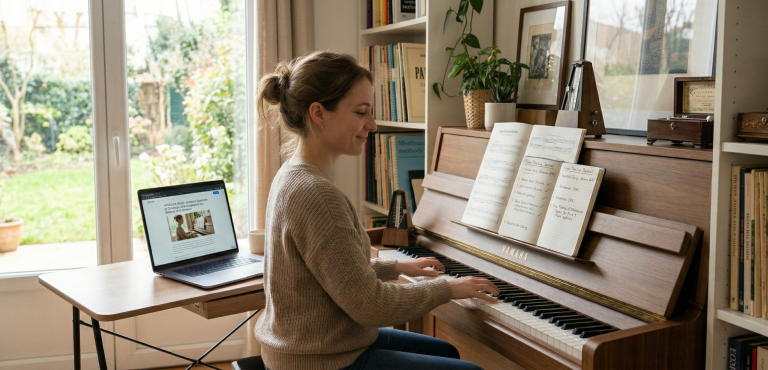
For those in the initial stages of learning, mastering notation, basic hand independence, and simple scales, the focus is on habit formation. The objective is to build muscle memory and establish correct posture. Practice sessions at this stage are mentally taxing because the brain is forming entirely new neural connections for bimanual coordination.
- Recommended Time: 20–45 minutes per day.
- Weekly Total: 2.5–5 hours.
- Primary Objective: Developing the “neural pathways” for reading and finger movement without inducing mental fatigue.
| Level / Grade | Daily Goal | Weekly Commitment | Pedagogical Focus |
| Early Beginner | 15–20 Minutes | 2–3 Hours | Note names, hand posture, simple melodies. |
| ABRSM Grade 1 | 30 Minutes | 3.5 Hours | Major scales (C, G, F), basic rhythm, 2-note chords. |
| ABRSM Grade 2 | 35–45 Minutes | 4–5 Hours | Dynamic variation (p vs f), simple hand crossings, primary triads. |
| ABRSM Grade 3 | 45–60 Minutes | 5–7 Hours | Compound time signatures, early intermediate repertoire, minor scales. |
Consistency is more critical than duration for beginners. Missing several days of practice often results in a “regression to the mean,” where the student feels they are starting over during the next session.
The Intermediate Phase (2-5 Years / Grades 4-7)
At this stage, the repertoire becomes longer and technically more demanding (e.g., Bach Inventions, Mozart Sonatas). The student must now master “intervallic reading” and move away from thinking about individual notes.
- Recommended Time: 1–1.5 hours per day.
- Weekly Total: 7–10 hours.
- Primary Objective: Integrating technical exercises (scales, arpeggios) with expressive interpretation and more complex rhythmic structures.
| Level / Grade | Daily Goal | Weekly Commitment | Pedagogical Focus |
| Grade 4-5 | 60–90 Minutes | 7–10 Hours | Arpeggios, syncopation, multi-page repertoire. |
| Grade 6-7 | 1.5–2 Hours | 10–14 Hours | Advanced dynamics (legato, staccato), polyphonic textures, complex keys. |
The Advanced and Pre-Professional Phase (5+ Years / Grade 8 and Beyond)
Advanced players often tackle virtuoso works by Liszt, Chopin, or Rachmaninoff, requiring significant physical stamina. To reach the ABRSM/RCM Grade 8 standard, a student must have invested approximately 1,500 to 5,000 total hours of study. Serious undergraduate piano majors or those preparing for conservatories like Juilliard may practice 4 to 6 hours daily, potentially reaching 10 to 12 hours during intensive periods.
- Recommended Time: 2–4 hours per day.
- Weekly Total: 14–28 hours.
- Primary Objective: Refining “Lecture à vue” (sight-reading), perfecting performance endurance, and deep-diving into polyphonic analysis.
| Professional Path | Daily Goal | Weekly Commitment | Strategy |
| Performance Major | 3–5 Hours | 21–35 Hours | 45-minute blocks with 10-minute breaks. |
| Concert Pianist | 4–6 Hours | 28–42 Hours | Repetition for myelination, deep structural analysis. |
| Cruise Ship/Gigging | 1–2 Hours | 7–14 Hours | Maintenance of “on-the-spot” interpretation skills. |
2. The Science of Deliberate Practice vs. Quantity
The phrase “practice makes perfect” is a misnomer; in reality, “perfect practice makes permanent.” Spending ten hours a week repeating mistakes only reinforces poor habits.
What is Deliberate Practice?
Dr. Anders Ericsson defined deliberate practice as individualized, solitary training designed to improve specific aspects of performance through successive refinement. Unlike recreational playing, deliberate practice requires:
- High Concentration: Practice must be scheduled during “energy peaks,” typically in the morning for most individuals.
- Specific Goals: Vague ambitions like “get better” are ineffective. Goals must be measurable, such as “play measures 5-10 at 80 bpm with zero errors”.
- Continuous Feedback: The student must identify errors immediately, such as a note being too harsh or a rhythm being uneven, and identify the physical cause.
- Mental Rehearsal: Visualizing the score and finger movements away from the instrument can be as powerful as physical practice, as it reinforces the cognitive map of the piece.
The Role of Neuroplasticity
Each repetition of a piano gesture fires off an action potential in the brain, triggering the production of “myelin”. Myelin is a fatty substance (white matter) that insulates the axons of neurons, enabling electrical signals to travel faster and with less energy loss.
The “Expert” Approach: Experts continue to repeat the passage after it is correct to build myelin, which supports consistent and accurate performance under the pressure of a recital.
The “Amateur” Mistake: Amateur pianists often stop repeating a passage as soon as they get it right once.
3. The Importance of Rest and Sleep
Scientific research indicates that the brain continues to “learn” the piano even after the student has left the bench. This “offline” learning is a critical component of the weekly practice schedule.
The Spacing Effect (Distributed Practice)
Learning in short sessions spread over a longer period is significantly more effective than “cramming” in one long session. This is known as the “spacing effect.” For a student with limited time, practicing 15 minutes every day (1.75 hours/week) is more beneficial than practicing for 2 hours once a week.
Sleep-Dependent Memory Consolidation
Sleep is the primary period for physical skill consolidation. During sleep, particularly REM and Stage 2 sleep, the motor cortex consolidates the “motoric patterns” acquired during practice into stable long-term memories.
- Rapid Replay: Studies have shown that during rest, the brain “rapidly and repeatedly replays” faster versions of the tasks practiced, strengthening the neural memory.
- Consolidation Gains: Pianists who sleep after practicing a new motor task show 15-20% improvement in speed and accuracy the following day, whereas those who stay awake for the same period show no improvement.
- Wakeful Rest: Even a 5-minute break of “wakeful rest” immediately after a practice session can trigger the consolidation process.
4. Structural Components of an Effective Practice Session
To make the most of your weekly hours, each session should be divided into specific modules. This prevents boredom and ensures a well-rounded development.
A. Technical Warm-up (15% of time)
Utilizing exercises such as Hanon or Czerny to improve finger independence, strength, and agility. This prepares the physiological components of the hand for the stressors of complex repertoire.
B. New Material / Repertoire (50% of time)
This is the “heavy lifting” portion. Focus on “Intervalles harmoniques” (harmonic intervals) and structural analysis. It is recommended to practice difficult sections in isolation rather than playing the piece from start to finish.
C. Review and Refinement (20% of time)
Polishing pieces that are already learned to ensure they remain in the “active memory” and are ready for performance at any time.
D. Creative / Musicianship Skills (15% of time)
This includes sight-reading, improvisation, or theory application. Developing these skills ensures the pianist is not just a “mechanical player” but a true musician.
Strategies for Efficient Sight-Reading
Sight-reading is a separate skill from repertoire study and requires its own dedicated time (ideally 5–10 minutes daily).
- Pattern Recognition: Fluent readers see “groups of notes” rather than individual dots. This is analogous to reading words instead of individual letters.
- Landmark Notes: Memorizing specific landmark notes on the staff (such as Bass F on the fourth line and Treble G on the second line) allows the eyes to orient quickly.
- The “Look Ahead” Rule: The eyes must stay one to two beats ahead of the fingers. This splits the brain’s attention between current action and future planning, which reduces anxiety.
- Quantity Over Quality: In sight-reading practice, mistakes are acceptable. The goal is to finish the piece without stopping, as stopping is the primary reason for a low score in examinations.
The Art of Polyphonic Playing
Polyphony, multiple simultaneous melodic lines, is most common in Baroque music, such as the fugues of J.S. Bach.
- Sovereign Hands: Each hand must be practiced separately until it can play its part “subconsciously” before attempting to combine them.
- Voice Separation: A helpful exercise is to play one voice while singing another. This forces the brain to decouple the two melodic strands.
- Textural Voicing: To bring out the polyphonic texture, a pianist must practice “voicing”—playing the primary subject (theme) slightly louder (forte) than the countersubject (accompaniment), even when both are in the same hand.
5. Preventing Burnout and Physical Injury
The piano is a physically demanding instrument. Over-practicing without proper technique can lead to Repetitive Strain Injury (RSI) or Tendonitis.
- The 50/10 Rule: For every 50 minutes of practice, take a 10-minute break away from the instrument. Stretch the forearms, neck, and back.
- Listen to the Body: Sharp pain is a signal to stop immediately. Dull aches suggest a need for better ergonomics, such as an adjustable bench or improved posture.
- Mental Practice: One can “practice” away from the piano by analyzing the score, singing melodies, or visualizing the fingerings. This contributes to the weekly “practice hours” without physical strain.
Intrinsic vs. Extrinsic Motivation
Long-term consistency is best sustained by “intrinsic motivation”, practicing for the joy of the music or the sense of achievement. “Extrinsic motivation,” such as avoiding a teacher’s disapproval, can lead to frustration. To maintain interest, students should spend the final 5-10 minutes of a session in “creative time,” improvising or playing favorite songs purely for fun.
Ergonomics and Aging
Piano playing is a physical activity. Correct posture, sitting with the belly button aligned with Middle D, and proper bench height (ensuring elbows are level with the keys) are essential to prevent repetitive strain.
- Cognitive Health: For older adults, piano practice acts as a “neuroprotective” activity. A randomized controlled trial showed that 12 months of piano practice significantly improved physical and psychological quality of life (QoL) and was associated with volume increases in the amygdala.
- Reaction Time: Older musicians exhibit superior performance in executive function and processing speed compared to non-musicians, as the brain adapts to the multi-sensory demands of the instrument.
Recommended Gear for Serious Practice
To optimize the hours spent at the keys, certain tools are non-negotiable for the modern pianist.
Ergonomic & Seating
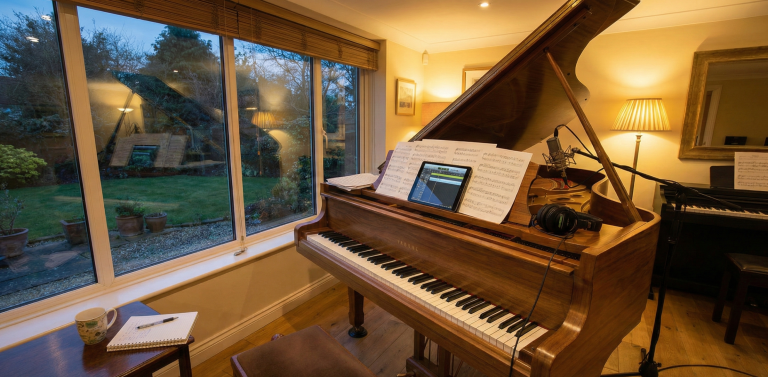
To support your practice hours, especially if you are using a digital setup with a tablet, having the right positioning is critical for your neck and posture. These products are designed to provide that exact precision:
K&M 19791 Tablet PC Holder (Professional Grade)
- This is the “Gold Standard” for pianists. It attaches to any microphone or music stand and allows for high-precision height and tilt adjustment. It is perfect for reaching that 1.55 Y-position without obstructing your view of the keys.
- Why it works: Highly stable, minimizes vibration when turning digital pages.
As an Amazon Associate I earn from qualifying purchases.
Hercules Stands – Tablet and Phone Holder
- For those who need to “raise” the tablet from the back of the piano (remontée), this long-arm holder allows you to position the screen exactly where you need it, ensuring your neck stays in a neutral ‘Montserrat’ posture.
- Why it works: Supports the precise -0.65 rad angle required for glare-free viewing.
As an Amazon Associate I earn from qualifying purchases.
PageFlip Butterfly Bluetooth Page Turner
- If you are practicing for several hours, manually swiping a tablet breaks your “flow.” A foot pedal allows you to keep your hands on the keys at all times.
- Why it works: Essential for “Advanced” repertoire where page turns are frequent and complex.
As an Amazon Associate I earn from qualifying purchases.
Standard chairs are detrimental to piano posture. An adjustable bench allows the pianist to align their elbows perfectly with the keyboard height.
As an Amazon Associate I earn from qualifying purchases.
Digital Pianos for High-Frequency Practice
- Roland FP-10: Considered the “best playing experience” under $500, featuring weighted keys with an “ivory feel”.
As an Amazon Associate I earn from qualifying purchases.
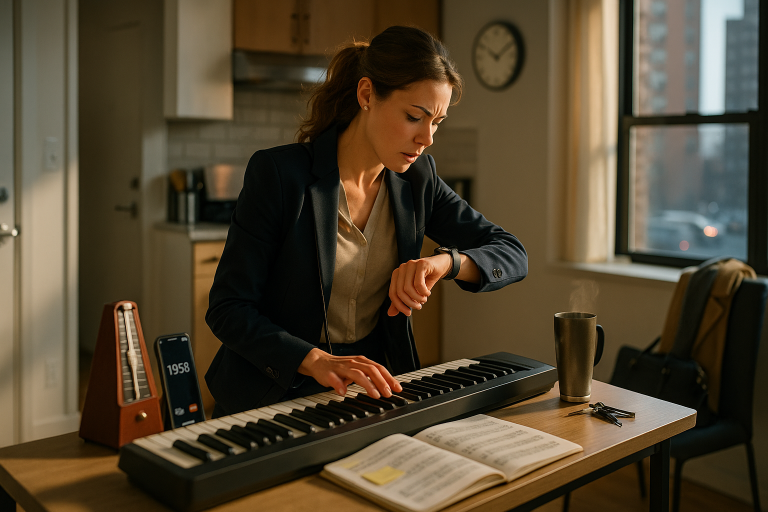
- Yamaha P-225 Digital Piano is the definitive choice for the dedicated pianist, delivering a sophisticated Graded Hammer Compact (GHC) action that provides the authentic tactile resistance required to bridge the gap between digital practice and acoustic performance.
As an Amazon Associate I earn from qualifying purchases.
Precision Metronomes
Timing is the bedrock of music. A mechanical metronome offers a visual pendulum, while digital versions offer subdivisions for complex rhythms.
- Wittner Taktell Classic offers a legendary mechanical pendulum that translates the beat into a visual dance, making it the perfect choice for developing an organic and traditional sense of tempo.
As an Amazon Associate I earn from qualifying purchases.
- Korg MA-2 Digital Metronome provides surgical digital precision with advanced rhythmic subdivisions and silent practice capabilities, serving as an indispensable, pocket-sized tool for the highly analytical student.
As an Amazon Associate I earn from qualifying purchases.
Conclusion
The question of how many hours one should practice piano each week is ultimately a question of intent. If the goal is to reach a level of effortless expression, one must commit to the discipline of daily, focused engagement. By scaling practice time according to development level, prioritizing quality over mere clock-watching, and utilizing the right pedagogical tools, any student can unlock the full potential of the instrument.
For those at the beginning of their journey, a commitment of 3 to 5 hours per week, supported by high-quality gear like a weighted digital piano and a reliable metronome, will provide a stable foundation. As the student progresses through the ABRSM/RCM grades, this commitment must naturally expand to accommodate the increasing complexity of polyphonic textures and advanced repertoire. Ultimately, the piano is a life-long pursuit where consistency, mindful correction, and the joy of creation determine the true rate of success.
Success is found in the intersection of patience and persistence. Start with a manageable schedule, master the art of deliberate practice, and the results will inevitably follow.
How many days a week should I skip practice?
Consistency is key, but one “rest day” per week is often beneficial for mental clarity. However, skipping more than two consecutive days can lead to a noticeable decline in muscle memory and finger dexterity.
How Many Hours per Week Should an Adult Amateur Practice?
Ideally, an adult amateur should commit to at least 1 hour a day, totaling 7 hours per week. While busy schedules may only allow for 15 minutes a day (1.75 hours/week), consistent daily repetition is required for the learning process to “start cooking” and to prevent the loss of progress made in previous sessions.
Can I practice for 5 hours in one day to catch up?
“Cramming” is highly ineffective for motor skills. While you may memorize the notes, the physical “automaticity” required for fluid playing will not develop as well as it would over five one-hour sessions spread across five days.
Is It Possible to Practice Piano “Too Much”?
Yes. Practice becomes counterproductive once a student begins “playing through fatigue.” Continuing to practice while physically tired or mentally distracted leads to “mindless repetition,” which can engrain mistakes and cause repetitive strain injuries like tendonitis. Research suggests little gain is found after the 2nd hour of a single session or the 4th to 6th cumulative hour of a single day.
Why Is Daily Practice More Effective than Weekend “Cramming”?
Progress is governed by the “spacing effect.” Short, daily sessions (distributed practice) allow the brain’s motor cortex to consolidate what has been learned during sleep. A student who practices for 20 minutes a day (140 minutes total) will typically outperform a student who practices for 3 hours once a week.
Is practicing on a digital piano as effective as an acoustic one?
For the first 3.5 hours of weekly practice (Beginner level), a weighted digital piano is sufficient. However, as one moves into Intermediate and Advanced levels, the lack of authentic “escapement” and “harmonic resonance” in most digital pianos can hinder the development of a sophisticated touch.
What should I do if I only have 15 minutes to practice?
Focus entirely on one small problem. Master two measures of a difficult bridge or run through your scales in a specific key. This “micro-practice” keeps the momentum alive and is better than not playing at all.
How Long Does it Take to Reach Grade 8 Proficiency?
Pedagogical data suggests that reaching Grade 8 (advanced level) requires approximately 1,500 to 2,000 hours of focused practice over a period of 8 to 12 years for children, though this can be accelerated by adults with prior musical experience.