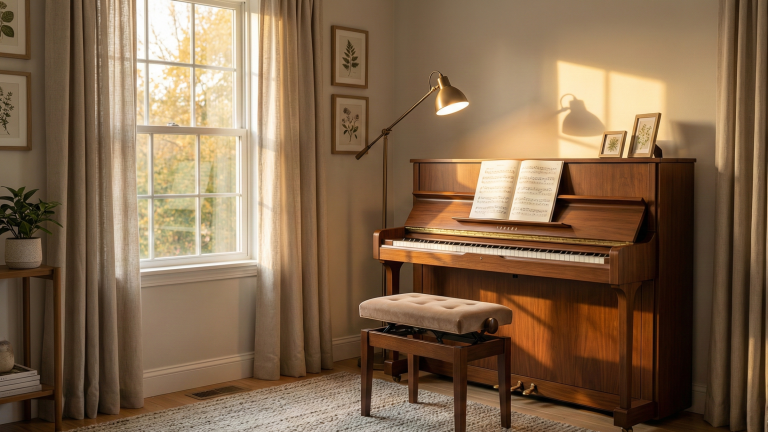
I remember the first time I stepped into a room designed specifically for silence. It wasn’t the absence of noise that struck me; it was the weight of the air. Every breath felt intentional. As a pianist, we spend thousands of hours obsessed with the mechanical touch of keys, but we often forget that the room itself is the final component of our instrument. Whether it’s the futuristic “silver forest” of Audeum in Seoul or the intimate, wood-clad walls of the new Bechstein Hall in London, the world is currently witnessing a renaissance in acoustic architecture.
In this guide, you will learn why the global piano community is shifting toward “analog sanctuaries,” how world-class institutions like Audeum and Bechstein are redefining the listening experience, and, most importantly, how you can replicate this “perfect sound” in your own practice space.
The architecture of perfect sound refers to the deliberate engineering of physical spaces to optimize acoustic resonance, clarity, and emotional impact. In 2026, this movement is led by “sonic sanctuaries” that use advanced materials, such as aluminum louvers for diffusion and reclaimed piano timber for warmth, to eliminate digital interference and return the listener to a pure, organic state of musical appreciation.
1. Audeum Seoul: Kengo Kuma’s “Architectural Instrument”
Located in the Seocho-gu district of Seoul, the Audeum Audio Museum is not just a museum; it is a 11,000-square-meter apparatus designed to reset the human senses. Founded by Michael Chung of Silbatone Acoustics, this “Audio Museum” serves as a lighthouse for anyone obsessed with high-fidelity sound and musical heritage.
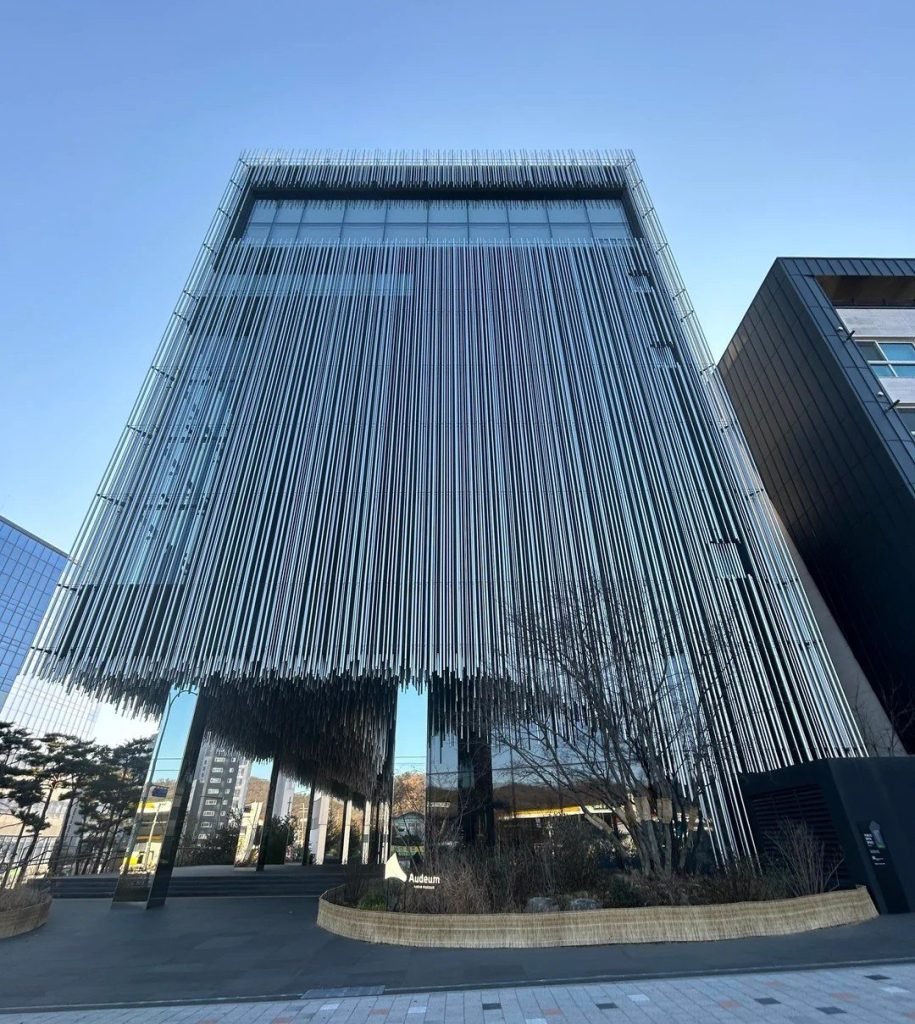
The External “Silver Forest”
Architect Kengo Kuma wrapped the building in 20,000 vertically overlapping aluminum louvers. This isn’t just for aesthetics. These pipes mimic the strings of a piano, filtering natural light and urban noise to create a transition zone between the chaotic city and the sonic sanctuary within.
During the design process, Kuma insisted that the pipes be manufactured as thin as possible to resemble the strings of a musical instrument, further reinforcing the concept of the building as a “large instrument”. This exterior serves as a filter, distancing the visitor from the urban noise of Gangnam and orienting them toward the silhouette of Cheonggye Mountain.
The Interior “Wood Drape”
Once inside, the cold aluminum gives way to the “Wood Drape”, layers of Alaska Cypress (Nootka Cedar).
- Acoustic Function: The three-dimensional texture of the wood diffuses sound waves, preventing harsh echoes.
- Sensory Experience: The natural scent of cypress lowers the listener’s heart rate, preparing the brain for deep, focused listening.
The Silbatone Collection: 150 Years of Sonic Evolution
At its core, Audeum serves as a dedicated sanctuary for the preservation and study of audio technology’s evolution. The museum’s timeline is vast, meticulously tracing the journey of sound from the invention of the phonograph in 1877 through to the peak of mid-20th-century high-fidelity engineering. It isn’t just a collection; it’s a physical archive of humanity’s quest to bottle lightning, or in this case, the perfect note.
The inaugural exhibition, Jung Eum: In Search of Sound, explores the philosophical concept of “correct sound” through the lens of High-Fidelity (Hi-Fi) reproduction. The artifacts within the Michael Chung collection are legendary among audiophiles for their extreme rarity. Many of these pieces were never intended for the average home or the commercial market; they were industrial-grade masterpieces designed for elite environments where compromise wasn’t an option.
One of the most striking chapters of the collection focuses on Western Electric systems from the early 1930s. These are the literal engines that brought voice to the cinema in 1932, representing a peak in acoustic efficiency that many modern systems still struggle to match. The gallery also highlights the 1937 Lansing Iconic loudspeakers, the true pioneers of the home monitoring experience. Standing beside the massive, four-meter-tall horn speakers linked to The Jazz Singer (1927), you get a visceral sense of the tectonic shift from the silent film era to the birth of modern, immersive audio.
Audeum acts as a mechanical sanctuary, housing an elite collection of audio technology spanning 70 to 250 years, from early phonographs to legendary Western Electric cinema systems. The technical brilliance of these vintage machines lies in their efficiency; massive horn-shaped speakers were designed to project sound across entire theaters using only a few watts of power, a stark contrast to modern electronic brute force. While entry is free and requires a rigorous advance booking, the true value lies in the live demonstrations where these vacuum tube systems are brought to life. Even with the language barrier of the Korean-led tours, the presence of a 120,000-vinyl archive and the raw emotional impact of hearing these “ancient” machines play music makes a repeat visit essential for any dedicated pianist or audiophile.
2. Bechstein Hall London: Where the Room is the Instrument
While Audeum focuses on the history of audio reproduction, the new Bechstein Hall on Wigmore Street in London represents the pinnacle of live piano performance environments. Opened in 2025, the hall marks C. Bechstein’s return to its historic London roots for the first time since 1916.
Architectural Heritage and Reclaimed Materials
The design of Bechstein Hall, executed by Estelle Buckland, is a masterclass in integrating the history of the building with the requirements of modern acoustics. The site previously housed Brinsmead Pianos and contained a hidden basement recital hall. During the demolition process, the team recovered handmade Minton tiles and original wood motifs, which were then woven into the modern bar and welcome areas to preserve the building’s lineage.
Crucially for the brand, the wall cladding in the recital hall incorporates timber from Bechstein pianos, literally building the instrument into the room’s architecture. This choice ensures that the room shares the same tonal characteristics, warmth, distinctive velvety tone, and incredible pianissimi, as the pianos themselves.
Acoustic Intimacy and Performance Innovation
The auditorium features 107 Poltrona Frau leather seats, arranged in a “subtly raked” configuration to maximize the number of seats with a direct view of the pianist’s keyboard. This intimacy creates a connection between the listener and the performer that is often lost in larger concert halls.
Technical acoustic consultation was provided by Evan Green of Kahle Acoustics, who balanced the use of hard finishes (necessary for piano projection) with the high-class aesthetic of a luxury venue. The hall’s scheduling also challenges traditional norms; most concerts last no more than an hour and start at unconventional times like 18:30 or 20:00 to accommodate the dining habits of the modern audience.
3. Global Landmarks for the Modern Audiophile
If you are traveling for inspiration, these locations are essential for your “Sonic Bucket List”.
House of Music Hungary (Budapest)
Designed by Sou Fujimoto and opened in 2022, this museum is situated in Budapest’s City Park, a historic center for European classical music. The building is defined by its “lotus root” roof, which features 100 circular openings that allow sycamore trees to grow through the structure, blurring the lines between nature and architecture.
- The Sound Dome: A hemispherical theater covered with a 360-degree sound system composed of 31 or 32 loudspeakers. It offers an immersive “hologram-like” sonic experience, projecting field recordings from the Carpathian Basin and experimental musical compositions.
- Sound Dimensions Gallery: A subterranean level housing a permanent exhibition that traces the history of European and Hungarian music from folk traditions to the birth of opera and the works of Liszt and Bartók.
- Acoustic Isolation: The building utilizes high-performance “box-in-box” structures to ensure that the delicate acoustics of the Sound Dome and recording studios are not compromised by building machinery.
Musical Instrument Museum (MIM), Phoenix
The MIM is considered one of the finest institutions of its kind globally, housing instruments from every country in the world. Its architecture blends modern aesthetics with functional elegance, using a high-ceilinged grand hall to set a tone of openness.
The museum’s “Global Galleries” utilize wireless headsets that automatically trigger high-fidelity audio as a visitor approaches an exhibit. This allows visitors to hear the authentic sound of rare pianos, harpsichords, and global folk instruments while standing inches away from the objects. The Artist Gallery features instruments played by legendary performers, highlighting the human connection to these “miracles of invention”.
The Musikverein and Concertgebouw: The Standard Bearers
No discussion of perfect sound is complete without the historic “shoebox” halls of Europe. The Musikverein in Vienna, specifically its Golden Hall, is world-renowned for its neoclassical architecture and spatial acoustics, which are considered unique in the world. Similarly, the Royal Concertgebouw in Amsterdam is lauded by critics for its exceptional acoustics and its “unique sound” that stands out among thousands of venues.
4. The Physics of Your Piano Room: 3 Steps to “Perfect Sound” at Home
You don’t need a million-dollar budget to improve your practice environment. Most “bad-sounding” pianos are actually just “bad-sounding” rooms.
Give Your Soundboard Room to Breathe
A piano is a transducer, it converts string vibration into air movement.
- Upright Pianos: Never place them flush against a wall. Leave 4 to 12 inches of space to allow the sound to reflect off the wall without being “muffled.”
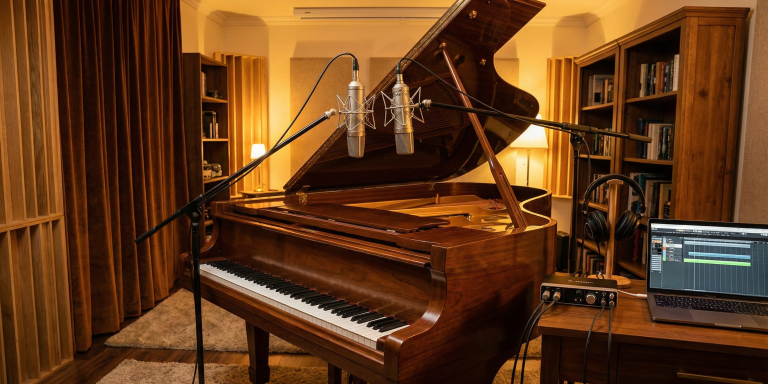
- Grand Pianos: Place a thick area rug underneath. This controls the downward reflections that often cause “muddiness” in the bass register.
Kill the “Flutter Echo”
If you clap your hands in your room and hear a metallic “zing,” you have a flutter echo. This happens when sound bounces between parallel hard walls.
- Solution: Use Acoustic Diffusers (bookshelves work great!) to scatter the sound, and Acoustic Absorbers (panels or heavy curtains) to soak up excess energy.
Manage the Bass Build-up
Low-frequency waves (the deep notes on your piano) love to hide in corners. This creates a “boomy” sound that masks your clarity.
- Pro Tip: Place Bass Traps in the corners of your room. These are dense foam or fiberglass blocks that “catch” the long bass waves before they can distort your performance.
The Impact of Flooring and Ceilings
Hard floors (wood, tile, concrete) amplify a piano’s resonance but can create excessive brightness. Placing an area rug that extends at least 3 feet beyond the piano’s footprint can help control these reflections. High, vaulted ceilings allow sound waves to resonate freely, giving the music depth and warmth, whereas low ceilings can dampen the sound prematurely.
Recommended Gear
To help you achieve sonic purity at home, here are a few expert-vetted recommendations available on Amazon:
- Acoustic Treatment: Acoustic Foam Panels – Perfect for reducing high-frequency harshness in small rooms.
As an Amazon Associate I earn from qualifying purchases.
- Bass Management: Corner Bass Trap Studio Foam – Essential for cleaning up the “muddiness” in your piano’s lower octaves.
As an Amazon Associate I earn from qualifying purchases.
- High-Fidelity Listening: Sennheiser HD 600 Open-Back Headphones or the Beyerdynamic DT 770 Pro – The industry standards for hearing the “true” tone of a piano without digital coloring.
As an Amazon Associate I earn from qualifying purchases.
As an Amazon Associate I earn from qualifying purchases.
Conclusion: The New Paradigm of Listening
The pursuit of the “perfect sound” isn’t about buying the most expensive equipment; it’s about respect. Respect for the physics of vibration and the human need for sensory clarity. Whether you are visiting the architectural marvel of Audeum Seoul or simply moving your upright piano six inches away from the wall, you are participating in a global movement toward intentional listening.
At PianoMode, we believe that when the environment is tuned, the artist is free. Take a moment today to listen to your room, your ears will thank you.
Can I use regular foam to soundproof my piano room?
A: No. Regular foam only absorbs high frequencies. To truly “treat” a room for a piano, you need density. Look for panels with a minimum density of 6 lb/ft³.
Does a high ceiling always mean better sound?
Generally, yes. High, vaulted ceilings allow sound waves to develop fully, giving the music a sense of “air.” Low ceilings often make a piano sound “compressed” or aggressive.
What is the best flooring for a piano?
Hardwood is the best for resonance, but it must be balanced with an area rug. Total carpeting often makes a piano sound “dead,” while total tile makes it sound too “bright” and piercing.
What is the “Jung Eum” exhibition at Audeum?
The inaugural exhibition, Jung Eum: In Search of Sound, explores the comprehensive history of high-fidelity (Hi-Fi) audio reproduction. It features exceptionally rare artifacts from the Michael Chung collection, specifically focusing on industrial Western Electric systems from the 1930s and the landmark 1937 Lansing Iconic loudspeakers. The exhibition aims to define the concept of “correct” or “perfect” sound by tracing the intersection of technical innovation and cultural history.
Why is Bechstein Hall considered unique for pianists?
Bechstein Hall was engineered as a literal extension of the instrument itself. By integrating genuine Bechstein piano timber into its architectural wall cladding, it offers a “recording studio-grade” acoustic environment within a luxury 107-seat auditorium. The ultimate design objective is to achieve total sonic intimacy between the performer and the listener.
How can I improve the acoustics of my own piano studio?
Optimizing the acoustics of a private studio involves three critical phases: high-frequency absorption (using acoustic panels), the diffusion of standing waves (utilizing bookshelves or specialized 3D diffusers), and low-end frequency management in corners (using bass traps with a minimum 4-inch depth). Furthermore, maintaining a 4–12 inch gap between the piano and the wall allows the soundboard to breathe and project more effectively.
What are the premier “Sound Dome” venues globally?
The House of Music in Budapest, Hungary, features one of the most sophisticated “Sound Domes” in the world, utilizing a 31–32 speaker array for a full 360-degree immersive experience. Similar audio spatialization technologies are currently employed in North American “Immersive Van Gogh” exhibitions to construct three-dimensional acoustic environments.
Are “listening bars” suitable for classical audiophiles?
Yes. Although they originated in Japanese jazz culture, many modern Hi-Fi lounges in London, New York, and Seoul are increasingly hosting dedicated classical vinyl sessions. These venues prioritize high-fidelity playback through analog signal paths and vacuum tube amplification, providing a sophisticated social alternative to isolated headphone listening.